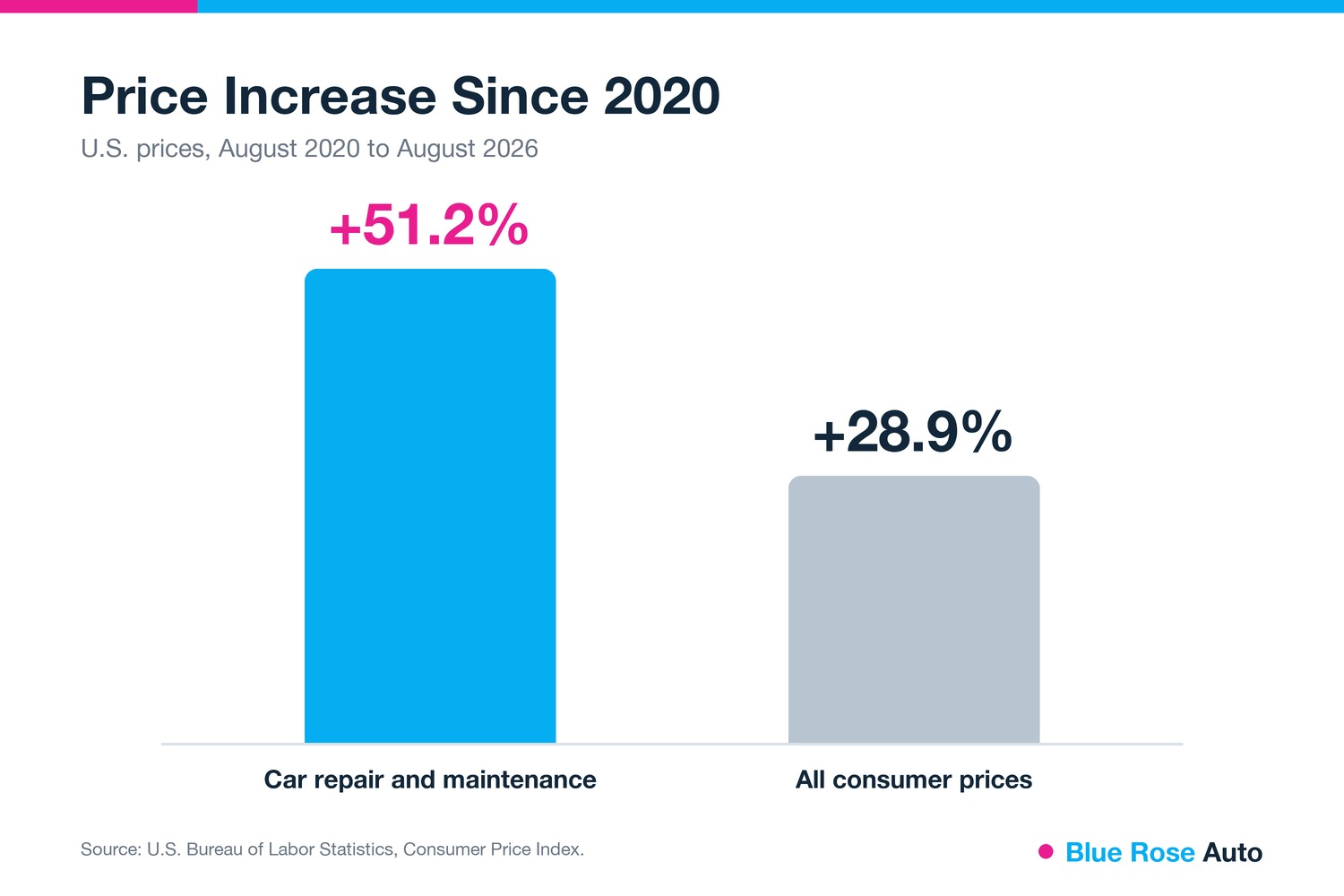
Car repair costs depend on the job, but the averages are now high. A check-engine-light repair averaged $554 in 2025 (CarMD), AAA puts maintenance, repairs and tires for a new car at 11.7 cents a mile (about $1,755 a year at 15,000 miles), and U.S. shop prices for maintenance and repair are up 51.2% since August 2020 (U.S. Bureau of Labor Statistics).
Last updated October 2026
Key takeaways
- Brakes, batteries, sensors and alignments usually run $100 to $600, while engine and transmission work runs $2,500 to $7,000.
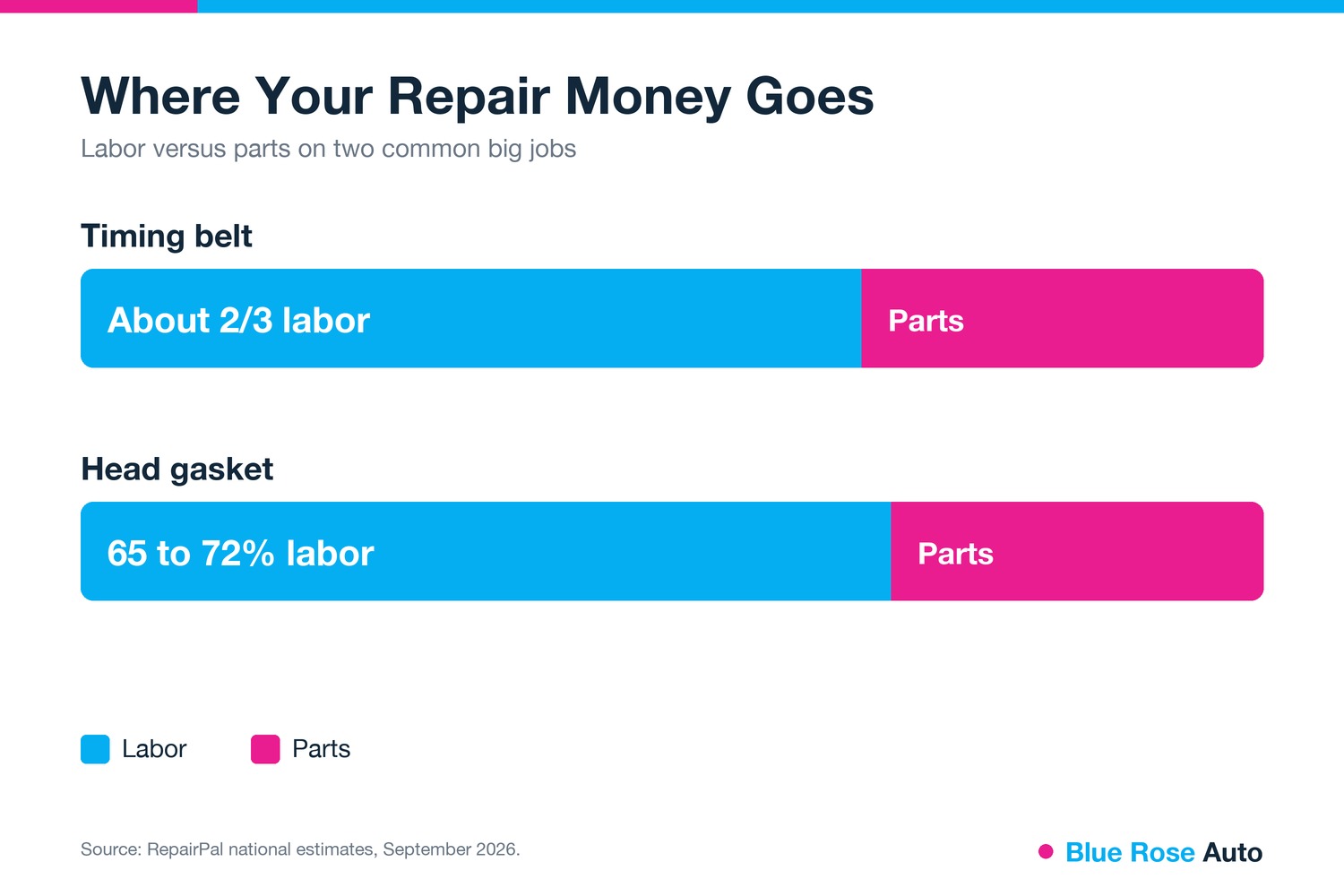
- On big jobs, labor is the biggest slice of the bill. RepairPal’s timing belt estimate is about two-thirds labor, and its head gasket estimate roughly 65 to 72%.
- A realistic maintenance and repair budget runs from about $54 a month (RepairPal’s all-model average) to $146 a month (AAA’s new-car figure).
- Once a repair passes roughly half of your car’s value, weigh replacement, and always get the price in writing before work starts.
Every day at Blue Rose Auto we talk with drivers who are stunned by major car repair costs. It is a fair reaction. A simple warning light can turn into a bill that feels far too high, and the number rarely arrives with an explanation.
Blue Rose Auto opened in 1994 as an independent shop, and we price auto repair for Eugene and Springfield drivers every day. This guide explains the numbers the way we explain them at the counter, with sourced averages, a price table and a way to decide when a repair is worth making. Every figure names its source and year.
What Is the Average Car Repair Cost in 2026?
The average car repair cost depends on what you count. CarMD’s 2026 Vehicle Health Index puts the average check-engine-light repair at $554 for 2025, and Kelley Blue Book (Cox Automotive) reports that drivers spend an average of $838 fixing their cars. Neither number covers every job, so treat them as a starting point rather than a bill.
CarMD’s $554 breaks into $331.98 for parts and $222.03 for labor. That is a 33% jump from $415.31 a year earlier, across more than 39 million repairs on vehicles averaging 12.8 years old. The West region, which includes Oregon, averaged $554.82. The figure covers check-engine repairs only, not brakes, tires or collision work.
How Much Do Car Repairs Cost Per Month and Per Year?
Budget roughly $54 to $146 a month for maintenance and repairs, depending on the source and the car. RepairPal’s all-model average is $652 a year, about $54 a month. AAA’s 2026 figure works out to about $1,755 a year, or $146 a month, for a new car driven 15,000 miles.
| Source | Yearly figure | Monthly figure | What it covers |
|---|---|---|---|
| RepairPal, 2026 | $652 | About $54 | All models and ages, scheduled maintenance plus unscheduled repairs |
| AAA Your Driving Costs, 2026 | About $1,755 at 15,000 miles | About $146 | A new vehicle over 5 years and 75,000 miles, including scheduled maintenance, an extended warranty, wear repairs and one set of tires |
The gap is not a contradiction. AAA prices a new car with tires and a warranty included, while RepairPal averages the whole fleet. AAA publishes no matching figure for older vehicles, so your best guide is your own last two years of receipts, plus a cushion for one large repair.
A big repair can erase months of budget in one visit. The 30-60-90 maintenance schedule gives you a simple calendar, and regular inspections catch small problems before they grow into thousand-dollar ones.
Common Car Repair Costs by Repair Type
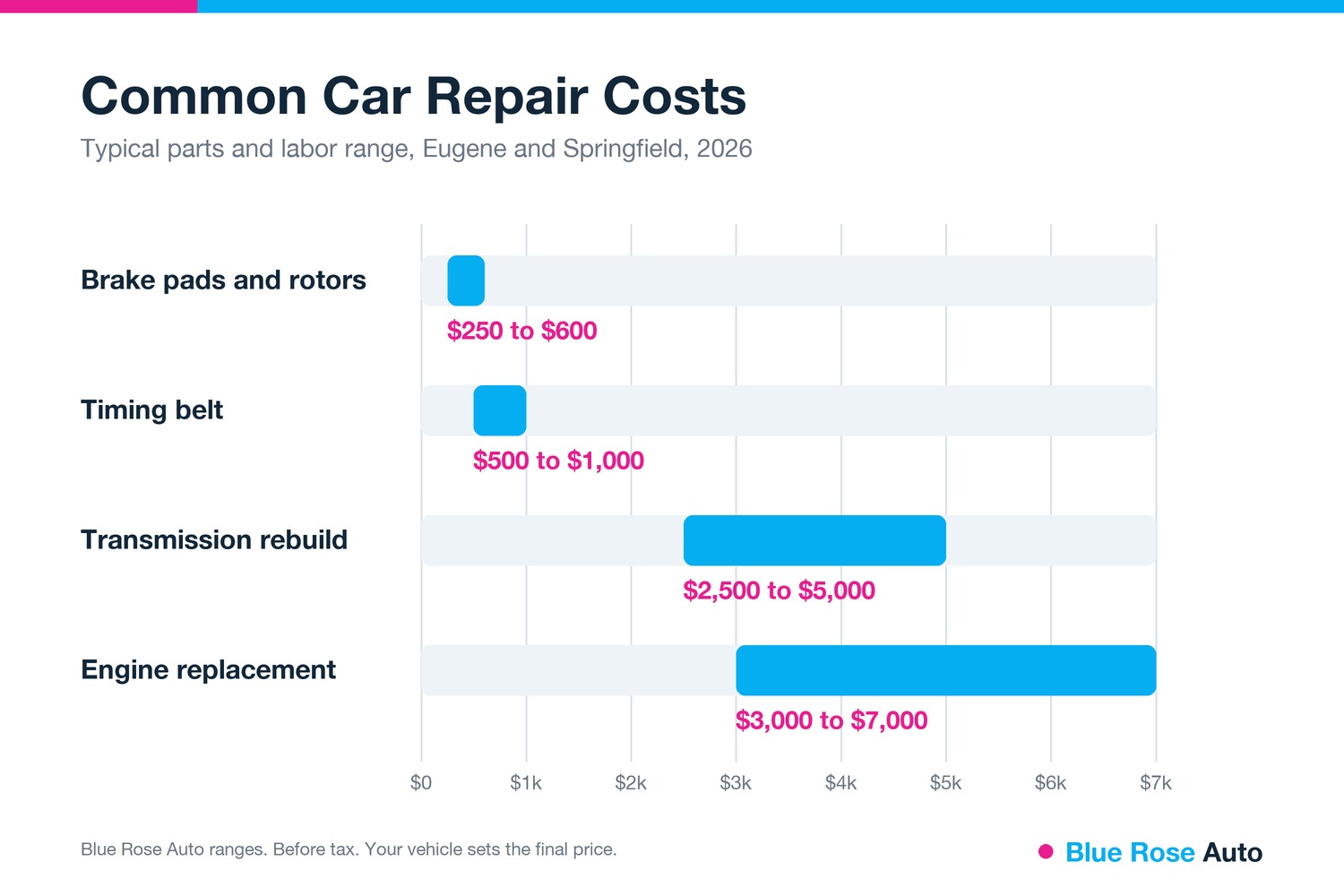
Routine wear repairs such as brakes, batteries, sensors and alignments run from about $100 to $600, alternators and starters top out near $1,100, and engine, transmission, head gasket and hybrid battery jobs run into the thousands. The table shows typical parts-and-labor ranges as of October 2026. Five rows are Blue Rose Auto’s own Eugene-Springfield ranges, and the rest are national ranges built from published sources.
| Repair | Typical range | Whose range | Parts versus labor and notes |
|---|---|---|---|
| Brake pads, per axle | $150 to $400 | National range | RepairPal splits its estimate at about $122 to $179 labor and $213 to $215 parts. |
| Brake pads and rotors, per axle | $250 to $600 | Blue Rose Auto Eugene-Springfield range | Rotors add parts cost, so pads and rotors together run higher than pads alone. |
| Timing belt | $500 to $1,000 | Blue Rose Auto Eugene-Springfield range | RepairPal’s national estimate is $918 to $1,338, split $603 to $885 labor and $315 to $453 parts, so about two-thirds is labor. Replacing the water pump at the same time can push the total past $1,000. |
| Clutch | $900 to $2,800 | Blue Rose Auto Eugene-Springfield range | Mostly labor, because the transmission has to come out. RepairPal’s national estimate is $1,630 to $2,047. |
| Head gasket | $2,000 to $4,000 | National range | Labor is about 65 to 72% of RepairPal’s $2,572 to $3,386 estimate ($1,669 to $2,449 labor, $903 to $937 parts). |
| Transmission, rebuild or remanufactured | $2,500 to $5,000 | Blue Rose Auto Eugene-Springfield range | National rebuild prices start near $1,500, and remanufactured units run $2,800 to $5,000 and up. |
| Transmission, new or OEM unit | $6,200 to $6,800 | National range | RepairPal puts parts at about $5,110 of its estimate, so the unit itself is most of the bill. |
| Engine replacement | $3,000 to $7,000 | Blue Rose Auto Eugene-Springfield range | The vehicle and the unit type (new, remanufactured or used) drive the price, so treat this as a wide range. |
| Alternator | $450 to $1,100 | National range | Three sources agree on a middle band of about $750 to $1,000. |
| Starter | $400 to $850 | National range | RepairPal lists $565 to $796, and Kelley Blue Book lists $744 to $837. |
| Battery, installed | $150 to $450 | National range | AGM and start-stop batteries sit at the top of the range. |
| Water pump | $450 to $1,150 | National range | RepairPal lists $891 to $1,135. It is often replaced with the timing belt, which shares the labor. |
| Radiator | $750 to $1,850 | National range | RepairPal lists $1,368 to $1,550, and MechanicsRated allows $750 to $1,850. |
| A/C compressor | $750 to $1,500 | National range | RepairPal lists $1,081 to $1,463. Refrigerant service is usually billed on top. |
| Catalytic converter | $1,300 to $3,500 | National range | CarMD’s 2025 average is $1,511, and $1,475 in the West. |
| Wheel bearing, per wheel | $300 to $800 | National range | RepairPal lists $346 to $504, and MechanicsRated allows $300 to $800. |
| Struts or shocks | $500 to $1,350 | National range | Sources differ on whether the price covers a pair or an axle, so ask which unit your quote uses. |
| Wheel alignment | $100 to $275 | National range | Two-wheel and four-wheel alignments price differently, and the sources disagree. |
| Oxygen sensor, one | $150 to $525 | National range | CarMD’s 2025 average is $287. |
| Spark plugs | $100 to $430 | National range | CarMD’s 2025 average is $299, or $480 when ignition coils are replaced too. |
| Check-engine diagnostic | $100 to $200 | National range | Pays for scan and testing time, not the repair itself. |
| Hybrid battery pack | $1,500 to $5,000 | National range | MechanicsRated puts independent shops at $1,500 to $2,600 and dealers at $3,500 to $5,000. RepairPal lists $4,856 to $5,053. |
We built the national ranges from the overlap of RepairPal’s estimates (September 2026), Kelley Blue Book (2025), CarMD (2025) and MechanicsRated (2026), rounded and before tax. RepairPal’s bands run high on simple jobs, so we used the overlap rather than any one site’s band. Your vehicle, the parts quality and how hard the part is to reach all move the price, which is why we inspect first and give you the real number before work starts.
Brake, Clutch and Timing Belt Costs
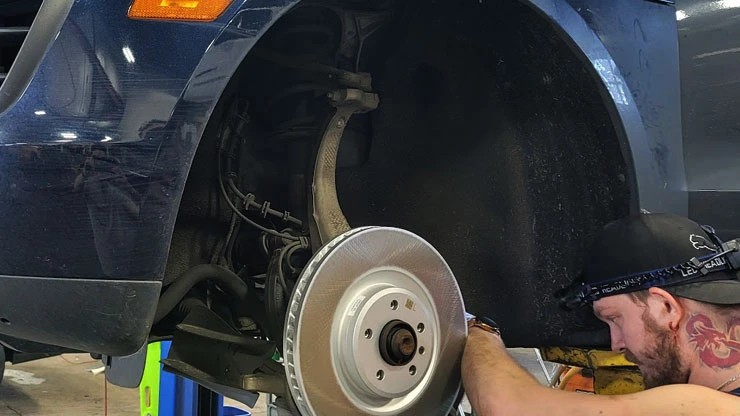
Brakes are the repair most drivers meet first. Pads alone run $150 to $400 per axle, and adding rotors lifts our Eugene-Springfield range to $250 to $600. Pad material, rotor wear and a seized caliper explain why brake pad replacement costs in Eugene and Springfield differ from car to car. Our brake repair in Eugene work starts with an inspection, so the quote lists only what your brakes need.
A clutch lands at $900 to $2,800 in our range because most of the bill is labor. A worn flywheel can add to it, and what changes a clutch replacement price comes down to the vehicle and the parts that fail alongside the disc. A timing belt costs $500 to $1,000 here, and it is the cheapest moment to replace the water pump, since the labor overlaps. Do them together.
Engine, Head Gasket and Transmission Costs
These are the major car repair costs that hurt most. An engine replacement runs $3,000 to $7,000 in our range, and the swing depends on whether the unit is new, remanufactured or used, which is why engine replacement cost for drivers in Oregon varies so widely. A head gasket sits at $2,000 to $4,000 nationally. Roughly 65 to 72% of that is labor, because the engine has to be opened up to reach the gasket.
Transmission work splits into two jobs. A rebuilt or remanufactured unit runs $2,500 to $5,000 in our range, while a new OEM unit reaches about $6,800 nationally. Rebuilds cost less. We repair, rebuild and replace transmissions as part of transmission repair in Eugene, and we say plainly which route fits your car’s age and value.
Electrical, Cooling, A/C and Exhaust Costs
An alternator runs $450 to $1,100, a starter $400 to $850, and an installed battery $150 to $450. Cooling parts run higher, with a water pump at $450 to $1,150 and a radiator at $750 to $1,850.
An A/C compressor costs $750 to $1,500 before refrigerant service, and we repair car A/C systems, compressors included, through car AC repair in Eugene. The catalytic converter is the big exhaust ticket at $1,300 to $3,500. CarMD lists it as the single most expensive common check-engine repair, at an average $1,510.88 in 2025, and a converter can fail because something upstream, such as a misfire or a bad oxygen sensor, went unfixed. We look for that cause first so the new converter lasts.
Suspension, Alignment and Hybrid Battery Costs
Wheel bearings run $300 to $800 per wheel, struts or shocks $500 to $1,350, and an alignment $100 to $275. We inspect and repair these parts as part of suspension and steering repair, and the alignment check usually follows any suspension job.
Hybrid battery packs have the widest spread in the table, from $1,500 to $5,000, because independent shops and dealers price them very differently. If you drive a hybrid, hybrid battery replacement deserves a written quote that names the pack, new or remanufactured, before you agree to anything.
Check-Engine Diagnostics and What the Fee Covers
A diagnostic runs $100 to $200 nationally. A scan reads a code, but a code points to a system, not always a part, so the fee pays for the testing that proves which part failed. Guessing at parts is how a $287 sensor job can turn into a $1,500 one. We run check engine light diagnostics before recommending any repair. At Blue Rose Auto the first 15 minutes are free, then $100 an hour, and that time is credited toward the repair if you go ahead.
CarMD’s 2025 data shows which check-engine repairs drivers pay for most often.
- Catalytic converter at an average $1,510.88, or 7.43% of repairs
- Oxygen sensor at $286.87, or 6.68%
- Ignition coil and spark plug at $480.21, or 6.00%
- Mass airflow sensor at $346.21, or 5.77%
Why Major Car Repair Costs Can Be So High
Cars today are far more advanced than they used to be. Even a small family sedan now has computers managing everything from fuel injection to braking and steering. When one of those systems fails, diagnosing and fixing it takes specialized tools, knowledge and parts.
- Complex systems mean more time and skill. Technicians need diagnostic scanners, specialized computers and brand-specific software.
- Parts are pricier than ever. Many are imported, limited to certain years or models, and slow to arrive.
- Labor rates reflect training and equipment. Shops invest thousands in tools and training every year.
Even a sensor swap can take hours when the part is buried deep.
How Much of a Repair Bill Is Labor?
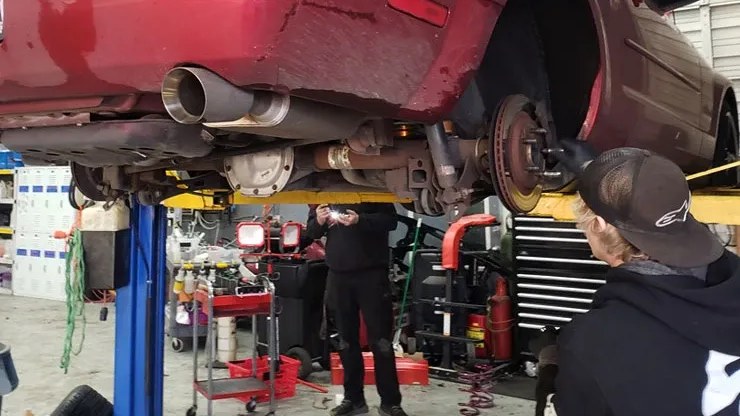
On big jobs, labor is the biggest slice of the bill. RepairPal’s timing belt estimate is $603 to $885 of labor against $315 to $453 of parts, and its head gasket estimate is $1,669 to $2,449 of labor against $903 to $937 of parts. That is why a cheap part can still mean an expensive repair. You are paying for the hours it takes to reach it.
Shop rates matter too. Tekmetric’s 2026 data, drawn from more than 10,000 shops, puts the average U.S. labor rate at $132 an hour and Oregon’s at $150, with individual states ranging from $85 to $197. That is a statewide average, not a Eugene or Springfield posting.
Why Newer Cars Cost More to Fix
Newer vehicles pack radar, cameras and ultrasonic sensors into bumpers, mirrors and windshields, and replacing one often means recalibrating it afterward.
Why Have Car Repair Prices Gone Up So Much?
Car repair prices have climbed because labor, parts and the age of the fleet all rose together. Bureau of Labor Statistics data show U.S. motor vehicle maintenance and repair prices up 51.2% from August 2020 to August 2026, against 28.9% for all consumer prices, and up 5.2% over the last 12 months.
- The mechanical repair part of that index is up 66.9% since August 2020 (BLS).
- Maintenance and servicing prices rose 7.9% in the 12 months to August 2026 (BLS).
- CarMD found check-engine labor costs up 51% in one year, against 23% for parts.
- The average vehicle in CarMD’s data is 12.8 years old, and older cars break in more expensive ways.
Two patterns show up in the data. Labor rose faster than parts, and the cars on the road keep getting older. Both push the total up on every quote.
Car Repair Costs in Eugene and Springfield
Local prices follow the national trend, with a few Oregon twists worth knowing before you compare quotes. The biggest one is labor. Tekmetric’s 2026 data puts Oregon’s average shop rate at $150 an hour, about $18 above the $132 national average, so a job that takes four hours of labor costs roughly $72 more here than the national figure suggests.
Two things work in your favor. Oregon has no general sales tax, so the parts and labor total on a Eugene or Springfield quote is close to what you pay, with no state sales tax added at the counter. And Lane County is outside Oregon DEQ’s vehicle emissions testing areas, which cover the Portland metro and Medford regions, so a check-engine light will not fail you on a test here.
That second point cuts both ways. With no test forcing the issue, drivers here can ignore a check-engine light for months, and a misfire left alone is one of the ways a $287 oxygen sensor job turns into a $1,511 catalytic converter. The Willamette Valley’s long wet season adds its own wear, mostly on brakes, tires and wipers, so plan for those items to come up a little more often than a dry-climate guide would suggest.
How Much Does It Cost to Repair a Car After an Accident?
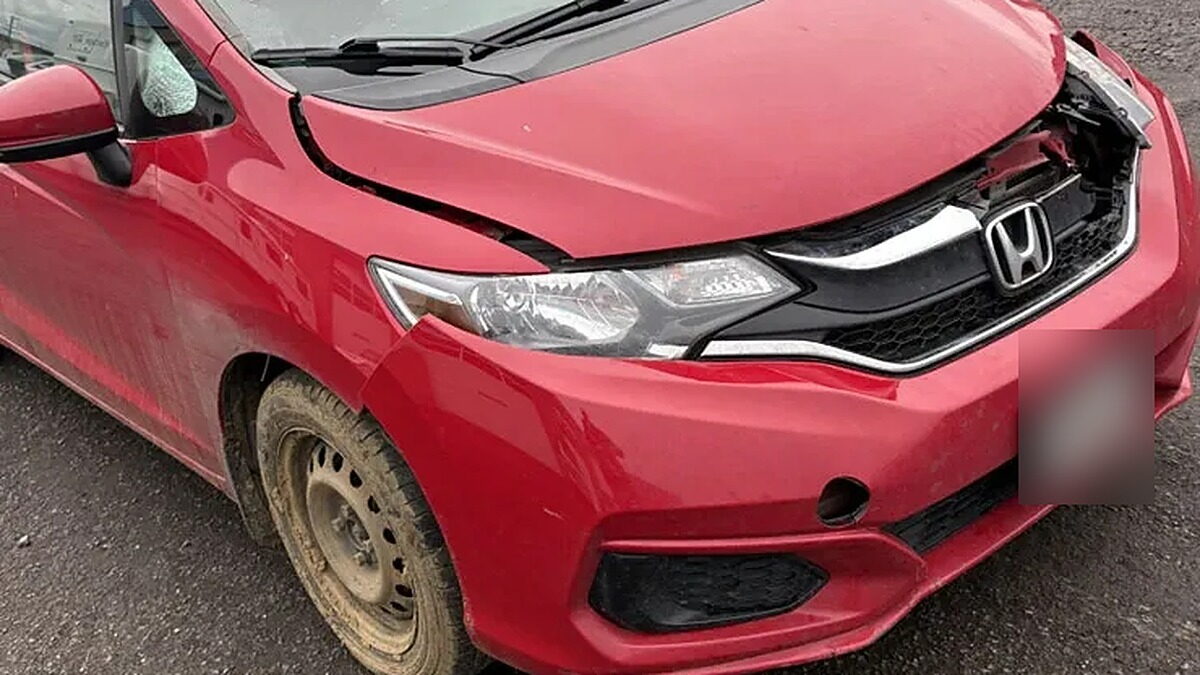
Collision repair depends on the vehicle and the damage. These are rough ballparks, not quotes.
- Minor fender benders run about $500 to $1,500.
- Moderate front-end damage runs about $3,000 to $7,000.
- Severe collisions involving frame damage or airbags can reach $10,000 or more.
Newer cars cost more because of the sensors behind the bumper and glass. AAA’s 2023 study found advanced driver-assistance systems can add up to 37.6% to a post-crash repair bill, with a front radar sensor running $500 to $1,300 and a windshield camera sensor $900 to $1,200. CCC’s 2026 Crash Course report found calibrations on 28.3% of repairable estimates in 2025.
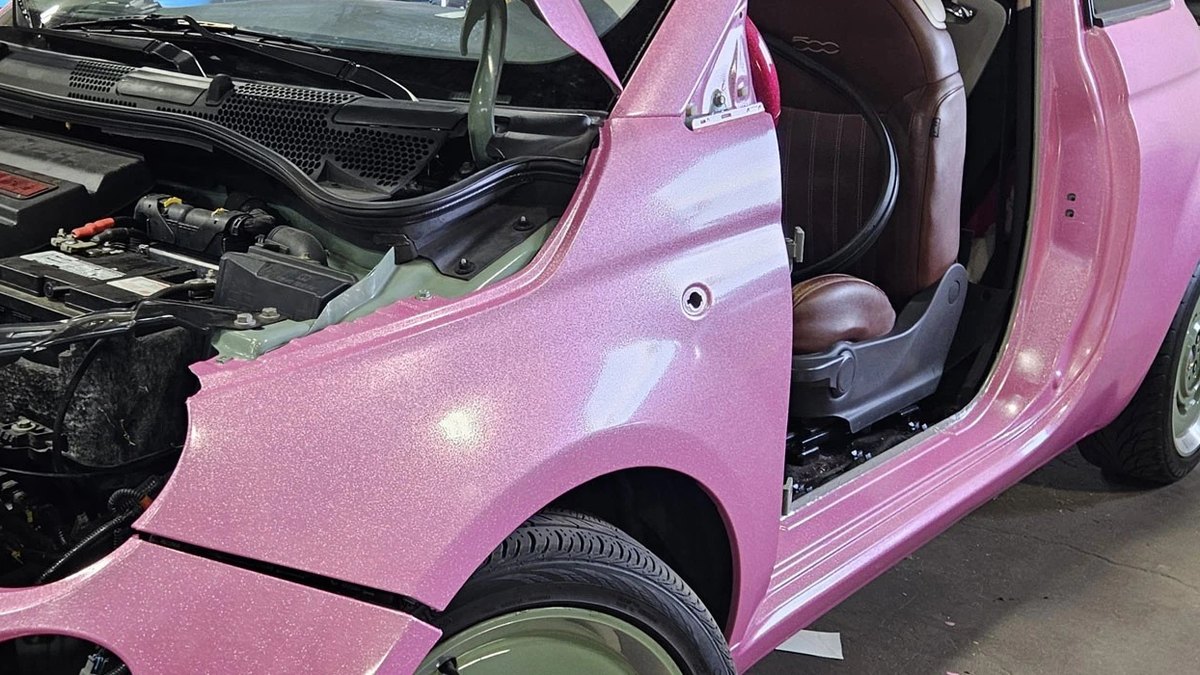
We handle estimates, insurance coordination and refinishing at our collision repair for Eugene and Springfield drivers, so you deal with one shop from teardown to final paint.

Car Repair Costs by Make and Which Brands Cost the Most
European luxury brands cost the most to repair, Japanese brands cost less, and American brands usually fall in between. RepairPal’s average annual repair cost is $652 across all models, and Honda comes in at $428, about a third lower.
Luxury European cars such as BMW, Audi and Mercedes-Benz top the list for the most expensive car repairs by brand, for three reasons.
- Parts are imported and take longer to arrive.
- Many systems need brand-specific diagnostic tools.
- Labor times run longer because everything is packed tightly under the hood.
Japanese brands such as Toyota and Honda tend to cost less to keep running over the long term. American brands usually land in the middle. Hybrids add their own line item in the high-voltage battery, covered in the table above.
We found no trustworthy published price list for every make, so we do not print one. Give us your year, make and model, and we will walk through what that vehicle typically costs to repair.
When Is a Car Repair Not Worth It?
You get an estimate, and it is close to or higher than what the car is worth. Our rule of thumb is that once a repair passes roughly 50% of the car’s current market value, it is worth seriously weighing replacement, especially on an older, high-mileage vehicle. It is a rule of thumb, not a law. If you still owe money on the car, it gets tricky.
Car Repair More Than Value, Still Owe Money
If you are still making payments and the repair bill is close to the car’s value, you are in a tough spot, because you may not be able to sell without paying off the loan. Focus on how much the repair matters.
- Safety-related fixes such as brakes or steering are always worth doing.
- Cosmetic or convenience repairs can often wait.
Sometimes a partial fix keeps the car running safely until the loan is paid down, and we will help you sort out what comes first.
Repairs Cost More Than Car Is Worth, Insurance and Total Loss
If the damage came from an accident, your insurer may declare the car a total loss. That means the repairs cost more than the car is worth, so the insurer pays market value instead of fixing it, and it happens often. CCC reports that a record 23.1% of claims were total losses in 2025.
If you disagree with the valuation, you can usually appeal with supporting repair estimates or recent service records. We can provide detailed estimates and records that help with that process.
A Worked Example of the 50% Rule
Say your car is worth $6,000 and the quote for a transmission is $3,500. That is 58% of its value, which is past the line. Now say the same car needs $1,200 in brake and suspension work. That is 20%, and we would fix it without hesitation if the rest of the car is sound.
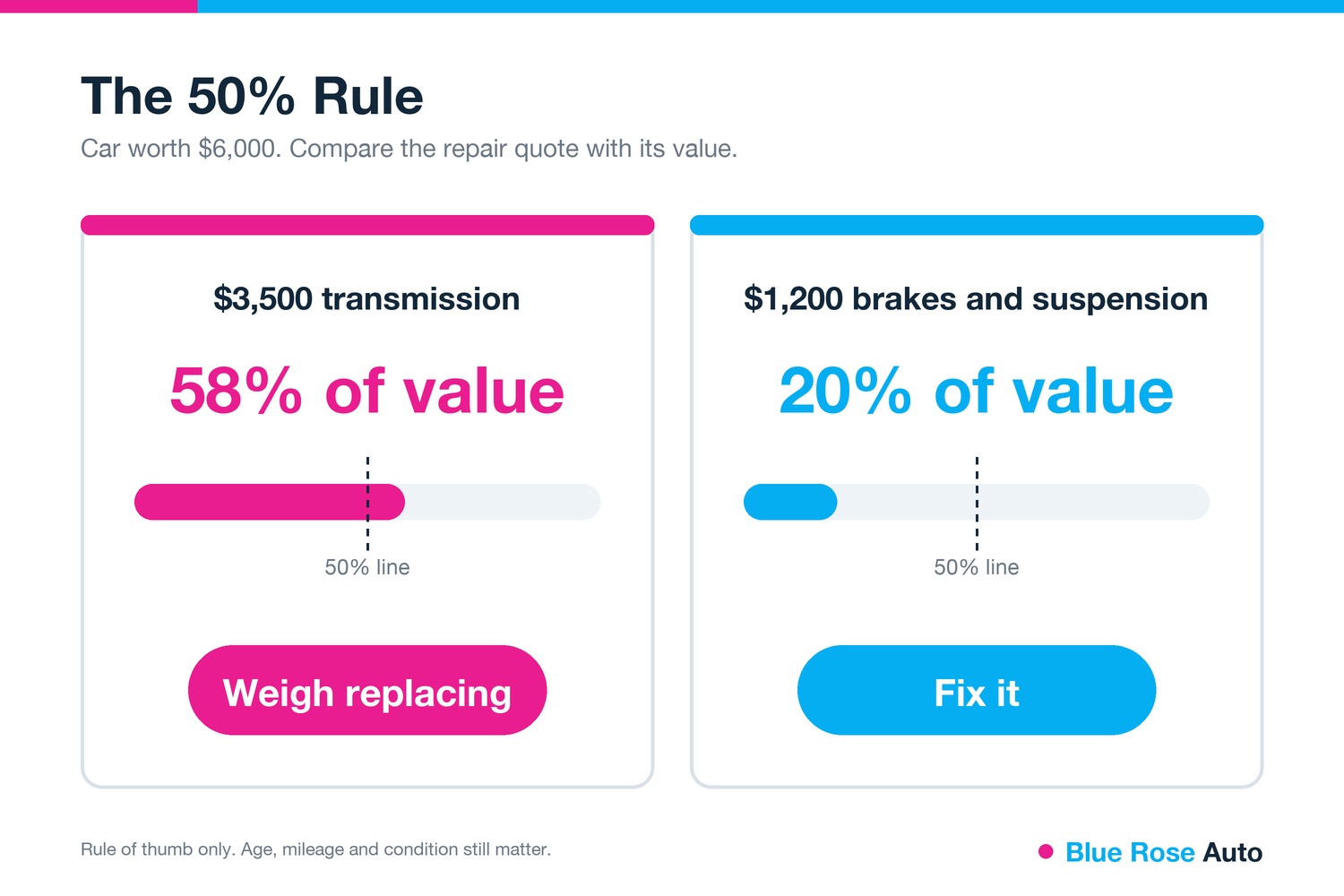
The rule bends. A low-mileage car a few years old deserves a repair that a 15-year-old car cannot justify.
How We Build a Repair Estimate at Blue Rose Auto
A price is only as good as the diagnosis behind it. Good shops follow the same basic path from complaint to quote, and this is how ours works, step by step.
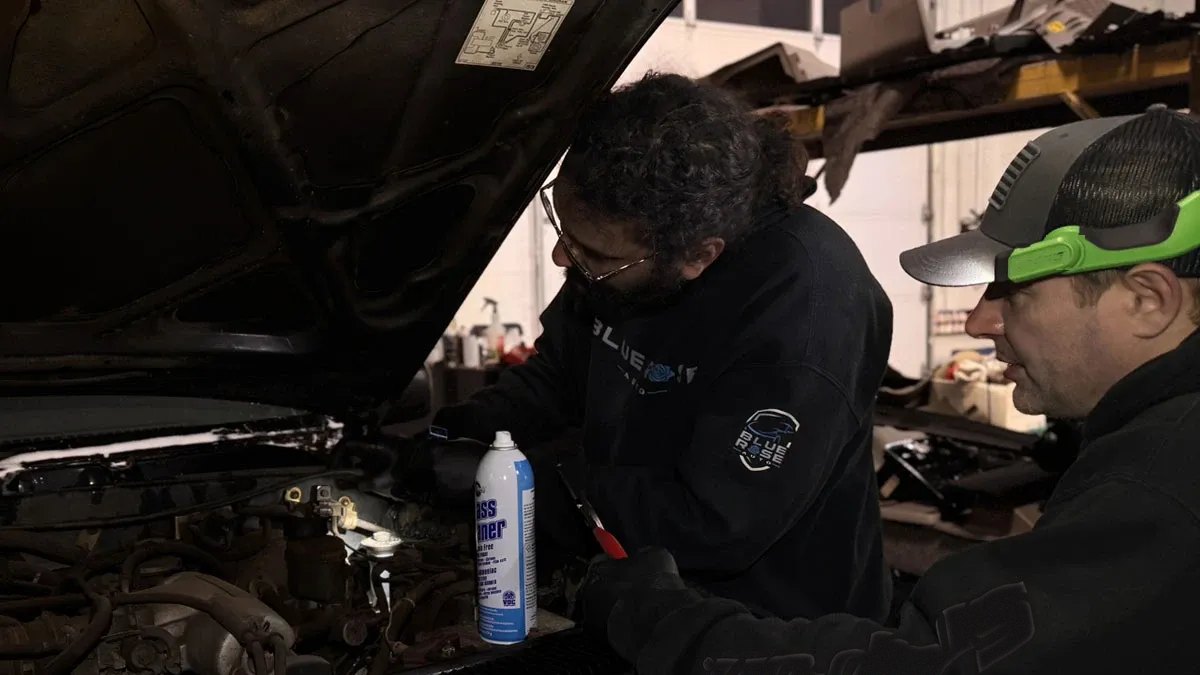
- We listen and confirm the problem. When did it start, what does it sound or feel like, and does it change with speed, temperature or rain? Where the symptom only shows up on the road, we drive the car to feel it ourselves.
- We test before we quote. Our ASE-certified technicians test until they know which part failed and why, because a code points to a system, not always a part. The first 15 minutes of diagnosis are free, and if it takes longer the rate is $100 an hour. That diagnostic time comes off your bill when you approve the repair.
- You get a written, line-item estimate. It lists each part, the labor hours and the total. Where there is a real choice of parts, such as OEM or a quality aftermarket part, we price both so you can pick.
- We sort now from later. Safety items come first. Anything that can wait gets marked that way, so you can plan and budget for it.
- Nothing starts until you say yes. If a part comes off and we find more, we call, give you the new price and wait for your answer before we touch it.
- We show you the old parts and back the work. Ask and we will show you what came off the car. Our repairs carry a 3-year, 36,000-mile warranty.
Two drivers with the same car and the same symptom can walk out with different numbers, because the cause is not always the same. That is why we test first and quote second.
How to Read a Repair Quote and Lower Your Bill
A good repair quote shows what failed, which parts go in, how many labor hours it takes and what the total is. Six checks keep a quote honest.
- Split the diagnosis from the repair. Ask for the diagnostic and the repair as separate lines.
- Multiply the labor. Labor hours times the hourly rate should match the labor total, and Oregon’s average rate is $150 an hour.
- Ask about the parts. OEM, aftermarket, remanufactured and used parts price very differently.
- Ask what can wait. Safety work comes first, and convenience repairs can often be scheduled later.
- Get a second quote on big jobs. For anything over about $1,000, a second written quote costs little and can save a lot.
- Get the warranty in writing. Ask how long the parts and the labor are covered before you approve the work. Ours is 3 years or 36,000 miles.
The cheapest repair is the one you never need. Oil changes, fluid services and catching small problems early prevent most of the big failures. And online estimators, this table included, show the middle of a range, so your quote can sit above or below it.
Honest Auto Repair Help for Oregon Drivers
Understanding major car repair costs helps you plan and budget. Every vehicle needs a big repair at some point, and the right shop makes it less stressful.
Blue Rose Auto is an independent shop at 3436 Olympic St in Springfield, Oregon, and we handle auto repair, collision repair and detailing. We inspect first, tell you what needs attention now and what can wait, and give you the price before any work begins. If we find something extra, we call before touching it.
Call (541) 641-8877 or send us a message to schedule your visit.
Frequently Asked Questions About Car Repair Costs
How do I know if a repair is worth it?
Compare the quote with the car’s current market value. If the bill is under about half of that value and the rest of the car is solid, fixing it usually makes sense. Past roughly 50%, replacement starts to look better, especially on an older, high-mileage vehicle. Safety repairs such as brakes and steering are worth doing either way.
What is the most expensive common car repair?
Engine replacement is the most expensive common repair at about $3,000 to $7,000, followed by a new transmission unit at up to roughly $6,800. A head gasket runs $2,000 to $4,000 nationally, and a hybrid battery pack can reach $5,000. A rebuilt transmission costs less, about $2,500 to $5,000 in our Eugene-Springfield range.
Why did my estimate go up after I dropped the car off?
Once a part comes off, we sometimes find related damage that was not visible from the outside. We call before doing anything extra, so you approve the new number first. No added work goes on your bill until you have heard the price and said yes.
Are dealer repairs more expensive than an independent shop?
Often, but not always. Kelley Blue Book says its repair price ranges come from data that excludes independent shops, so they lean toward dealer pricing, and shop labor rates run from $85 to $197 an hour across the U.S. (Tekmetric, 2026). The only reliable comparison is two written quotes with the same parts grade and labor hours.
How can I keep repair bills down?
Stay on top of maintenance. Oil changes, fluid services and catching small problems early prevent the big failures that cost thousands. Ask for a line-item quote, find out what can wait, and get a second written quote on any job over about $1,000. A fixed maintenance schedule keeps you ahead of most surprises.
Do you give estimates before starting work?
Always. We inspect first, explain what needs attention now and what can wait, and give you the price before any work begins. If we find more once a part comes off, we call before doing it. Call (541) 641-8877 to book an inspection.
What is the average car repair cost?
The average check-engine-light repair cost $554 in 2025, according to CarMD, and Kelley Blue Book reports an average repair spend of $838. Everyday jobs such as brake pads or a battery run $150 to $450, while major repairs run into the thousands. Your real number depends on the vehicle, the part and the labor hours.
How much should I budget for car repairs per year?
Plan on about $650 to $1,755 a year. RepairPal’s all-model average is $652 a year, and AAA’s 2026 data works out to about $1,755 a year for a new car driven 15,000 miles, including scheduled maintenance, tires and an extended warranty. Older cars have no matching AAA figure, so add a separate fund for one large repair.
Why have car repairs gotten so expensive?
Prices rose because labor, parts and vehicle age all climbed. U.S. maintenance and repair prices are up 51.2% since August 2020 against 28.9% for all consumer prices (BLS), and CarMD found check-engine labor costs up 51% in one year on vehicles averaging 12.8 years old. Newer cars also add sensors and computers that take longer to diagnose.
How much is a car diagnostic?
A check-engine diagnostic typically runs $100 to $200 nationally. That pays for scanning the codes and testing to find which part failed, because a code points to a system, not always a part. At Blue Rose Auto the first 15 minutes are free, then $100 an hour, credited toward the repair if you approve it.
Sources
- U.S. Bureau of Labor Statistics, Consumer Price Index for motor vehicle maintenance and repair, data through August 2026
- CarMD, 2026 Vehicle Health Index, covering 2025 repairs
- AAA, Your Driving Costs fact sheet, 2026
- RepairPal, reliability and average annual repair costs, 2026
- RepairPal, repair cost estimator pages, estimates updated September 2026
- Kelley Blue Book, average vehicle repair costs, published March 2025
- MechanicsRated, car repair prices 2026
- Tekmetric, average auto repair labor rates by state, 2026
- AAA, advanced vehicle systems and post-crash repair costs, December 2023
- CCC, Crash Course 2026 report on total losses and calibrations
Related Guides
- How Often to Start Your Car to Avoid Issues, Complete Educational Guide
- How Often Should You Replace Your Car Battery
- Wheel Alignment vs Front End Alignment Explained for Oregon Roads
- What to Do When Power Steering Goes Out Before Damage Gets Worse
- Signs Your Starter Is Failing
- Alternator Belt Replacement
- How to Tell if a Catalytic Converter Is Clogged
- Cooling System Maintenance and Radiator Repair
- Spark Plug Replacement Costs for Eugene and Springfield Drivers
- Engine Mount Replacement Cost
- What Drives Car Repaint Costs
- What Collision Insurance Covers
0 Comments