
A bad starter usually shows up as one loud click, a slow or grinding crank, or total silence while your dash lights and radio still work. If the lights stay bright and the engine will not turn, the starter is the likely cause. If the lights dim or a jump start brings the car back, suspect the battery or the charging system first. The quickest check is a voltage reading with the car off.
Last updated October 2026
Key takeaways
- The sound tells you most of it. One click with bright lights points to the starter, while fast clicking with dim lights points to the battery or loose terminals.
- A charged battery reads 12.6 volts or higher with the car off (Interstate Batteries). Below that, charge and test the battery before you blame the starter.
- A jump start that does not help, with bright dash lights, points to the starter or its wiring.
- Starters rarely trigger a warning light, so test one before the next cold, wet week. Replacement typically runs $400 to $850 nationally.
What the Starter Does Every Time the Key Turns
The starter is a small, powerful electric motor with one job. When you turn the key or press the start button, it pulls current from the battery and spins the engine fast enough for fuel and spark to take over. Without that first spin, the engine cannot run.
It sits low on the engine, on the driver or passenger side depending on the car, right where heat, road spray and grime collect. Short trips make it work harder. The engine shuts off, cools, then starts again, over and over, and each start wears the brushes, windings and bearings inside. Heat and oil leaks add to the wear.

Bad Starter Symptoms at a Glance
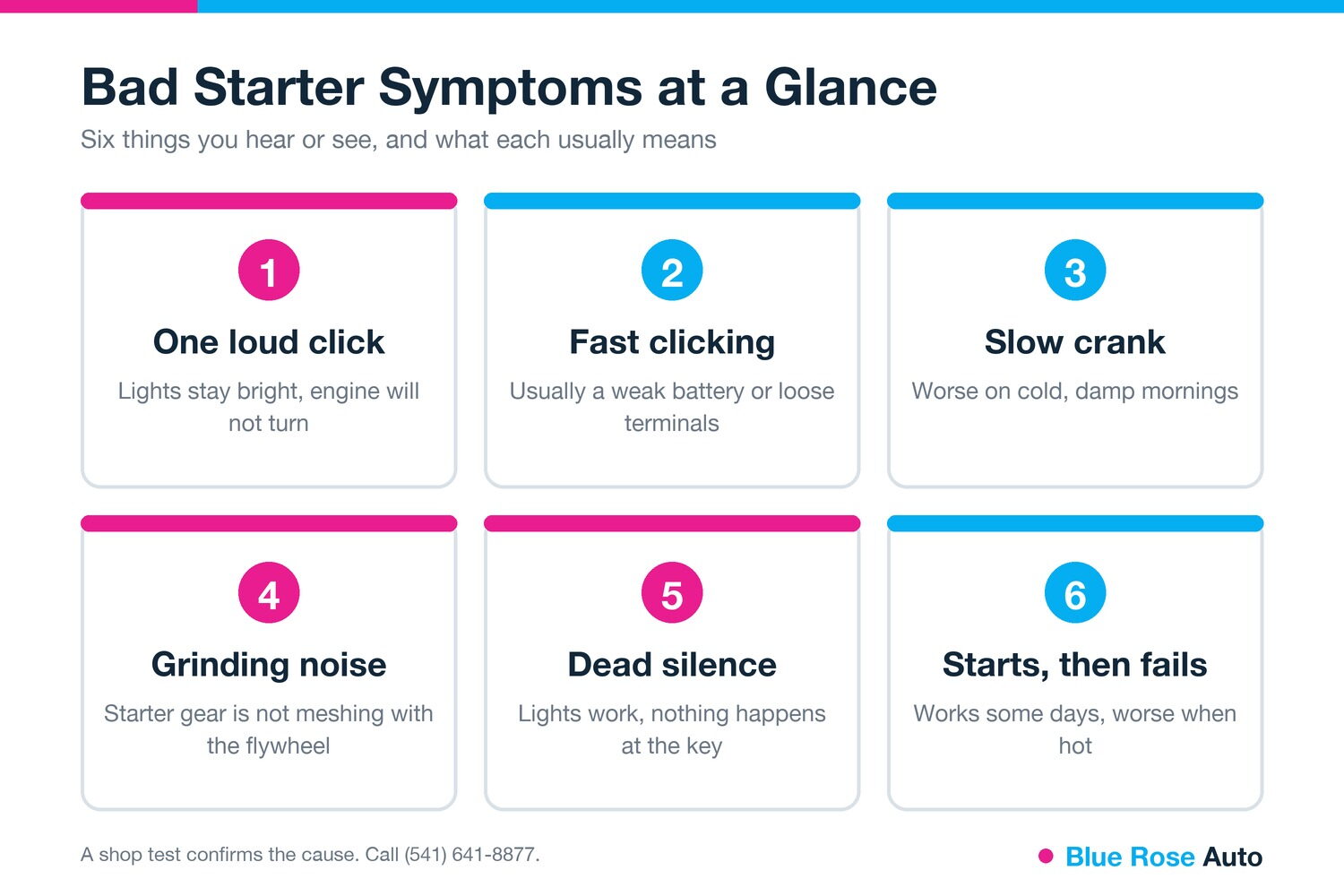
The graphic shows six things you hear or see, and what each usually means, and the table adds what to do next.
| What you notice | What it usually means | What to do next |
|---|---|---|
| One loud click. Lights stay bright, engine will not turn. | Starter solenoid or starter motor, sometimes the starter relay | Stop cranking and get it tested. |
| Fast clicking, dim dash lights | Usually a weak battery or loose terminals, often corroded | Check the battery first, which should read 12.6 volts at rest. |
| Slow crank, worse on cold, damp mornings | Weak battery, worn starter brushes or resistance in the cables | Charge and test the battery, then test the starter draw. |
| Grinding noise as it starts | Starter gear is not meshing with the flywheel | Stop. Repeated tries damage the flywheel. |
| Dead silence. Lights work, nothing happens at the key. | Starter, relay, ignition switch or neutral safety switch | Try Neutral, then get it tested. |
| Starts, then fails. Works some days, worse when hot. | Worn contacts or heat soak | Book a test before it strands you. |
The signs of a bad starter overlap with battery trouble, so test before you buy a part.
How to Know If Your Car Starter Is Bad When You Turn the Key
The most common sign shows up the moment the key turns. You hear a click, yet the engine does nothing, while the dash lights stay bright and the radio works.
That click usually comes from the starter solenoid trying to engage. Inside the starter, worn contacts or a worn motor stop the engine from spinning, and the battery seems fine, which confuses drivers. Once is random. Twice is the starter talking.
Car Won’t Start and Just Clicks
Count the clicks. One loud click with normal dash power points to the starter or its relay. A rapid chatter with dim lights points to low battery voltage, because the solenoid keeps engaging and dropping out without enough power to hold.
A fully charged battery reads 12.6 volts or higher with the car off, according to Interstate Batteries, and 11.9 volts or below counts as dead. So a reading well under 12.6 means charge and test the battery first. Loose or corroded terminals cause the same chatter, and wet-season corrosion is common in the Willamette Valley.
How to Know If Your Car Starter Is Bad When the Engine Cranks Slowly
A slow crank is a battery question first. The engine turns over but sounds strained or lazy. Cold cuts battery output, and a battery maker notes that short trips never fully recharge it, so a damp morning near freezing in Eugene is when a weak battery pretends to be a bad starter.
If the battery tests good and the cables are clean, the starter becomes the suspect. Worn brushes, tired windings or aging bearings force the motor to work harder and pull more current. A jump start often rescues a weak battery for a day. When it helps briefly or not at all, we test the starter draw before anyone buys a part.
How to Know If Your Car Starter Is Bad When Nothing Happens at All
Sometimes the car stays completely quiet. No click, no crank, and the dash lights still come on.
At that stage power reaches the dash but the start command never gets through the starter circuit. A failed starter motor or solenoid can do it. So can a bad starter relay, a worn ignition switch or a neutral safety switch that does not know the car is in Park. Shift to Neutral and try again. If the car starts in Neutral, the neutral safety switch is the suspect. On push-button cars, a security or immobilizer fault can also block the start, and a scan tool shows it.
Other Warning Signs That Often Get Missed
Starter problems do not always look the same.
- Grinding noises during startup. The starter gear is not lining up with the engine’s flywheel. Every attempt damages both parts.
- Intermittent starting trouble. The car starts fine one day and struggles the next. If it will not crank when hot but starts after it cools, suspect heat-related resistance in a worn starter.
- The starter keeps running after the engine starts. A loud whine means the starter drive failed to disengage, and driving on risks the engine’s ring gear.
- Whirring without cranking. The motor spins but the engine does not turn, which points to a slipping starter drive or a weak solenoid.
- A burning smell or smoke. Stop cranking and call. Repeated attempts overheat the starter and its wiring.
Sound and behavior are your only early signals. Wiring can imitate a bad starter too. Corroded cables or a loose ground strap block power from reaching the motor, which is why we test the whole circuit and not only the part.
Starter vs Battery vs Alternator, How to Tell Which One Failed
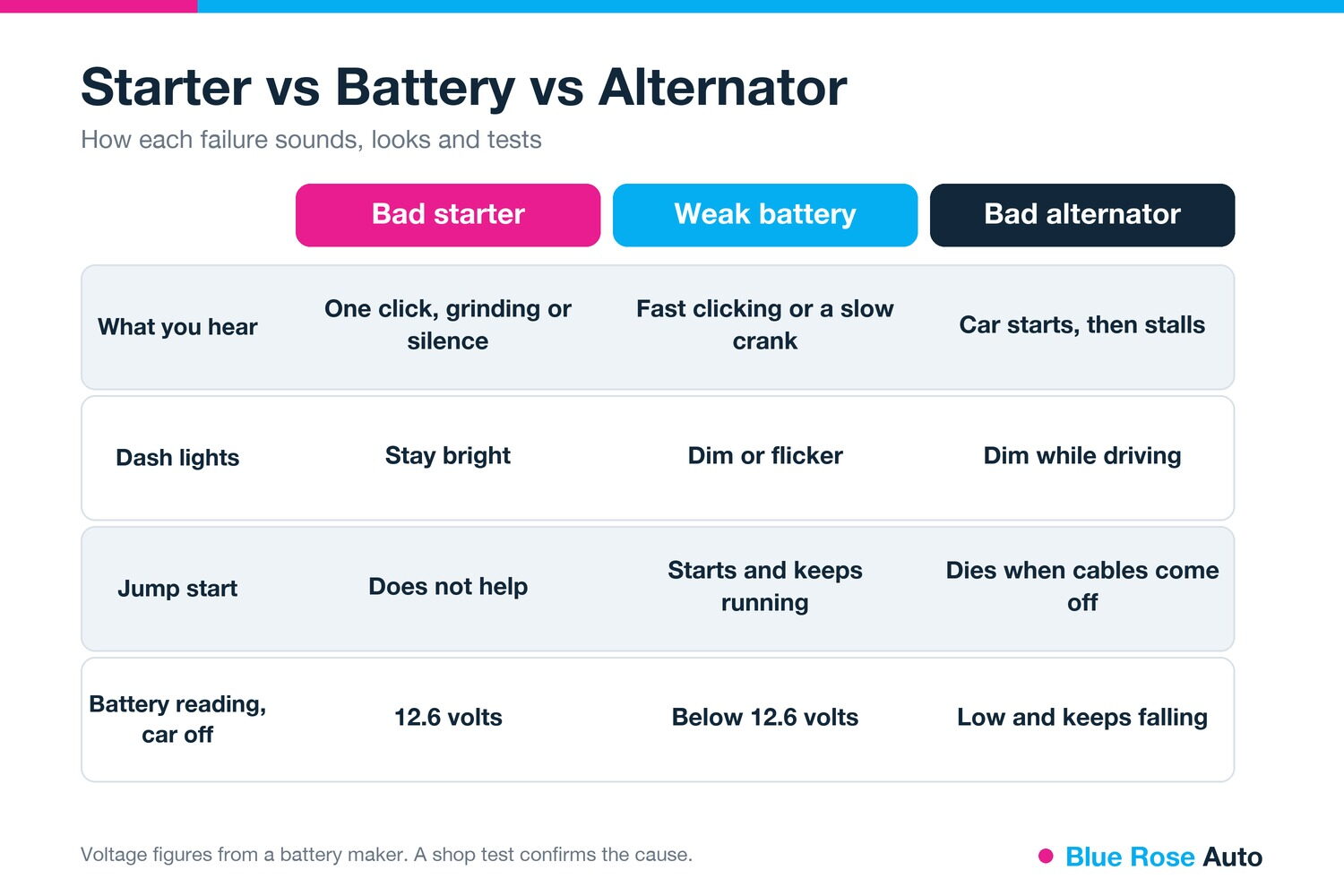
These three parts share symptoms, so guessing wastes money. A weak battery usually brings dim lights and a slow crank that improves after charging. A failing starter often shows full electrical power with little or no engine movement. A failing alternator lets the car start, then lets the battery run down until it stalls.
| Bad starter | Weak battery | Bad alternator | |
|---|---|---|---|
| What you hear | One click, grinding or silence | Fast clicking or a slow crank | Car starts, then stalls |
| Dash lights | Stay bright | Dim or flicker | Dim while driving |
| Jump start | Does not help | Starts and keeps running | Dies when cables come off |
| Battery reading, car off | 12.6 volts | Below 12.6 volts | Low and keeps falling |
| Reading with the engine running | 13.7 to 14.7 volts | 13.7 to 14.7 volts | Below 13 volts |
Voltage figures from a battery maker (Interstate Batteries). A shop test confirms the cause.
A worn drive belt can make a healthy alternator look dead, so we check the alternator belt before we condemn the alternator.
Quick Tests You Can Do in the Driveway
- The headlight test. Turn the headlights on, then try to start the car. Lights that stay bright while the engine will not turn point to the starter. Lights that dim hard or go out point to the battery or its connections.
- The voltage reading. Put a multimeter on the battery posts. With the engine off, 12.6 volts or higher is healthy.
An older battery is always the first suspect, and how often a battery needs replacing depends on climate and how you drive.
Can a Bad Starter Drain the Battery?
It can. A failing starter or a poor connection can pull more current than normal on every start attempt, and repeated attempts run the battery down. That is why we test the battery and the starter together instead of one at a time.
How to Jump Start Your Car and What It Tells You
A jump start gets you moving, and it also works as a quick test. If the engine fires and keeps running after you remove the cables, the battery was likely dead. If it fires and then dies as soon as the cables come off, the alternator is not supplying current. If the car still will not turn over, or clicks once, the starter or its wiring needs attention.
Keep the car in Park or Neutral with the parking brake set, and keep hands, hair and loose clothing clear of belts and fans. Stop after a few tries, because the starter and its wiring overheat. Repeated jump starts also strain the cables, the battery and the charging system, so treat a jump as a temporary move and not a fix.
Can You Tap a Starter to Make It Work
Sometimes, but briefly. A light tap on the starter housing while someone turns the key can free a worn contact or a dead spot in the motor. If the car cranks after a tap, you learned the starter is wearing out. You did not repair it.
Confirm the battery is good first. Set the parking brake, keep the car in Park or Neutral, and stay clear of belts and fans. Skip the tap if you smell smoke. Use it only to reach a shop, because the next failure is the one that strands you.
How Long Can You Drive With a Bad Starter
As long as the engine keeps running, the car keeps driving, because the starter sits idle once the engine fires. The problem is the next restart, which may not happen. Go straight to a shop or home, and do not shut the engine off anywhere you cannot get a ride or a tow.
Can a Bad Starter Shut the Car Off While Driving?
No. An engine that dies on the road points to fuel, ignition or the charging system, not the starter.
Can a Starter Go Bad From Sitting?
Sitting does not wear a starter, but it lets the battery drain and moisture corrode the terminals. A car that sat through a wet Oregon winter may need a charge and a test before you blame the starter.
Can a Starter Fail Without Warning?
Yes. A worn starter can work fine on Monday and quit on Tuesday, with no warning light.
What a Starter Costs to Replace in Eugene and Springfield
Starter replacement typically runs $400 to $850 nationally. RepairPal’s cost guide puts it at $565 to $796, and Kelley Blue Book’s at $744 to $837, with the final number set by the vehicle. We quote the exact price after diagnosis.
Where the starter sits moves the price most, since some engines put it in easy reach and others bury it under the intake manifold, which adds labor hours. Shop labor matters too, and Tekmetric’s 2026 data puts the average Oregon rate at $150 an hour against $132 nationally, a statewide average and not a Eugene or Springfield posting.
| Item | Typical cost | Note |
|---|---|---|
| Starter replacement, national range | $400 to $850 | Exact quote after diagnosis |
| RepairPal national guide | $565 to $796 | Varies by vehicle |
| Kelley Blue Book national guide | $744 to $837 | Varies by vehicle |
| Battery, if that was the real problem | $150 to $450 installed | Common false alarm |
| Alternator, if that was the real problem | $450 to $1,100 | Depends on the vehicle |
We lean toward a new or quality remanufactured starter over a one-off rebuild, because rebuild quality varies and a new unit carries stronger warranty coverage. Our first 15 minutes of diagnosis are free, then it is $100 an hour, and we credit that time to the repair when you approve it. We back repairs with a 3 year / 36,000 mile repair warranty. The same labor-plus-parts math drives how repair prices add up on bigger jobs.
How Long Do Starters Last
Starter makers put typical life between 100,000 and 150,000 miles (Unitech Motor). Heat, an engine oil leak onto the motor, frequent short trips and repeated cranking all shorten it.
Driving around Eugene and Springfield is mostly short hops, errands and campus runs, so a local starter often sees more start cycles per mile than a highway commuter’s.
Is Remote Start Bad for Your Car or the Starter
Remote start does not automatically harm a vehicle, but it adds start cycles, and every start is wear on the starter. A healthy starter handles that fine, but a worn one may fail sooner, so test it before the cold season.
Is Auto Start Bad for Your Car in Stop-and-Go Traffic
Cars that shut off at lights and restart on their own use heavier-duty starters built for the extra restarts. Wear still adds up in stop-and-go driving around Eugene and Springfield. Many of these systems also pause stop-start when the battery is weak, so a car that quits restarting at lights may be telling you about the battery before the starter.
What to Do If Your Car Won’t Start
Match what you see to the likely cause.
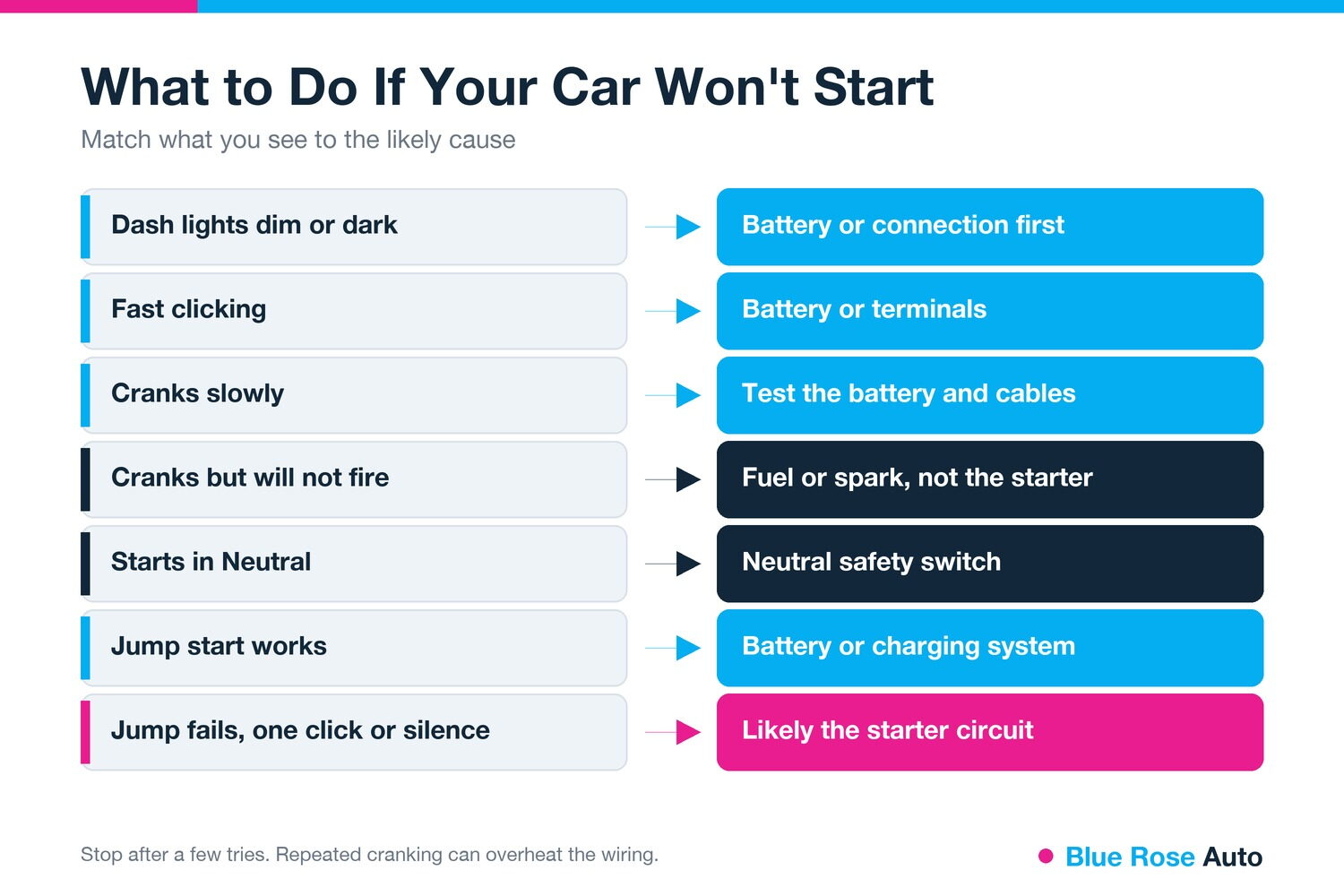
- Dash lights dim or dark point to battery or connection first.
- Fast clicking usually comes down to battery or terminals.
- Cranks slowly. Test the battery and cables.
- Cranks but will not fire. Think fuel or spark, not the starter.
- Starts in Neutral but not Park, which means the neutral safety switch.
- Jump start works, so look at the battery or charging system.
- Jump fails, one click or silence. Likely the starter circuit, so stop cranking and call (541) 641-8877.
Check the battery terminals for loose clamps and white or green crust first. Stop after a few tries. Repeated cranking can overheat the wiring.
Why Starter Problems Are Common in Eugene and Springfield
Short trips, damp mornings and wet-season moisture strain starters and the batteries that feed them.
We see it most on cold, damp mornings, when a weak battery looks like a starter failure and a worn starter finally quits. Checking the battery, terminals and starter belongs on any winter car maintenance checklist for Eugene drivers, ideally before the first cold, wet week.
How We Test a Starter at Blue Rose Auto
Replacing a part that still works does not fix the car, so we test first. Our ASE-certified technicians follow the same path on every no-start.
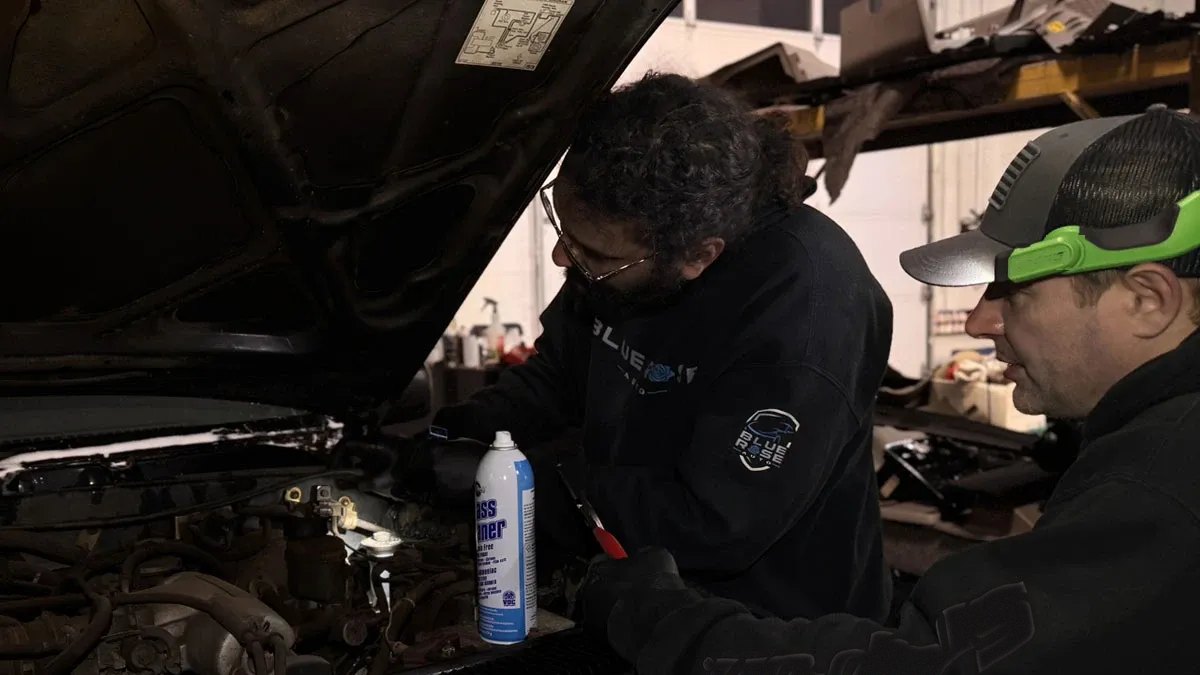
These are the seven checks before we quote a repair.
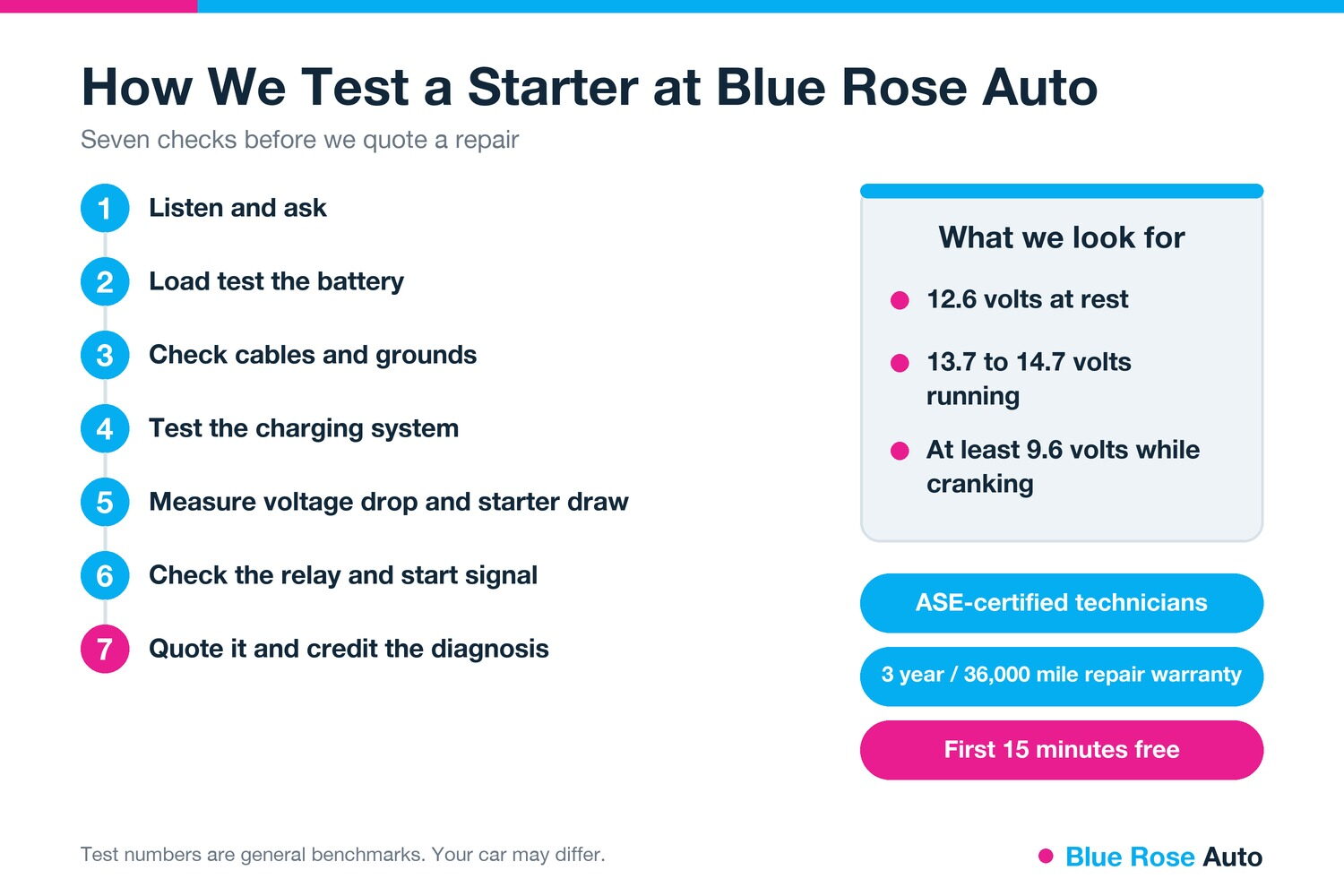
- Listen and ask. We ask what you heard and when it happens, whether cold, hot or after a short trip.
- Load test the battery. We read the battery state and load test it. A healthy battery rests at 12.6 volts and holds at least 9.6 volts while cranking.
- Check cables and grounds. We inspect the terminals, cables and ground straps for corrosion and loose connections.
- Test the charging system. We confirm the alternator holds 13.7 to 14.7 volts with the engine running.
- Measure voltage drop and starter draw. We measure voltage drop on the positive and ground sides of the starter circuit, then the current draw while cranking, and compare both to specification.
- Check the relay and start signal. We confirm the start command reaches the solenoid, rule out the relay, neutral safety switch and ignition switch, and scan for immobilizer faults on push-button cars. That is auto electrical work as much as starter work.
- Quote it and credit the diagnosis. We price the repair and credit your diagnostic time when you approve it.
What we look for comes down to 12.6 volts at rest, 13.7 to 14.7 volts running and at least 9.6 volts while cranking. Test numbers are general benchmarks. Your car may differ. Our diagnosis runs first 15 minutes free, then $100 an hour, credited to an approved repair, and our repair warranty is 3 year / 36,000 mile. That is engine diagnostics work, so the answer comes from measurements and not from swapping parts.
Frequently Asked Questions About Starter Problems
How do I know if my starter is bad?
If you turn the key and hear one click, grinding or nothing while the dash lights and radio stay bright, the starter is the likely cause. If the lights dim or a jump start brings the car back, suspect the battery or charging system. A voltmeter test settles it.
Is it the battery, starter or alternator?
A battery reading 12.6 volts or higher at rest on a car that will not crank points to the starter. A car that starts after a jump and keeps running points to the battery. A car that runs, then dies when the cables come off, points to the alternator, which should read 13.7 to 14.7 volts running.
Why does my car click but not start?
One loud click with normal dash power usually means the starter or its relay. Fast clicking with dim lights usually means low battery voltage or loose, corroded terminals. We check the battery and terminals first because that fix is quicker and cheaper, then test the starter circuit.
How long can you drive with a bad starter?
The starter is idle once the engine runs, so the car can keep driving. The risk is the next restart, which may fail without warning. Drive straight to a shop or home, and avoid shutting the engine off anywhere you cannot get a ride or a tow.
Can you jump-start a car with a bad starter?
Not reliably. A jump start fixes a low battery, so if the starter itself is worn the car usually still will not crank, or it works once and fails again. Use a jump only to reach a safe place, keep hands and clothing clear of belts and fans, and then have the car tested.
Does tapping the starter work?
Sometimes, and only briefly. A light tap can shift a worn contact enough to let the motor crank once, which tells you the starter is wearing out. It is not a repair. Set the parking brake, keep hands, hair and clothing clear of belts and fans, and use the tap only to reach a shop.
How long does a starter last?
Starter makers put typical life at about 100,000 to 150,000 miles. Heat, an engine oil leak, frequent short trips and repeated cranking shorten that. Driving around Eugene and Springfield means short trips with many restarts, so a local starter can wear sooner than a highway commuter’s.
How much does starter replacement cost?
Starter replacement typically runs $400 to $850 nationally. RepairPal’s guide shows $565 to $796 and Kelley Blue Book shows $744 to $837, depending on the car and where the starter sits. We give an exact quote after diagnosis, and our diagnostic time is credited to an approved repair.
Can a bad starter drain the battery?
It can. A failing starter or a poor connection can pull more current than normal on every start attempt, and repeated attempts run the battery down. That is why we test the battery and the starter together, and why a new battery sometimes does not fix a no-start.
Does cold weather make a starter fail?
Cold alone does not wear a starter out, but it exposes a weak one. Cold cuts battery output and thickens engine oil, so a worn starter can quit on a damp, cold Eugene morning. On those mornings we test the battery first, because it is the likelier cause.
Trusted Starter Repair for Eugene and Springfield Drivers
Blue Rose Auto works from 3436 Olympic St, where we handle auto repair in Springfield for drivers from across the Eugene metro. If your car shows starting trouble, call (541) 641-8877 or contact us to schedule starter testing and repair.
Sources
- Interstate Batteries, car battery voltage FAQ
- Interstate Batteries, why car batteries die
- Unitech Motor, how long car starters last
- RepairPal, starter replacement cost estimate
- Kelley Blue Book, average vehicle repair costs
- Tekmetric, average auto repair labor rates by state, 2026

0 Comments