Yes, you can wash a vinyl wrapped car, and through a wet Oregon winter you should. Hand wash it, or use a touchless wash, about every two weeks with a soap between pH 5 and 9. Rinse the grit off first, dry with a squeegee and microfiber, keep any pressure washer under 1,200 psi, and wait 72 hours after install.
Knowing how to wash a vinyl wrapped car here comes down to one season. Rain does little to cast vinyl by itself. The trouble is what it leaves when it dries. 3M’s current maintenance bulletin says to protect a wrapped car “from dew or rain, which may contain acidic pollutants,” and Eugene gets about 78% of its yearly rain from October through March.
| Question | Short answer | Whose rule |
|---|---|---|
| First wash after install | 72 hours | 3M (Avery says 48) |
| How often | Every 2 weeks, sooner under trees | Avery IB 1.50 |
| Soap | pH 5 to 9, no solvents or abrasives | Avery IB 1.50 |
| Automatic car wash | Touchless only, skip the wax add-on | 3M and Avery |
| Pressure washer | Under 1,200 psi, 40-degree tip, 12 in or more away | 3M and Avery |
| Drying | Silicone squeegee, then microfiber | 3M and Avery |
| Wax | Gloss only, no petroleum distillates | 3M (gloss only); Avery (no distillates) |
| Waterless wash | Light dust only; hand wash a dirty car first | Avery |
What does an Oregon winter do to a wrap?
Rain alone seldom hurts a vinyl wrap. The wear comes from what the water brings with it, which is grit off wet roads, dew that dries into water marks, fir pitch, and moss on cars that sit under trees for weeks. In the Willamette Valley, frost is the usual cold-weather problem, not snow. Vinyl wrap care here means handling those four.
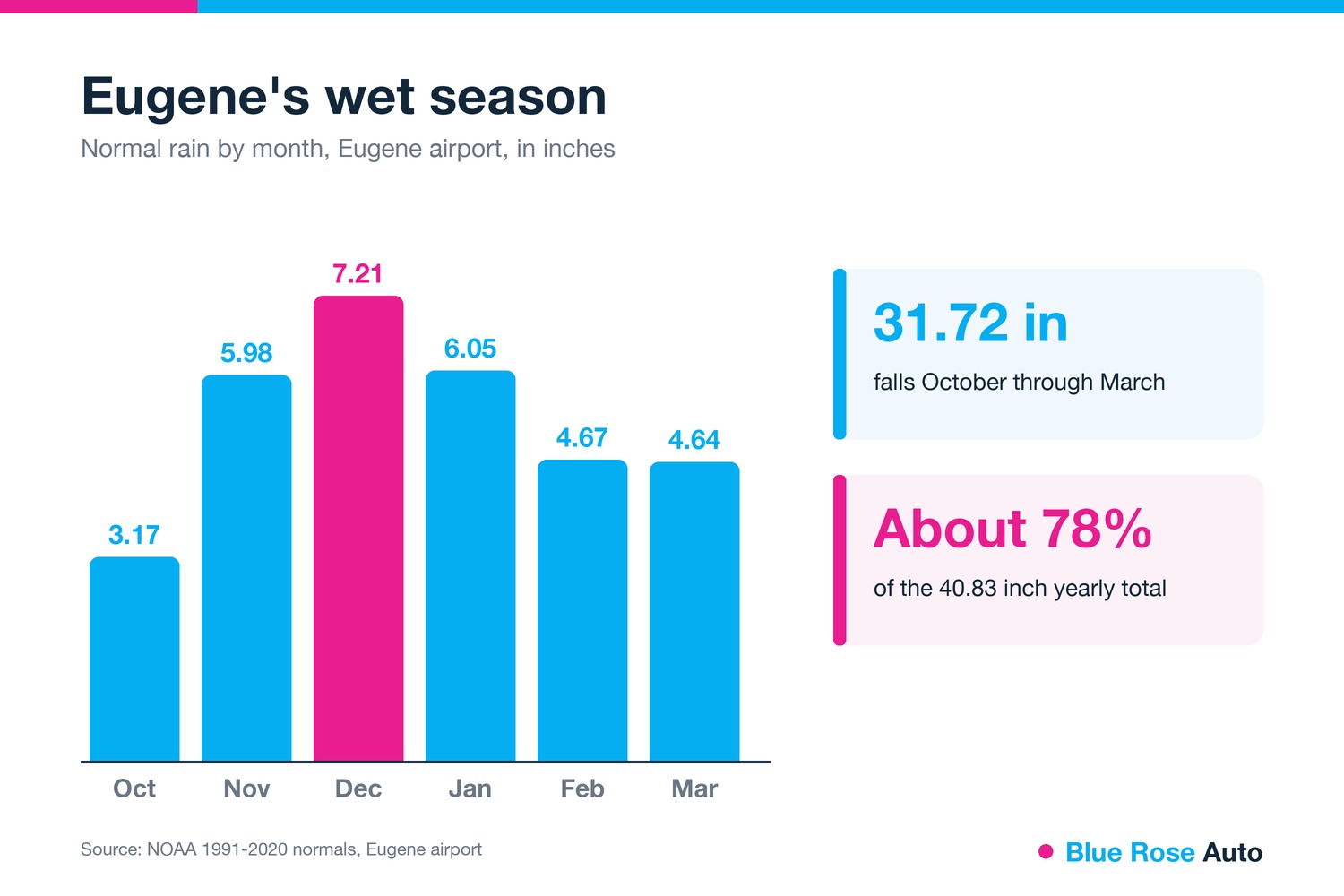
NOAA’s 1991-2020 normals for the Eugene airport put the yearly total at 40.83 inches. Of that, 31.72 inches (about 78%) falls October through March. The monthly normals run 3.17 inches in October, 5.98 in November, 7.21 in December, 6.05 in January, 4.67 in February and 4.64 in March, and every one of those wet days is a chance for dirty water to dry on a hood.
- Road film and grit. 3M warns that dirt and debris “can be hard and scratch the film” when wiped in.
- Water marks. Avery Dennison’s IB 1.50 blames stubborn spots on “air pollutants that mix with seasonal dew.”
- Fir pitch and sap, which Avery warns “can stain and damage the PVC film” if left.
- Moss and algae along the cowl and seams. We tell fleet customers the same thing, since covered parking earns its keep in this valley.
On frosty mornings, let the frost melt on its own, and never take a metal scraper to the film.
How do you wash a vinyl wrapped car?
To wash a vinyl wrapped car, rinse it first, then hand wash from the roof down with a mild soap between pH 5 and 9 and a soft microfiber mitt. Don’t scrub. Rinse again, squeegee off the standing water, and finish with a clean microfiber towel so drops don’t dry into spots. Can’t hand wash? A touchless automatic is the fallback both 3M and Avery Dennison accept. A brush wash is not. We install vinyl wraps at our Springfield, OR shop, so if you spot an edge starting to lift after a wash, call (541) 641-8877.
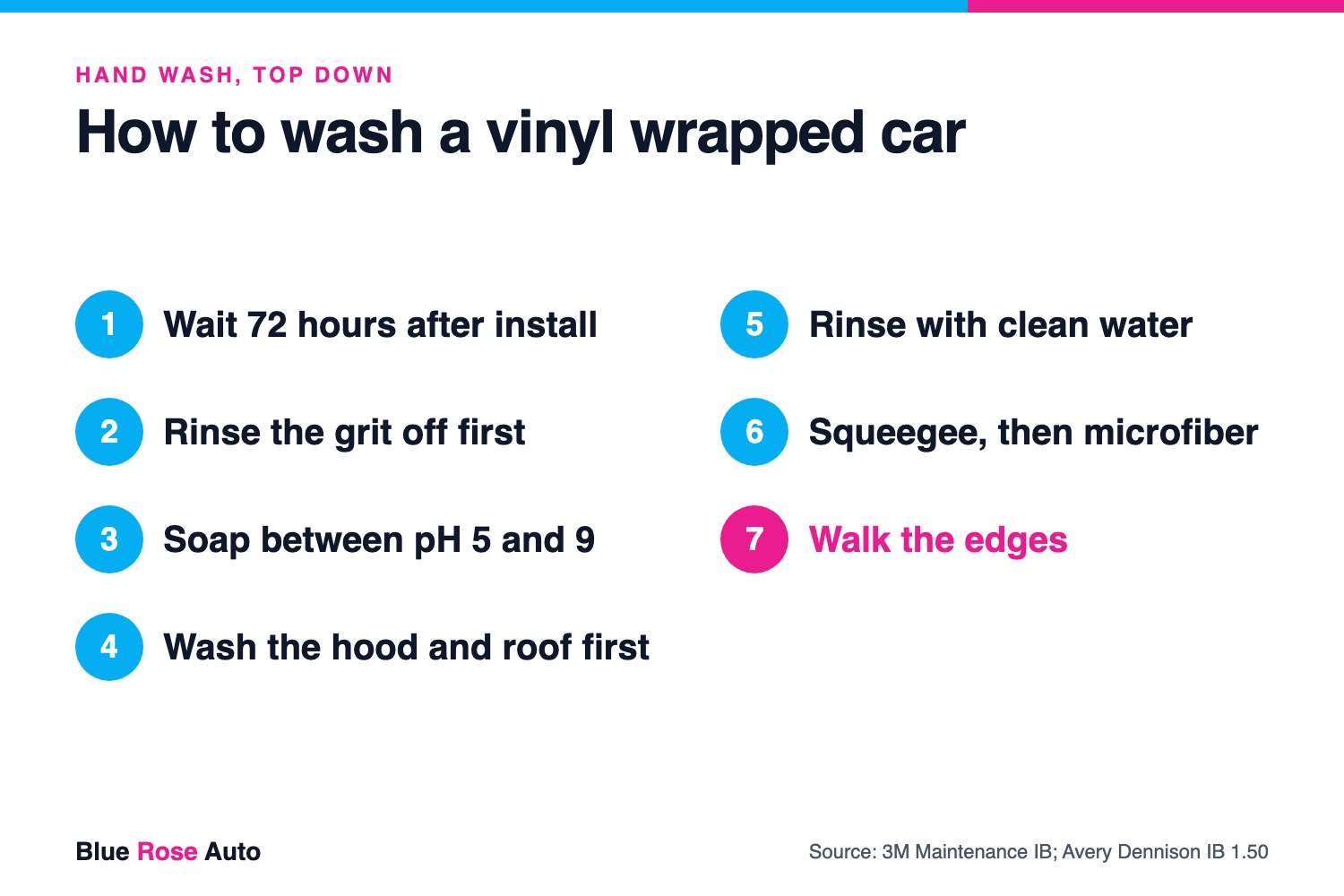
- Wait 72 hours after install. That’s 3M’s minimum. Avery’s is 48. Some guides say two weeks, but neither film maker asks for that.
- Rinse the grit off first, top down. No step prevents more scratches.
- Use a soap that meets the spec (next section) on a soft sponge or microfiber mitt. A second bucket of plain water for rinsing the mitt between panels keeps the grit you just lifted from going back on the film.
- Wash the hood and roof first. Keep it light. 3M is blunt about it and says “Never scrub the film.”
- Rinse with clean water until the seams run clear.
- Squeegee, then microfiber. 3M says to “immediately use a silicone squeegee to remove water, then dry the surface with a clean microfiber cloth,” which keeps drops from drying into spots.
- Walk the edges at corners, seams and wheel arches.
How often? Avery’s answer is “ideally, a vehicle wrap should be cleaned every 2 weeks.” 3M’s is “whenever it appears dirty.” Under trees, get sap and droppings off the day they land. For a general schedule, see how often to wash a car in Oregon weather.
Is a waterless wash enough in winter?
Only on light dust. Avery’s IB 1.50 calls a waterless wash or spray wax “the preferred method” when the car is “not overly dirty,” and its Supreme Wrap care brochure says to hand wash an extremely dirty car first and follow up with a waterless product. A wrap that has driven wet roads all week is the dirty case. Wiping road grit around with a spray bottle is how swirl marks start, so hose it off first. On matte film, pick a waterless product made for matte, since Avery warns that ones containing wax “can fill in the texture and cause shiny spots.”
Which soap is safe on vinyl wrap?
A soap is safe on vinyl wrap when it’s mild, free of abrasives and solvents, and sits between pH 5 and 9, the range Avery Dennison sets in IB 1.50. 3M’s current bulletin allows a wider band, nothing below pH 3 or above 11. So a cleaner inside 5 to 9 satisfies both film makers.
Check the label for these points.
- pH between 5 and 9
- No abrasives or cutting compounds
- No petroleum distillates, which Avery warns can turn up in car-wash wax
- No aromatic solvents. Avery names acetone, M.E.K., toluene, paint thinner and lacquer thinner.
- A hidden test spot first, which both makers ask for
Dish soap? Neither maker names one either way. Avery’s SW900 data sheet wants cleaners free of “harmful detergents” and phosphates, so if the label can’t show that, buy a pH-neutral car shampoo. A re-wrap costs far more than the right soap.
Can a wrapped car go through a car wash?
Yes, if it’s touchless. Avery’s IB 1.50 calls “a brushless automatic car wash with just spray” acceptable, and 3M recommends touchless whenever you can’t hand wash. Brush washes are out. 3M warns that brushes “can catch a loose edge of the graphic” and dull its finish.
Skip the wax option at the end of the tunnel too, since Avery warns it can contain petroleum distillates “which can damage the wrap.” Our rule on fleet jobs is the same, which is hand wash or touchless, period. Vans with commercial and fleet wraps that sit at Springfield job sites all winter should be washed on a schedule, not when they finally look dirty.
Is it safe to pressure wash a wrap?
Yes, carefully. 3M’s December 2024 maintenance bulletin says power washing “may be used,” but warns that too much pressure forces water under the film and lets it lift. Avery Dennison treats a pressure washer as a last resort, for when nothing else has worked. Both bulletins cap pressure at 1,200 psi.
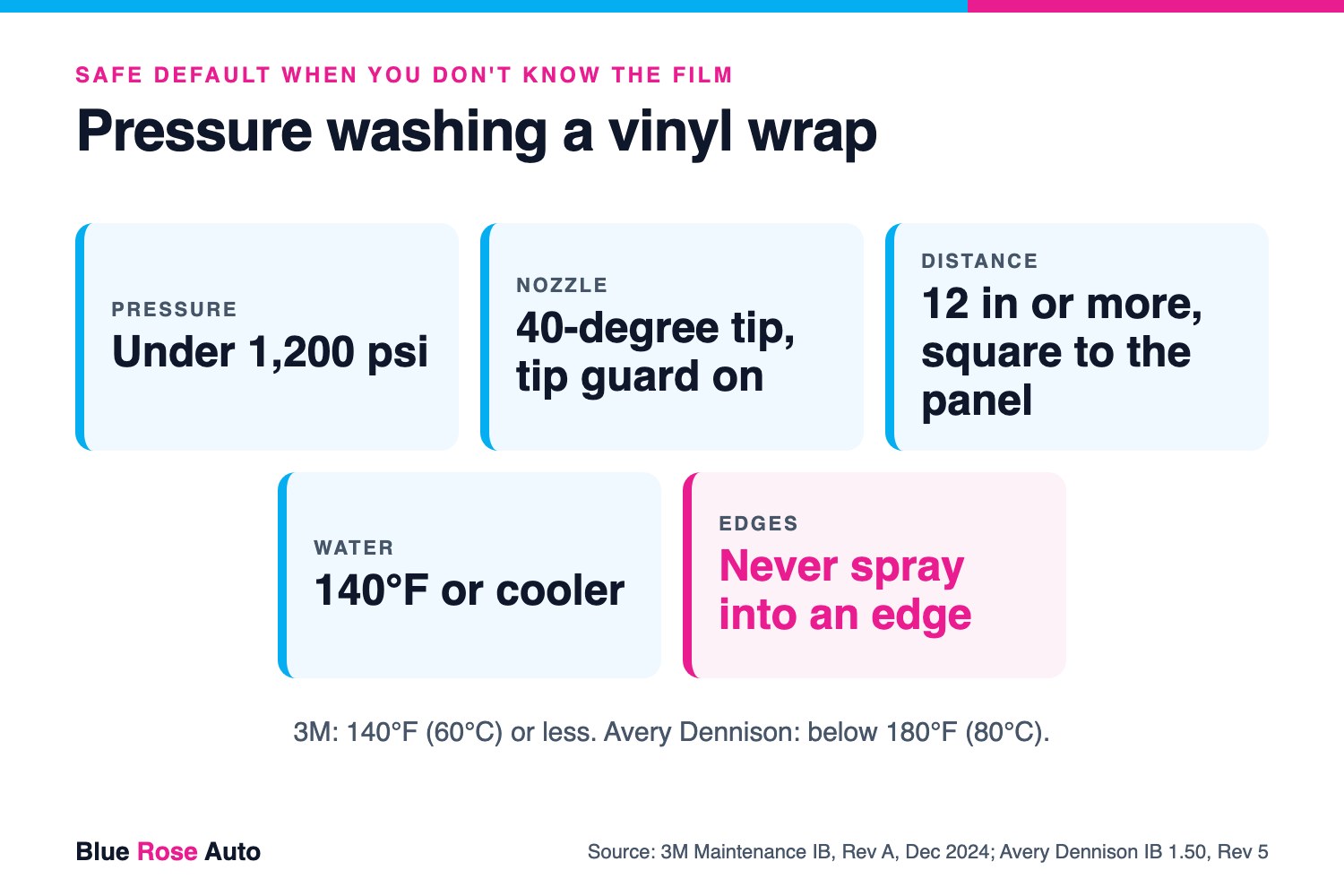
Each maker’s own pressure settings for a vinyl wrapped car are below. Don’t know the film? Follow the stricter number in each row.
| Setting | 3M (Maintenance IB, Rev A, Dec 2024) | Avery Dennison (IB 1.50, Rev 5, 2024) | Safe default |
|---|---|---|---|
| Maximum pressure | 1,200 psi | Below 1,200 psi | Under 1,200 psi |
| Water temperature | 140°F (60°C) or less | Below 180°F (80°C) | 140°F or cooler |
| Nozzle | 40-degree or wider, with a tip guard | 40-degree wide spray | 40-degree tip, tip guard on |
| Distance and angle | At least 12 in, perpendicular (90° ±10); or at least 39 in at 60° or more | At least 12 in from the edges, perpendicular | 12 in or more, square to the panel |
| Edges | Never aim between 0° and 60° at an edge; check for edge lift after | Perpendicular “will avoid lifting edges” | Never spray into an edge |
| When to use it | “May be used”; aggressive washing can damage the graphic | Only when other methods haven’t worked | Rinse with a garden hose first |
On the numbers, the two makers differ only on water temperature. The 1,500 to 2,000 psi figure still repeated online came from 3M’s old Instruction Bulletin 6.5, which 3M retired in December 2024 when it reorganized its bulletins. For most winter road film, a garden hose is all you need.
Should you dry a wrap after it rains?
After a wash, always. After rain, it helps, mostly on dark gloss and matte films where water marks show first. But nobody towels a car off after every rainy day in December, Eugene’s wettest month at 7.21 normal inches, so for a car that lives outside, a garage, carport or cover does more than any towel.
Water marks form because rain and dew carry pollutants, and when the water evaporates they stay behind. Dry with a silicone squeegee, then microfiber, blotting on matte. 3M suggests a cloth car cover when there’s no garage. Put it on a clean, dry car, or the wind will rub grit into the film all night.
How do you remove sap, moss and droppings?
Soften, don’t scrape. For bug splatter, bird droppings and tree sap on 2080 film, 3M’s method is to soak the spot “for several minutes with hot, soapy water,” then rinse and dry. Only then try a bug-and-tar remover or IPA, tested on a hidden spot. Avery Dennison wants them cleaned off immediately.
| Contaminant | What to do | Source |
|---|---|---|
| Fir pitch / tree sap | Soak with hot, soapy water, rinse, dry. If it stays, test a bug-and-tar remover or IPA in a hidden spot. No scraping | 3M Product Care Guide; 3M Maintenance IB |
| Bird droppings, bugs | Same soak; Avery says they “can stain and damage the PVC film,” so act fast | 3M Maintenance IB; Avery IB 1.50 |
| Moss, algae, mildew, pollen | Mild detergent and water first. Bleach only on known 3M film, tested first | 3M Maintenance IB; Avery SW900 PDS |
| Fuel spills | Wipe off right away to avoid “degrading the vinyl and adhesive,” then wash | 3M Product Care Guide |
Moss is where the makers split. 3M allows “a 3 to 5% sodium hypochlorite (full-strength household bleach) solution, or mild liquid detergent and water” on its films, while Avery’s data sheet wants chlorine-free cleaners. Unknown film? Skip the bleach. On printed wraps under Avery’s DOL 6460 polyurethane overlaminate, IPA must be “a very quick wipe with no pressured rubbing.”
Can you wax or ceramic coat a wrap?
Gloss film can take a wax with no petroleum distillates in it. Matte, satin and textured films get no wax or polish at all. A ceramic coating can go on a wrap, but it’s a warranty question first, because 3M excludes coated 2080 film from its warranty and Avery voids its warranty for coatings containing petroleum distillates or solvents.
| Finish | Wax? | Spot cleaning | Watch out for |
|---|---|---|---|
| Gloss | Yes, if free of petroleum distillates (3M lists specific waxes) | 70/30 IPA/water (3M) | Scratches from grit; rinse first |
| Matte / satin | No wax or polish | 50/50 or 2 parts IPA to 1 part water (Avery), 70/30 (3M); blot | Wax “can fill in the texture and cause shiny spots” (Avery) |
| Textured (carbon fiber and similar) | No wax or polish (3M) | Warm water and gentle soap (Avery) | No brushes or hard scrubbing (3M) |
| Chrome / mirror | Follow the film maker | Wipe in one direction, no brushes (Avery) | Swirl marks |
| Printed, polyurethane overlaminate | Ask your installer | IPA as “a very quick wipe” only (Avery) | IPA left to soak in can soften the film |
The flatter or more textured the finish, the less you put on it.
On coatings, we have a stake. As a Ceramic Pro Certified Elite Dealer we apply ceramic coatings on vinyl and paint protection film, including Ceramic Pro LUX, which Ceramic Pro makes “For Paint Protection Film and Wraps.” The film makers draw a line, though. 3M’s bulletin states that “3M does NOT warrant 2080 films with coatings or other aftermarket additions,” and Avery’s data sheet warns that coatings with petroleum distillates or solvents “void any warranty.” Check which film is on the car, and what its warranty covers, before coating it. The paint-side debate is in ceramic coating vs wax.
Why do the hood and roof wear out first?
Flat panels hold rain, dew and sap longer than doors do and take more sun, and the film makers rate them that way. Avery’s IB 1.50 notes that horizontal areas “trap the chemicals on the surface of the material,” and 3M writes that vinyl degrades “particularly on horizontal surfaces such as the hood, trunk lid, and roof.” Wash and inspect those first.
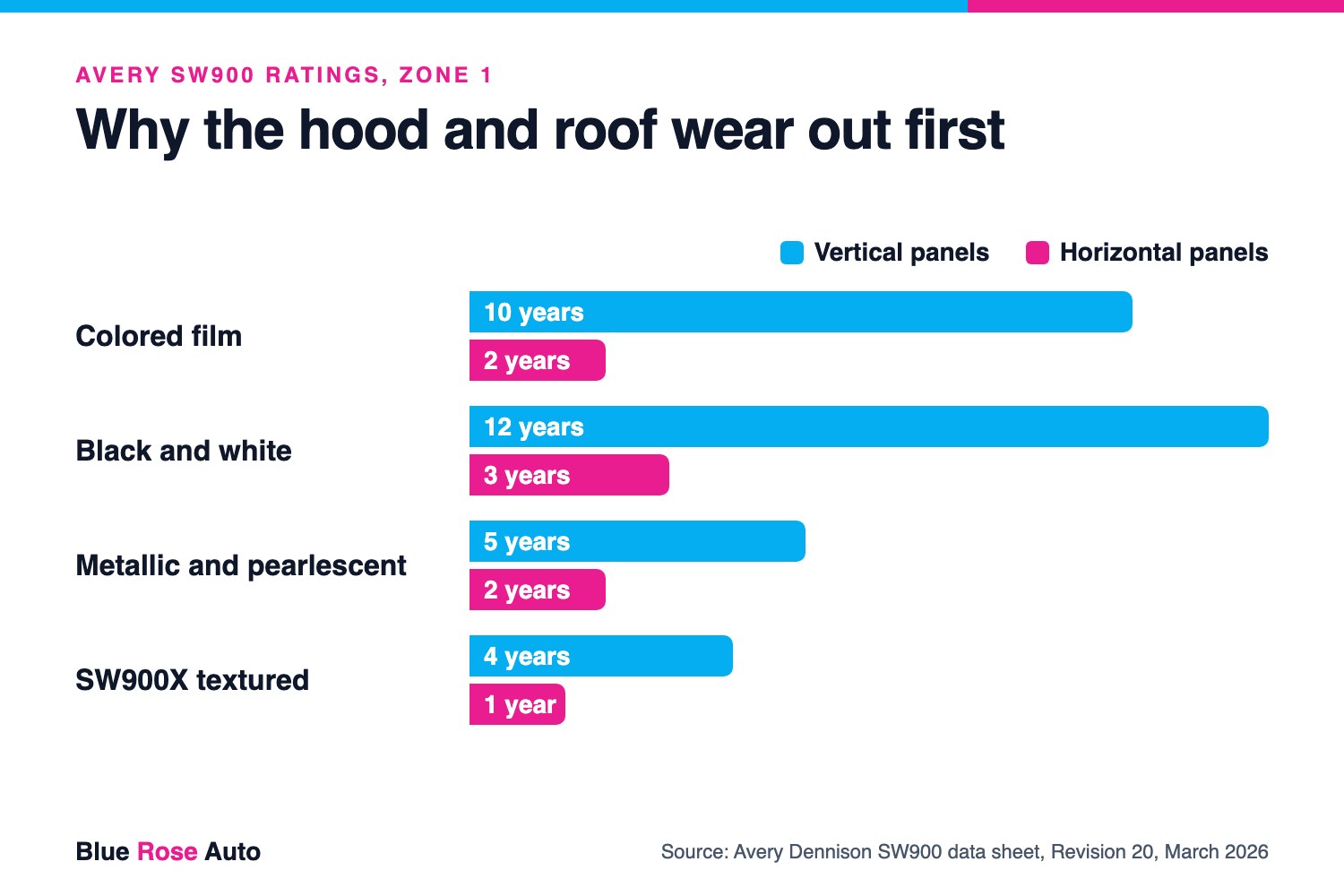
The gap is wide. Avery’s SW900 data sheet (Revision 20, March 2026) rates colored film at 10 years on vertical panels and 2 years on horizontal ones in Zone 1, the longest-life zone in its table. Black and white films get 12 and 3 years, metallic and pearlescent 5 and 2, and SW900X textured films 4 and 1. They’re Avery’s warranted ratings for its own film, not a forecast for your car. Either way, the flat panels are where to look first.
Parking matters more than any product. Garage or cover the car if you can, and skip the spot under a dripping Douglas fir, since 3M advises against parking near shrubs and trees that could scratch the film. Our guidance on color-change and vinyl wraps is that a quality wrap “generally holds five to seven years before the color starts to fade or the edges lift.” For paint, see how wraps and paint hold up over time.
What should you check on a wrap each fall?
Walk every edge and seam after the first wet-season wash, usually in October. 3M’s bulletin says to check every graphic for edge lifting after power washing, and a corner that goes into the rainy season already open will collect water and grit until spring.
- Lifting corners and seams at door edges, wheel arches and bumper recesses
- A dirt line under an edge, a sign water is already getting in
- Bubbles or tenting where film has pulled off a curve
- Dull, chalky patches on the hood and roof
- Scratches. According to 3M, most mild ones “disappear when exposed to sunlight on warm days.” Deep ones mean new film.
3M’s fix for a loose edge is to trim it back to where the adhesive still holds, then apply an edge sealing tape or edge sealer. One panel can often be redone, but 3M notes a replaced section can look different from older, faded film.
Edge already lifting? Have it looked at before a winter of water works under it. We handle vinyl wrap installs and paint protection at the shop. Rather hand off the washing? Book exterior detailing, say the car is wrapped, and ask that no polish or clay bar touch the film.
What else do wrap owners ask?
Can I use Dawn dish soap on a vinyl wrap?
Maybe, but check the label. Neither 3M nor Avery Dennison approves or bans a dish soap by name. Avery’s spec asks for a cleaner between pH 5 and 9, with no abrasives, no strong solvents, and no harmful detergents or phosphates. If a dish soap label doesn’t show it meets those terms, use a pH-neutral car shampoo instead.
What is the best cleaner for a vinyl wrapped car?
Usually a plain car shampoo. One that’s pH-neutral, with no wax, solvents or abrasives, does the job on most wraps, as long as it sits inside Avery’s pH 5 to 9 range. Avery also recommends its own Supreme Wrap Care cleaners. Whatever you buy, test it on a hidden spot first, which both makers require.
How do you wash a matte wrapped car?
Mostly the same way as gloss. Keep wax out of everything that touches it, shampoo and waterless sprays included, and blot it dry rather than wiping. Avery’s SW900 data sheet says matte film is “subject to extreme color and gloss shift when exposed to cleaners, wax, and polish.” For spot cleaning matte film, Avery’s brochure suggests a 50/50 isopropyl alcohol and water mix.
How soon can I wash my car after it’s wrapped?
3M says 72 hours. Its bulletin says not to wash a 2080 wrap until at least 72 hours after installation, while Avery’s care brochure gives 48 hours for its Supreme Wrap film. Wait the full 72 hours unless your installer says otherwise, and make the first wash a gentle one, by hand or touchless.
Can I take a wrapped car through a touchless car wash?
Yes. 3M recommends a touchless wash when the car can’t be hand washed, and Avery calls a brushless, spray-only automatic “acceptable.” Avoid any wash with spinning brushes, which can catch an edge and dull the finish, and skip the wax add-on, which may contain petroleum distillates.
Will rubbing alcohol damage a vinyl wrap?
Not when it’s diluted and used briefly. Both film makers use isopropyl alcohol and water for spot cleaning, with 3M at a 70/30 mix and Avery at 2 parts alcohol to 1 part water or 50/50 on matte and satin. Wipe, don’t soak. On Avery’s DOL 6460 overlaminate, use only “a very quick wipe.”
Does rain damage a vinyl wrap?
No. What it leaves behind can. 3M’s bulletin says dew or rain “may contain acidic pollutants” and suggests a cloth car cover when there’s no garage. Avery links stubborn water spots to pollutants mixed with seasonal dew, so through the wet months, wash and dry the wrap regularly.
Can you wax a wrapped car?
On gloss film, yes. Use a wax with no petroleum distillates or abrasives, and test it on a hidden spot first. On matte, satin and textured films, no. Avery warns that wax can fill in the texture and cause shiny spots. 3M rules out waxes and polishes on those finishes too.
How long does a vinyl wrap last in Oregon?
Usually five to seven years. That’s our guidance for a quality vinyl wrap with normal care, and garage parking and hand washing stretch it. In Zone 1, the longest-life zone in its table, Avery rates colored SW900 film at 10 years on vertical panels but 2 years on horizontal ones, so the hood and roof show wear first.
Is an edge already lifting on your wrap?
Most wrap care is a hose, the right soap and a microfiber towel. If an edge has started to lift, or the hood and roof look tired going into the wet season, bring the car to our Springfield shop at 3436 Olympic St. We’ll take a look and tell you straight whether the film needs work or just a wash, and our 3-year, 36,000-mile warranty covers the wraps we install. Call (541) 641-8877 to book a time, and ask about the wrap films and finishes we install.
Written by Blue Rose Auto, 3436 Olympic St, Springfield, OR 97478. Blue Rose Auto opened in 1994 and our technicians are ASE-certified.
0 Comments