
If you hit a deer in Oregon, pull onto the shoulder, turn on your hazards and stay away from the animal. Call 911 if anyone is hurt or the deer is blocking traffic. Photograph the car and the scene. If damage tops $2,500, Oregon requires a DMV report within 72 hours. Comprehensive coverage usually pays, if you carry it.
Fall is the worst of it. ODOT documents more than 6,000 vehicle collisions with deer and elk each year, and they peak in October and November, when migration and the rut put animals on the move (ODFW, October 2022).
By the Blue Rose Auto collision team, Springfield, OR · Last reviewed October 2026. General information, not legal or insurance advice.
This guide runs in the order things happen after a deer strike. Safety comes first. The first hour covers photos, a drivability check, Oregon’s reporting rules and the deer itself, including a western-Oregon salvage rule on white-tailed deer worth knowing before you load anything into the truck. The first week brings the insurance decision, which mostly comes down to comprehensive versus collision and whether a claim is worth filing at all. Then comes the repair, where a front-end deer strike often hides more damage than the bumper cover shows. Blue Rose Auto opened in 1994, and our ASE-certified technicians work at 3436 Olympic St in Springfield, so we write this from the body-shop end of the claim. Every legal or insurance point below links to its source. If your car is already parked and you want the damage measured, call (541) 641-8877.
Save these numbers before you need them.
| Who | Number | When |
|---|---|---|
| Emergency | 911 | Anyone hurt, or the car or deer is a traffic hazard |
| Oregon State Police non-emergency | *OSP (*677) from a mobile, or 800-442-0776 | Reporting the collision or an injured deer |
| City of Eugene dead-animal removal | 541-682-4800 | Carcass on a public right-of-way in Eugene |
| Blue Rose Auto | (541) 641-8877 | Damage inspection and collision repair estimate |
These numbers come from Oregon State Police and the City of Eugene.
Hit a deer in Oregon? What to do first
Stop somewhere safe, make the car visible and stay out of the travel lane. Oregon DMV says to stop at or near the scene without blocking traffic. ODFW’s first advice covers the second before impact, because many serious crashes happen when a driver swerves into a tree or an oncoming car.
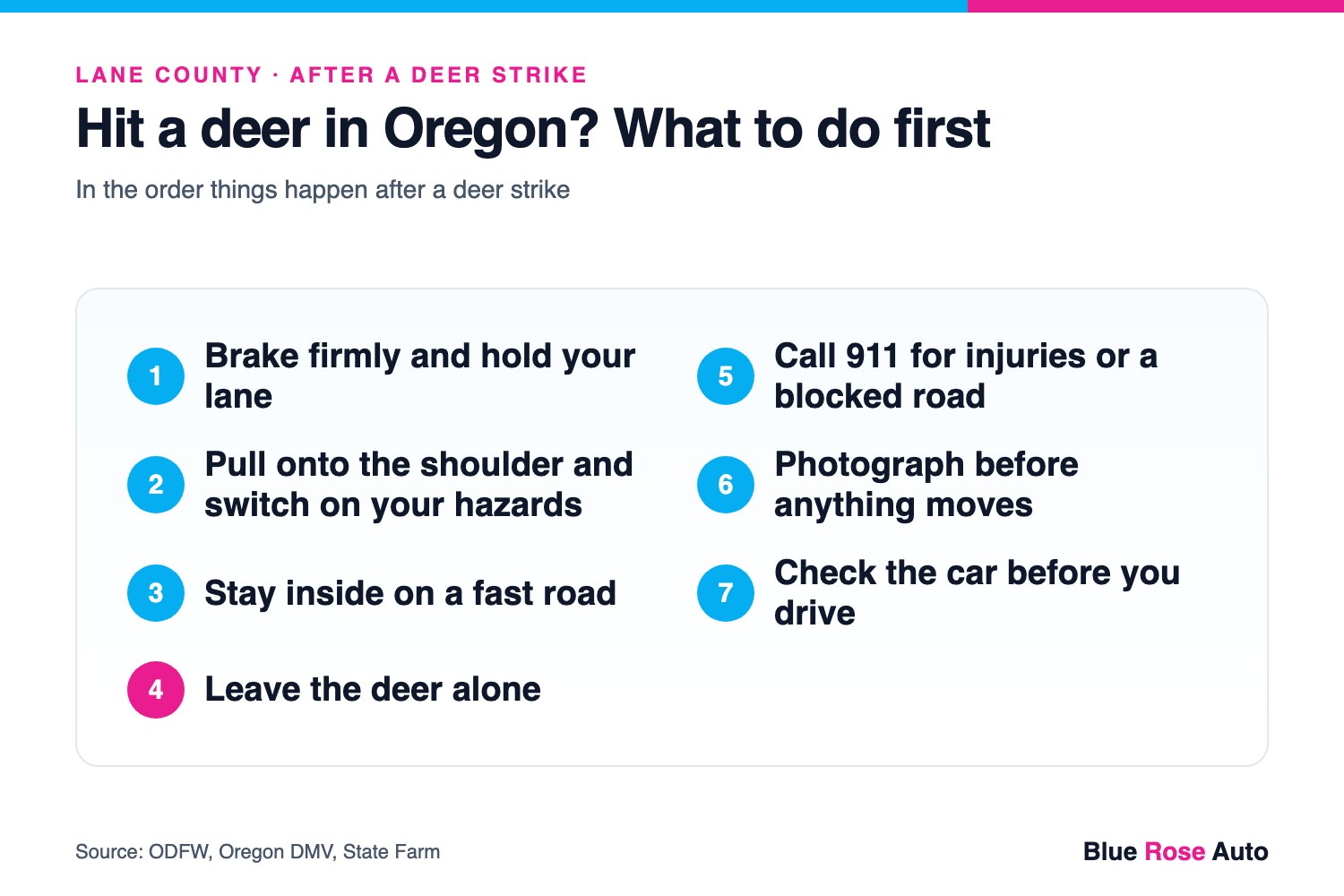
- Brake firmly and hold your lane. ODFW’s advice, in capitals, is “DON’T SWERVE to avoid an animal.” Too late this time? Remember it next time.
- Pull onto the shoulder and switch on your hazards. Leave the headlights on after dark so the next driver sees you.
- Stay inside on a fast road. With a narrow shoulder and 55 mph traffic, the car is the safest place to make calls.
- Leave the deer alone. One that looks dead may only be stunned. State Farm says not to approach an injured or frightened animal.
- Call 911 for injuries or a blocked road, including a deer lying in a travel lane. Otherwise use the OSP non-emergency line, *677 from a mobile.
- Photograph before anything moves. The list below is what an adjuster will ask for.
- Check the car before you drive. Use the six-point check further down.
Photos to take for the claim
- All four corners, far enough back to show the whole car
- Close-ups of every crack, dent and broken light
- The deer, or any hair or blood left on the car if it ran off
- The road, with a mile marker or sign in frame
- Skid marks and the debris field, if there is one
- Whatever else you hit, such as a guardrail, fence or mailbox
Do you have to report hitting a deer in Oregon?
In Oregon, a deer strike must be reported to the DMV within 72 hours if anyone is hurt, damage to your vehicle tops $2,500, any vehicle has more than $2,500 in damage and a vehicle is towed, or damage to other property tops $2,500 (ORS 811.720 and 811.725). Police must also be notified, using a non-emergency number. Skipping the DMV report can lead to a suspension notice.
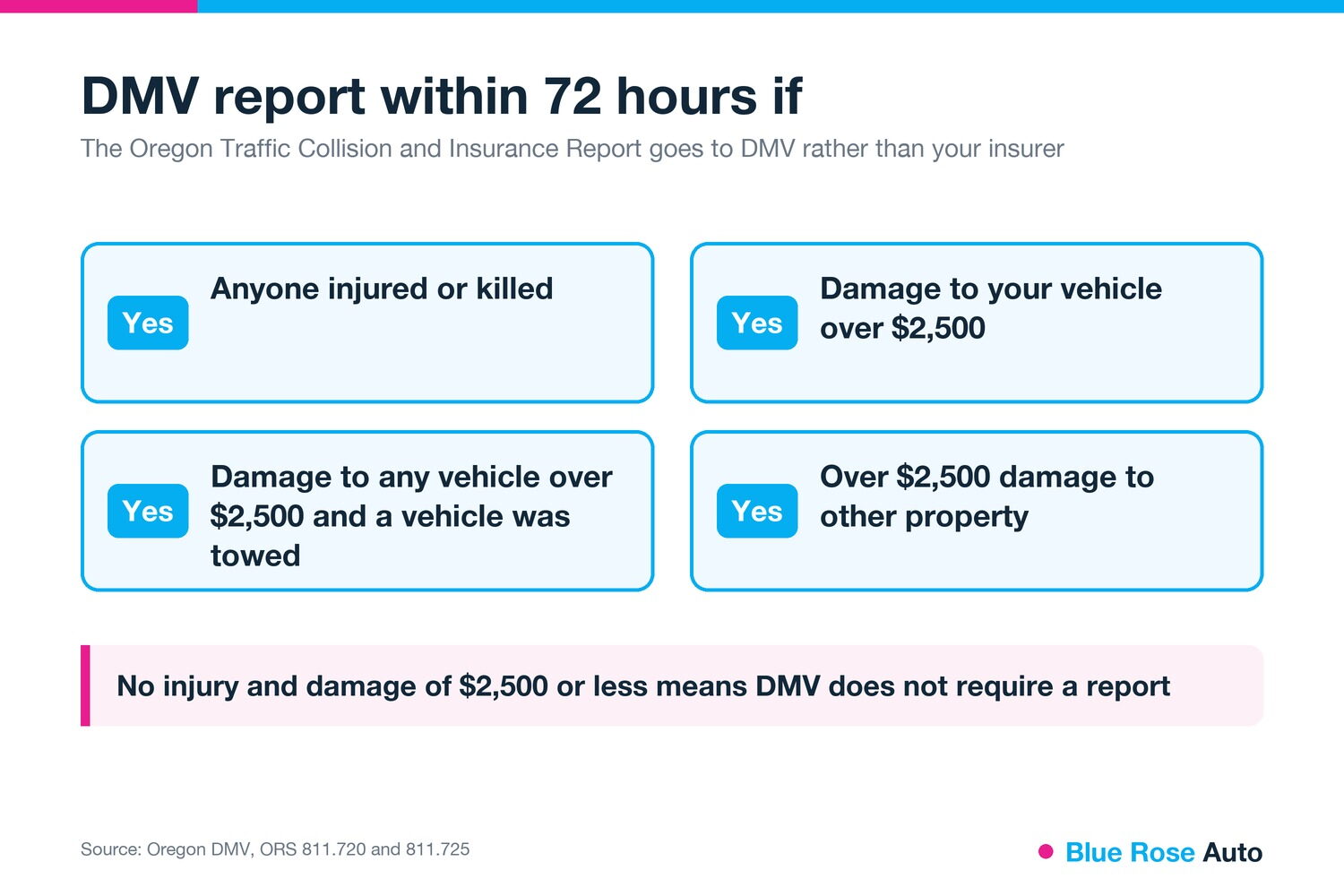
The table below shows when Oregon requires a DMV report after a deer strike.
| Situation after a deer strike | DMV report within 72 hours? |
|---|---|
| Anyone injured or killed | Yes |
| Damage to your vehicle over $2,500 | Yes |
| Damage to any vehicle over $2,500 and a vehicle was towed | Yes |
| Over $2,500 damage to other property (fence, guardrail, sign) | Yes |
| No injury, damage $2,500 or less | Not required by DMV (your insurer may still want photos and a statement) |
The thresholds come from Oregon DMV collision reporting, ORS 811.720 and ORS 811.725.
Not sure whether damage tops $2,500? A written estimate settles it. The form is the Oregon Traffic Collision and Insurance Report, it goes to DMV rather than your insurer, and you file it even if a trooper wrote a report at the scene. Missed the 72 hours? Submit it as soon as possible. Skip it and, in DMV’s words, “Oregon law requires DMV to issue a suspension notice.”
Do you have to call the police?
Yes, when the crash meets those reporting rules. DMV says “You must immediately notify police if you are a driver involved in a collision that meets the reporting requirements.” Use a non-emergency number. On highways around Eugene-Springfield, OSP takes these calls at *677 from a mobile or 800-442-0776; inside city limits, the local police non-emergency line works too. Below the threshold with nobody hurt, no DMV report is required.
What happens to the deer after you hit it?
That depends on whether the deer is alive, dead in the road, or something you’d like to keep. Oregon covers each case. ORS 498.016 governs putting an injured animal down, road crews clear carcasses from public roads, and ODFW issues a free salvage permit.
If the deer is still alive
Stay back. ORS 498.016 allows anyone to kill “crippled or helpless wildlife” for a humane purpose, but they “shall immediately report such killing,” in practice to OSP. Want the meat? ODFW says to call OSP or local police before the animal is dispatched. A deer thrashing in a live lane is a 911 call.
If it’s dead in the road
Move it to the side only if that’s safe; otherwise call 911. According to ODFW, “ODOT and county road maintenance crews are responsible for removing animals from public roadways.” Inside Eugene, Public Works handles dead animals on public rights-of-way at 541-682-4800 (City of Eugene). Private property needs a private removal business.
Can you keep the deer?
Oregon allows people to salvage a deer or elk killed by a vehicle, with a free ODFW permit completed within 24 hours of taking the animal. The head and antlers go to an ODFW field office within 5 business days for chronic wasting disease testing. Around Lane County that means black-tailed deer and elk, because white-tailed deer are protected in most of western Oregon.
Per ODFW, white-tailed deer “can only be salvaged from Douglas County and east of the crest of the Cascade Mountains.” The other salvage rules are short.
- Anyone may salvage a deer or elk the vehicle killed. If it was injured and then put down, only the driver who hit it may salvage it, unless a wildlife officer dispatched it.
- An animal whose antlers were removed can’t be legally salvaged.
- The whole carcass comes off the road and right-of-way, gut pile included.
- Selling any part is prohibited.
- Hitting a deer on purpose to get the meat is illegal.
Not sure which species you hit? Leave it.
Is it safe to drive after hitting a deer?
Before driving after a deer strike, check six things, which are leaking fluid (especially coolant), headlights and turn signals, whether the hood latches, tires and wheels, the radiator and fan area behind the grille, and dashboard warning lights. If the hood won’t latch, lights are out at night, or fluid is pooling, call for a tow.
- Fluid under the front. Green, orange or pink liquid is coolant, which means the radiator or a hose took the hit (see radiator and cooling system repair).
- Lights. One headlight on a dark road is how the second deer gets you.
- Hood latch. Press down. If the hood moves, it can fly up at speed.
- Tires and wheels. Listen for rubbing as you roll forward a few feet.
- Behind the grille. Shine a phone light through. A fan blade touching the radiator means stop.
- Warning lights. Any new warning light needs a look before a long drive.
Coolant leaks from a front-end hit often start slow, which is why the temperature gauge can read normal at the roadside and then creep up a few miles down the road, when nobody is looking at it. So look.
Broken windshield? That goes to a glass specialist, because Blue Rose Auto doesn’t replace glass, though we repair the body damage around it.
Is hitting a deer comprehensive or collision?
Hitting a deer is usually a comprehensive claim, not collision, according to State Farm. If you swerve, miss the deer and hit a guardrail or another car, it is usually treated as collision. Comprehensive is optional in Oregon. The minimum liability coverage the state requires pays for other people’s damage and nothing toward your own car.
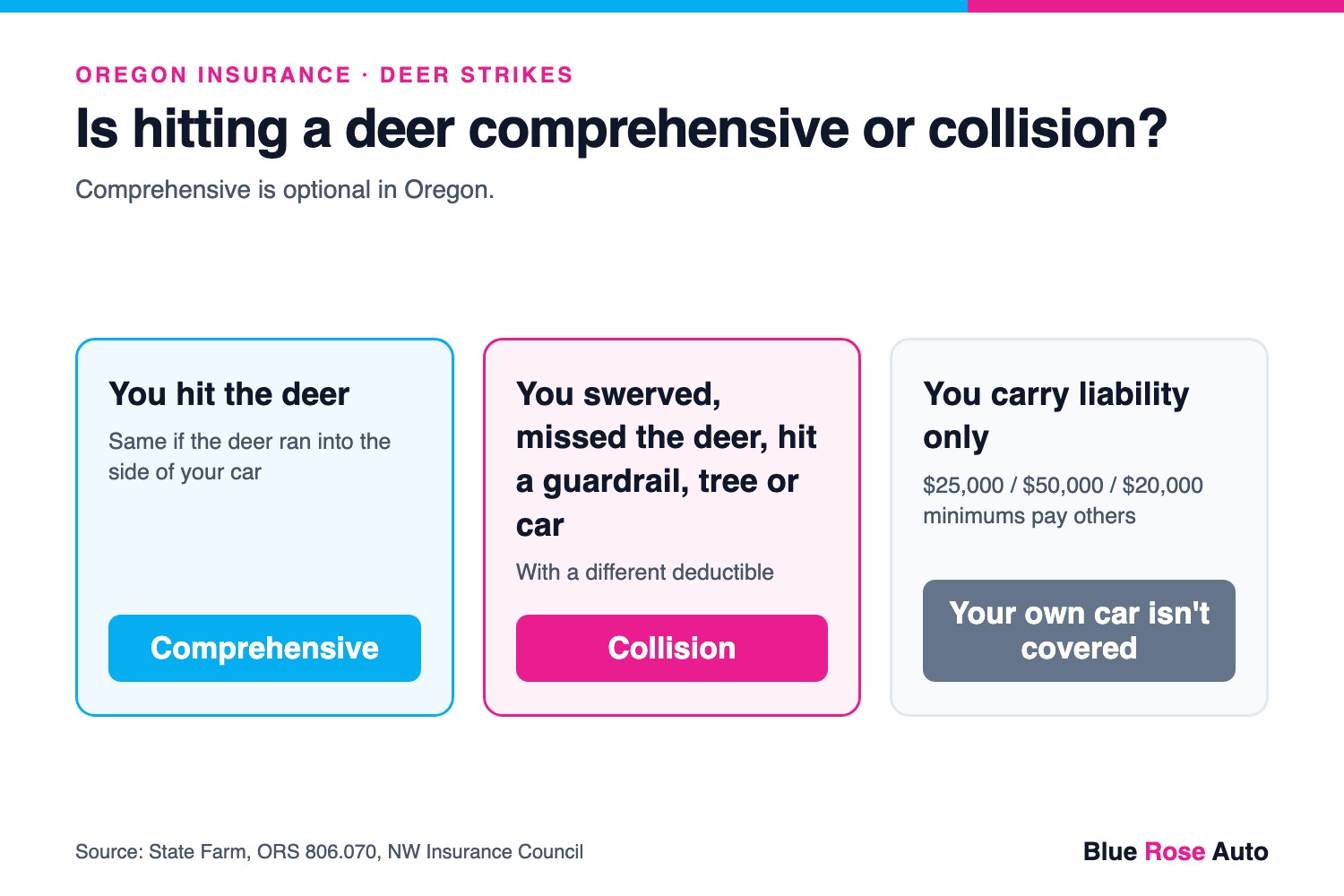
Insurers usually classify a deer strike in Oregon the way this table shows.
| What happened | Usually covered under | Source |
|---|---|---|
| You hit the deer | Comprehensive (“other than collision”) | State Farm |
| The deer ran into the side of your car | Comprehensive | State Farm (strike with an animal) |
| You swerved, missed the deer, hit a guardrail, tree or car | Collision | State Farm |
| You carry liability only | Your own car isn’t covered, and liability pays others ($25,000 / $50,000 / $20,000 minimums) | ORS 806.070, NWIC |
The swerve row costs people. State Farm says a swerve that ends in another car or object “will likely be considered a collision loss,” with a different deductible. Collision coverage works differently, and what collision insurance covers is worth reading before you file.
What if you only have liability?
Then your own car isn’t covered. ORS 806.070 sets Oregon’s minimums at $25,000 per person, $50,000 per accident and $20,000 for property, all paid to someone else. NW Insurance Council calls comprehensive (“Other Than Collision”) the only coverage that pays for your car after an animal hit, and it’s optional. Oregon’s required PIP covers medical bills, not body work. If you lease or have a car loan, your lender may require comprehensive.
Should you file a claim for a deer hit?
File when a written repair estimate clearly beats your deductible, and ask your agent how a comprehensive claim is rated on your policy first. Don’t decide from a roadside look. On whether premiums go up, State Farm’s own answer is “Maybe,” depending on your policy, your state and what happened in the crash.
NW Insurance Council puts the average wildlife-vehicle collision claim at $4,135 (undated). That’s an average, not a forecast, so a light hit can still land under your deductible. Get yours in writing.
| If… | Then usually… |
|---|---|
| Written estimate is below your comprehensive deductible | Paying out of pocket is the only option, because the claim would pay nothing |
| Estimate is well above the deductible | Filing makes sense; ask your agent how comprehensive claims are rated |
| Estimate is close to the deductible | Get the bumper cover off first, since hidden damage often raises the number |
| You swerved and hit something else | Expect a collision claim with its own deductible |
Watch the close-call row, since a walk-around estimate only prices what’s visible. We explain what to expect from collision repair once the car is in the shop too.
What does deer-strike repair usually involve?
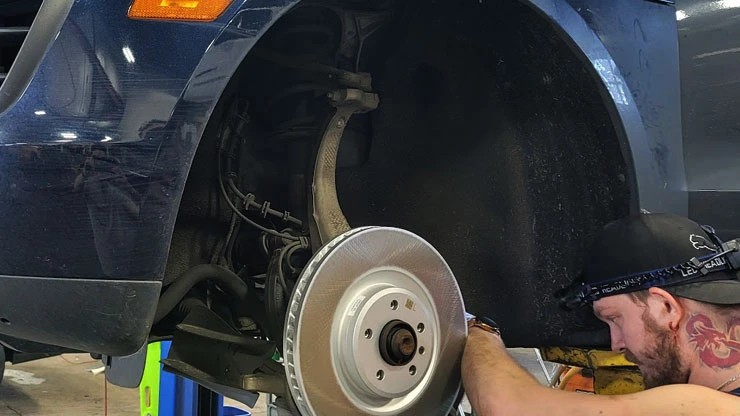
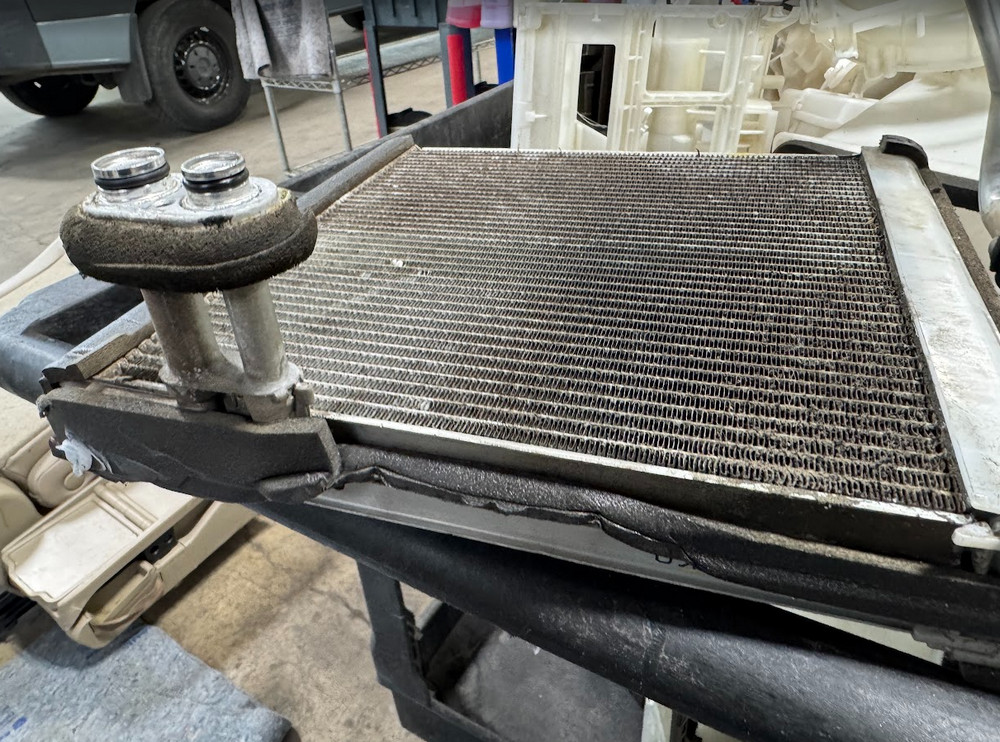
A deer strike is usually a front-end repair, and the bumper cover you can see is the smallest part of it. Behind that plastic sit the energy absorber, reinforcement bar, mounting brackets and radiator support, then the radiator, A/C condenser and cooling fan, plus headlamp mounts, the hood latch and the fenders.

On a front-end deer strike, the bumper cover often flexes back into shape while the absorber, brackets or radiator support behind it don’t. That’s why on deer-strike repairs we check what’s behind the cover, measure, and tell you what we find before any part gets ordered, with a heads-up if the estimate changes.
Sensors are the other hidden cost. Many newer cars mount radar or cameras behind the bumper cover or grille, and those may need calibration after a front-end repair. Steering wheel off-center now? Book an alignment check after a hard front-end hit.
Driving a Tesla? Blue Rose Auto is a Tesla Approved Body Shop for collision and structural repair, and every other make gets the same auto body and collision repair from teardown through the final check. Not sure what’s behind the bumper cover? Bring it in. We look past the plastic before anyone orders parts, and we handle deer-strike collision repair for Lane County drivers every fall.
When do deer strikes peak around Lane County?
ODOT documents more than 6,000 collisions with deer and elk a year, peaking in October and November (ODFW). Lane County transportation planners told NBC16 in 2018 that November is the local peak, that twilight is the riskiest time (roughly 5 to 7 a.m. and 5 to 8 p.m. in late fall), and that most animal collisions happened in clear, dry weather.
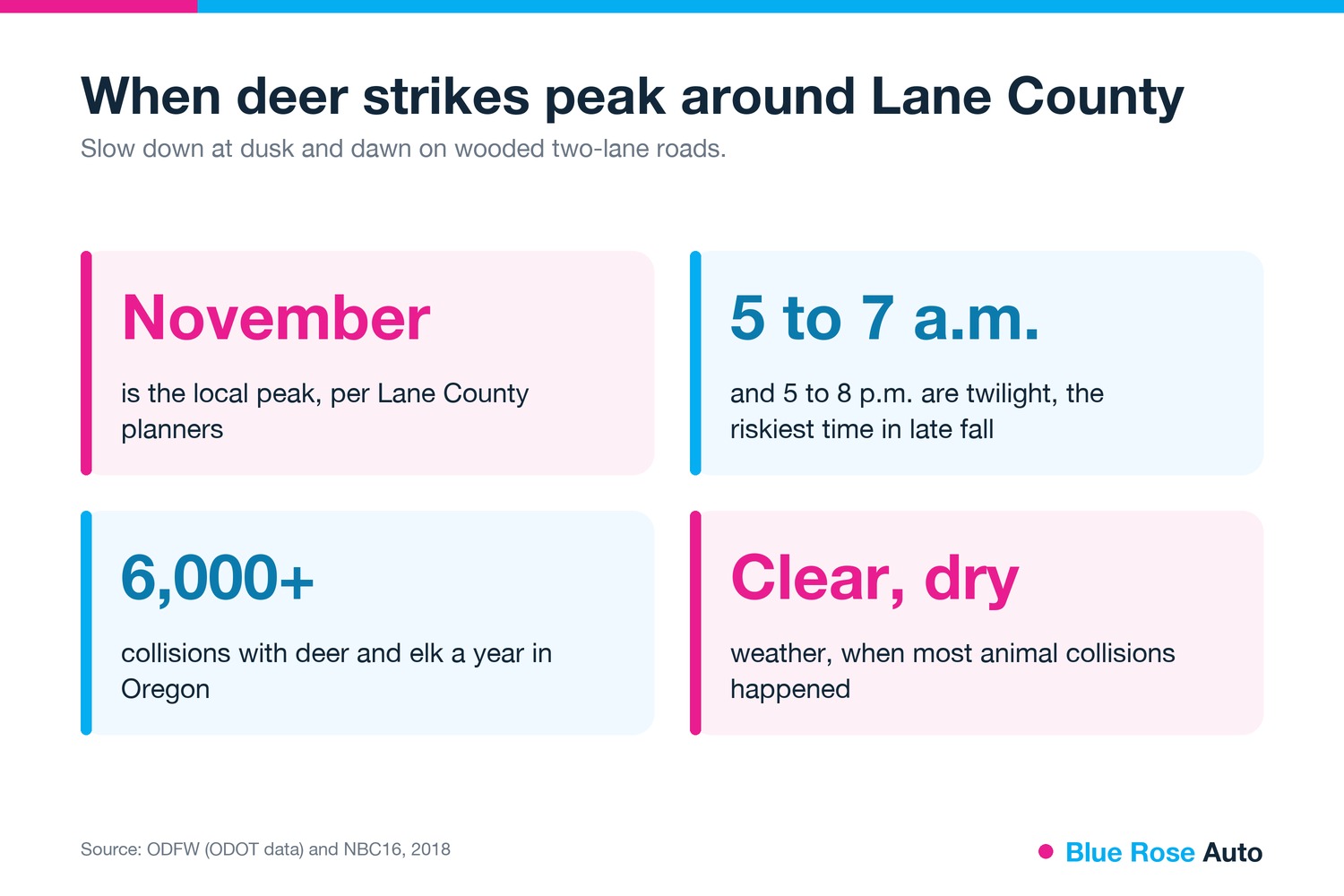
Nationally, State Farm puts the odds of an animal collision at 1 in 145, based on more than 1.6 million animal-collision claims from July 2025 through June 2026, with the risk highest in fall. ODFW adds the location, which is rural two-lane state highways with a 55 mph limit, around dawn and dusk.
A 2018 county analysis reported by NBC16 counted 79 animal collisions on Lane County roads reported to ODOT from 2013 to 2016. Marcola Road led with 12, and 30th Avenue, Jasper-Lowell Road and Row River Road had 4 each. The counts are old. The weather finding isn’t. “Drivers are typically much more cautious as the weather begins to turn to rain and fog, but most animal collisions have actually occurred in clear and dry conditions,” said Lane County Senior Transportation Planner Becky Taylor.
Wildlife crossings on Hwy 97 near Sunriver cut collisions by nearly 90 percent, per ODFW. On other roads, habits matter:
- Slow down at dusk and dawn on wooded two-lane roads.
- Use high beams when no one is coming, and scan the shoulders.
- Brake for a deer instead of swerving, then watch for a second one behind it.
Wet fall roads are hard on the rest of the car too, so we also cover fall and winter car prep for wet Willamette Valley roads.
Frequently asked questions
Do I have to call the cops after hitting a deer?
Yes, if the crash meets Oregon’s reporting rules. Oregon DMV says to notify police immediately when a crash meets its reporting requirements, such as an injury or more than $2,500 in damage, using a non-emergency number such as *677. Call 911 if someone is hurt or the road is blocked.
Will my insurance go up if I hit a deer?
Maybe. State Farm says it depends on the terms of your policy, the state you live in and what happened in the crash. Ask your agent how a comprehensive claim is rated on your policy before you file, and get a written repair estimate so you know how the damage compares with your deductible.
Is it my fault if I hit a deer?
State Farm says a direct deer strike is typically a comprehensive claim, not a collision claim, while swerving into another car or object is likely a collision loss. Whether your insurer records it as at-fault depends on the company and your policy, so ask your agent. Keep every scene photo you took.
Can you go to jail for hitting a deer on accident?
The accident itself is not the legal risk. Skipping the duties afterward is. Failing to file a required DMV report is a Class B traffic violation under ORS 811.725 and can bring a suspension notice. Hitting a deer on purpose to salvage it is illegal, per ODFW. For your own situation, ask an attorney.
What if the deer runs away and leaves no fur or blood?
Photograph the car and the road anyway. Note the time and place, tell your insurer exactly what happened, and run the same six-point drivability check, because missing fur or blood on the bumper does not change how the damage gets repaired. A bent absorber or cracked radiator support looks the same either way.
What makes a car totaled after hitting a deer?
The insurer compares the repair estimate with the car’s value. Heavy front-end damage, deployed airbags or structural damage on an older car can push repair costs past what the car is worth. Ask your adjuster how the cutoff is calculated before you agree to anything, and keep your written estimate.
How long does it take to fix a car after hitting a deer?
It depends on what turns up when the bumper cover comes off, how fast parts arrive and how quickly the insurer approves the estimate. A cracked bumper cover alone goes faster than a job that reaches the radiator, condenser and fan. We tell you what we find before ordering parts, then set a timeline.
Can I keep the deer I hit in Oregon?
Often yes, with a free ODFW roadkill salvage permit completed within 24 hours of taking the animal, and the head and antlers go to an ODFW field office within 5 business days. White-tailed deer are protected in most of western Oregon, so if you are unsure of the species, leave it.
How do I file the Oregon DMV collision report?
Submit the Oregon Traffic Collision and Insurance Report to DMV within 72 hours when anyone is hurt or damage tops $2,500. It goes to DMV, not your insurer, and you file it even if a trooper wrote a report. Missed the window? Submit it as soon as possible to avoid a suspension notice.
Is it safe to drive my car after hitting a deer?
Not until you check six things. Look for leaking coolant, working headlights and turn signals, a hood that latches, tires and wheels that roll freely, a fan clear of the radiator, and any new dashboard warning light. If the hood will not latch, lights are out at night or fluid is pooling, call for a tow.
Get the damage checked
Blue Rose Auto opened in 1994, and our ASE-certified technicians work at 3436 Olympic St in Springfield. Call (541) 641-8877 or contact us. We measure the damage and write the estimate and tell you what we find before any part gets ordered.
0 Comments