An RV wrap costs about $2,500 to $15,000 for a full wrap, and most land between $4,000 and $12,000 depending on length and type, according to published RV wrap guides. A half wrap on a smaller rig runs closer to $1,500 to $3,000, and a Class A costs the most because of its sheer panel area. Blue Rose Auto wraps RVs for owners in Eugene and Springfield from our shop at 3436 Olympic St in Springfield, Oregon, and below we explain what drives the price, how long film lasts and when paint is the better call.
Last updated October 2026
RV owners start looking at wraps when the exterior fades, the factory graphics crack or peel, or the rig needs a new look without the cost and downtime of a repaint. A wrap changes how a motorhome or trailer looks and puts a layer of film over sound paint. It does not repair damage underneath, and that limit shapes most of the advice in this post.
Key takeaways
- Published guides put a full RV wrap at $2,500 to $15,000, with most between $4,000 and $12,000 (RV Lifestyle and Design Transition Studio).
- A 25 ft travel trailer runs $4,500 to $6,000 and a 35 ft camper $6,500 to $9,000, while a 40 ft Class A is quoted anywhere from $6,500 to $15,000 (published guides).
- Standard exterior repaint runs $6,000 to $12,000 and a basic paint restoration $3,500 to $6,000, so a wrap costs less than the top paint tiers but overlaps a standard repaint (published RV paint price guides).
- Avery Dennison rates SW900 color film at 10 years on side panels in its best zone but only 2 years on a horizontal surface such as a roof, and 3M rates its 2080 film at 8 years and 3 years (published passenger-vehicle tables).
- Eugene gets 40.83 inches of rain in a normal year and about 78% of it falls from October to March (National Weather Service normals).
Why RV Wraps Are a Smart Upgrade
An RV wrap is a good fit when the paint underneath is sound and you want a new color, new graphics or a protective layer. Sun, rain, bugs and road debris wear on large exterior panels, decals crack and colors dull, and film covers all of that with a surface you can change later.
What an RV Wrap Is
An RV wrap is adhesive vinyl film applied over the exterior of a motorhome, trailer or camper van. A full wrap covers every painted or graphic panel, a half wrap covers one side or the lower half, and smaller jobs cover the ends, a slide-out or a cap with graphics or a solid color. Yes, you can wrap an RV, though the surface area and the seams are very different from a car.
Owners usually choose a wrap for four reasons.
- A wrap changes color and style without a repaint, and color change vinyl wrap comes in gloss, satin, matte and metallic finishes.
- Film adds a barrier against UV, dirt and light surface wear on paint that is still in good shape.
- Business rigs and mobile offices carry logos and lettering, and we install commercial wraps for work vehicles too.
- Install time is measured in days, with published guides reporting 3 to 5 days for a mid-size camper, which keeps the rig in service through the travel season.
One honest limit. Film does not repair chalky gelcoat, a failing clear coat or a cracked cap. It follows the surface it is stuck to, so damage under the film shows through it or lifts it.
RV Wrap Cost in Eugene and Springfield in 2026
A full RV wrap costs $2,500 to $15,000 in published guides, and the price climbs with length, height and the number of seams, slide-outs and awnings. The chart below shows four sizes with the figures guides publish for them.
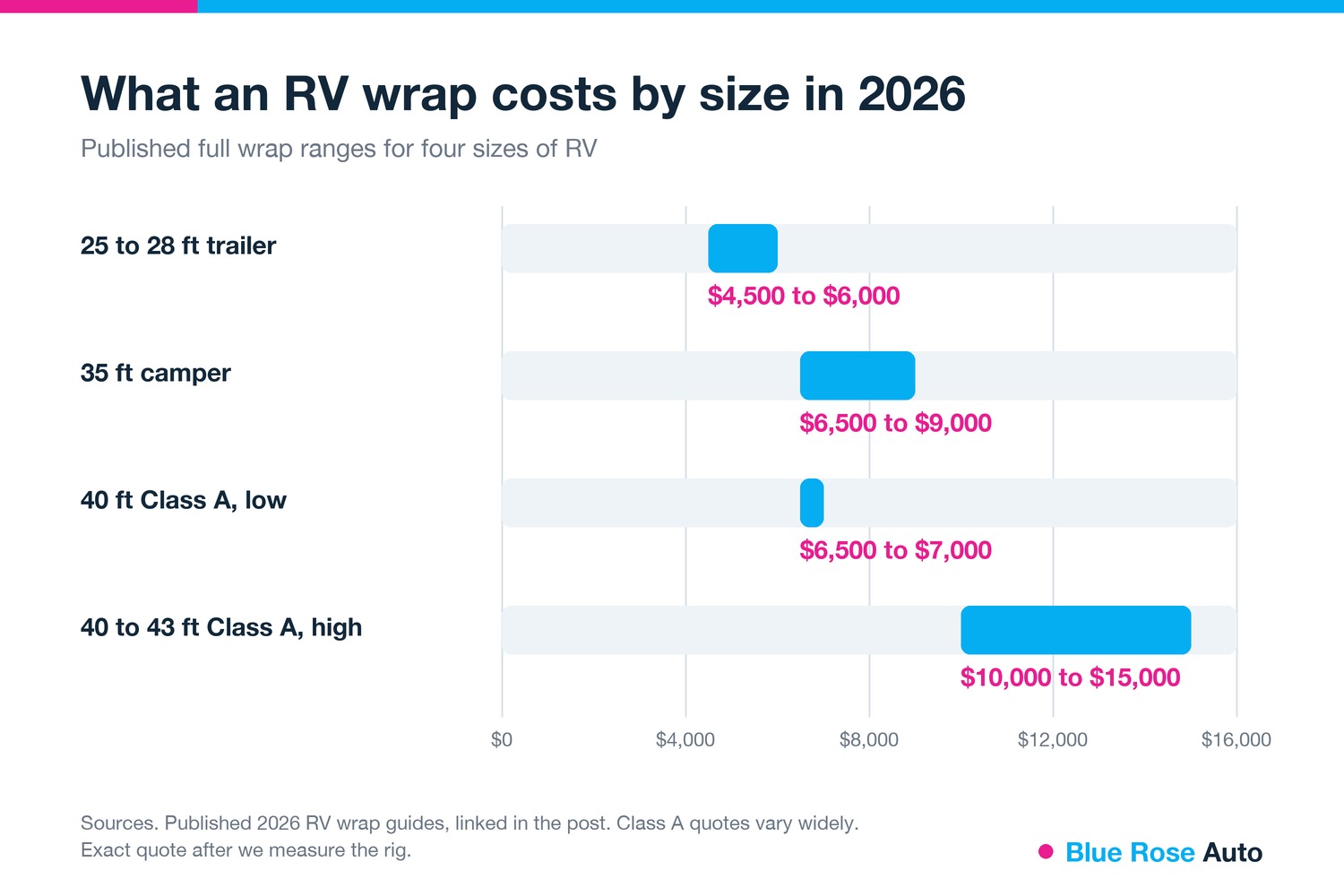
Published Class A figures disagree by about 2 to 1. One supplier prices a 40 ft Class A at $6,500 to $7,000, while an RV owner describing a 43 ft diesel pusher reports $12,000 to $15,000 or more. We show both because the gap is real, and it is why we quote after we measure the rig and inspect the surface instead of pricing from a chart.
What a Full Wrap Costs by RV Size
Size is the first driver of cost, so the table lists what published guides report for each size.
| RV size | Published range | Source |
|---|---|---|
| 25 to 28 ft travel trailer | $4,500 to $6,000 | Design Transition Studio for a 25 ft trailer, and The Vinyl Creator at about $5,000 for a 28 ft trailer |
| 35 ft camper | $6,500 to $9,000 | Design Transition Studio |
| 40 ft Class A, low quote | $6,500 to $7,000 | The Vinyl Creator |
| 40 to 43 ft Class A, high quotes | $10,000 to $15,000 | Design Transition Studio at $10,000 to $14,000, and The RV Geeks at $12,000 to $15,000 or more for a 43 ft |
| Any RV, full wrap, widest range | $2,500 to $15,000 | RV Lifestyle |
No guide we checked prices a full Class B or Class C on its own, so read the 25 to 28 ft and 35 ft rows as the neighborhood for most Class C motorhomes and treat the number as a planning range. Blue Rose Auto quotes your rig after we measure it. These are published market figures, not Blue Rose Auto prices.
Partial Wraps, Half Wraps and Graphics
A partial wrap costs a fraction of a full one because it uses less film and fewer hours. The ranges below come from RV owners and guides who have priced real jobs.
| Job | Published range | Source |
|---|---|---|
| Half wrap, 24 ft Class B or C | About $1,500 | The RV Geeks |
| Half wrap, 25 to 30 ft trailer, both sides | $2,000 to $3,000 | The RV Geeks |
| Each end of a trailer | About $500 | The RV Geeks |
| Front and back only of a Class A | About $1,500 | The RV Geeks |
| Each window or slide-out | $200 to $250 | The RV Geeks |
| Partial wraps and graphics on small RVs | $1,000 to $5,000 | RV Lifestyle |
Wrapping only the front and back of a Class A can hide a cracked clear coat on the caps, though film is not a repair and a failing surface under it will keep failing. A graphic package follows the pattern of graphic wraps for vehicles, with the artwork designed and printed before install.
What Drives the Price
Square footage, surface condition and film choice move an RV wrap quote more than anything else. One published model prices material at $8 to $12 per square foot plus $2 to $3 per square foot of labor (The Vinyl Creator), and a motorhome has several hundred square feet of sidewall.
- Length and height set the film quantity, and a tall Class A or fifth wheel uses far more than a short trailer.
- Slide-outs, awnings, vents, rivets and seams add cutting and edge work.
- Film type matters, since gloss, satin, textured and metallic film are priced differently.
- Custom artwork adds a design fee, and printed graphics cost more than a solid color.
- Oxidized, chalky or damaged surfaces need correction or repair before any film goes on.
- Old decals and graphics have to come off first, and removal takes labor.
What a Written Quote Should Itemize
A useful RV wrap quote lists the film and finish, the surface prep, the design or artwork fee, what is covered at slide-outs and windows, removal of old graphics, and the warranty terms. If any of those lines is missing, ask for it before you compare two quotes, because the cheaper number often leaves out prep.
What Happens During RV Wrapping
An RV wrap install follows a fixed order, and the prep before the film goes on decides how well it holds. The standard steps for a rig look like this.
- Wash and decontaminate the exterior so dirt, wax and road film do not sit under the vinyl.
- Inspect the surface for oxidation, peeling decals, dents, caulk and seam condition, and note anything that needs repair first.
- Remove old graphics and decals, then remove or mask lights, handles, trim and other hardware.
- Correct or repair rough or chalky spots, since film needs a sound, smooth surface.
- Lay out and install the film panel by panel, working around slide-outs, windows, seams and rivets.
- Post-heat the edges and recesses, let the adhesive cure, and finish with a final inspection and aftercare instructions.
Surface condition is the step owners underestimate. Avery Dennison does not warrant removal of its film from poorly adhered, improperly cured or chalked paint, or from paint older than 5 years, and chalky oxidation is a common problem on older RV finishes. That is why paint correction and polishing sometimes comes before the film.
Temperature matters too. Avery’s SW900 data sheet sets minimum application temperatures at 50 F for flat and simple curves and 60 F for complex curves. Eugene’s normal January high is 48.0 F (NOAA), so a winter install needs a controlled space, and installs are easier to schedule in the warmer months. Published guides report about 3 to 5 days for a mid-size camper and a week or more for a large motorhome (Design Transition Studio). We give a time for your rig when we quote it.
RV Vinyl Wrap vs Paint
A wrap usually costs less than a standard repaint and more than a basic restoration, and paint outlasts film. The bars below set the wrap range from published guides beside the RV paint figures we use at Blue Rose Auto.
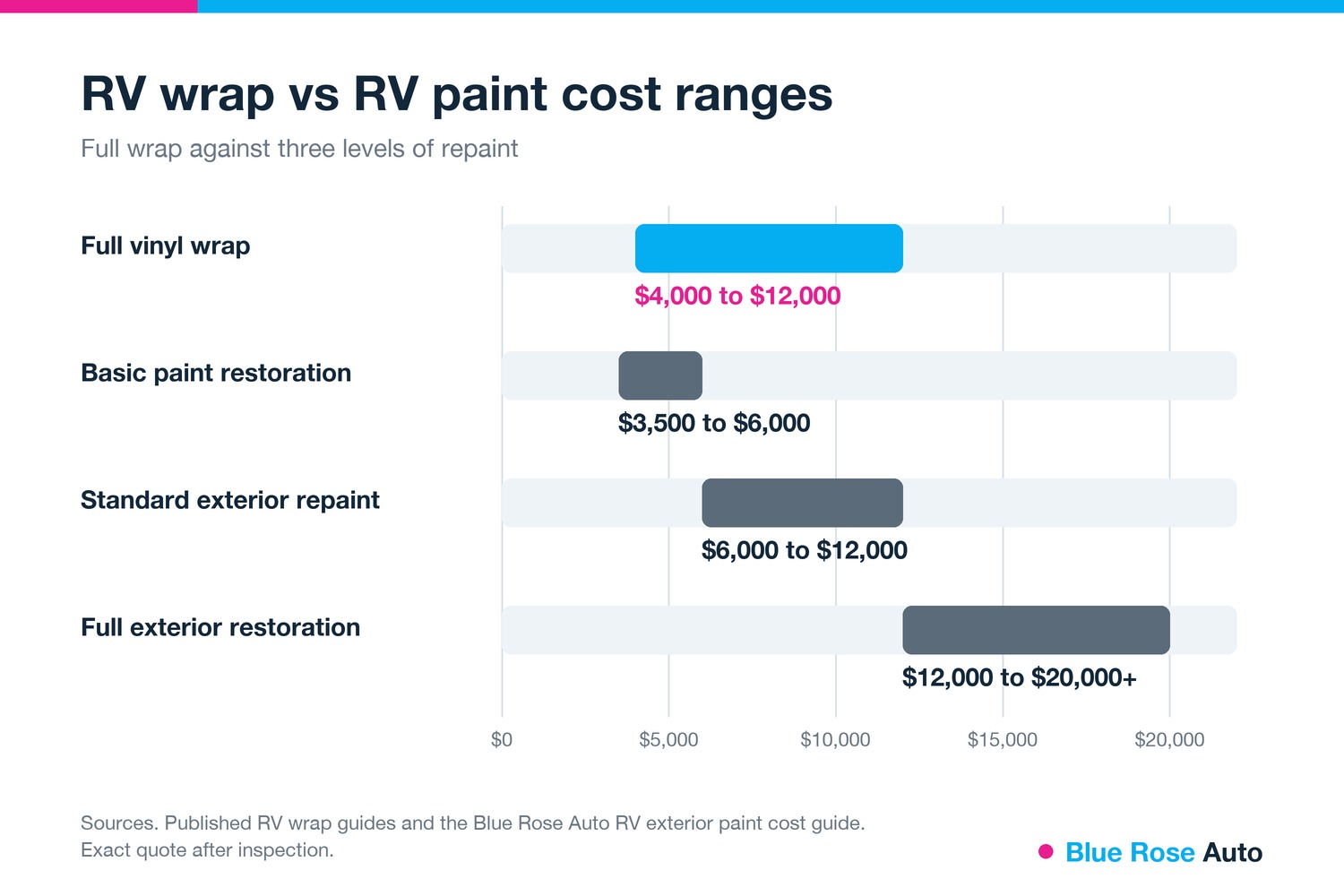
We paint RVs too, and the figures for RV exterior paint cost in Oregon are $3,500 to $6,000 for a basic restoration, $6,000 to $12,000 for a standard exterior repaint and $12,000 to $20,000 or more for a full restoration. We handle that work through RV painting services in Oregon.
| Factor | Full vinyl wrap | Professional repaint |
|---|---|---|
| Typical cost | $4,000 to $12,000 for most RVs, larger rigs to $15,000 (published guides) | Basic restoration $3,500 to $6,000, standard repaint $6,000 to $12,000, full restoration $12,000 to $20,000 or more (Blue Rose Auto) |
| Life of the finish | About 3 to 7 years in RV guides, less on roofs and caps | Longest, and scratches can be buffed out |
| Reversible | Yes, if the paint under it is sound | No |
| Best when | You want a color change, branding or protection for sound paint | Paint is failing or chalky, you want one permanent finish, or resale matters |
When paint wins is worth saying plainly. A fiberglass rig with a failing clear coat needs the surface fixed, and a wrap would hide the damage for a season or two and then lift. Paint also outlasts film and can be buffed, which vinyl cannot. For a car the numbers are lower because a car has far less surface, and car wrap vs paint costs are broken out separately.
How Long RV Wraps Last
RV guides put wrap life at about 3 to 7 years, with 4 to 5 years the common figure, and film makers publish a much shorter life for horizontal surfaces such as roofs and caps. RV Lifestyle says wraps last 5 to 7 years and that many owners say 4 to 5 is the norm, and Getaway Couple says at least 3 to 4 years.
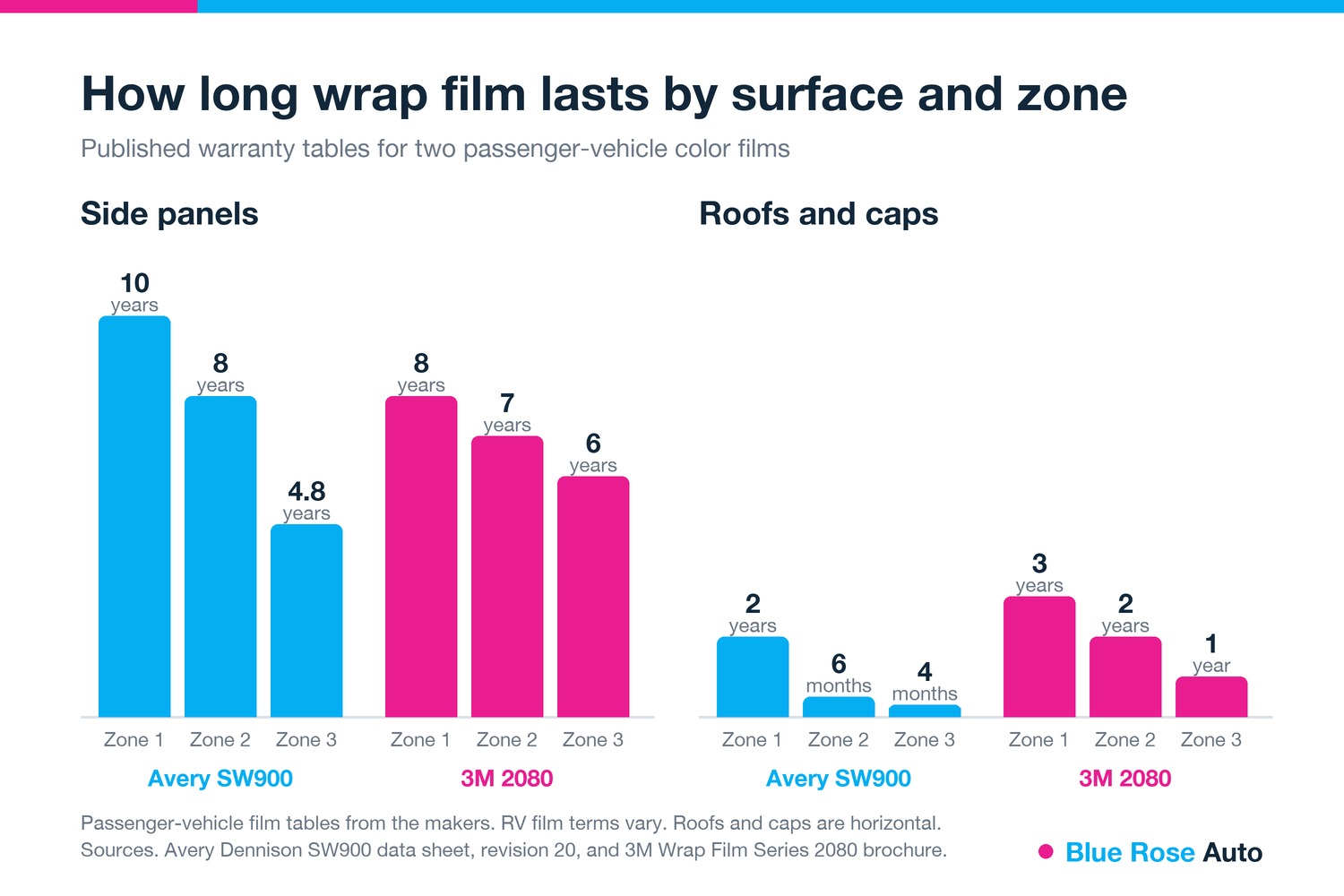
Both film makers publish durability by warranty zone and by surface angle. Avery Dennison calls surfaces within 10 degrees of vertical “vertical” and surfaces from 45 to 90 degrees off vertical, such as a hood or roof, “horizontal.” The tables are for passenger-vehicle films, so we use them as a guide to how horizontal surfaces age and not as an RV-specific warranty.
| Film and zone | Side panels | Roofs and caps |
|---|---|---|
| Avery SW900 Zone 1 | 10 years | 2 years |
| Avery SW900 Zone 2 | 8 years | 6 months |
| Avery SW900 Zone 3 | 4.8 years | 4 months |
| 3M 2080 Zone 1 | 8 years | 3 years |
| 3M 2080 Zone 2 | 7 years | 2 years |
| 3M 2080 Zone 3 | 6 years | 1 year |
The Avery figures are for SW900 color film, and other film types carry different numbers. Roofs and caps take the sun straight on and hold standing water, so they age fastest, and a garage or cover helps. Blue Rose Auto offers a 3-year, 36,000-mile warranty on vinyl wraps, and we explain how it reads for your rig when we quote it.
Care That Extends Wrap Life
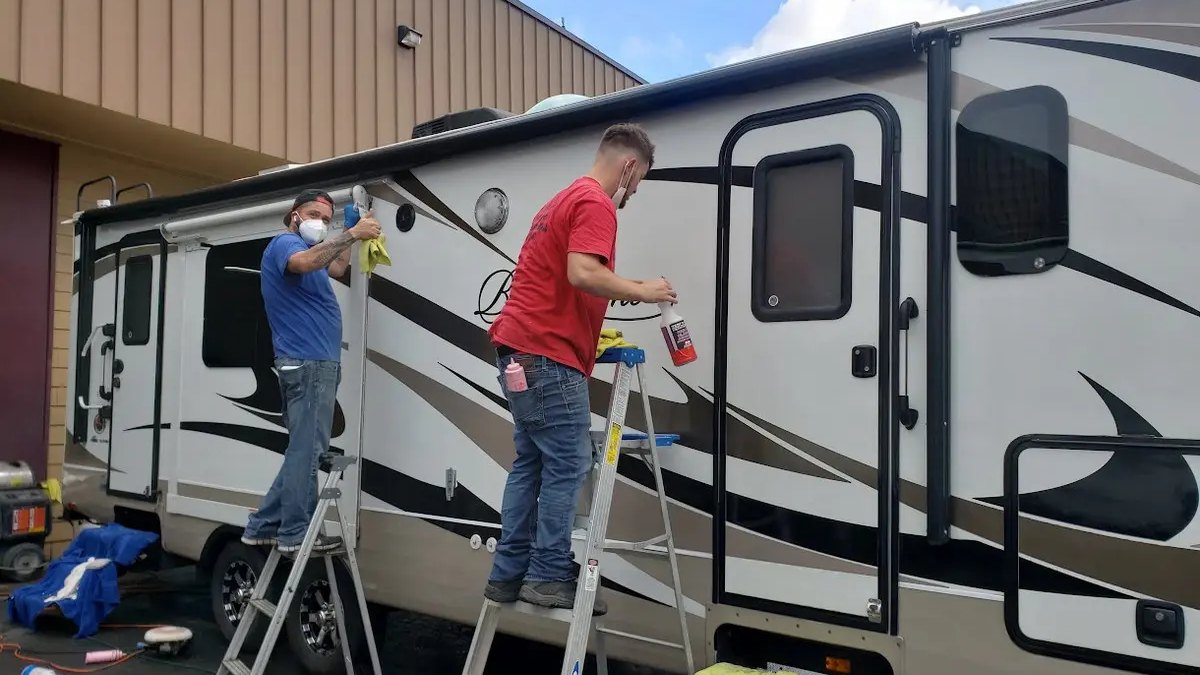
Washing will not damage a wrap if you use mild cleaning products and a soft mitt. Hand wash instead of using brushes, keep a pressure washer away from edges and seams, and skip harsh solvents. Do not wax matte or satin film. Park under cover when you can, since sun and standing water are what wear film out.
Removing a Wrap Later
A wrap can come off later if the paint under it is sound, and removal is a separate job from the install. Avery Dennison gives no removal warranty on chalked, poorly adhered or improperly cured paint, or on paint older than 5 years. Car wrap removal starts around $500 (Car and Driver), and we found no verified RV figure, so ask any installer to quote removal before the film goes on.
What Eugene and Springfield Weather Does to an RV Wrap
Eugene is not the desert Southwest, but a parked RV still takes sun on its roof and standing water through a long wet season. The numbers below come from National Weather Service and NOAA normals for the Eugene airport.
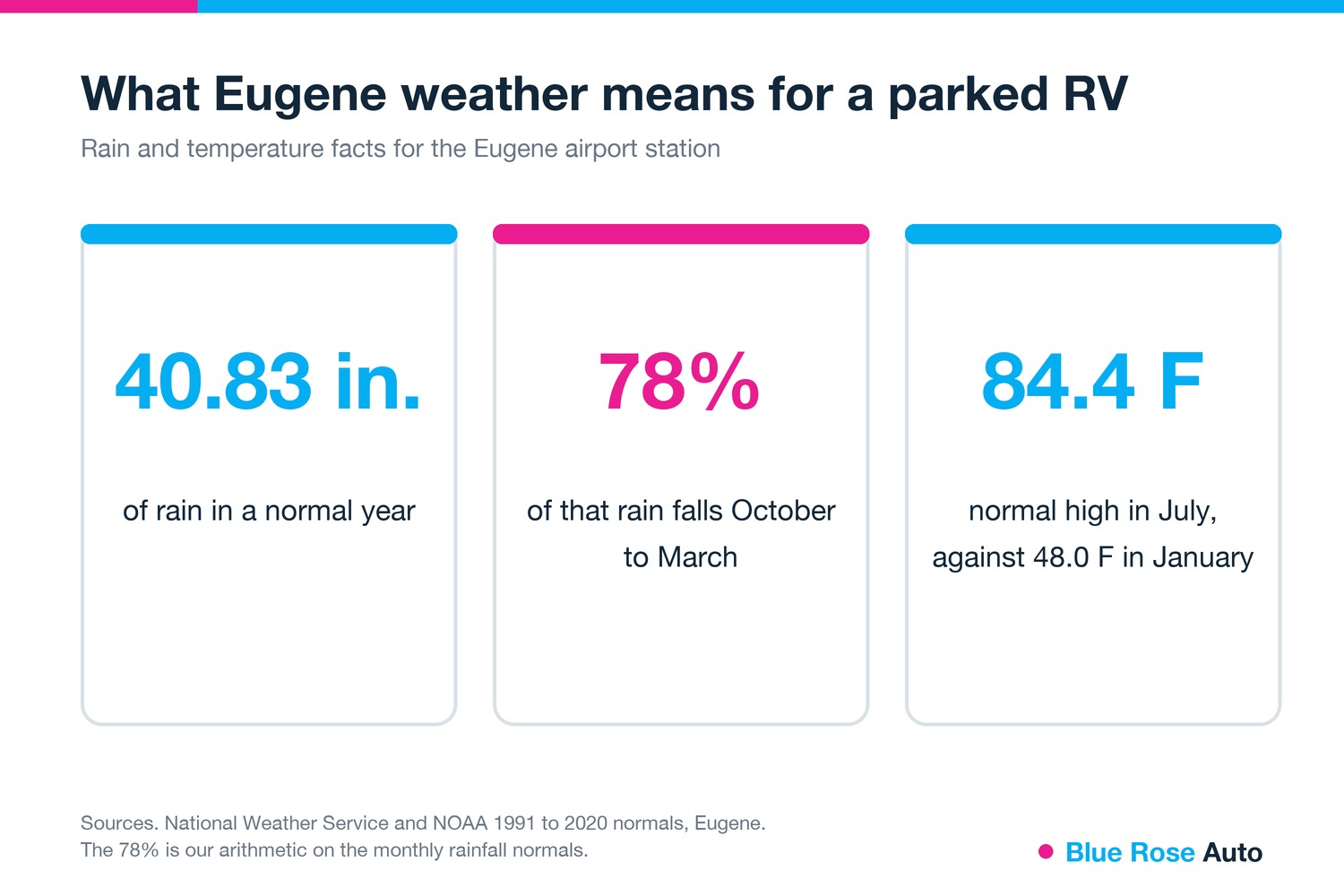
Eugene gets 40.83 inches of rain in a normal year, and about 78% of it falls from October to March (National Weather Service normals, our arithmetic on the months). The normal high is 84.4 F in July and 48.0 F in January (NOAA, 1991 to 2020). Rain on cured film is not the usual problem. Sap, moss and dirt that collect at edges and seams are, and so is a roof that sits wet for months.
That is why storage matters here. A covered space or a breathable cover keeps the roof and caps out of the worst of it, which is the logic behind storing an RV in Oregon’s rain. If the roof itself is the problem, a coating is a different job from a wrap, and an RV roof coating suits that problem.
Where Drivers Across Lane County Ask for Wrap Services
Blue Rose Auto serves RV owners across Lane County from 3436 Olympic St in Springfield, Oregon, and opened in 1994. Owners looking for an RV wrap near Eugene will find the shop on the Springfield side of the river.
Eugene owners can bring a rig to the shop for wraps in Eugene and get a measured quote for the whole vehicle.
Springfield owners are already local, since the shop and its wrap work in Springfield sit at the same address.
Junction City owners can have a vehicle wrapped or painted through car wrap and paint in Junction City, where Blue Rose Auto opened in 1994.
Cottage Grove owners can do the same through car wrap and paint in Cottage Grove.
Services Often Paired With RV Wraps
An RV wrap often comes with prep or finishing work, and most of it is work we already do. The common pairings are below.
Panel damage needs collision repair before the film goes on, and fiberglass, roof or water damage belongs with motorhome repair in Eugene first.
Oxidized panels respond to paint correction before any film is applied.
A full refresh often includes auto detailing for the interior and exterior.
Blue Rose Auto is a Ceramic Pro Certified Elite Dealer, and RV ceramic coating is a separate product from a wrap that protects paint instead of covering it.
Business owners use commercial wraps for branded rigs and service vans.
The tow vehicle often gets window tinting for long road trips.
Frequently Asked Questions About RV Wraps
How much does it cost to wrap an RV?
A full RV wrap costs about $2,500 to $15,000, and most fall between $4,000 and $12,000 according to published guides. A 25 ft trailer runs $4,500 to $6,000 and a 35 ft camper $6,500 to $9,000. Those are market figures, and Blue Rose Auto quotes your rig after measuring it.
How much does it cost to wrap a motorhome?
A 40 ft Class A runs $6,500 to $7,000 in one published quote and $10,000 to $15,000 in others, a spread of about 2 to 1. Length, height, seams and film type explain the gap. No guide prices a full Class C alone, so a measured quote beats any chart.
How much does it cost to wrap a travel trailer or fifth wheel?
A 25 to 28 ft travel trailer runs about $4,500 to $6,000 and a 35 ft camper $6,500 to $9,000 in published guides. A half wrap on a 25 to 30 ft trailer, both sides, runs $2,000 to $3,000. Fifth wheels are priced by length and height like any other rig, so we measure first.
Is it cheaper to wrap an RV or paint it?
Often, though not always. A full wrap runs $4,000 to $12,000 for most rigs, which overlaps a standard repaint at $6,000 to $12,000 and costs more than a basic paint restoration at $3,500 to $6,000. Paint lasts longer and can be buffed, while wrap can be changed or removed later.
How long does an RV wrap last?
RV guides put wrap life at about 3 to 7 years, with 4 to 5 years the common figure. Film makers publish far less for horizontal surfaces, such as 4 months to 3 years on a roof, against 4.8 to 10 years on side panels. Those are passenger-vehicle tables used as a guide.
Can you wrap over old decals or oxidized paint?
No. Old graphics come off first because decal edges telegraph through the film and old adhesive fails. Chalky or oxidized surfaces need correction or a repaint, since Avery Dennison does not warrant removal from chalked or poorly adhered paint. A smooth, sound, clean surface is what holds film.
Does vinyl protect the paint underneath?
On sound factory paint, vinyl blocks UV, road debris and light surface wear. It cannot fix a failing clear coat or chalky gelcoat, and it can lift if the paint under it is poorly adhered. Think of film as protection for good paint, not a repair for damaged paint.
Can a wrap be removed later?
Yes, on sound paint. Avery Dennison gives no removal warranty on chalked, poorly adhered or improperly cured paint, or on paint older than 5 years. Removal is a separate job, and car wrap removal starts around $500 (Car and Driver). Ask for the removal price before the film goes on.
How long does an RV wrap take to install?
Published guides report about 3 to 5 days for a mid-size camper and a week or more for a large motorhome. Install time depends on size, seams, prep and film choice, and cold weather slows it, since Avery sets application minimums of 50 F and 60 F. We give a time for your rig when we quote.
Can you wrap just part of an RV, or add graphics?
Yes. Half wraps, trailer ends, slide-outs and custom logos are common, from about $200 to $250 for a window or slide-out up to $2,000 to $3,000 for a half wrap on a 25 to 30 ft trailer. Describe the sections you want and the quote reflects that scope.
Talk Through Your RV Wrap With Blue Rose Auto
Blue Rose Auto wraps RVs for owners across Eugene, Springfield and Lane County, and we install 3M and Avery Dennison film. Call (541) 641-8877 to describe your rig, or send the details through the contact form and we will set up a time to look at the surface and measure it.
Sources
- RV Lifestyle, RV wrap designs and cost, accessed October 2026
- The RV Geeks, RV wraps, accessed October 2026
- The Vinyl Creator, vehicle wraps price 2026
- Design Transition Studio, RV vinyl wrap cost, accessed October 2026
- Getaway Couple, is it worth it to wrap your RV, accessed October 2026
- Car and Driver, how much does a car wrap cost
- Avery Dennison, Supreme Wrapping Film SW900 product data sheet, revision 20
- 3M, Wrap Film Series 2080 brochure, printed 2020
- NOAA National Weather Service, 1991 to 2020 climate normals for Eugene, Oregon
- National Weather Service Portland, Eugene climate book, monthly precipitation normals
- Blue Rose Auto, RV exterior paint cost in Oregon
0 Comments