RV ceramic coating is a professionally applied liquid layer that bonds to an RV’s painted and gelcoat surfaces and slows UV oxidation, water spotting and road film for years. Published guides put it at $1,200 to $2,500 for a Class B or small travel trailer, $2,000 to $3,500 for a Class C and $3,500 to $6,500 for a Class A (Gilroy Blackout, Latest Cost and RV Lifestyle). Blue Rose Auto is a Ceramic Pro Certified Elite Dealer in Springfield, Oregon, and we quote your rig after we inspect the finish.
Last updated October 2026
Key takeaways
- Published national guides put a professional RV coating at $1,500 to $5,700, with a median near $3,600 (RV Lifestyle, 2023).
- Class B and small trailers run $1,200 to $2,500, Class C $2,000 to $3,500 and Class A $3,500 to $6,500 (Gilroy Blackout, updated June 2026, and Latest Cost, January 2026).
- Wax lasts about 1 to 3 months and a professional coating about 2 to 5 years, both car-based ranges (Jalopnik, 2026).
- Eugene gets 40.83 inches of rain in a normal year and about 78% of it falls from October to March (National Weather Service normals).
- A coating helps with UV, water spots and washing. It does not stop rock chips, and that job belongs to paint protection film.
Sun, road grime, rain and long storage wear down an RV’s exterior, and owners usually start researching RV ceramic coating once fading, oxidation or staining shows. Wax gives a short shine. A ceramic coating bonds to the surface and gives you a harder layer that resists UV damage and environmental buildup for much longer.
Oregon winters make the problem easy to spot. A rig that sits outside through a wet season comes out with chalky finishes and water spots that no longer buff away, and that is a sign the clear coat or gelcoat has started to weaken. We want you to protect the finish before that point, because correcting a chalked surface costs more than protecting a sound one. We keep the guidance below tied to published numbers and say so where a figure is a national range and not our own price.
Why RV Ceramic Coating Makes a Difference
An RV has a huge amount of surface facing the sky and the weather, so oxidation shows up fast. Over time the finish turns dull and dry, and wax wears off quickly under outdoor conditions. A ceramic coating gives you a semi-permanent layer that helps repel water, reduces how much dirt sticks and slows oxidation, so washing gets easier and the finish keeps its gloss longer.
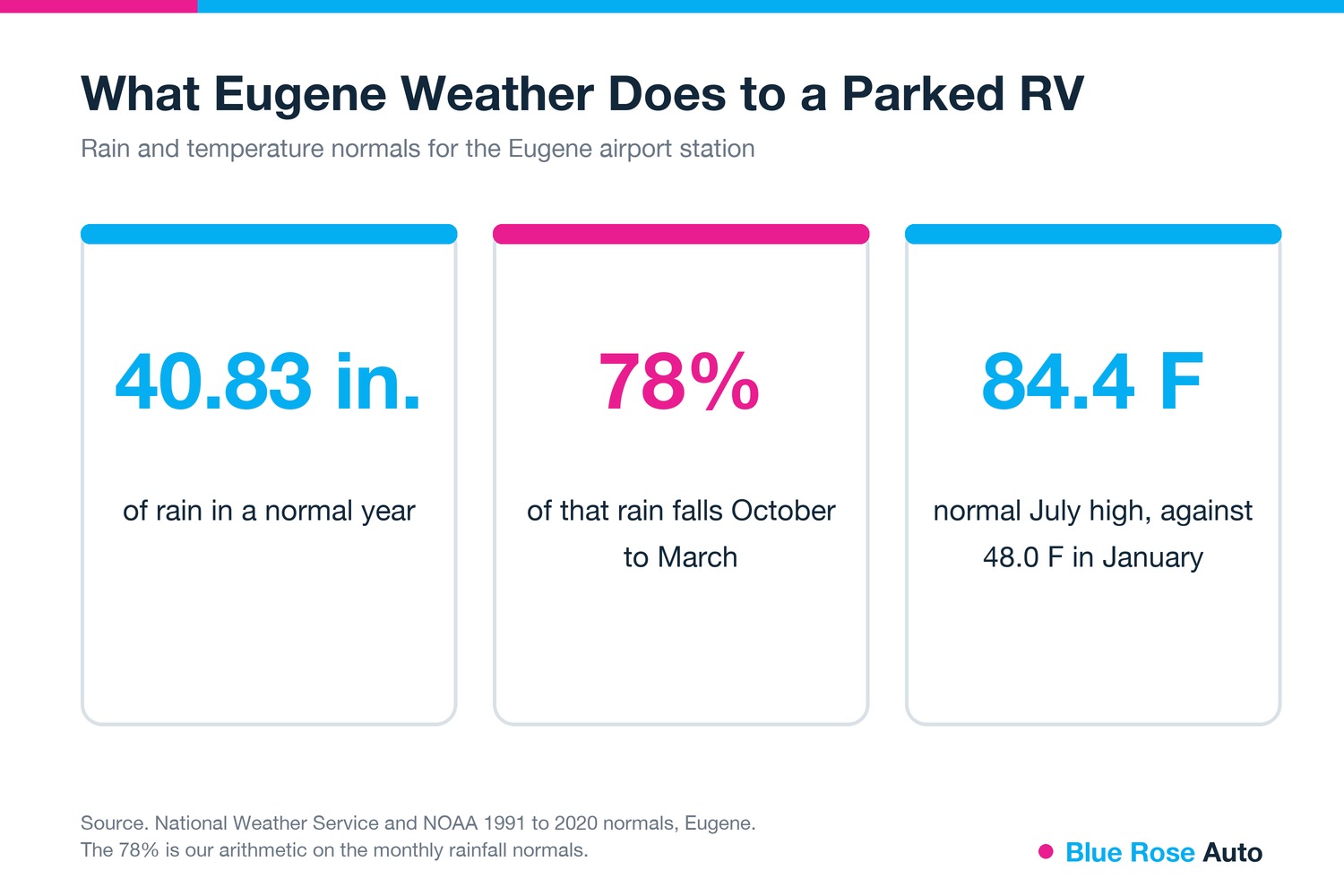
Eugene gets 40.83 inches of rain in a normal year, and about 78% of it falls from October to March (National Weather Service normals for the Eugene airport station, our arithmetic on the months). A rig parked wet for six months collects road film and water spots. The coating’s job in that stretch is easier washing and slower oxidation, not waterproofing. Summer adds its own load, because the normal July high is 84.4 F against 48.0 F in January (NOAA, 1991 to 2020), and roofs and horizontal panels take the sun straight on.
Be clear on the limits too. A coating adds a hard, slick layer, but it does not add thickness you can count on against impacts. Gravel, branches and parking-lot dings still mark the surface, and a coating will not stop a rock chip. If chips are your worry on the front cap, car paint protection methods compares coating with film, and the same logic holds for a rig.
For owners who store an RV outdoors, a coating is added defense against the seasonal swing. If you want the finish to stay sound, it also helps to read how paint fades in the first place, since the UV mechanism is the same on a motorhome as on a car.
What Makes RV Ceramic Coating Different From Traditional Wax
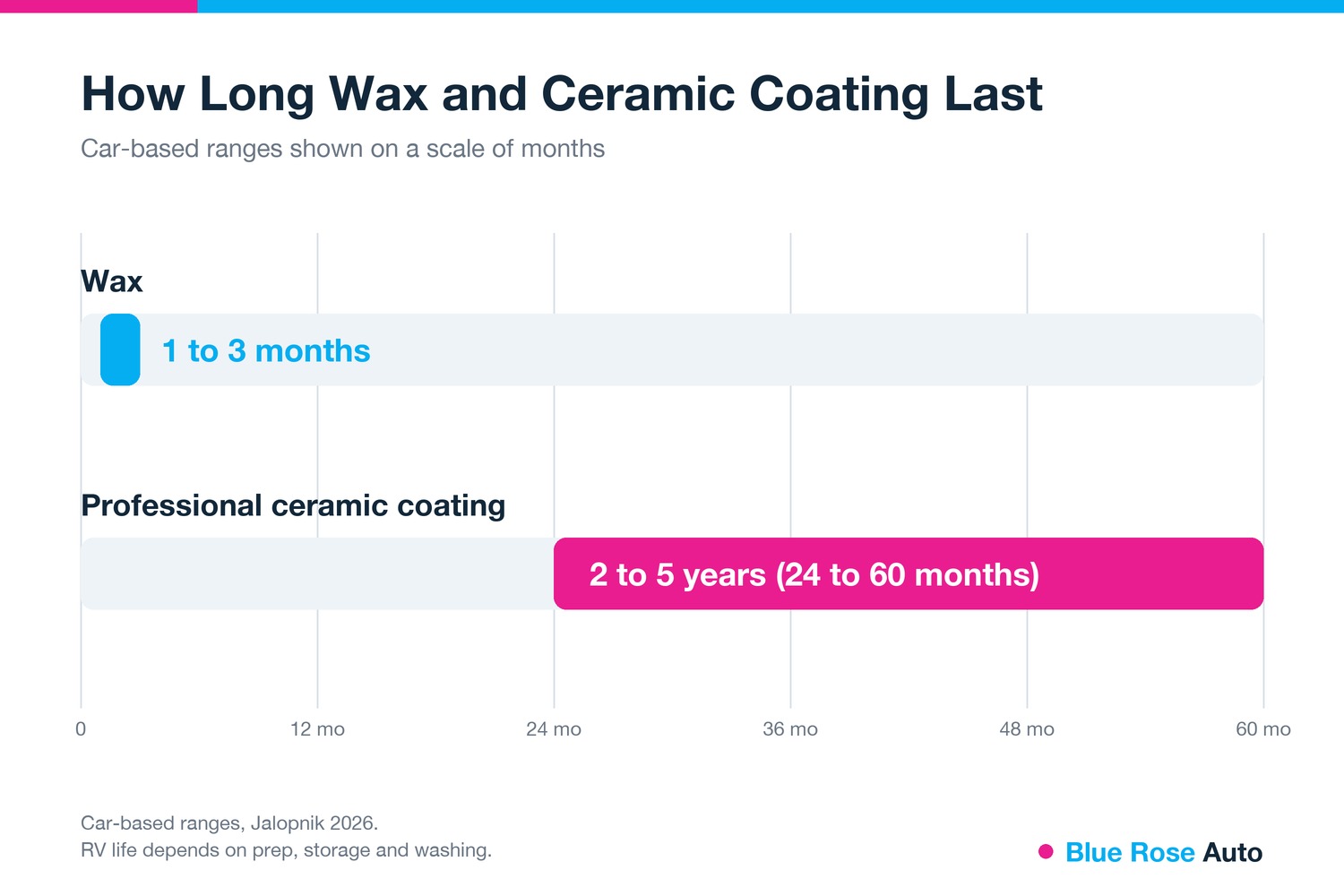
Traditional wax sits on top of the surface and gradually washes away. A ceramic coating bonds chemically to the exterior and forms a harder, longer-lasting shield. Jalopnik puts wax at about 1 to 3 months and a professional ceramic coating at about 2 to 5 years, and those are car-based ranges that we reuse in our ceramic coating vs wax comparison.
- Longer durability. Wax may last a few months, and a coating can last multiple years with proper maintenance.
- Better UV resistance. Sun exposure causes fading, and a coating reduces the surface oxidation that UV rays cause.
- Easier cleaning. Dirt and road grime rinse off more easily, which cuts scrubbing time on a big rig.
- Gloss that holds. The surface keeps a deeper shine through repeated rain and road debris.
Many owners who search for RV ceramic coating near me want to stop waxing a 30 foot sidewall every few months.
Is RV Ceramic Coating Worth It
RV ceramic coating is usually worth it for a rig stored outside in Oregon and used for several seasons, and it matters less for a covered, rarely used rig. The coating pays you back in fewer hours of waxing and easier washing, not in an exact dollar figure.
The logic is simple and uses only the sourced lifespans. If wax lasts 1 to 3 months, keeping an outdoor rig protected for a full year means about 4 to 12 waxing sessions on a surface that size (our arithmetic on Jalopnik’s range). A coating goes on once and is rated at 2 to 5 years (24 to 60 months) on a car, so the labor you avoid is large even before the shine counts.
Wax or a sealant is enough in a few cases. If your RV sits in a garage or under a full cover, rarely sees the road and still has a sound factory finish, a regular sealant keeps things in shape for less. If the finish is already past polishing, a coating will not rescue it, and the better path is paint, which we cover in the RV exterior paint cost guide.
RV Ceramic Coating Cost in Eugene and Springfield
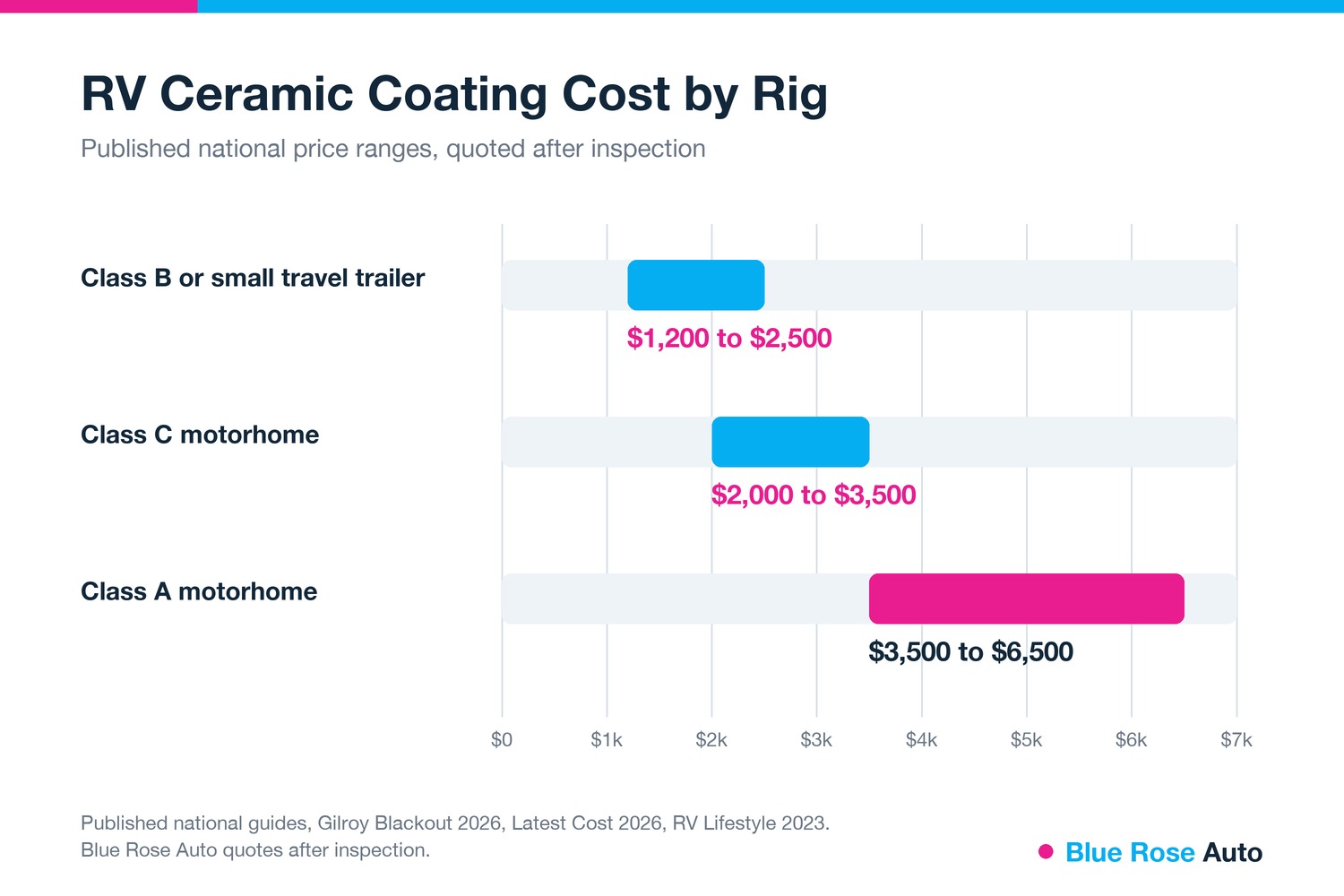
Published national guides price a professional RV ceramic coating at $1,200 to $2,500 for a Class B van or small travel trailer, $2,000 to $3,500 for a Class C and $3,500 to $6,500 for a Class A. These are national ranges, not Blue Rose Auto prices, and we quote your rig after we inspect the finish.
| Rig | Typical professional price |
|---|---|
| Class B van or small travel trailer | $1,200 to $2,500 |
| Class C motorhome | $2,000 to $3,500 |
| Class A motorhome | $3,500 to $6,500 |
| Typical across rigs | $1,500 to $5,700, median about $3,600 |
The tiers come from Gilroy Blackout (updated June 2026), Latest Cost (January 2026) and RV Lifestyle (2023), and the guides disagree a little at the edges, so we show a range and not one number. Gilroy prices Class A gas at $3,000 to $5,000 and diesel at $4,000 to $6,500, which is why the Class A tier runs wide. For comparison, a professional coating on a car runs about $800 to $2,000 (Jalopnik, 2026), and the car ceramic coating guide covers that side.
Five things move the price.
- Rig length and the amount of painted or gelcoat surface.
- How much oxidation has set in.
- The condition of the gelcoat and any prior damage.
- The hours of correction the finish needs before coating.
- Graphics, decals and trim that have to be worked around.
Coating is cheaper than the alternatives at every tier, but it does a different job. Published guides put a full RV wrap at $4,000 to $12,000 for most rigs in our RV wrap cost guide, and a standard exterior repaint at $6,000 to $12,000. A wrap changes how the rig looks, paint renews it, and a coating protects the finish you already have.
Preparing an RV for Ceramic Coating
Surface preparation decides how well the coating performs, and a coating applied over a dirty or chalked surface does not bond properly. Skipping prep cuts durability and ruins the result, so the work before the coating matters as much as the coating itself.
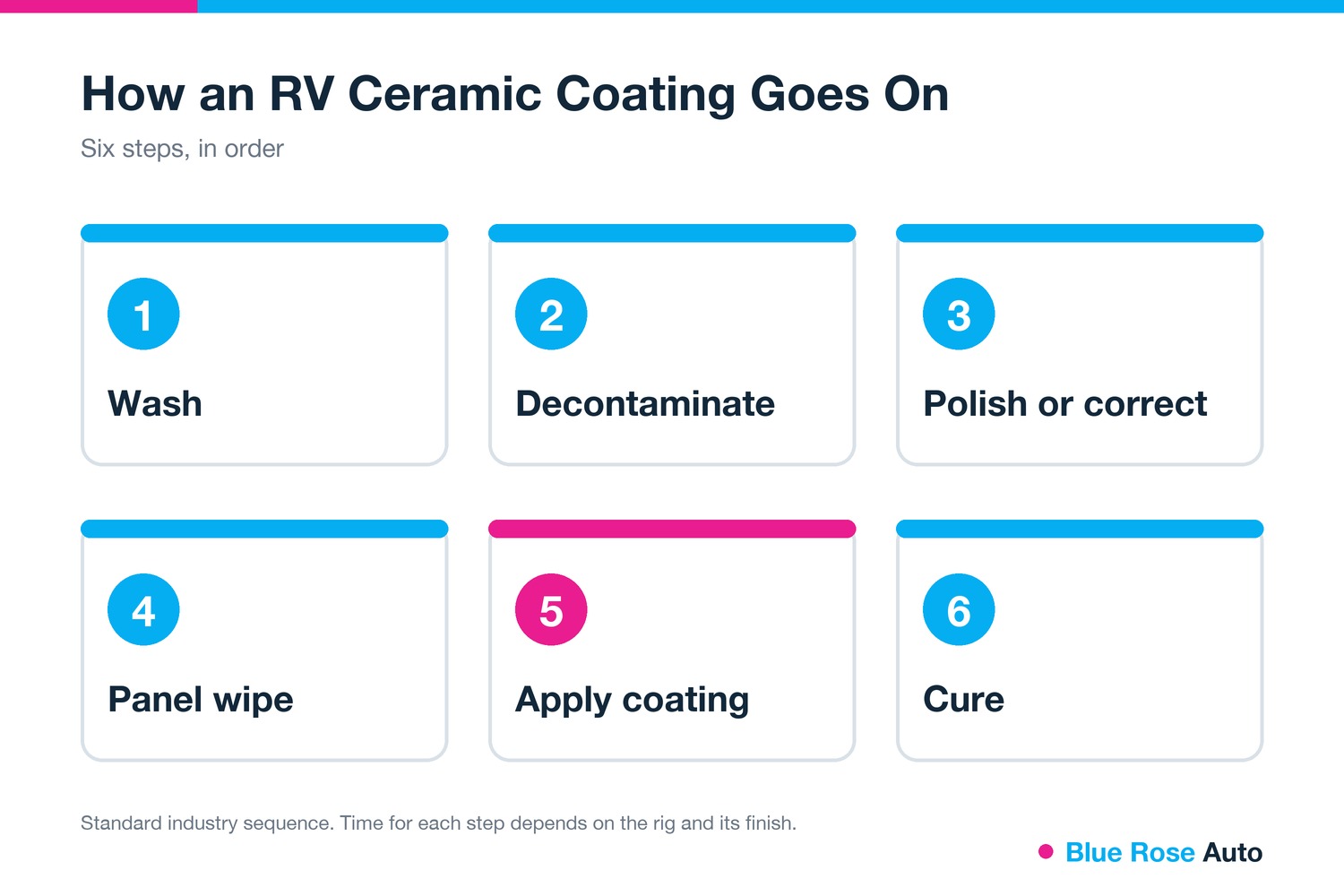
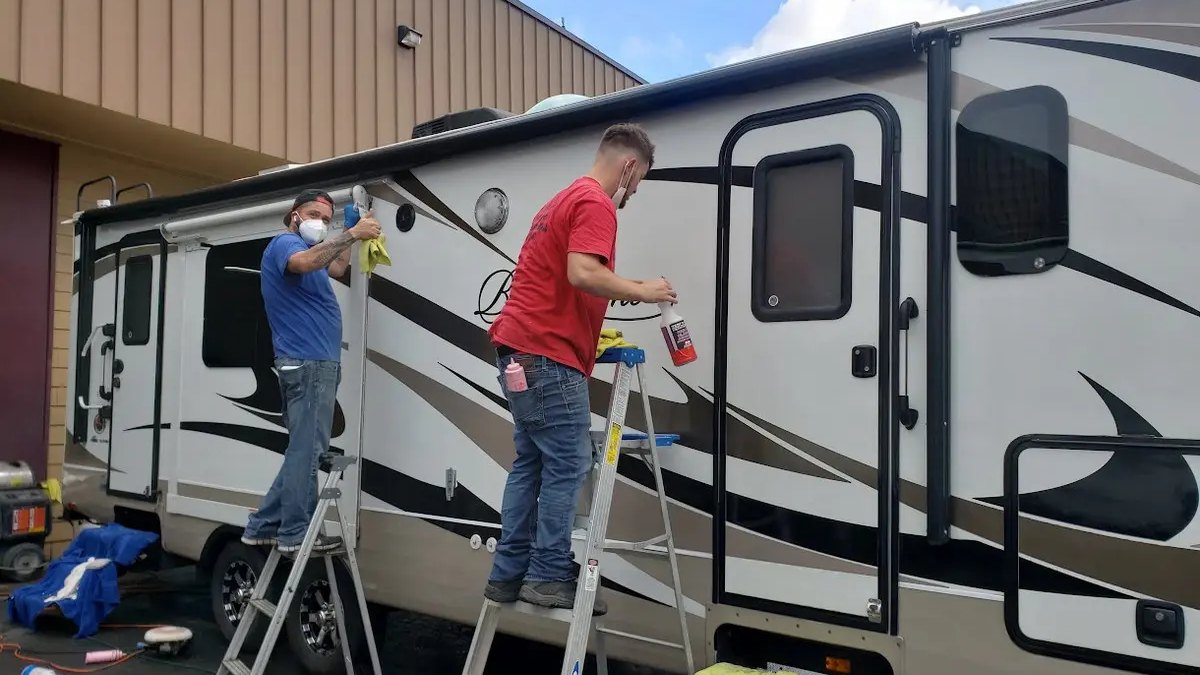
A standard industry sequence runs in order.
- Wash the whole rig to remove loose dirt, road film and bug residue.
- Decontaminate the surface to lift embedded grit and mineral deposits that washing leaves behind.
- Polish or correct oxidation, chalking and light defects so the coating has a sound surface to bond to.
- Panel wipe every surface to remove polishing oils and residue.
- Apply the coating panel by panel.
- Let it cure before it sees moisture.
Cure times are product-specific. One applicator, writing on the Tiffin Motorhomes blog in August 2025, reports that the product used requires 72 hours to fully cure and advises waiting at least seven days before washing. Your product and conditions may differ, and we tell you the cure and first-wash timing for your rig when we inspect it. Do not wash a fresh coating early, no matter how dusty it looks.
Coating Fiberglass, Gelcoat and Painted RV Panels
Gelcoat and painted panels are not the same surface, and the prep differs. Painted panels behave much like an automotive finish. Gelcoat is a thicker, more porous layer that oxidizes and chalks in the sun, and chalked gelcoat has to be corrected before anything bonds to it.
That is why we do not treat a ceramic coating for fiberglass RV surfaces as a one-product job. We look at each panel type, correct what needs correcting and pick the product for the surface. Most sprays sold as ceramic skip that correction step, and they are not the same as a professional coating applied by a certified installer.
Vinyl graphics and RV wraps need a compatibility check before any coating goes on. Film and adhesive behave differently from paint, so we ask before coating over decals and we do not promise a result on graphics until we have looked at them. A toy hauler’s ramp door, a trailer’s front cap and a Class A’s painted nose each get their own plan.
Common Exterior Problems Seen Around Lane County
Local weather shapes the wear on an RV finish. Oregon rain leaves mineral deposits that form water spots, and a rig that sits outside all winter often comes out with faded, chalky panels. Summer sun accelerates oxidation on roofs and horizontal surfaces, and highway travel bakes bug residue and road grime onto the front and lower panels.
- Water spots from mineral-heavy rain that dries on the surface.
- Chalky residue on fiberglass and gelcoat after a wet season outside.
- UV fading on roofs, caps and other horizontal panels.
- Bug residue and road grime baked on after highway trips.
A coating reduces how much of this builds up and how hard it is to clean. It does not remove damage that already exists, which is why inspection comes first.
Services Often Completed Alongside RV Protection
Owners sometimes want more done while the rig is in for inspection. If the finish is past protecting, our RV exterior paint work restores it, and if you want a new look we install RV wraps in Eugene and Springfield. Business owners with branded rigs can update lettering through commercial wraps after the coating work is done.
The roof is a separate surface with its own product, and the RV roof paint guide explains what to know before coating one. We also handle boat and RV repair, and the winter storage prep guide covers the steps before a long wet season. Detailing at our shop, including auto detailing in Springfield, starts with the same wash and decontamination that a coating needs.
Why Owners Search Ceramic Coating for RV Near Me
Convenience plays a part, but quality and preparation matter just as much. Coating a large surface takes proper environment control and professional tools, and many owners start searching ceramic coating for RV near me after they realize that do-it-yourself kits rarely give long-term durability on motorhome surfaces. Local service also makes it easier to schedule and to come back if a maintenance question comes up.
Blue Rose Auto is a Ceramic Pro Certified Elite Dealer, and our technicians are ASE-certified. The shop sits at 3436 Olympic St in Springfield, about 7 road miles and 15 minutes from downtown Eugene via I-105. We also coat cars, with ceramic coating in Springfield and ceramic coating for Eugene drivers at the same shop.
How Long RV Ceramic Coating Lasts
A professional ceramic coating lasts about 2 to 5 years on a car (Jalopnik, 2026), and an RV can land anywhere in or below that range depending on prep, storage and washing. Be careful with marketing claims of 10 years or more, because we could not tie them to a published test. Regular washing with the right products adds real years to the life of the coating.
Maintenance is simple. Wash on a steady schedule with a pH-neutral soap, avoid brush washes and let an annual inspection catch worn spots on the horizontal surfaces first. Those panels take the most sun and fail earliest, so they deserve the closest look.
How to Care for a Coated RV Through an Oregon Winter
Winter care comes down to regular washing, gentle tools and good storage. Eugene’s wet months run October to March, when about 78% of the year’s rain falls (National Weather Service normals), so road film and water spots build up fast on a parked rig.
- Wash every few weeks with pH-neutral soap and a soft mitt, and rinse the roof and caps.
- Skip brush washes, which can scratch the surface and strip a fresh coating.
- Dry panels after washing so mineral water does not leave spots.
- Store the rig under a breathable cover or in a covered space, never under a tight plastic tarp that traps moisture.
The RV and boat winterizing guide covers the storage side in more detail.
Frequently Asked Questions About RV Ceramic Coating
How long does application take?
It depends on the rig’s length, how much polishing the finish needs and the cure time of the product. A Class B is quicker than a Class A with chalked panels. We give you a time for your rig when we inspect it, instead of quoting a one-size number that your finish may not match.
Does ceramic coating prevent scratches and rock chips?
It helps with light surface marks and makes dirt easier to wipe away, but it does not stop deep scratches or rock chips. A coating is a thin hard layer, not armor. Paint protection film is the product built to take gravel hits, and a coating handles the rest of the finish.
Is polishing required before coating?
Yes, in most cases. Oxidation, chalking and swirls get sealed under the coating if you skip correction, and the coating also bonds better to a sound surface. How much polishing your RV needs depends on its finish, which is why we inspect before we quote.
Can older RVs receive ceramic coating?
Yes, if the finish is still sound enough to correct. Prep steps remove oxidation before the coating goes on. If the gelcoat is too far gone to polish, repaint is the better path, and we tell you that at inspection instead of coating over damage.
Is RV ceramic coating worth it?
For a rig stored outside in Oregon and used for several seasons, usually yes. A coating is rated at 2 to 5 years on a car against 1 to 3 months for wax (Jalopnik, 2026), so you avoid many rounds of waxing. A covered, rarely used RV may be fine with a sealant.
Is ceramic better than wax for an RV?
Ceramic lasts much longer than traditional wax. Jalopnik puts wax at 1 to 3 months and a professional coating at 2 to 5 years on a car. Wax is cheaper up front, but on a large rig the repeat labor adds up, and a coating resists UV and water spotting better.
Can coating go over decals and graphics?
It depends on the graphics. Vinyl film and adhesives vary, so we check compatibility before coating over decals and we do not promise a result until we have looked at them. If your rig has a wrap, tell us at inspection so we can plan the work around it.
What is the average RV ceramic coating cost?
Published guides put a professional RV ceramic coating at about $1,500 to $5,700, with a median near $3,600 (RV Lifestyle, 2023). Class B and small trailers sit at the low end and a large Class A at the top. Blue Rose Auto quotes your rig after we inspect the finish.
What does RV ceramic coating cost for a Class B, Class C and Class A?
Published national guides put a Class B van or small travel trailer at $1,200 to $2,500, a Class C at $2,000 to $3,500 and a Class A at $3,500 to $6,500 (Gilroy Blackout, 2026, and Latest Cost, 2026). Length, oxidation and correction time move a quote within each range.
Can you ceramic coat a fiberglass RV or toy hauler?
Yes, with the right prep. Fiberglass and gelcoat surfaces need correction first when they are chalked, and a toy hauler’s painted and gelcoat panels each get the product and prep that suit them. We inspect the surface and tell you what the rig needs before we quote.
Protect Your RV for the Long Road Ahead
A ceramic coating preserves shine, protects against oxidation and makes washing easier through Oregon’s wet winters and bright summers. If your RV shows oxidation or fading, bring it to Blue Rose Auto at 3436 Olympic St in Springfield and we will inspect the finish and recommend the right protection plan. Call (541) 641-8877 to ask for an RV ceramic coating quote.
Sources
- Gilroy Blackout, Class A vs Class C RV Protection, updated June 2026
- Latest Cost, Cost of Ceramic Coating for RVs, January 2026
- RV Lifestyle, Protective RV Coatings, November 2023
- Jalopnik, Ceramic Coating vs Waxing, 2026
- Tiffin Motorhomes blog, To Ceramic Coat or Not, August 2025
- NOAA National Weather Service, Eugene climate normals 1991 to 2020, precipitation and temperature
0 Comments