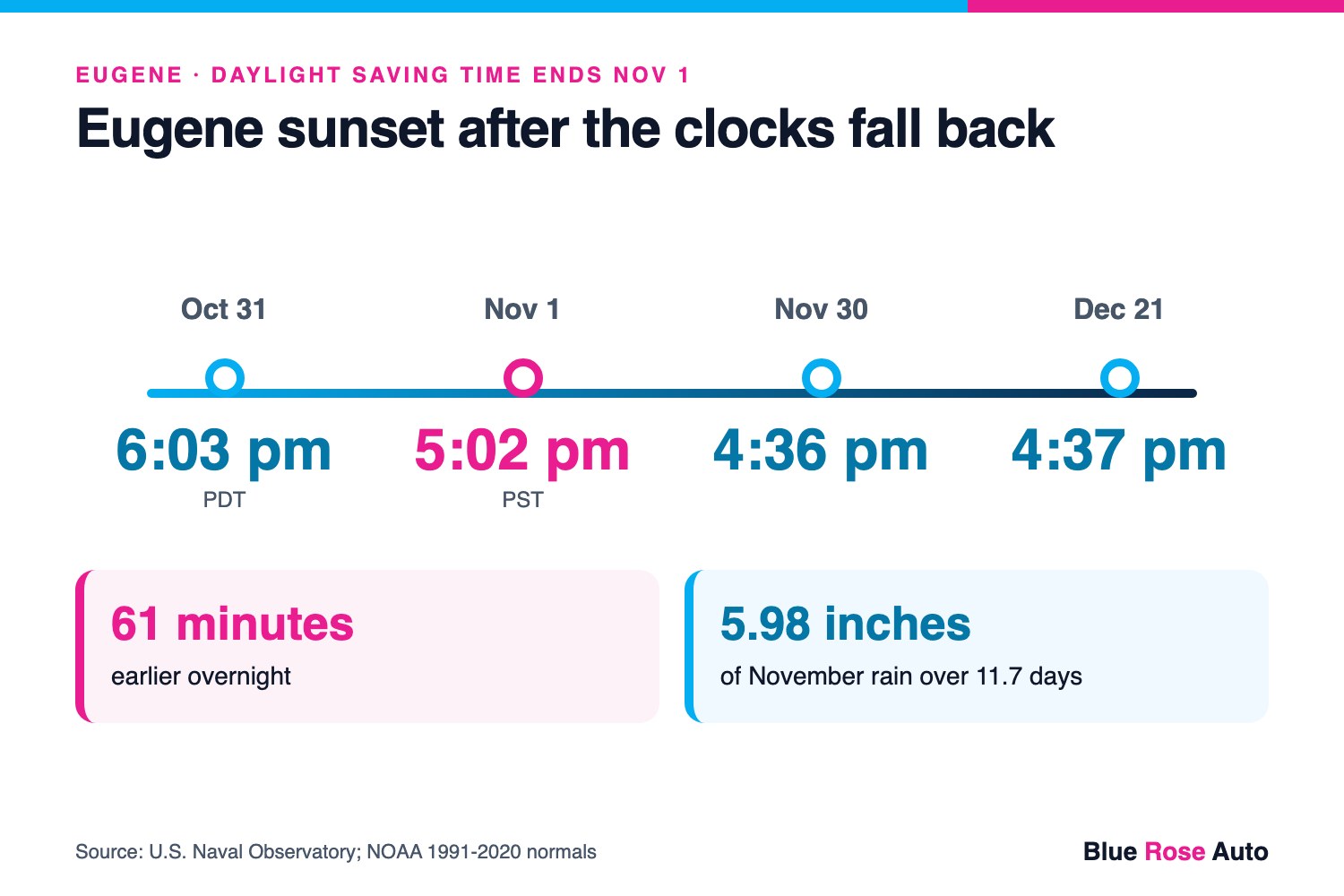
Daylight saving time ends at 2 a.m. Sunday, Nov. 1, 2026. In Eugene the sun sets at 6:03 p.m. on Oct. 31 and at 5:02 p.m. the next day, moving the drive home into the dark. Oregon requires headlights from sunset to sunrise, and AAA found foggy headlights give off just 22% of a new lens’s light on low beam.
If foggy headlights at night already turn the drive home into a squint, here’s what the numbers say and a 10-minute check for lenses, aim, bulbs, wipers and the rear defogger. Most of it you can do yourself in the driveway. A few items need a technician, and we’ll say which.
Last reviewed October 2026. We update this post each October. It pairs with our guide to seasonal car care for the valley’s wet months.
What changes when the clocks fall back on Nov 1?
Clocks go back one hour at 2 a.m. on Sunday, Nov. 1. For a Eugene commuter, that turns a 5:15 p.m. drive home that started in daylight on Friday into one that starts at dusk on Monday. By the end of November, the same drive starts in the dark, after civil twilight has already ended at 5:08 p.m.
Federal law sets the first Sunday of November (15 U.S.C. § 260a), and NIST spells out this year: “During 2026, daylight saving time is in effect from March 8 at 2 a.m. (local time) to November 1 at 2 a.m. (local time).”
| Date | Sunrise | Sunset | Civil twilight ends |
|---|---|---|---|
| Sat Oct 31, 2026 (PDT) | 7:48 am | 6:03 pm | 6:33 pm |
| Sun Nov 1, 2026 (PST) | 6:49 am | 5:02 pm | 5:32 pm |
| Mon Nov 30, 2026 | 7:26 am | 4:36 pm | 5:08 pm |
| Mon Dec 21, 2026 | 7:44 am | 4:37 pm | 5:10 pm |
Source: U.S. Naval Observatory, downtown Eugene (44.05 N, 123.09 W). Under ORS 801.325 and 811.515(1), headlights are required from sunset.
Sunset moves 61 minutes earlier overnight, then keeps sliding. From Oct. 31 to Nov. 30 it loses 87 minutes in total. Mornings are the odd part. Sunrise jumps an hour earlier to 6:49 a.m., so the school run feels brighter for a couple of weeks. That doesn’t last. By Dec. 21 the sun is up at 7:44 a.m., and both commutes sit near the dark.
Why it matters is in the crash data. The Insurance Institute for Highway Safety says “about half of traffic deaths occur either in the dark or at dawn or dusk.” For people on foot it’s starker. NHTSA’s 2023 pedestrian report counted 7,314 pedestrians killed, and found that “more pedestrian fatalities occurred in the dark (77%) than in daylight (19%), dusk (2%), and dawn (2%).”
Then add rain. NOAA’s 1991-2020 climate normals for the Eugene airport show 5.98 inches of precipitation in November, over 11.7 days with at least a tenth of an inch, and an average low of 37.7°F. Dark and wet arrive together. Better to find tired lights and wipers now than on the first dark, rainy Monday.
When does Oregon law require headlights?
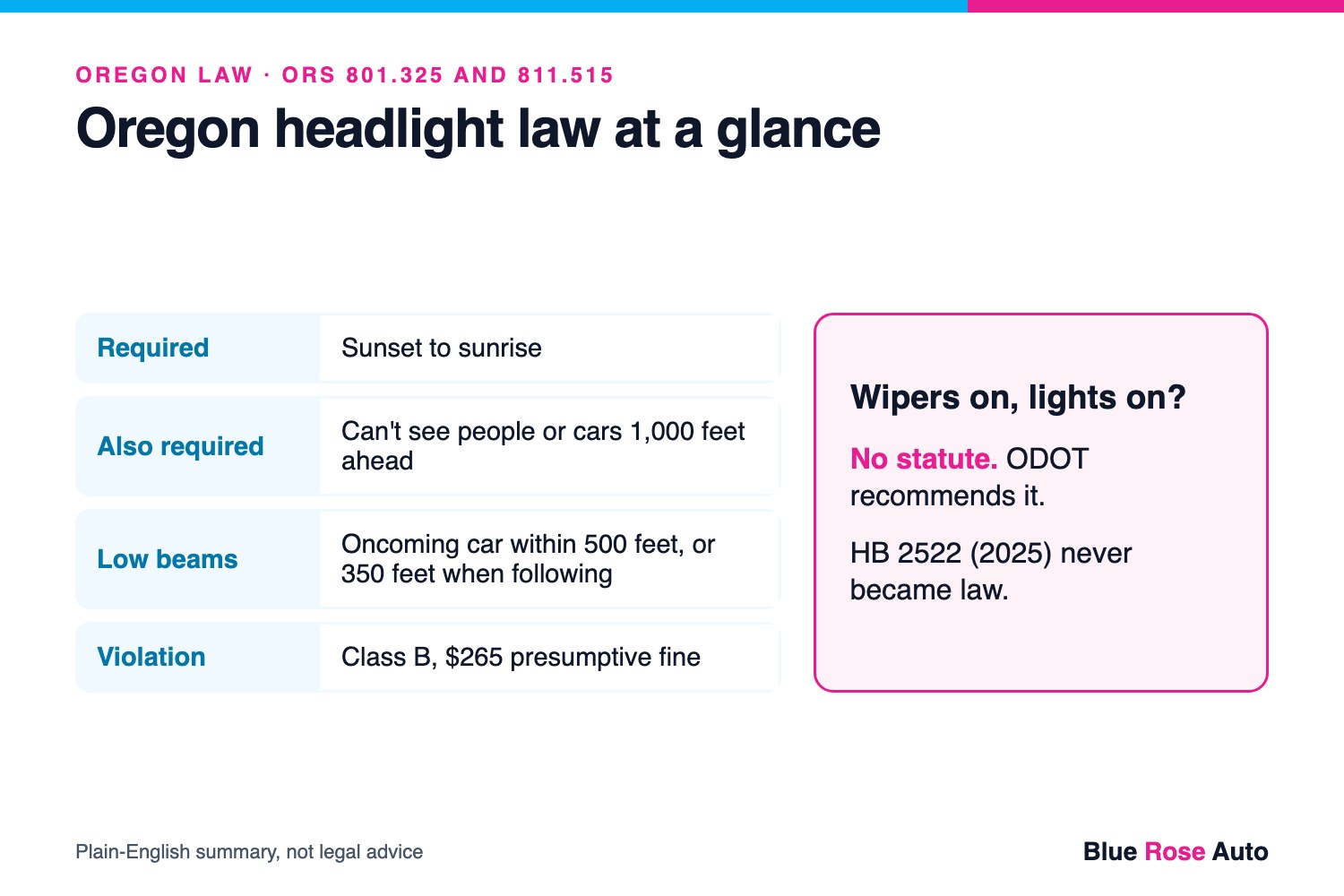
Oregon requires headlights whenever a “limited visibility condition” exists. ORS 801.325 defines that two ways, any time from sunset to sunrise, and any other time when poor light or weather means people and vehicles aren’t clearly visible on a straight, level, unlighted highway 1,000 feet ahead. Under ORS 811.515(1), required lights must be displayed whenever those conditions exist. From Nov. 1, that means headlights on by about 5:02 p.m. in Eugene. Getting it wrong counts as unlawful use or failure to use lights under ORS 811.520, a Class B traffic violation with a $265 presumptive fine under ORS 153.019. One thing Oregon law doesn’t say is “wipers on, headlights on.” House Bill 2522 (2025) proposed requiring headlights whenever the wipers run, and the current text of ORS 811.515 has no such rule. ODOT still recommends turning headlights on with the wipers.
Here is the definition word for word:
“Limited visibility condition” means “(1) Any time from sunset to sunrise; and (2) Any other time when, due to insufficient light or unfavorable atmospheric conditions, persons and vehicles are not clearly discernible on a straight, level, unlighted highway at a distance of 1,000 feet ahead.”
Part (2) is the one people forget. A downpour on Beltline at 2 p.m. can trigger it, no clock involved.
Is there a “wipers on, headlights on” law in Oregon?
No. The idea gets repeated online, and even ODOT’s Lights and Swipes page words it loosely, but no Oregon statute ties headlights to wipers. HB 2522, the 2025 bill that proposed it, carries the summary “Requires the use of headlights when the windshield wipers are on.” It reached the Senate Committee on Rules in June 2025, and we could not confirm it became law, so check the current statute if the question matters to you.
ODOT’s advice still stands, and we’d follow it. “When driving with the windshield wipers on, drivers should also turn on their headlights for safety.” The same page says some studies found daytime headlight use cut crashes “by up to 10%.” The habit keeps you legal, too, since rain heavy enough to hide a car at 1,000 feet already puts you under 801.325(2).
Low beams near other cars
Under 811.515(6), you have to dim to a beam that keeps glare out of an oncoming driver’s eyes once that car is within 500 feet. Following another car, the line is 350 feet. Parking lights alone don’t count, either: 811.515(2) bars driving on them in limited visibility unless the headlights are also on.
This is a plain-English summary of the statutes as of October 2026, offered as general information and not legal advice. If you’ve been cited, talk to an Oregon traffic attorney.
Do foggy headlights really reduce visibility at night?
Yes. AAA tested headlights from two popular sedans about 11 years old and found that clouded lenses on low beam produced only 22% of the light of new ones. A hazy lens also scatters what light does get through. That matters most on dark roads, where NHTSA says 77% of 2023 pedestrian deaths happened.
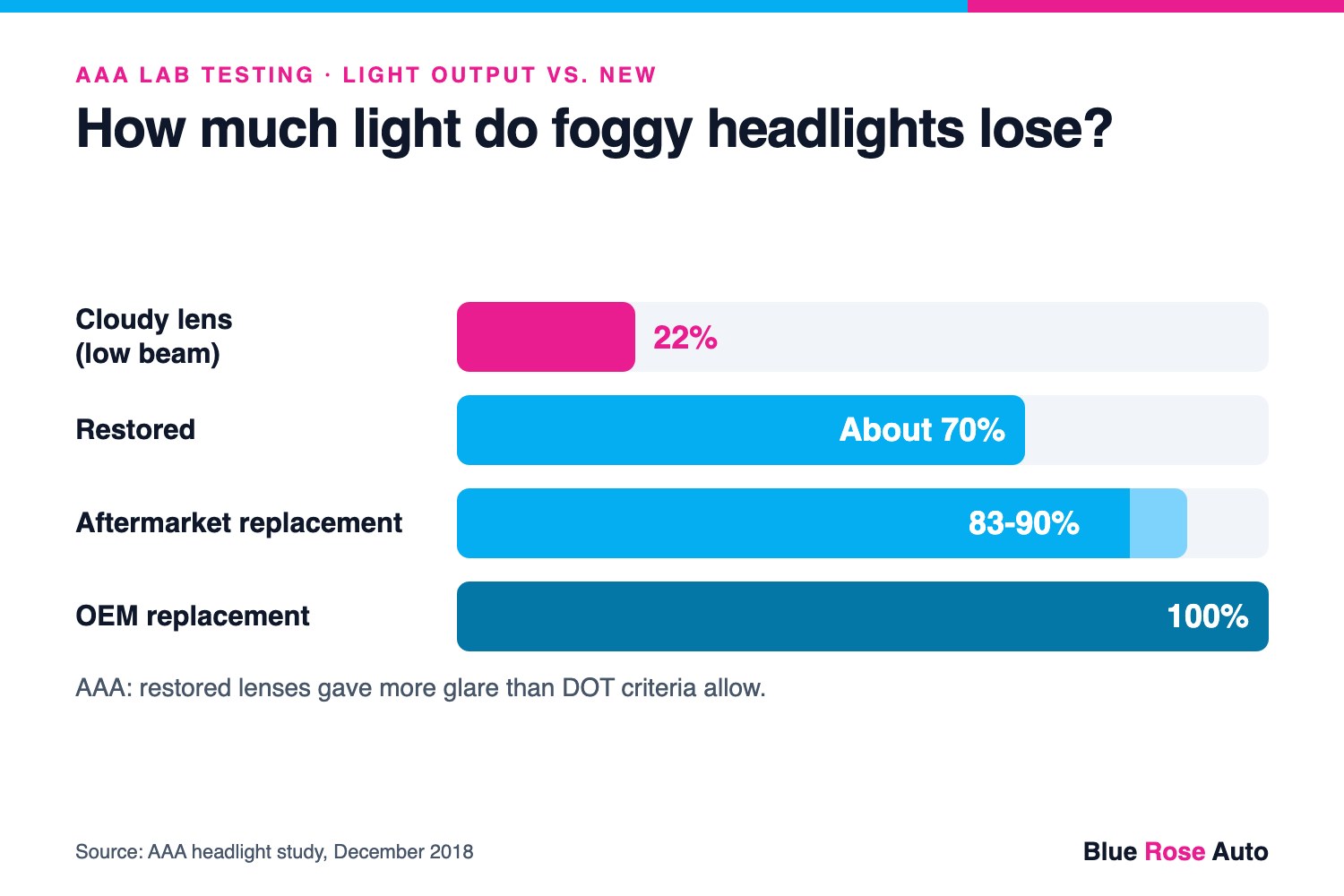
So foggy headlights at night aren’t a cosmetic complaint. The AAA study, published in December 2018, ran its tests in an accredited lab to Federal Motor Vehicle Safety Standard 108 (FMVSS No. 108). AAA’s headline figure was “only 20 percent” of new-headlight output; on low beam, the setting you use in town, it was 22%.
Lost light is only half of it. A frosted lens spreads the beam, sending some of it up and sideways instead of down the road. Car and Driver’s before-and-after test, covered below, found restored lenses threw a beam with “less scatter,” which tells you the haze was doing the scattering.
Distance is where this bites. Jennifer Stockburger of Consumer Reports’ Auto Test Center told CR that drivers “need a minimum of 300 to 350 feet to see and react and brake when traveling at 60 mph,” and that many new headlights already fall short of that on clear, moonless nights. Take away most of the light and you’re out-driving your headlights at speeds well under 60, on I-5 or anywhere else.
Headlight quality matters before any haze, too. The IIHS found vehicles with good-rated headlights have “19% fewer nighttime single-vehicle crashes and 23% fewer nighttime pedestrian crashes” than those with poor-rated ones. That’s a real gap. Even new cars vary: “Forty-six percent of headlight systems tested on model year 2026 vehicles earn a good rating.” Start with average lights, add a cloudy lens, and you’re well below average.
Why do headlights get cloudy and yellow?
Most modern headlight lenses are plastic. Usually it’s polycarbonate, with a UV-protective hard coat on the outside. Years of UV, weather and road grit wear that coating down until the bare plastic is exposed, and exposed plastic oxidizes and yellows. AAA says deterioration can start “as early as three years to five years.” It’s the same UV damage that dulls paint, just on a clear part you look through.
Why do headlights get foggy but not tail lights?
Different plastic. Headlight lenses are polycarbonate because it doesn’t crack when a stone hits it at highway speed, but it’s sensitive to UV and abrasion. Signal lamps, tail lights included, can use acrylic (PMMA) instead, which is more brittle but far more UV-stable. A lamp-testing lab’s materials sheet puts numbers on it. After a three-year UV exposure test to SAE J576, uncoated polycarbonate reached 25% to 35% haze, while acrylic sat around 5%. That’s five to seven times the haze. The same sheet notes FMVSS 108 caps UV-induced haze on headlamp material below 30%, one reason polycarbonate headlamp lenses get a protective hard coat. Tail lights also face backward, away from the gravel and bugs that sandblast the front of the car.
Should you restore or replace foggy headlights?
Restoration is a reasonable first step for lenses that are hazy on the outside but not cracked or wet inside. AAA found professional and DIY restoration both brought light output back to about 70%, but with more glare than federal criteria allow. Replacement restored 100% with OEM parts and 83-90% with aftermarket ones.

The four options side by side (AAA’s 2018 numbers unless noted):
| Option | Light output vs. new | How long it holds | Watch-outs |
|---|---|---|---|
| Leave cloudy lenses | About 22% on low beam | Keeps getting worse | Scatter and glare |
| Household hacks (toothpaste, Magic Eraser) | Not measured by AAA | Temporary; no UV protection added | Looks clearer, re-yellows quickly |
| Restoration (DIY kit or professional) | About 70% | CR says kits held “a year or so” | AAA found more glare than DOT criteria allow. Car and Driver found them brighter and more focused, not twice the reach |
| Aftermarket replacement headlight | 83-90% | New lens; coating quality varies | AAA says it can mean less intensity and more glare |
| OEM replacement headlight | 100% | New factory coat; AAA says wear can start in 3-5 years | AAA’s recommended option for the most improvement |
We’d rather be honest here. In a test published in March 2026, Car and Driver ran a restoration kit on a Corolla and filmed the road before and after. The beam “didn’t suddenly stretch twice as far down the road,” Katherine Keeler wrote, but the restored lenses “project a slightly brighter, more concentrated beam with less scatter.” Restoration is a real improvement, not a reset to factory, and AAA “recommends replacement since this method offers the most improvement in the amount of light produced.”
So why restore at all? On a lot of cars the outer coating is the only thing that’s failed, and removing the oxidized layer and resealing it gets most of the light back without new parts. Ask any shop what the finish and protective coat include. That decides how the lens holds up.
Do toothpaste, WD-40 or a Magic Eraser fix foggy headlights?
They can make a lens look better for a while, and that’s about it. Toothpaste and melamine sponges are mild abrasives that scrub off some of the oxidized surface. Nothing in them replaces the UV coat that failed, so the bare plastic starts yellowing again. Motor1, reporting on a viral dish-soap-and-Magic-Eraser video in October 2025, cited Chemical Guys, which says the method “might restore clarity temporarily, but without adding protection afterward, headlights will start yellowing again.”
WD-40 is the odd one. Its maker’s own foggy-headlight guide starts with wiping off surface grime, then points to polishing, sanding and “reapplying a UV-protective clear coat” for the haze itself. A wet, oily film can hide fine scratches for an evening. It doesn’t remove oxidation.
One warning from Consumer Reports applies to every abrasive method. If the lenses look clear, don’t use a restoration product at all. “They are abrasive and can easily damage lenses that don’t need such severe restoration.” Clear lenses but dim light? That points to bulbs, which CR says dim over time and “should be replaced after a few years.”
How long does headlight restoration last?
It depends almost entirely on the protective coat put on at the end. Consumer Reports tested kits in 2016 and found that for under $25, even very old lenses “could be made clear again, even if only for a year or so.” A year on, many of its test lenses had begun to haze over again. A local body shop told CR it commonly refinishes lenses for customers every year.
For cost context, Motor1 cited GearJunkie’s ranges in 2025: professional restoration typically $50 to $150, DIY kits $10 to $25. Those are national figures, not our price; call us for a quote on your car. Whichever route you take, a few habits slow the return of the haze:
- Park in a garage or shade when you can. UV is the main cause.
- Wash the lenses with car shampoo, not harsh solvents or degreasers.
- Before anyone sands, ask what UV-blocking coat goes on afterward and how long it’s rated to last.
- A look every October, using the driveway check below, catches new haze while it’s still faint.
When restoration isn’t the answer
Before anyone sands a lens, it’s worth looking at where the haze is. Yellowing on the outside surface is the coating breaking down. Inside fog is trickier, because a little of it is normal. Headlamps are vented, and HELLA, the German lamp maker, explains in its workshop guide to headlight condensation that a light mist on the inside of the lens should dry off after the lights have been on a while, and that it shows up more “in the cold months and in humid weather.” That describes a Willamette Valley November. Water drops on the lens or water pooling in the bottom of the housing are different. HELLA says to check the seal and the vents, and to replace the lamp if water keeps collecting. Polishing the outside won’t touch any of that, and trapped moisture corrodes bulb holders and connectors over time. Skip restoration, too, if:
- The lens is cracked or chipped through.
- One side is dim while the lens looks clear. That points at the bulb, the socket or the wiring, which the next section covers.
- A lens you already restored has gone cloudy again. At that point replacement is the honest recommendation.
If the haze is on the outside and the lens is intact, professional headlight restoration is a sensible first step before the darkest weeks of the year.
Are your headlights aimed right and your bulbs healthy?
A clear lens can still throw a bad beam. Aim, bulbs and the charging system are separate faults. Polishing plastic fixes none of them. The American Optometric Association’s night-vision fact sheet lists aim right next to clean lenses: “Ensure that headlights are properly positioned, aimed and aligned (may require assistance of an auto mechanic or service professional).”
Signs the aim is off:
- Oncoming drivers flash you while you’re already on low beam.
- The beam lights up the treetops and road signs more than the road.
- Light pools a short way ahead of the bumper and the road beyond it stays dark.
Aim isn’t only a comfort issue. ORS 811.515(6) asks for a beam “so aimed that the glaring rays are not projected into the eyes of the oncoming driver.” The statute treats low beams as compliant, but a headlight knocked high by a pothole or a minor bump still throws exactly that glare at the driver coming the other way. Restored lenses add some glare of their own, per AAA, so aim matters more after restoration. If any sign fits, have a technician check it.
Bulbs, sockets and the charging system
Bulbs dim with age, and they rarely fail together. If one side looks weaker, yellower or a different color, replace bulbs in pairs so the beam pattern matches. Check the socket too, because green or white corrosion on the contacts can make even a brand-new bulb flicker and look weak. Our Springfield shop replaces burned-out headlight and tail-light bulbs and fixes corroded sockets.
Lights that dim at idle often point to the battery or alternator instead. When the lenses are clear but the lights still seem weak, a battery and charging-system test is a quick way to rule the electrical side in or out. Older battery? Here’s how often a car battery needs replacing. For flicker that comes and goes, or lights that cut out, book an electrical diagnosis for flickering lights. Our ASE-certified technicians test the circuit before replacing anything.
How can you reduce headlight glare when driving at night?
Fix what’s on your own car first. Clean glass inside and out, clear lenses, aimed headlights and good wipers. Then change where you look. The American Optometric Association’s night-driving fact sheet tells drivers never to look straight at oncoming headlights, and to hold their lane by watching the lane marker or fog line until the car passes.
The rest of the AOA’s list is worth knowing, because some of it runs against habit:
- Dim the dash. Turn interior lights off and dashboard lights down to the lowest level you can still read.
- Skip yellow “night driving” glasses. The AOA says not to wear sunglasses or yellow, amber or other tinted lenses at night. The scene can look brighter, but tinted lenses cut the light reaching your eyes.
- Ask about anti-reflection coating. For prescription glasses, the AOA recommends it to cut reflections from dash lights, street lights and other cars.
- Slow to your headlights. Drive only as fast as you can stop within the distance your headlights light up, on the road surface you actually have.
Glare and halos that keep getting worse can also be your eyes, not the car. The AOA lists them as possible signs of early cataracts, contact-lens problems or other eye conditions, and says that’s “time for an eye exam!” If the car checks out and oncoming lights still blind you, book that exam.
When should you replace wiper blades before the rain?
Trico, a wiper manufacturer, says a general rule is to change wiper blades every six months, and sooner if they streak, squeak, chatter or show worn rubber. In Eugene, November averages 5.98 inches of rain over 11.7 days with at least a tenth of an inch, so fall is the right time to check.
Trico’s guide names four signs. In plain terms:
- Streaks. Bands of water left behind usually mean a bent frame or a damaged edge.
- Squeaking. A high-pitched noise on every pass says the rubber isn’t gliding anymore.
- Chatter. The blade skips instead of flipping smoothly. Trico blames temperature extremes, since heat can leave the rubber with a permanent set, and cold stiffens it.
- Aging and wear. Cracked, split or rounded rubber. Rain, road grit, bugs and bird droppings all eat at it.
Night makes all four worse. Streaks that look harmless at noon smear headlight glare at 6 p.m., and the AOA warns that “a dirty, streaked or fogged windshield can cause glare and reduce visibility.” Clean the inside of the glass while you’re at it; that film is invisible in daylight and lights up when oncoming headlights hit it. Top up the washer fluid, too.
Wipers are also required equipment. ORS 815.215 says they must be “designed for cleaning rain or other moisture from the windshield,” and failing to have them is a Class C traffic violation.
Swapping blades is usually a quick DIY job.
Why won’t the rear defogger clear the back glass?
Those thin lines across the back glass are an electric heating grid. When it stops clearing, the cause is usually electrical. NAPA AutoPro lists the usual suspects:
- A blown fuse. “A surge or short circuit can also cause the fuse to fail.”
- A failed relay, so the grid never gets power.
- “Any scratched or broken gridline,” which leaves a stripe that stays fogged.
- “Loose or corroded connections” at the small terminals on each side of the glass.
- Damaged or disconnected wiring.
Start with the fuse. Your owner’s manual shows which one feeds the rear defogger, and checking it takes a flashlight and a minute. Some lines clear and others don’t? Look for a break in the line. Don’t scrape the inside of the back glass with anything sharp. The grid sits right on the surface, and one slip can cut a line.
If the fuse is fine and nothing heats, book an electrical diagnosis for a dead rear defogger so the circuit gets tested piece by piece instead of guessed at. A front windshield that won’t clear is a different system, the heater and A/C.
The 10-minute driveway check before Nov 1
Do this at dusk, parked facing a garage door or a wall, ideally with a helper outside the car while you work the switches. The table shows what failing looks like and who should fix it.
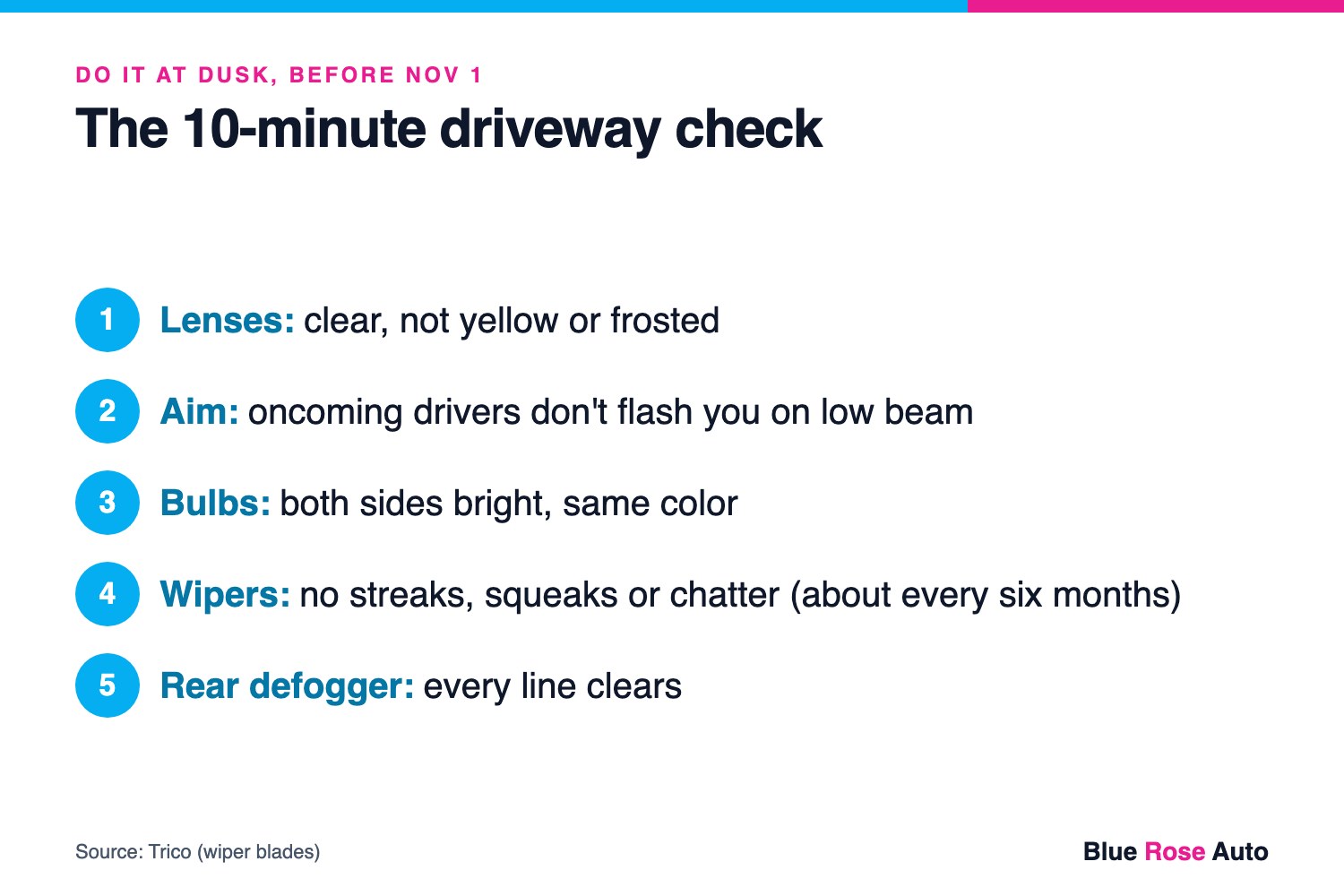
| Check | What failing looks like | What to do | Who fixes it |
|---|---|---|---|
| Lens clarity | Yellow or frosted outer surface | Restore, or replace if cracked | Have the lenses restored |
| Inside the housing | Droplets or pooled water behind the lens (a light mist that clears once the lights warm up is normal) | Have the seal and vents checked; restoration won’t fix it | A technician |
| Aim | Beam lights trees or pools just ahead; oncoming drivers flash you on low beam | Have the aim checked | A technician |
| Bulbs and sockets | One side dim, out or a different color | Replace bulbs in pairs; check sockets for corrosion | Bulb and socket replacement |
| Brightness changes | Lights dim at idle or flicker | Battery and charging test | Battery and charging check |
| Wiper blades | Streaks, squeaks, chatter, cracked rubber | Replace (Trico says about every six months) | DIY |
| Washer fluid and inside glass | Film or haze inside the windshield | Top up; clean the inside | DIY |
| Rear defogger | Lines don’t clear, or nothing heats | Check the fuse; look for broken lines | Electrical diagnosis |
If every row passes, good. If one fails, you found it while it’s still light at 6 p.m., before the clocks change on Nov. 1.
Frequently asked questions
Do I have to use headlights in the rain in Oregon?
Only when visibility drops, or after sunset. ORS 801.325 counts any time people and vehicles can’t be clearly seen 1,000 feet ahead, plus sunset to sunrise. Oregon’s lighting statute has no wipers-on rule, but ODOT recommends headlights whenever the wipers are on. The simplest habit is wipers on, lights on.
What time does it get dark in Eugene after Nov 1?
Sunset in Eugene is 5:02 p.m. on Nov. 1, 4:36 p.m. by Nov. 30 and 4:37 p.m. on Dec. 21, according to the U.S. Naval Observatory. Civil twilight ends about 30 minutes after sunset, and real dark follows. Oregon law requires headlights from sunset, not from full dark.
Do cloudy headlights really make a difference?
Yes. AAA measured clouded headlights at just 22% of new-lens output on low beam, and the haze scatters some of what’s left. It creeps up slowly, so it’s easy to miss, and AAA says lenses can start deteriorating as early as three to five years in.
Is it worth restoring cloudy headlights, or should I replace them?
Restore them if the haze is on the outside and the lens is intact. AAA measured restored lenses at about 70% of new output. A cracked lens, moisture inside, or haze that returns after restoration points to replacement, and OEM parts brought light back to 100%. For an intact lens, start with professional headlight restoration.
Does WD-40 or toothpaste fix foggy headlights?
Not for long. Both can make a lens look clearer, but neither puts back the UV coat that failed, so the haze returns, which is why proper restoration ends with a new UV-blocking seal over the sanded plastic. Even then, Consumer Reports found kits held about a year.
Why do headlights get foggy but not tail lights?
Mostly the plastic. Headlight lenses are polycarbonate, which resists stone chips but yellows under UV once its hard coat wears off, while tail lights can use acrylic, which in a three-year SAE J576 UV test hazed about 5% against 25% to 35% for uncoated polycarbonate. Tail lights also face away from road grit.
Is condensation inside a headlight normal?
A light mist that clears after the headlights have been on for a while is normal, says lamp maker HELLA, and it’s more common in cold, humid weather. Water drops on the lens or water pooling inside the housing aren’t normal. Have the seal and vents checked before moisture corrodes the bulb socket.
How often should wiper blades be replaced?
About every six months, says wiper maker Trico, or sooner if they streak, squeak or chatter. Check them before November, when the Eugene airport averages 5.98 inches of rain under NOAA’s 1991-2020 normals, because blades that pass on a dry afternoon show every flaw at night in the rain.
Why did my rear defogger stop working?
Usually it’s a blown fuse, a failed relay, a broken grid line or a loose, corroded terminal, according to NAPA AutoPro. Yes, it has a fuse. Check that first, using your owner’s manual to find it. If the fuse is good and the glass still won’t clear, book an electrical diagnosis of the relay, terminals and wiring.
Get your lights and wipers ready before the dark commute
Blue Rose Auto is at 3436 Olympic St in Springfield and opened in 1994. We handle headlight restoration, and our ASE-certified technicians take on electrical diagnosis for dim, flickering or dead lights. Call (541) 641-8877 to book a time.
0 Comments