To remove oxidation from car paint, wash and clay the panel, then machine or hand polish with a compound until the chalky film is gone, and finish with wax, sealant or ceramic coating. Clear coat is only about 40 to 50 microns thick, so you can only polish away a small part of it. If the clear coat is peeling or flaking, polishing will not fix it and the panel needs refinishing. Professional paint correction typically runs $300 to $1,200 depending on the stage (published 2026 market ranges). We correct and protect paint at our shop in Springfield, Oregon.
Last updated October 2026
Key takeaways
- Factory paint is about 100 to 150 microns thick in total, and the clear coat on top is typically 40 to 50 microns (published detailing guides, 2026).
- Detailing industry guidance says to remove no more than 25 to 30 percent of the clear coat over the life of a car, so every polish spends something you cannot get back.
- Even, chalky dullness is oxidation and usually polishes out. Peeling, flaking or sharp-edged patches are clear coat failure and need refinishing.
- Market ranges for correction run about $300 to $700 for one stage and $600 to $1,200 for two stages, while a mid-grade repaint runs $1,000 to $4,500 (AAA, 2026).
- Baking soda, toothpaste and WD-40 do not restore oxidized paint. They scratch it or hide it for a short time.
Oxidation shows up first on the hood, roof and trunk lid, because those flat panels take the most direct sun. Drivers in Eugene and Springfield tend to notice a dull patch on a bright afternoon and wonder whether it will polish out or whether the paint is finished. The answer depends on one question, whether the clear coat is worn or failing, and the sections below show how to tell the difference before you pick up a polisher.
What Causes Paint Oxidation on Vehicles
Paint oxidation is the clear coat wearing out under sunlight and outdoor exposure until the surface turns rough, dull and chalky. It starts quietly. The gloss thins out, the color looks washed, and the paint feels slightly gritty under your hand.
What Oxidation Actually Is
Clear coats contain UV absorbers and stabilizers that turn ultraviolet light into heat and mop up the free radicals it creates (CoatingsTech, American Coatings Association). Those additives wear down over years of exposure. Once they thin out, the clear coat roughens at a microscopic level and scatters light instead of reflecting it, and that scattered light is what you see as a chalky film.
Why Hoods and Roofs Fade First
Horizontal panels face the sun for more hours than doors do, so the hood, roof and trunk lid dull first on cars that live outside. Several habits make it worse.
- Continuous UV exposure wears down the clear coat’s stabilizers over the years.
- Dirt and airborne contamination settle on the surface and stay there between washes.
- No regular paint protection means bare clear coat takes every hour of sun directly.
- Improper washing with harsh materials scrubs away protective layers and leaves fine scratches that catch the light.
Covered parking and a protective layer slow all four of these down, which is why we come back to protection at the end of the process.
Oxidation or Clear Coat Failure and How to Tell
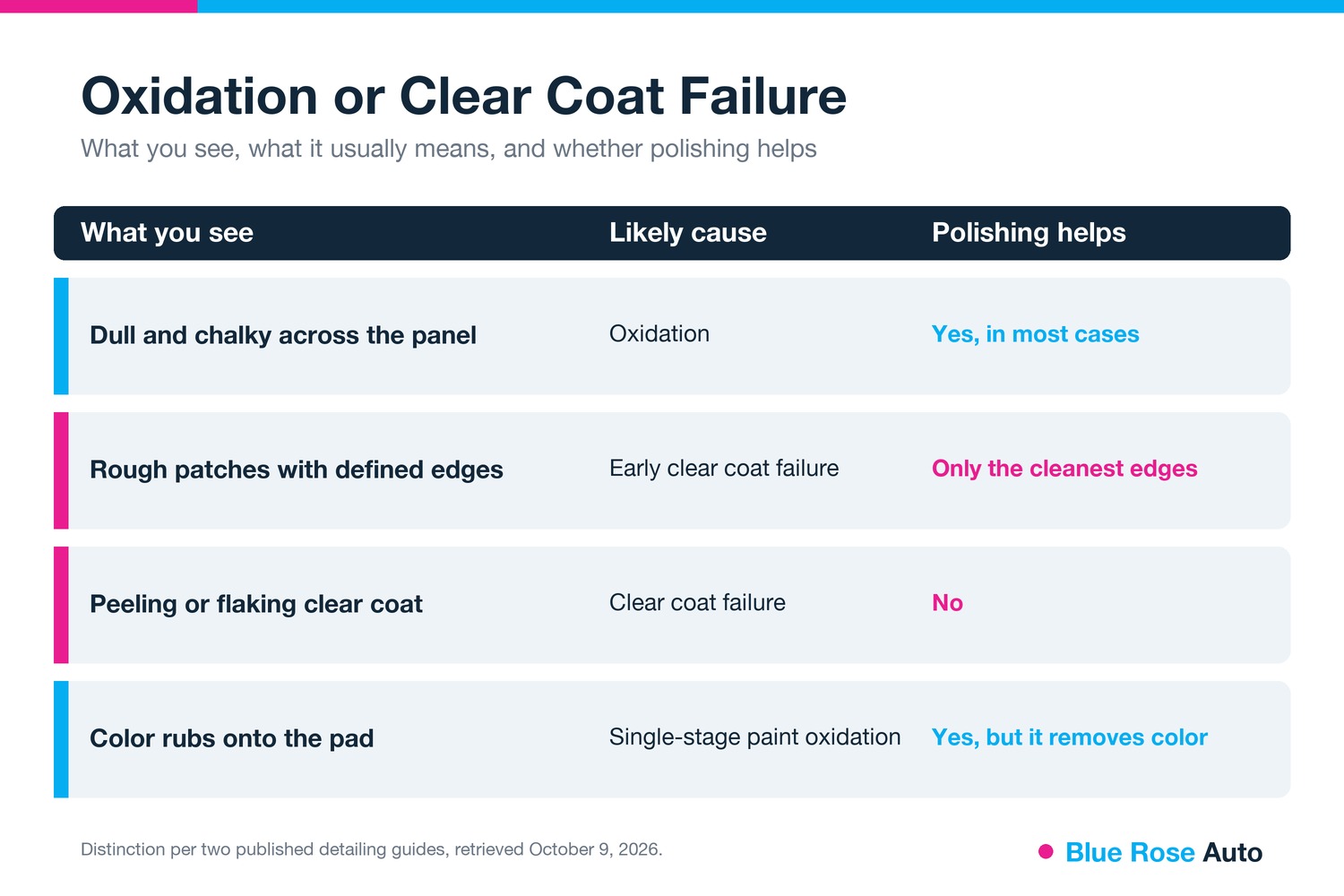
Oxidation and clear coat failure look alike from ten feet and need opposite fixes, so identify which one you have before you spend money. Oxidation is a worn surface that polishing can level. Failure is a structural problem that polishing cannot reach.
| What you see | Likely cause | Polishing helps | What we do |
|---|---|---|---|
| Dull and chalky across the panel | Oxidation | Yes, in most cases | Wash, clay, compound, polish, protect |
| Rough patches with defined edges | Early clear coat failure | Only the cleanest edges | Inspect, then refinish if it keeps spreading |
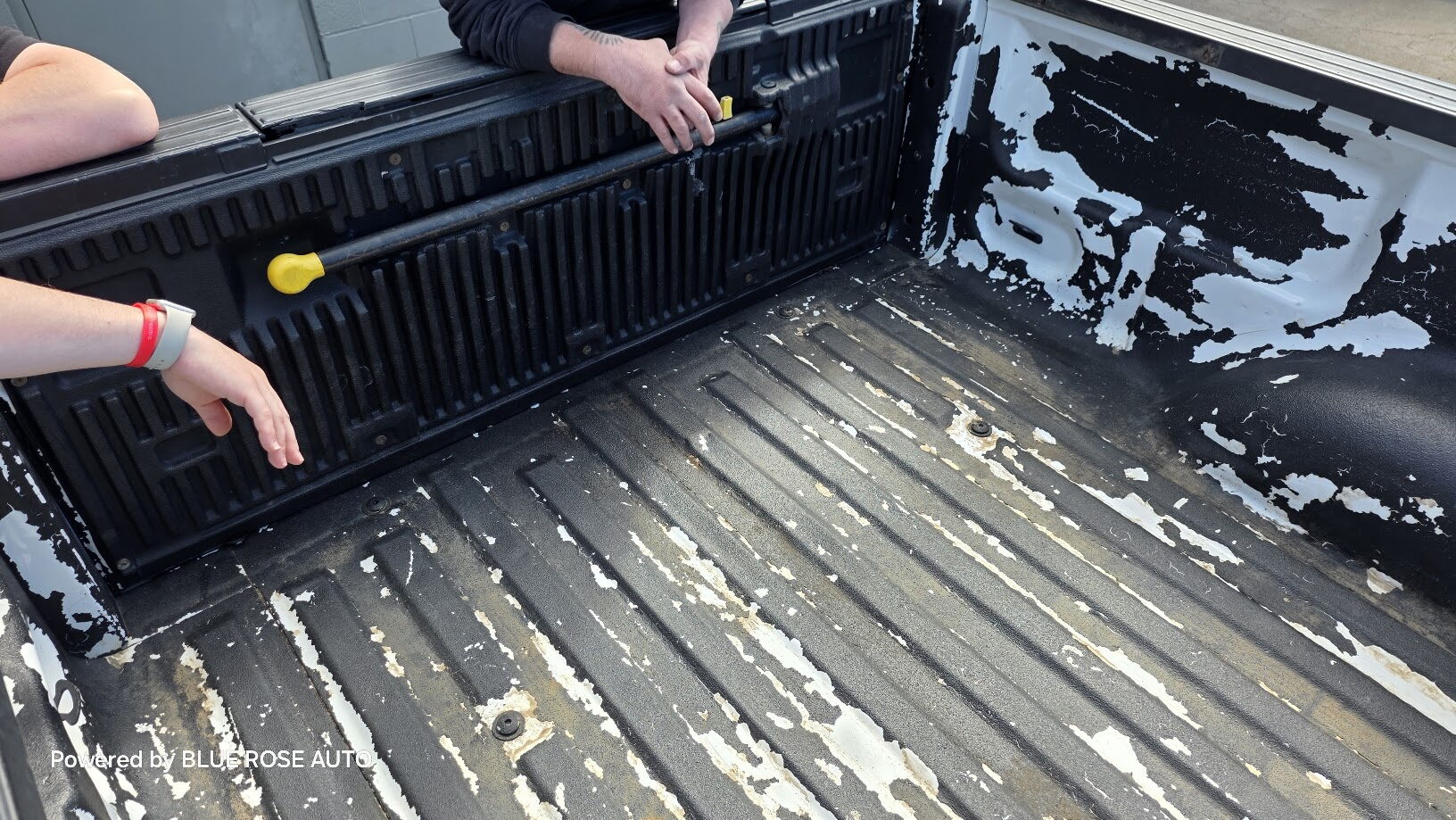
| Peeling or flaking clear coat | Clear coat failure | No | Refinish the panel |
| Color rubs onto the pad | Single-stage paint oxidation | Yes, but it removes color | Gentler compound and fewer passes |
The Fingernail and Polish Test
Run a clean fingertip across the dull area. Uniform haze that feels smooth to slightly gritty is typical of oxidation. Patches with sharp edges you can catch with a fingernail point to failing clear coat (published detailing guides). Then try a polish on a small test spot. If the shine comes back in the spot, you are dealing with oxidation. If the edges stay rough or the finish lifts, you are not.
Why Peeling Clear Coat Cannot Be Polished
Polishing levels a surface, and peeling clear coat has no surface left to level. The protective layer has lost its bond to the color coat underneath, so the damage is structural. Detailing guides agree that repainting may be the only fix once clear coat is peeling.

A panel like this one needs refinishing, which is paint work and not detailing. We handle collision repair and custom paint, and we inspect the panel first so you know which route fits. A vinyl wrap does not fix this either, because film will not hold on peeling clear coat (see the wrap versus paint guide).
How to Remove Oxidation From Car Paint Before It Gets Worse
The process follows five steps in order, and skipping the early ones is how people grind dirt into the paint. This is the standard approach used across the detailing trade.
Step by Step Process
- Wash and decontaminate the surface. Wash with a pH-balanced car soap, rinse, then run a clay bar or clay mitt with lubricant over the paint. Clay lifts bonded contaminants that washing leaves behind. Polishing over them drags grit across the finish.
- Inspect the severity and test a small area. Check whether the damage is oxidation or failure, using the test above. Tape off trim and try the polish on a patch about the size of a dinner plate before committing to the whole panel.
- Compound, then polish the affected areas. Work in small sections. A compound has more cutting power and removes the chalky layer. A finer polish follows to refine the surface. Lighter oxidation may need only the polish.
- Restore gloss with correction. Wipe each section with a panel prep or isopropyl wipe to remove polishing oils, then check the finish under good light. If haze or marring remains, repeat with a finer pad rather than a harsher compound.
- Protect the finish. Corrected paint is bare clear coat. Seal it with wax, a sealant, ceramic coating or paint protection film so the sun does not start the same process again.
The sooner oxidation is addressed, the more clear coat is left to work with, and that leads to the number that limits every polish.
How Much Clear Coat You Can Spend
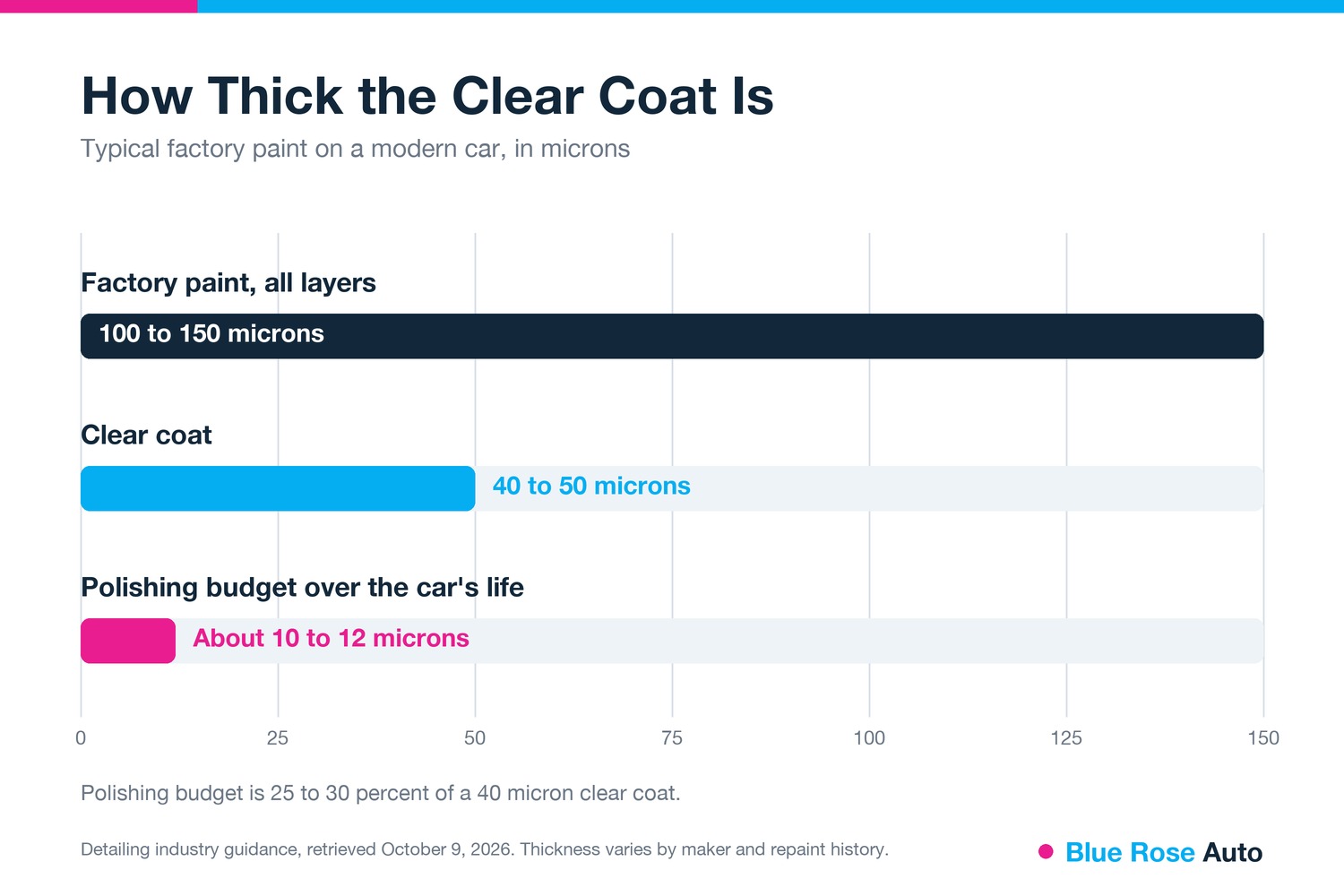
A factory finish is about 100 to 150 microns across primer, color and clear coat, and the clear coat alone is typically 40 to 50 microns (published detailing guides). That is thinner than a sheet of paper, and polishing removes some of it every time.
| Layer | Typical thickness |
|---|---|
| Factory paint, all layers | 100 to 150 microns |
| Clear coat | 40 to 50 microns |
| Polishing budget over the car’s life | About 10 to 12 microns |
Detailing industry guidance says to remove no more than 25 to 30 percent of the clear coat across the life of the car. Polishing budget is 25 to 30 percent of a 40 micron clear coat, which works out to roughly 10 to 12 microns in total, and the UV protection is concentrated in the top layer, so deep cuts cost more than they look. This is a rule of thumb from detailing guidance and not a paint maker specification, and actual thickness varies by maker and by repaint history. A paint thickness gauge is how detailers check how much clear coat remains before cutting.
Older cars with single-stage paint, which has color and gloss in one layer and no separate clear coat, behave differently. Oxidation there removes color paint, so you will see pigment on the pad, and the budget is even tighter.
How to Remove Oxidation From Car Paint by Hand
You can remove light oxidation by hand with a foam applicator, a quality compound and a lot of patience, but hand work only goes so far. Plan on a small panel at a time, about two feet square, and keep your pressure moderate and even.
- microfiber or foam applicator pads
- a cutting compound, then a finishing polish
- clean microfiber towels for wiping residue
- paint-safe car soap and a clay bar for the prep
- painter’s tape to protect trim and rubber
Work in overlapping straight passes, wipe the residue, and check the result in shade or under a light before moving on. Too much pressure or a harsh abrasive can mark the finish further, and you cannot undo it. Hand work stops helping when the shine will not even out across a panel, when the oxidation is heavy, or when you are covering a hood and roof. That is the point where machine paint correction gives steadier results than your arm can.
How to Remove Oxidation From a Car With Baking Soda and Other Home Remedies
Baking soda does not remove oxidation safely. It is a gritty abrasive with no controlled particle size, so it dulls and scratches clear coat instead of restoring it. A compound uses graded abrasives that break down as you work, and that difference is why compound polishes and a kitchen paste do not behave alike.
| Method | What it does | Our verdict |
|---|---|---|
| Baking soda paste | Scrubs with uneven grit | Skip it, it scratches clear coat |
| Toothpaste | Mild abrasive with no paint testing | Skip it, results are uneven |
| WD-40 | Hides shallow marks for a short time | Skip it, it restores nothing |
| Car compound and polish | Levels the worn surface in graded steps | Use this, with protection after |
On WD-40, the consumer group Which? tested it on scratches and found it only a temporary fix that washed away at the first treatment. It is not a detailing product. If you want to try something at home, a purpose-made compound on a test spot is the safe version of the experiment.
How to Get Rid of White Oxidation on Car Paint
White oxidation is the cloudy, chalky film that appears when the clear coat has worn down, and it is most common on older vehicles with heavily weathered paint. It looks cloudy or uneven under direct sunlight. How to get rid of white oxidation on car paint depends on how deep the damage has gone.
Mild oxidation may improve with:
- polishing
- compounding
- machine paint correction
Severe oxidation may require:
- several correction passes with a stronger compound
- refinishing the damaged panels
- a protective coating afterward
Inspection tells you whether the paint can still be restored or whether refinishing is the better route. We handle paint work for drivers in Eugene, Springfield, Junction City and Cottage Grove, and Blue Rose Auto opened in 1994.
Oxidation Removal Costs in Eugene and Springfield
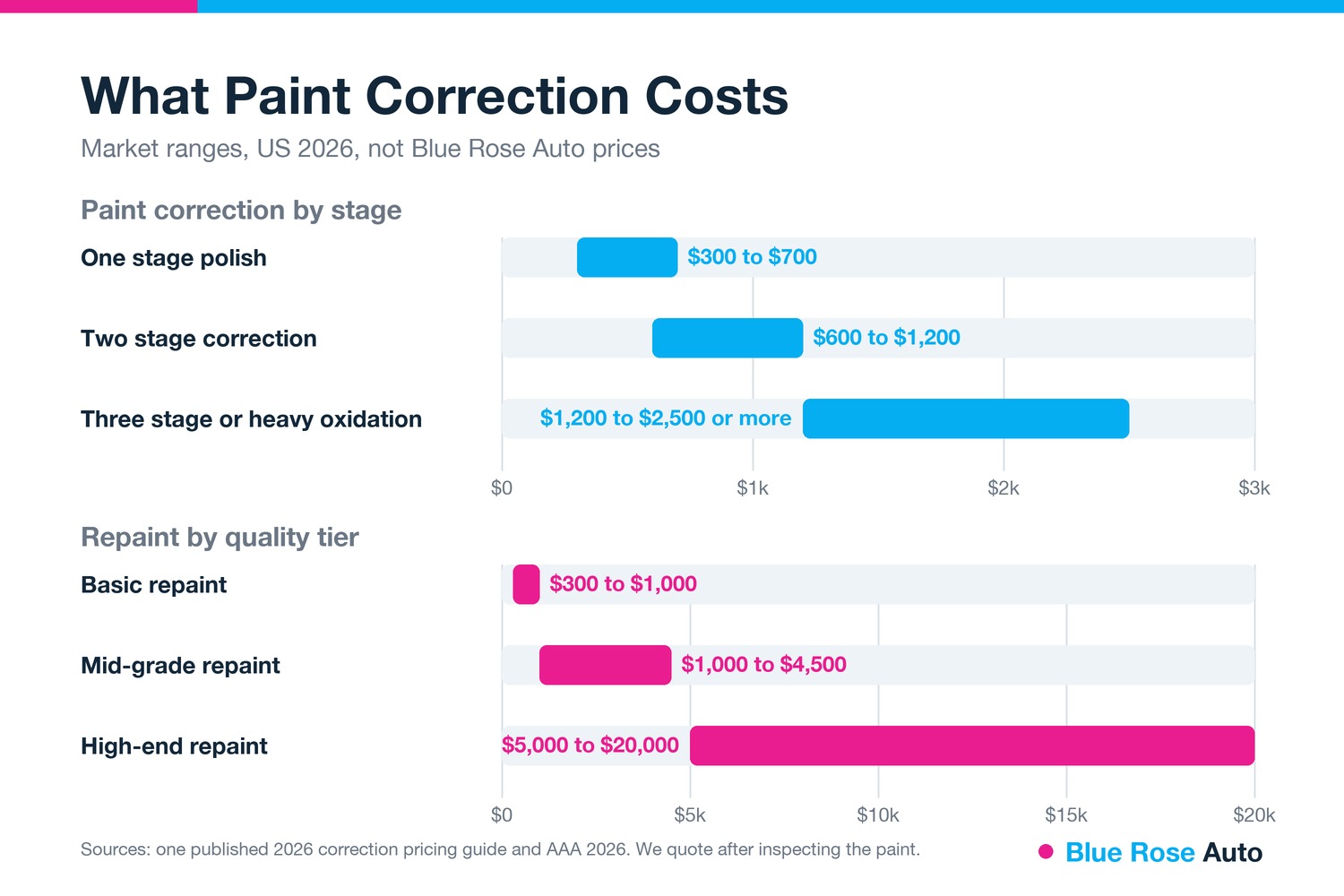
Paint correction runs about $300 to $1,200 for most cars, and the stage count and the paint condition set the price. The figures below are market ranges from published sources and are not Blue Rose Auto prices. We quote after inspecting the paint.
What Paint Correction Costs by Stage
One published 2026 pricing guide puts one stage polish at $300 to $700, two stage correction at $600 to $1,200 and three stage correction at $1,200 to $2,500 or more. Each stage is a full pass with a different compound and pad, so heavy oxidation that needs three stages costs more than a light one.
| Work | Market range | Source |
|---|---|---|
| One stage polish | $300 to $700 | Published pricing guide, 2026 |
| Two stage correction | $600 to $1,200 | Published pricing guide, 2026 |
| Three stage or heavy oxidation | $1,200 to $2,500 or more | Published pricing guide, 2026 |
| Basic repaint | $300 to $1,000 | AAA, 2026 |
| Mid-grade repaint | $1,000 to $4,500 | AAA, 2026 |
| High-end repaint | $5,000 to $20,000 | AAA, 2026 |
When Repainting Costs More but Is the Right Call
Repaint is the right call when the clear coat has failed, because correction cannot fix peeling. AAA breaks repaint into three tiers, from $300 to $1,000 for basic paint to $5,000 to $20,000 for high-end paint sanded to bare metal. We walk through the tiers in the wrap versus paint comparison and explain the factors in our breakdown of what affects car repaint cost.
Services Often Recommended After Paint Correction
Corrected paint looks best when the rest of the car matches it. Body damage may need collision repair before polishing begins, since polishing over a dent or a bad repair wastes the work. Many drivers pair correction with auto detailing for the full interior and exterior. A ceramic coating seals the corrected finish, and window tinting cuts cabin heat and slows interior fading from the same sun that dulled the paint.
Why Paint Protection Matters After Oxidation Removal
Corrected paint is bare clear coat with less of it than before, so it needs a protective layer straight away. Without one, the same UV exposure that caused the oxidation can start again.
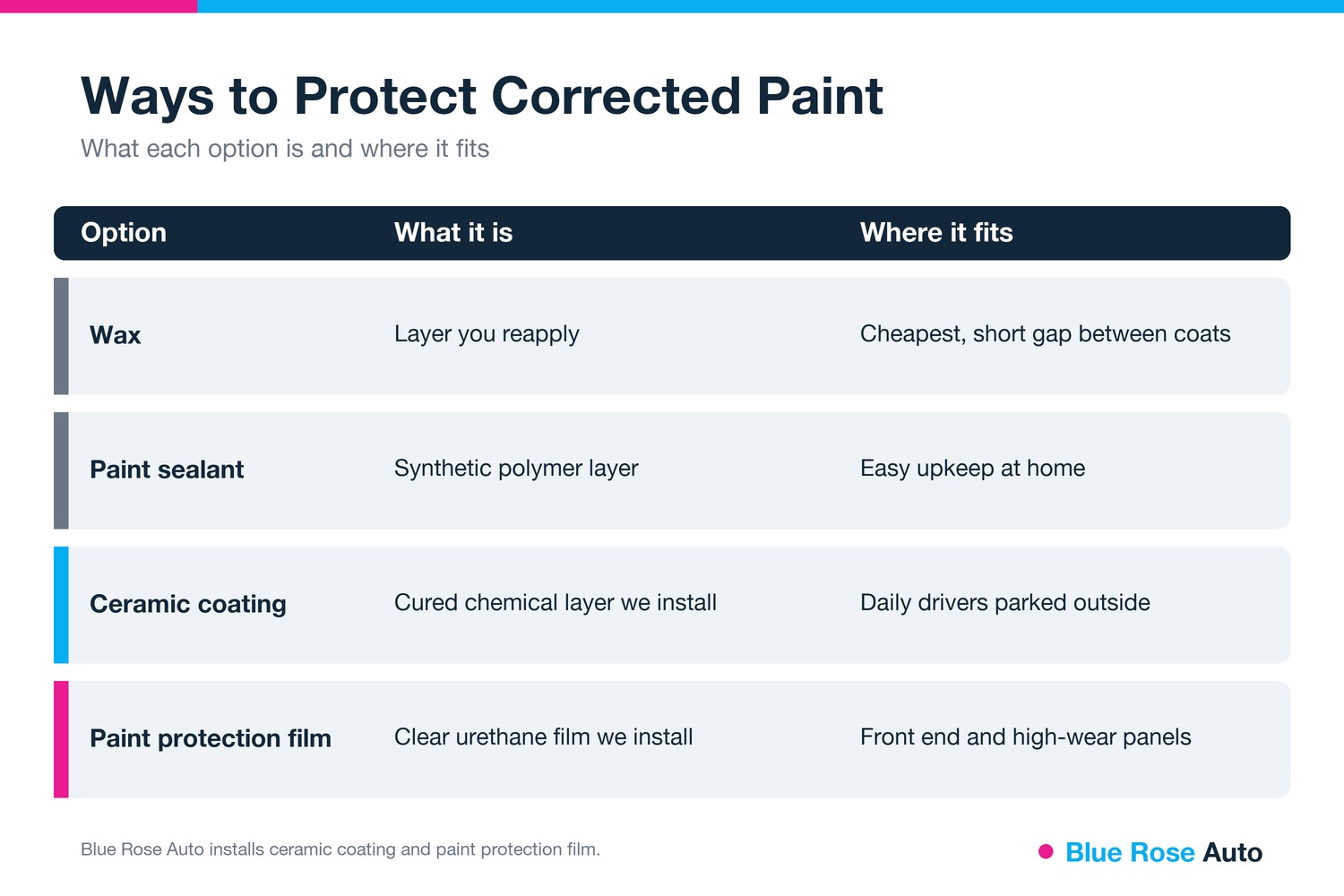
| Option | What it is | Where it fits |
|---|---|---|
| Wax | Layer you reapply | Cheapest, short gap between coats |
| Paint sealant | Synthetic polymer layer | Easy upkeep at home |
| Ceramic coating | Cured chemical layer we install | Daily drivers parked outside |
| Paint protection film | Clear urethane film we install | Front end and high-wear panels |
We install ceramic coatings as a Ceramic Pro Certified Elite Dealer, and ceramic coating in Springfield and ceramic coating in Eugene are the same work done for drivers on either side of the river. We install paint protection film from STEK, HITEK, XPEL and SunTek. Our 3-year, 36,000-mile warranty covers the ceramic coatings and film we install. It does not cover paint correction on its own. For the wax decision, our guide to ceramic coating versus wax compares them.
Hand washing and covered parking help whatever you choose. Our notes on how often to wash your car cover the routine, and the guides on preventing paint fading and paint protection methods go deeper on prevention.
Frequently Asked Questions About Paint Oxidation
What causes oxidation on car paint?
Ultraviolet light wears down the stabilizers in the clear coat, and the surface then roughens and scatters light, so it looks chalky. Rough washing, dirt and unprotected paint speed that up. Hoods, roofs and trunk lids fade first because they take the most direct sun.
Can oxidation be removed completely?
Light to moderate oxidation can usually be polished out, because the damage sits in the top of the clear coat. Heavy oxidation may need several passes and may only improve. Peeling or flaking clear coat cannot be polished away, and that panel needs refinishing.
Does oxidation damage the clear coat?
Oxidation is the clear coat wearing out. Left alone, the weakened layer can eventually crack and peel, and at that point polishing no longer helps. That is the main reason to treat chalky paint early, while compounding can still restore it.
Is hand polishing enough for oxidation removal?
For light oxidation on a small area, careful hand polishing can improve the finish. Larger panels and heavier oxidation usually need a machine, because a machine delivers steadier pressure and more cutting action than a hand pad. Hand work also tires quickly, which leads to uneven results.
Can baking soda restore faded paint?
No. Baking soda is a gritty abrasive with no controlled particle size, so it can dull and scratch clear coat rather than restore it. A purpose-made compound uses graded abrasives that break down as you work. We recommend leaving baking soda for the kitchen.
What does white oxidation mean?
White or cloudy oxidation means the clear coat has worn down enough to scatter light. Mild cases can improve with compounding and polishing. If the white areas have sharp edges, feel rough or lift when you pick at them, the clear coat is failing rather than oxidizing.
How much does oxidation removal cost?
Published 2026 market ranges run about $300 to $700 for a one stage polish and $600 to $1,200 for two stage correction. Heavy cases run higher, and a mid-grade repaint runs $1,000 to $4,500 (AAA, 2026). We quote after inspecting the paint.
Does ceramic coating stop oxidation?
A ceramic coating adds a hard protective layer that helps the paint resist UV light, contamination and washing wear. It does not make paint immune, and it cannot repair existing oxidation. We correct the paint first and then coat it, so the coating bonds to a clean surface.
Can faded paint return after correction?
Yes. Correction removes the worn surface but does not stop the sun, so unprotected paint can start to dull again. Wax, a sealant, ceramic coating or paint protection film slows that down, and regular hand washing and shade help as well.
Should oxidation be repaired early?
Yes. Early oxidation sits in the top of the clear coat, where a light polish can reach it. Once the clear coat starts to flake, the only fix is refinishing the panel, which costs more than polishing. Every polish also removes a little clear coat, so starting early keeps options open.
Can you buff out oxidation on a car?
Yes, if it is true oxidation, meaning an even chalky dullness across the panel. Buffing with a compound removes the worn top layer and restores gloss. If the clear coat is peeling, flaking or showing defined edges, buffing will not fix it and the panel needs refinishing.
How many times can you polish a car before the clear coat is gone?
Detailing industry guidance says to remove no more than 25 to 30 percent of the clear coat over the life of the car. On a 40 micron clear coat that is roughly 10 to 12 microns in total. Each stage takes a small amount, so aggressive polishing should be rare.
Restore Shine Before Oxidation Causes Permanent Damage
Oxidation gets more expensive the longer it sits, because it eats clear coat you cannot replace. If your paint looks faded or chalky, we inspect the finish, tell you whether it is oxidation or failing clear coat, and recommend correction and protection or a refinish. Call (541) 641-8877 or book a time online and bring the car to 3436 Olympic St in Springfield.
Sources
- Paint depth glossary, published detailing reference, retrieved October 9, 2026
- Clear coat polishing budget, published detailing guide, retrieved October 9, 2026
- Oxidation removal guide, published detailing guide, retrieved October 9, 2026
- Paint correction cost guide, published pricing guide, 2026
- CoatingsTech, American Coatings Association, UV absorbers and HALS in automotive clearcoat
- Which?, Does WD-40 remove car scratches, 2021
- AAA, How Much Does It Cost to Paint a Car, 2026
0 Comments