Yes. A low-speed crash can bend a bumper reinforcement, shift a radar or parking sensor, or knock the alignment out with no visible mark on the paint. The tell-tale signs are panel gaps, pulling or an off-center wheel, new warning lights, leaks, and noises over bumps, so get a measured inspection and scan before you settle the claim.
Hidden damage after a minor car accident is easy to miss in a Willamette Valley winter, when wet streets and the odd patch of black ice on a bridge deck add their share of low-speed bumps. Here is where it hides, a two-week self-check, when the car is safe to drive, and the Oregon rules once the estimate grows.
Last updated October 2026. Oregon statutes are quoted from the current text on oregon.public.law.
Can a minor car accident cause hidden damage?
Yes, and the bumper is usually why. A modern bumper is a plastic cover over a foam absorber and a metal reinforcement bar. The cover is built to flex, so after a slow hit it can spring back into shape while the foam behind it stays crushed and the bar stays bent. From the curb, the car looks fine.
Automakers set a low bar for real damage. Honda’s repair position statement, as quoted by I-CAR’s Repairability Technical Support (the 2019 version; Honda has revised it since), defines a collision as “damage that exceeds minor outer panel cosmetic distortion.” Anything past a scuff counts. To sort a scuff from something worse, start with these signs a bumper needs more than a cosmetic fix.
Unibody versus body-on-frame and why it matters
Most cars and crossovers are unibody, which means the body shell is the structure. With no separate frame to take the hit, force from a bumper strike can travel into the frame rails, inner fender aprons or trunk floor. Pickups and some large SUVs are body-on-frame, so a bend can hide under the bed or cab. On a small crash, “frame damage” rarely looks dramatic. No kink, no crumple. Usually it’s a shift that only a measurement will show.
Why are winter fender benders different here?
Rain does more of the damage than snow. The Federal Highway Administration’s five-year average for 2019 to 2023 counts 744,911 weather-related crashes a year, 12% of all crashes, and its table puts wet pavement in 70% of them. FHWA also finds 13% of property-damage-only crashes happen in adverse weather (FHWA road weather data).
That’s the Willamette Valley in November, with weeks of wet roads and then a clear, cold night that freezes the wet patches. The Oregon Department of Transportation warns that black ice “is particularly hazardous because the road looks wet, not icy,” and “Bridges and overpasses are more prone to black ice.” Its advice is to leave “at least three times as much” following distance.
Winter also changes what a small hit leaves behind.
- Curb slides. A slow slide into a curb is a classic hit to the wheel, tie rod and control arm, often with no body damage.
- Cold bumper covers. Stiff plastic cracks more readily at clips and tabs, yet can still spring back over a crushed absorber.
- Cracked paint. Months of rain reach bare metal through a cracked crease, and rust starts long before you see a bubble.
- Dirty sensors. Road grime on a radar face can trigger a fault message by itself, so wipe it before assuming the worst.
A wet-season tap deserves a closer look than the same tap in August, and a winter car checklist covers the rest of the cold-weather prep.
Where does hidden damage hide? A zone-by-zone guide
Hidden damage follows the hit. A front strike loads the reinforcement bar, radiator support and front sensors; a rear strike reaches the trunk floor and parking sensors; a curb goes straight into the steering and suspension. Find where you were hit below, then check the clues in the third column.
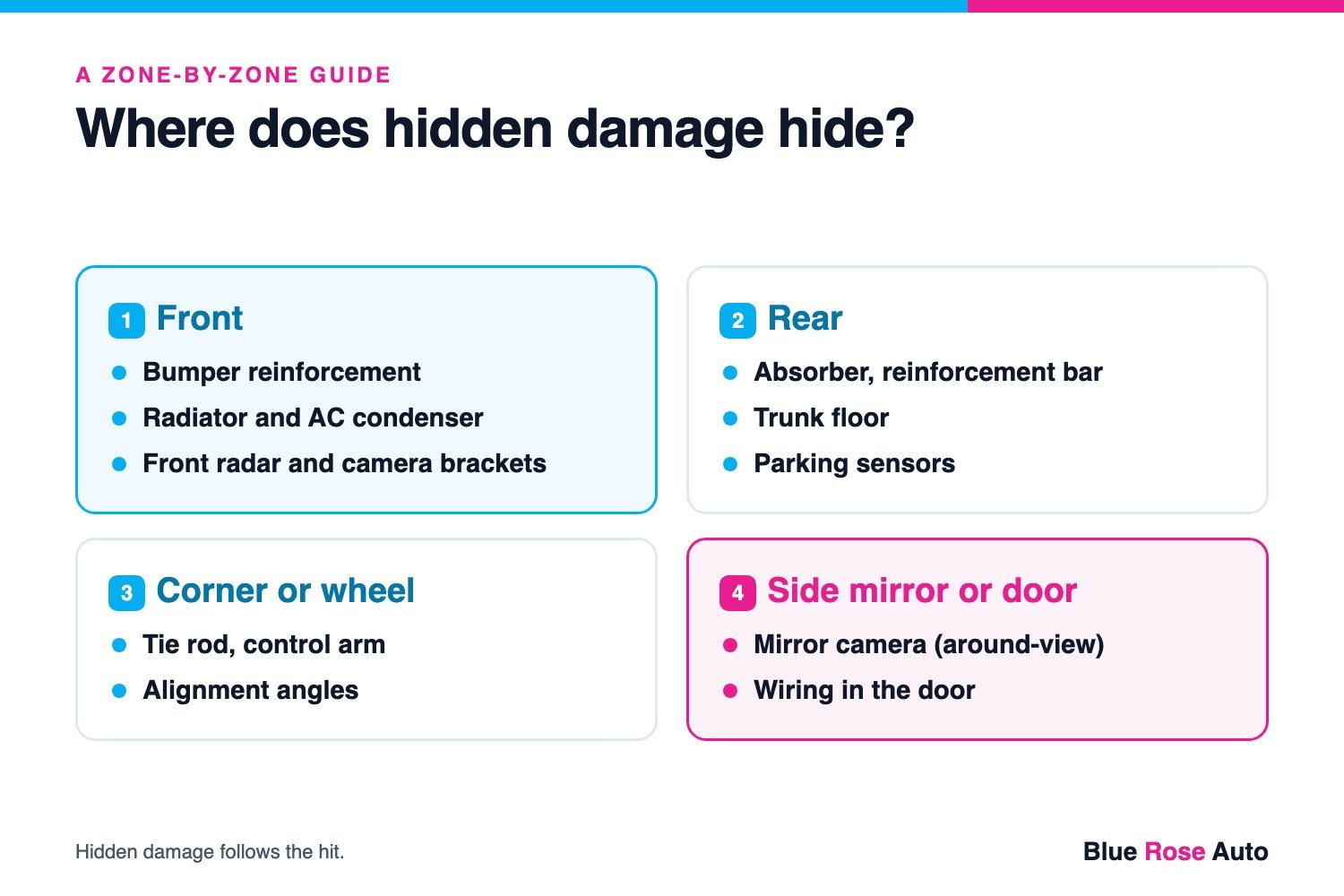
| Where you were hit | What can bend or shift | What you might notice | How a shop checks |
|---|---|---|---|
| Front (nosed into a car, a post) | Bumper reinforcement, foam absorber, radiator support, radiator and AC condenser, front radar and camera brackets, headlight mounts | Uneven hood gap, coolant drip, radar or adaptive-cruise message, headlight aimed off | Cover off, measure the front structure, scan for codes, check sensor aim |
| Rear (rear-ended at a light) | Absorber, reinforcement bar, rear body panel, trunk floor, parking sensors, exhaust hangers | Trunk lid sits off or won’t latch, park assist beeps at nothing, exhaust rattle | Cover off, check trunk floor and rails, scan, test parking sensors |
| Corner or wheel (curb slide, clipped wheel) | Tie rod, control arm, strut or knuckle, wheel, alignment angles | Car pulls, steering wheel off-center, clunk over bumps, inside-edge tire wear | Alignment readings, suspension inspection, road test |
| Side mirror or door | Mirror camera (around-view), door hinge, wiring in the door | Camera view black or skewed, door hard to close, new wind noise | Visual check, scan, door gap check |
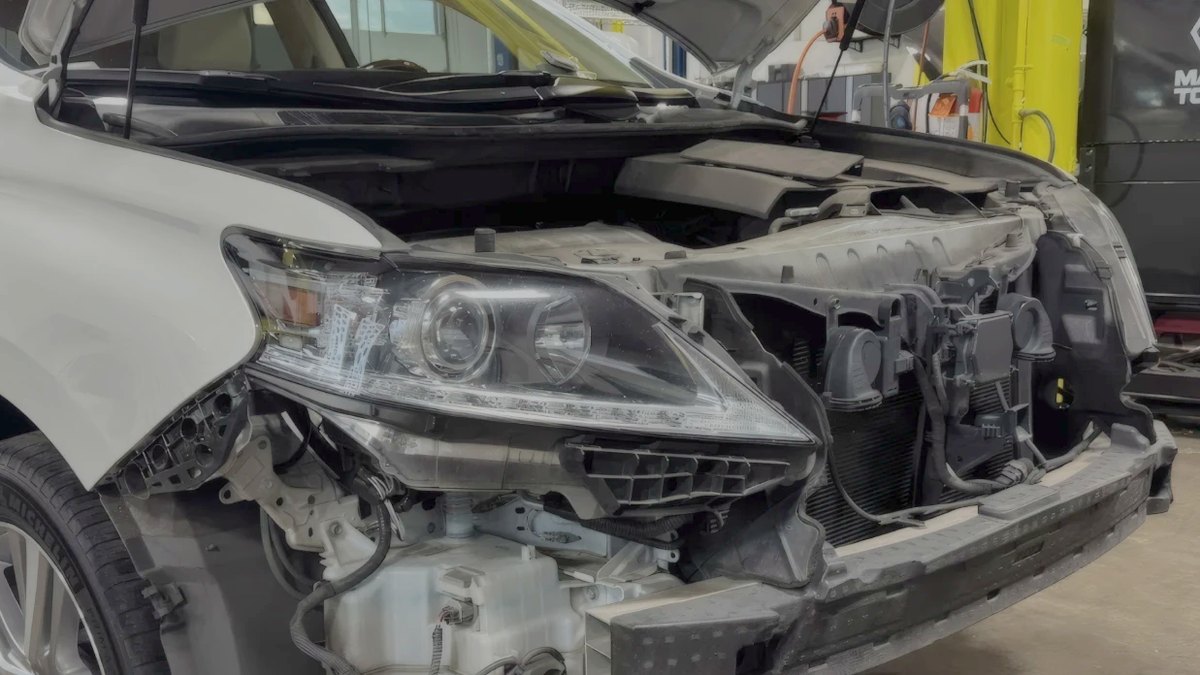
A crash can also disturb wiring behind panels. The honest answer after a front or rear hit? Take the cover off. That step is part of bumper repair, including the reinforcement behind the cover.
What are the signs of frame damage after an accident?
The clearest signs are new gaps between panels, doors or a trunk lid that close differently, and a car that sits or tracks differently. On a unibody car the structure is the body, so even a small shift shows up first in how the panels line up.
Walk around the car in daylight.
- Uneven panel gaps. Compare the hood gap left and right, then around each door and the trunk. Wide at one end and tight at the other is a red flag.
- Doors or trunk that don’t close right. A door that suddenly needs a harder slam usually means the opening moved, not the latch.
- Ripples in the trunk floor. Lift the mat after a rear hit; buckled metal there is structure.
- Uneven tire wear on one side, which takes weeks to show.
We start by checking the hidden damage, not just the crushed panel you can see, because a hard hit often bends structure behind the bumper cover.
If any of those signs show, book a collision inspection that measures the structure and checks the sensors. Straightening is its own job, covered under frame and chassis repair. Blue Rose Auto is a Tesla Approved Body Shop, so Tesla owners can have structural and cosmetic repairs done to Tesla’s standards (see structural repair on a Tesla).
Sensor and driver-assist signs (and why no warning light doesn’t mean fine)
A sensor knocked off aim can keep working, just wrongly, so the dash may stay dark. Watch for parking sensors that beep at nothing, a “radar unavailable” or adaptive-cruise message, lane-keeping that tugs at odd moments, or a camera view that sits crooked. Any of these after a bump is worth a scan.
Why isn’t a quiet dash proof? AAA’s December 2023 study says a warning appears “if an ADAS component is failing and causing the system to be inoperable.” A slightly bent radar bracket isn’t failing. It works fine, aimed at the wrong lane. Honda’s position, via I-CAR, adds that driver-assist systems “often will not display DTCs during a vehicle scan unless there is damage to the applicable system, so aiming and/or calibration may be required.”
According to the Insurance Institute for Highway Safety, “Automakers stipulate systems be calibrated anytime a sensor is removed and replaced or reinstalled.” So a sensor-carrying bumper that comes off for repair brings calibration with it. The same 2023 IIHS survey found “nearly three-quarters of those whose repairs were required due to crash damage said they had issues with the technology after repair.”
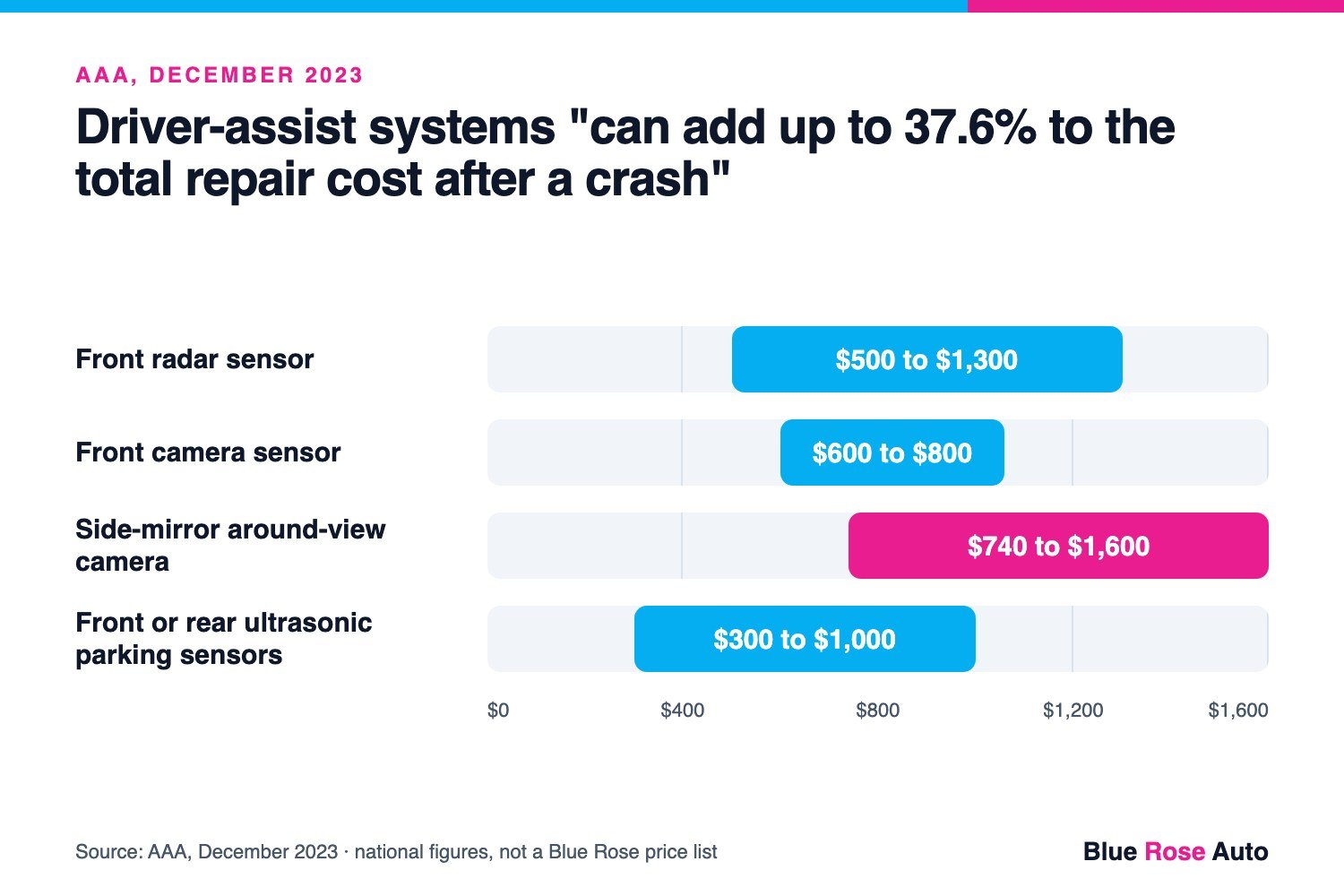
The costs add up. AAA’s 2023 figures cover a 2023 Ford F-150, Nissan Rogue and Toyota Camry, over and above the normal bodywork.
| Item (AAA, December 2023) | Range or average |
|---|---|
| ADAS components, minor front collision | $1,540 average (13.2% of the average total repair) |
| ADAS components, minor rear collision | $684 average (40.9% of a $1,698 average total) |
| Front radar sensor | $500 to $1,300 |
| Front camera sensor (not including a windshield) | $600 to $800 |
| Windshield-mounted camera sensor | $900 to $1,200 |
| Side-mirror around-view camera | $740 to $1,600 |
| Front or rear ultrasonic parking sensors | $300 to $1,000 |
AAA’s headline is that driver-assist systems “can add up to 37.6% to the total repair cost after a crash.” Those are national figures, not a Blue Rose price list. CCC’s 2026 Crash Course report found calibrations on 28.3% of repairable estimates in 2025, so sensor work is no longer a rare add-on. Ask any shop who performs the calibration and request the record.
Clean the sensor faces first, since winter grime alone can set off a warning. Then follow AAA Oregon/Idaho, whose 2018 release says calibration “requires special training, tools and information” and advises drivers to “request proof of the work once complete.” Ask for the scan and calibration records. Keep them with your invoice.
Suspension, alignment and steering signs
A minor accident can knock the alignment out, often without a scratch on the body. A curb slide or a clipped wheel can bend a tie rod or shift the alignment angles. You’ll notice a pull to one side, a steering wheel that sits off-center on a straight road, clunks over bumps, or tires wearing on the inside edge.
Curb hits are the sneaky ones. When a wheel stops dead against concrete, the force goes into the tie rod, the lower control arm, sometimes the strut or knuckle. Paint can come through untouched while toe and camber, the angles that keep the tire flat and pointed straight, do not.
On your next few drives, check these four things.
- Wheel position. Is the steering wheel level on a straight, flat road?
- Pull. Lighten your grip for a second. Does the car drift?
- Noise. Listen for a clunk over speed bumps from the corner that hit.
- Vibration. Feel for a new shake at highway speed, say on Highway 126.
Don’t align around a bent part. A good shop replaces anything bent first, then sets the angles. Start with a wheel alignment check; a bent arm or tie rod means suspension and steering repair. For background, read about common suspension problems and the difference between a wheel alignment and a front-end alignment.
Leaks, warning lights and noises to watch for
After a front hit, a typical delayed sign is a small puddle under the nose overnight, often coolant from a radiator or AC condenser that got pushed back. A new check engine light, an exhaust rattle after a rear hit, or a fresh noise also means something behind the panels moved.
Here is what each clue usually points to.
- Green, orange or pink drips up front. Coolant. The radiator and condenser sit right behind the reinforcement bar.
- Clear, watery drips. Often AC condensation, though in November with the AC off they deserve a second look.
- Reddish drips toward the back of a rear- or all-wheel-drive car. Possibly transmission or differential fluid, worth a lift inspection soon.
- A new check engine light. Wiring, connectors and sensors live behind the bumper, so get the codes read. A flashing light is different, so stop driving and have it checked right away.
- Rattle or drone from the back. A rear hit can bend exhaust hangers, and a hard one can reach driveline parts on rear- and all-wheel-drive cars.
- Wind noise from a door that moved slightly and no longer seals.
Honda’s position, reported by I-CAR, is blunt. “Damage that requires the replacement of body parts will always require a post-repair diagnostic scan.” If your car needed parts, ask whether it was scanned before and after.
Is it safe to drive after a fender bender?
Often, but not always. If an airbag went off, fluid is pooling, a tire is rubbing, or the lights or steering are clearly wrong, don’t drive it. Smaller changes, like a slight pull or a park-assist message, mean drive carefully and go straight to a shop. Treat the table as shop guidance, not a rule.
| Stop and arrange a tow | Drive carefully, straight to a shop | Probably fine to drive, but book an inspection |
|---|---|---|
| Airbag deployed; fluid pooling under the car; a tire rubbing, cut or leaning in; headlights or brake lights out; steering wheel badly off or the car won’t track straight; brake, airbag or temperature warning lit | A new pull or slightly off-center wheel; a park-assist or driver-assist message; a trunk or door that won’t latch fully; a new noise over bumps | No warning lights, wheel centered, no leaks, panels line up, nothing feels different (still run the two-week check) |
A tow has a legal side, too. When a crash does more than $2,500 in damage and any vehicle must be towed from the scene, Oregon law requires every driver involved to report it, even one whose car barely got scratched.
A two-week self-check after a small crash
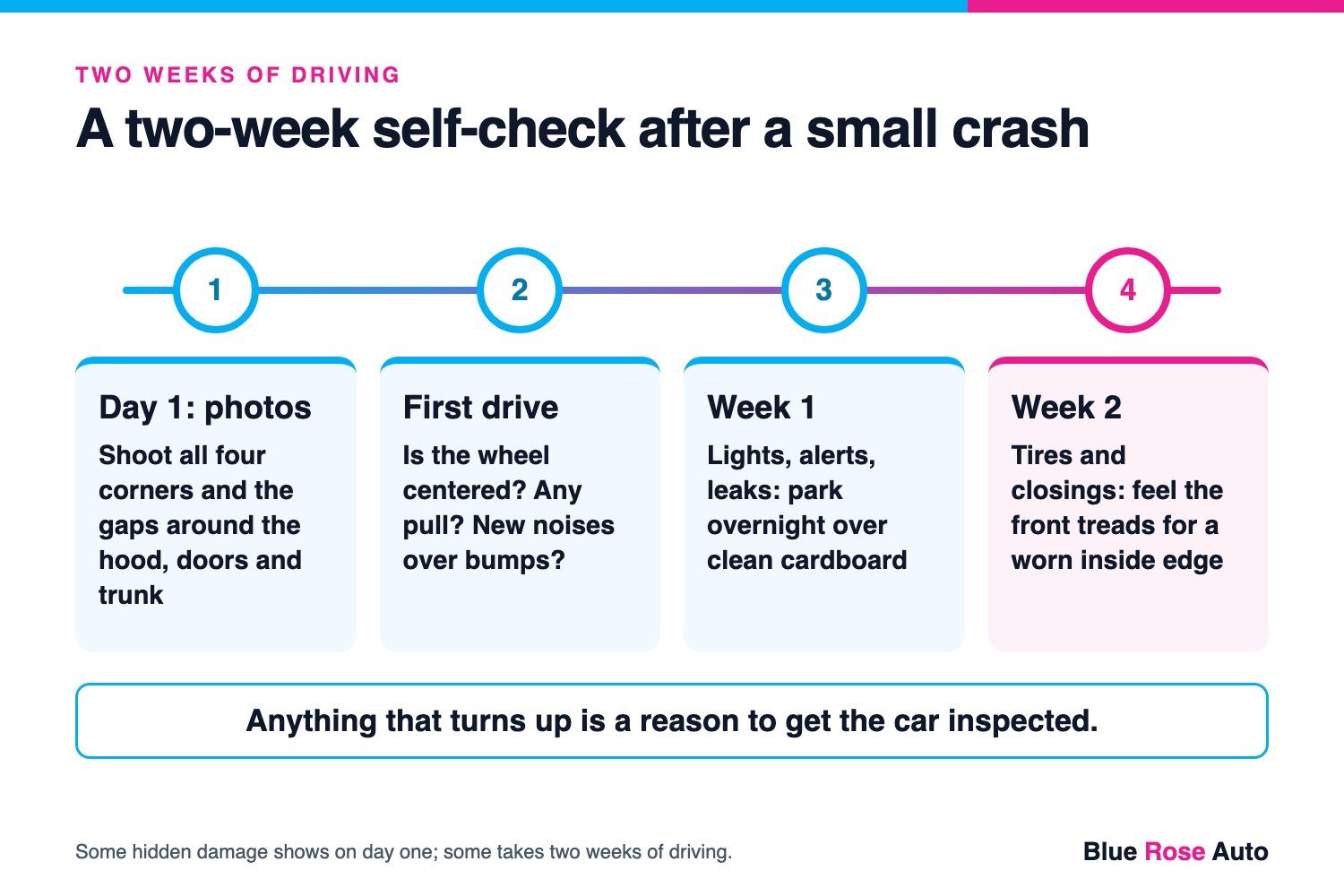
Some hidden damage shows on day one; some takes two weeks of driving. Photos on the day, attention on the first drive, a leak test in week one and a tire check in week two cover the signs a quick walk-around misses. Anything that turns up is a reason to get the car inspected.
Why the delay? Adrenaline hides small changes on the drive home. A cracked radiator end tank may only seep once the engine has heated and cooled a few times. Tire wear from bad toe needs miles to show. And a crushed bumper absorber gives no symptom at all. You only learn it was gone in the next crash, which is why a teardown beats waiting.
- Day 1 photos. Shoot all four corners, the gaps around the hood, doors and trunk, and a few low shots underneath. They help with the insurer and give you a baseline.
- First drive. Is the wheel centered? Any pull? New noises over bumps?
- Week 1 lights, alerts and leaks. Note any warning light or park-assist alert with nothing behind you, and park overnight over clean cardboard.
- Week 2 tires and closings. Feel the front treads for a worn inside edge, and open and close every door, the hood and the trunk.
Don’t wait out the list if something’s already off. Get the car inspected as soon as possible, so hidden damage doesn’t progress and safety systems can be evaluated.
If anything on that list shows up, call (541) 641-8877 and we’ll look before any part gets ordered.
What a shop checks that you can’t
A body shop can measure the structure against factory dimensions, read the car’s computer modules with a scan tool, take the bumper cover off, and road-test the result. Each step turns “looks fine” into a measured answer.
- Pre-repair scan. Pulls stored trouble codes, including ones that never lit the dash. Honda’s position calls for “A preliminary diagnostic scan during the repair estimation phase.”
- Teardown. With the cover off, the absorber, bar, brackets and sensor mounts can be seen and handled. Small-crash surprises tend to turn up here.
- Measuring. Structure gets checked against the maker’s numbers. Measuring instead of eyeballing it is the whole point.
- Road test and post-repair scan, to confirm the car tracks straight and no codes remain.
Ask for proof. That means the removed parts and the scan printout. A shop that found a bent bar should be glad to show you the bar. Our order is simple. We measure, we align, and we tell you what we find before any part gets ordered.
The estimate grew after teardown. What does Oregon law say?
Oregon protects you here. Under ORS 746.292(2), a body and frame shop must give you a written estimate on request before work starts, and it “shall not charge for the work done or parts supplied in excess of the estimate without the consent of such customer.” Hidden damage found at teardown means a revised estimate and your sign-off. Not a surprise bill.
Insurers call that revision a supplement, and ORS 746.292(4)(d) bars a shop from denying the insurer “reasonable access to any repair facility for the purpose of inspecting or reinspecting the damaged vehicle.” Under ORS 746.280(1), an insurer “may not require that a particular person make the repairs” as a condition of paying. A photo estimate can’t include damage nobody has seen, so get a teardown-informed written estimate before signing a cash-settlement release. Policy questions? See what collision coverage pays for.
| Oregon rule | What it means for you | Source |
|---|---|---|
| Written estimate on request (ORS 746.292(2)) | Ask before work starts; no charges above it without your consent | ORS 746.292 |
| Itemized invoice (ORS 746.292(1)) | Every part and job listed; used parts must be stated | ORS 746.292 |
| Insurer reinspection (ORS 746.292(4)(d)) | The insurer can inspect or reinspect the car at the shop during usual business hours, for example when hidden damage is added | ORS 746.292 |
| Your choice of shop (ORS 746.280(1)) | An insurer may not require a particular shop as a condition of paying | ORS 746.280 |
| Check the work first | “Make sure you are satisfied with the finished work before the insurance company pays the repair shop.” | Oregon DFR |
The Oregon Division of Financial Regulation’s consumer hotline is 888-877-4894.
Do you have to report a “small” crash in Oregon?
Sometimes, and hidden damage is often what tips it. ORS 811.720 makes a crash reportable when anyone is hurt or when property damage runs “in excess of $2,500” (the figure in the statute today). A dent that looks like a few hundred dollars can pass that line once the bumper comes off.
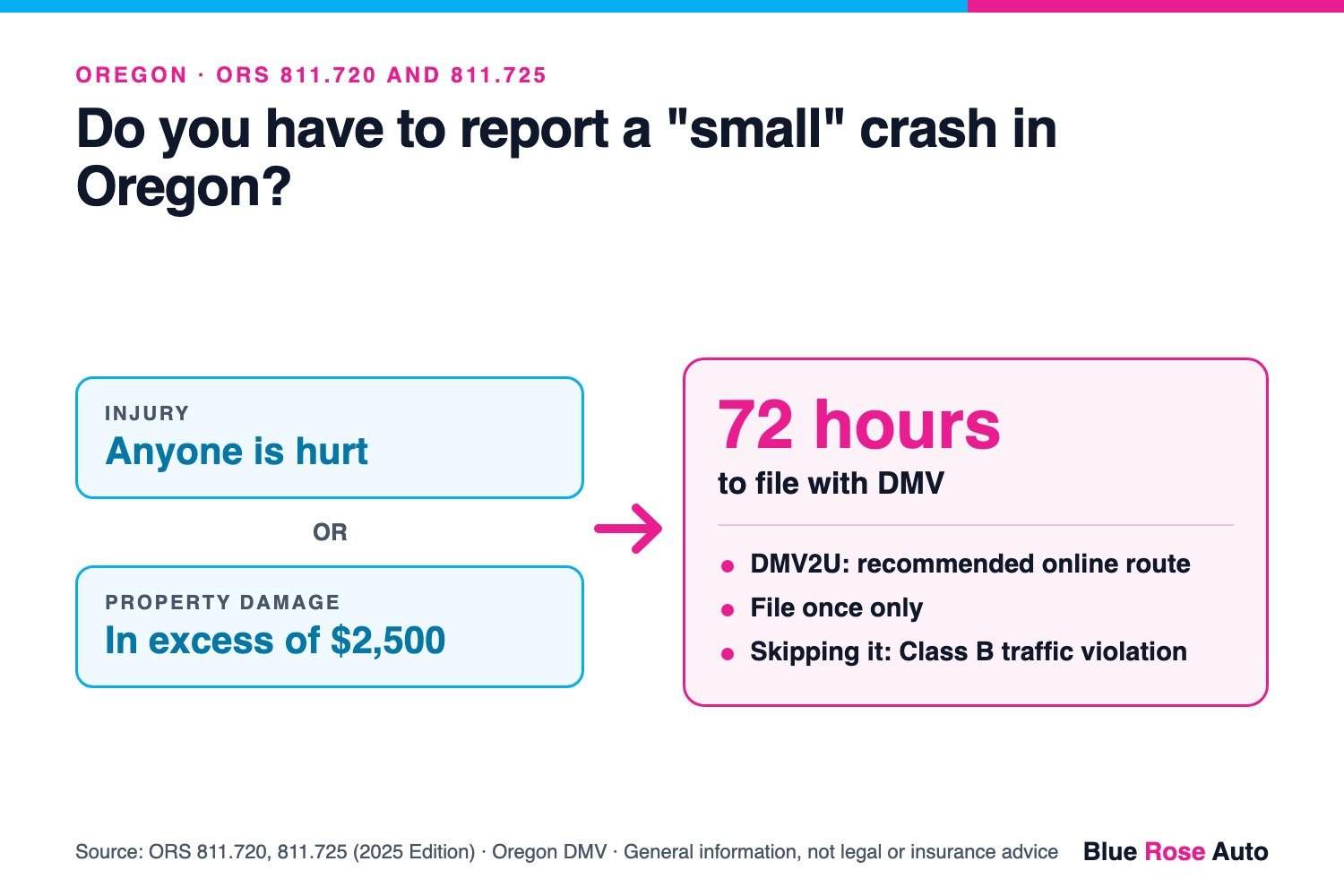
ORS 811.725 gives each driver who must report 72 hours to file with DMV; skipping it is a Class B traffic violation. The Oregon DMV collision page says to file “even if a report is filed by law enforcement,” and DMV2U is its recommended online route. Not sure you had to report? DMV accepts evidence such as “a repair bill or estimate from an auto repair business.” File once only (“Each report you submit shows as a new collision on your record”) and save your own copy, since DMV can’t give you one. Full text is at ORS 811.720.
This is general information, not legal or insurance advice. For your own claim or report, check with your insurer, Oregon DMV or an Oregon attorney.
Frequently asked questions
At what speed does frame damage occur?
No speed is safe by default. It depends on where the car was hit, the angle, and what it hit. A curb, post or trailer hitch concentrates force on a small area, so even a walking-pace bump can move structure. If panel gaps or tracking changed, get it measured.
Can a minor accident mess up alignment?
Yes. A curb slide or a clipped wheel can bend a tie rod or shift toe and camber. The body may look perfect. Watch for a pull, an off-center steering wheel and inside-edge tire wear, and have bent parts checked before an alignment after a curb hit.
Do I need ADAS calibration after a minor accident?
If a radar, camera or parking sensor, or the bumper or bracket holding it, was removed, replaced or moved, then yes. IIHS reports automakers “stipulate systems be calibrated anytime a sensor is removed and replaced or reinstalled.” A scan alone may miss a misaimed sensor. Ask for the calibration record.
Will insurance cover hidden damage found later?
Usually it’s handled as a supplement, where the shop documents the new damage and sends a revised estimate, and Oregon law lets the insurer reinspect. Coverage depends on your policy, so tell the insurer as soon as the damage turns up, before the extra work starts. If the other driver was at fault, ask their insurer about diminished value.
What counts as minor damage after an accident?
There’s no single definition of “minor,” but two lines matter in practice. Honda’s repair position treats anything beyond “minor outer panel cosmetic distortion” as a collision that needs scanning. Oregon’s line is money, because over $2,500 in damage makes the crash reportable to DMV. A scuffed cover with nothing bent behind it is minor; a bent bar or a moved sensor is not, whatever the paint looks like.
How badly does a minor accident affect insurance?
It depends on your insurer, your policy and who was at fault, so ask your agent before deciding. One Oregon limit helps. Under ORS 746.265, an insurer using your DMV driving record to set rates or decide on renewal can’t count an accident more than three years old (ORS 746.265).
Does frame damage mean my car is totaled?
Not automatically. Many unibody cars with structural damage are measured and pulled back to factory dimensions. Whether a car is totaled is the insurer’s call, weighing repair cost against the car’s pre-crash value. CCC reports a record 23.1% of claims were total losses in 2025.
Is it worth claiming minor damage?
Get a written estimate first, ideally with the bumper cover off, then compare it with your deductible and Oregon’s $2,500 reporting line. A quick photo estimate can miss the bent bar or misaimed sensor that changes the math. Rear-ended with no visible damage? Read your policy’s notice clause, which says when you have to tell the insurer about an accident, even one you never claim.
How long does collision repair take after a minor accident?
It depends on parts availability, whether teardown turns up a supplement, and how fast the insurer approves it. We can give a realistic timeline only after an inspection, because the bumper cover has to come off first. Here’s what to expect once repairs start.
Get it checked before you settle
Hidden damage after a minor car accident doesn’t fix itself, and it’s far easier to sort out before the claim closes. Call (541) 641-8877 for a written estimate before you settle. Blue Rose Auto opened in 1994, and our ASE-certified technicians check behind the bumper cover and tell you what they find before any part gets ordered. Read more about a collision inspection before you settle the claim, or contact the shop.
Blue Rose Auto, 3436 Olympic St, Springfield, OR 97478.
0 Comments