
Wet leaves usually stain car paint rather than damage it. Tannins leach out of soaked leaves and leave a brown outline sitting on top of the clear coat, and a proper wash or a clay bar usually removes it. A print only counts as damage when it’s etched into the clear coat and you can still see it after washing. That needs machine polishing, not scrubbing.
Found brown outlines on your hood and searched for wet leaves on car paint damage? Start with that split. Eugene’s normal October rain is 3.17 inches, more than double September’s 1.39 (National Weather Service, 1991-2020 normals). Leaves that land on a parked car this time of year rarely get the chance to dry out.
Written by the Blue Rose Auto detailing team in Springfield, OR. Last updated October 2026.
Can wet leaves damage car paint?
Usually not in a permanent way. A soaked leaf sitting on a hood leaves a tea-colored print on top of the paint, and most of those prints wash out. Damage starts when the print sinks into the clear coat and stays visible after a proper wash. Don’t reach for a polisher before you’ve washed it.
The color comes from tannins, brown plant compounds that dissolve out of wet leaves. Rain does the leaching. Picture a tea bag pressed flat against your roof. The longer it sits wet, the harder that outline is to remove. Plenty of sites put an hour count on when a stain “sets,” but none we read cite a source for it, so we won’t repeat one. Get leaves off when you see them. Wash the outline soon after.
Is it a stain, bonded residue or etched paint?
Every leaf print falls into one of three tiers, and each has its own test. The mildest, a stain, sits on top of the paint and fades or disappears with a pH-neutral wash. A bonded mark survives the wash, and the panel feels gritty when you drag a fingertip across it inside a thin plastic sandwich bag; clay bar decontamination lifts it, and then the paint needs fresh protection. An etched print is in the clear coat itself. After washing and claying, the surface feels smooth, your fingernail doesn’t catch an edge, yet the leaf shape still distorts reflected light when you look across the panel at an angle. Etching only comes out with machine polishing, done after the clear coat is measured so the polish doesn’t take off more than the paint can spare. Scrubbing harder at any tier just adds scratches. Blue Rose Auto inspects the mark in Springfield, OR before recommending anything. Call (541) 641-8877.
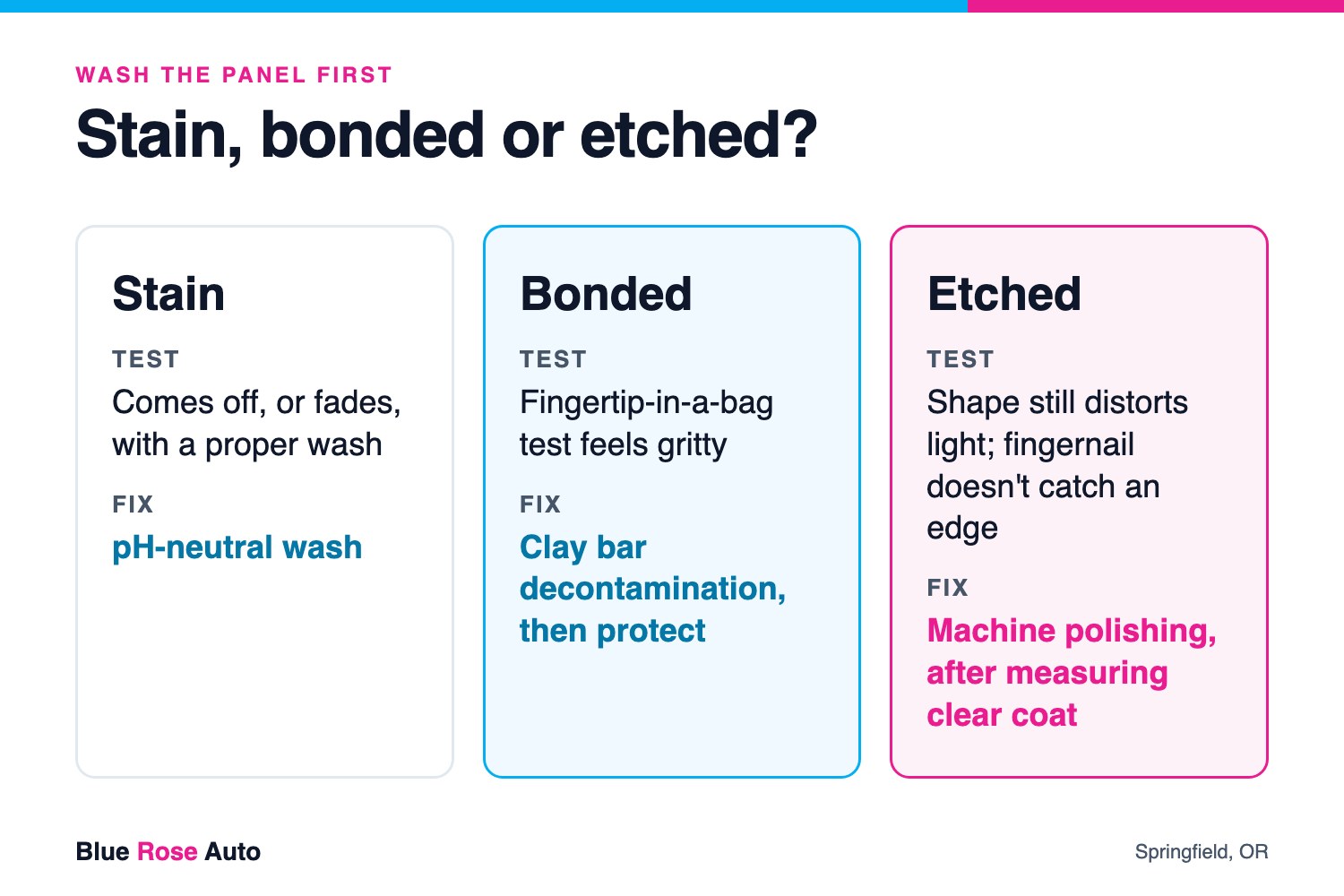
Wash the panel first, then run two quick checks.
| Tier | What it looks like | At-home test | What fixes it | Shop job? |
|---|---|---|---|---|
| Stain | Brown or tan leaf outline sitting on top of the paint | Comes off, or fades, with a proper wash | pH-neutral wash, repeat if needed | No |
| Bonded | Outline or specks still there after washing; paint feels rough under a plastic-bagged fingertip | Fingertip-in-a-bag test feels gritty | Clay bar decontamination, then protect | Optional, since clay is part of exterior detailing |
| Etched | Outline visible in reflection from an angle after washing and claying; surface feels smooth | Reflection test shows the shape still distorting light, and a fingernail doesn’t catch an edge | Machine polishing, after measuring clear coat | Yes |
Most leaf marks stop at the first row. If yours made it to the third, scrubbing harder only adds scratches.
Why is my car sticky under maples and birches?
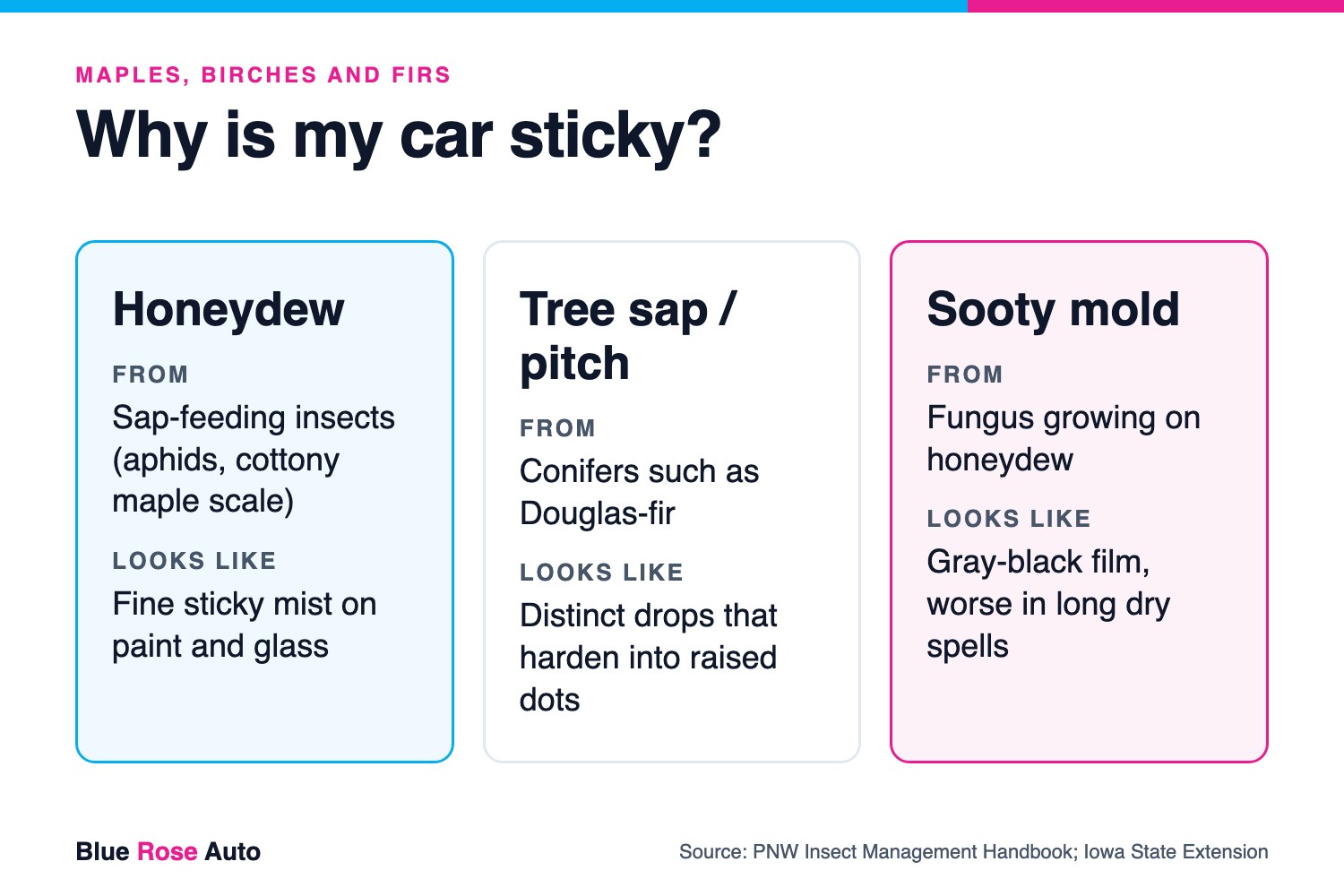
That tacky film is usually honeydew, not sap. Honeydew is what sap-feeding insects such as aphids excrete after feeding, and it drifts down from infested trees in a fine mist that coats everything parked below. Real tree sap shows up as distinct drops instead. The difference matters because honeydew covers the whole car, glass included, and feeds a black fungus if it stays put.
Iowa State Extension describes honeydew as “basically the plant sugars that end up passing through the digestive system of sap-feeding insects,” and notes that shade trees such as maples and oaks can carry aphid populations big enough to produce noticeable amounts (Iowa State Extension). The regional handbook is blunter. Its birch aphid entry warns that honeydew “may become a sticky nuisance when it falls on decks, cars, or other landscape surfaces” (PNW Insect Management Handbook).
Sooty mold, the gray-black film, gets worse “when we go a long period without rain to wash off the honeydew,” per Iowa State. Eugene’s August normal is 0.39 inches. A car parked under an infested maple all summer has had a long, dry season to collect it.
| Residue | Where it comes from | What it looks/feels like | Source |
|---|---|---|---|
| Honeydew | Sap-feeding insects (aphids, cottony maple scale) on maples, birches, oaks | Fine sticky mist on paint and glass; can turn black with sooty mold | PNW Handbooks, Iowa State Extension |
| Tree sap / pitch | The tree itself, including conifers such as Douglas-fir | Distinct drops that harden into raised dots | General detailing observation, no single source |
| Sooty mold | Fungus growing on honeydew | Gray-black film, worse in long dry spells | Iowa State Extension |
Douglas-fir is Oregon’s state tree and grows west of the Cascades (Oregon Department of Forestry). If hard amber dots keep appearing on a roof parked near conifers, pitch is the more likely culprit than honeydew.
How do you remove sap and leaf stains safely?
Work from the gentlest step up, and stop as soon as the mark is gone. The goal is to lift contamination without grinding it across the clear coat, which is how a ten-minute stain turns into a polishing job.
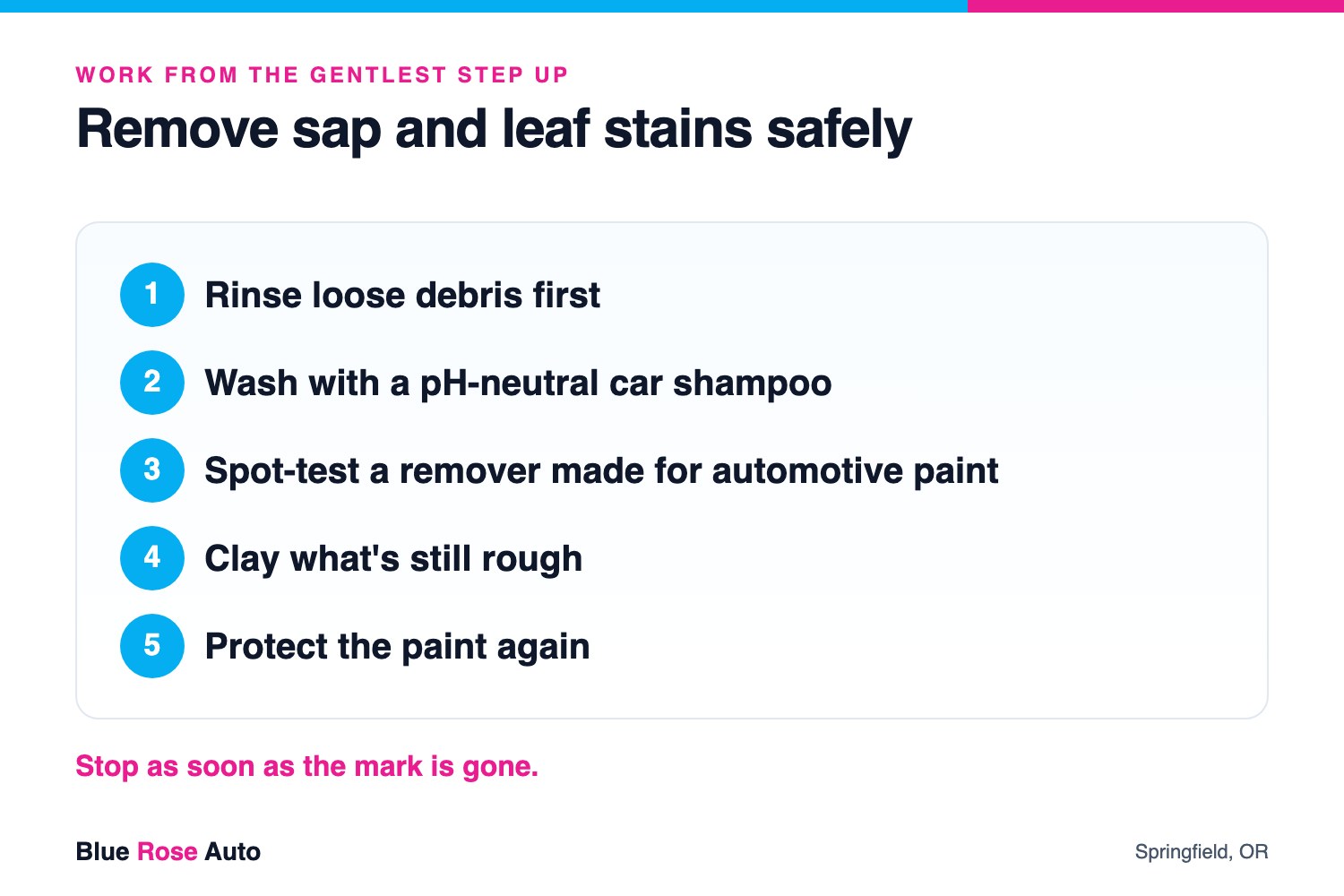
- Rinse loose debris first. Grit and fir needles act like sandpaper under a wash mitt. Flood the panel with plain water before anything touches it.
- Wash with a pH-neutral car shampoo. A clean mitt and this step alone clear most tannin stains and fresh honeydew.
- Spot-test a remover made for automotive paint. For sap drops that survive the wash, try a product labeled safe on car paint in a hidden spot first, then let it soften the sap instead of rubbing hard.
- Clay what’s still rough. A clay bar with plenty of lubricant pulls bonded specks out of the surface (more on that below).
- Protect the paint again. Removers and clay strip wax or sealant. Put a coat back on before the next rain.
Household degreasers and lubricants weren’t formulated for clear coat and can strip what protection the paint had. Skip the kitchen cabinet.
Clay is the step people search for without knowing when they need it. A lubricated clay bar grabs contamination stuck in the surface but not etched into it, such as sap mist or the gritty leftovers of a leaf stain. Paint feels like fine sandpaper after a wash? That’s your cue. Our clay bar decontamination for bonded sap is part of an exterior detail, and wax or sealant can go on right after, because clayed paint is bare paint.
When is a leaf print in the clear coat?
A leaf print is in the clear coat when it survives both a wash and a clay, feels perfectly smooth, and still shows its outline in reflected light. No cleaner will touch it now. Nothing is sitting on top anymore. The surface itself has changed shape. Leveling is the only fix.
Signs you’re looking at etching:
- The outline shows up best when you crouch and look across the panel toward a light source.
- Your fingernail slides over it without catching any edge.
- Clay passes over it smoothly and leaves the shape behind.
Water spots etch into the clear coat, and leaf prints can too. When a car comes in with leaf prints, we inspect the paint before deciding on polish. Clear coat is typically only 40 to 50 microns thick (published detailing guides, 2026), so if a print needs machine polishing to level an etched leaf print, we measure clear coat depth and choose safe polishing levels, because clear coat removed doesn’t grow back. Detailing has limits too. It can’t undo severe wear or real damage. Chalky, faded paint is oxidation, which is a different problem from leaf etching.
If the print survived a wash and a clay, bring the car in and we’ll take a look.
Why does moss grow in window seals every fall?
Moss grows where water sits and light doesn’t reach, and window rubbers on a car parked in shade fit that description. In western Oregon the timing tracks the rain. Seals that looked clean in September can show a green line along the rear window or sunroof by late winter.
We found no car-specific research on this. Here’s the honest source instead. Oregon State University’s lawn research says that “in western Oregon, growth normally starts with fall rains and reaches a peak in early spring” (OSU Extension, EM 9175). OSU is talking about lawns, but the same wet, shaded conditions apply to a rubber seal under a carport. Its companion video notes that western Oregon’s mild, wet winters encourage moss (OSU Extension, EM 9176).
Gentle removal works best:
- Brush with a soft detailing brush, never wire.
- Apply a mild, car-safe cleaner diluted in water and let it soak a minute.
- Rinse at low pressure. Pressure washers and rubber seals don’t mix.
- Dry the channel with a microfiber, then check that nearby drains aren’t packed with debris.
Skip harsh solvents. They dry out rubber faster than moss ever will.
What do fall leaves do to cowls and drains?
The costliest leaf damage often isn’t on the paint. Leaves and needles collect in the cowl, the vented panel below the windshield, and in the channels around sunroofs and door bottoms. Each one has a drain. Packed leaf litter can block it and send water somewhere it shouldn’t go.
Places to check after a windy week:
- The cowl. Clearing the windshield doesn’t clear the trough beneath it; lift out what you can reach.
- Sunroof drains. Small tubes in the corners of the sunroof tray clog quietly with needles.
- Door drains. Slots along the bottom edge of each door should let water out freely.
A damp passenger footwell weeks after leaf season can point to water leaking in after the cowl drains clog. If the carpet has already soaked up water, interior detailing that extracts moisture from carpet is part of drying it out properly.
Why do bird droppings etch more on cold nights?
The common explanation is acid, but a car-care manufacturer’s own testing points somewhere else. Autoglym’s research says etched bodywork “is not due to the corrosive properties of bird droppings. Instead, the damage results from the paint lacquer contracting and molding to the uneven texture of the dried deposits as it cools” (Autoglym research).
Autoglym describes three phases:
- Heat expansion. Warm sun softens and expands the clear coat.
- Hardening. The dropping dries into a rigid, uneven crust.
- Cooling contraction. As temperatures drop, “particularly overnight,” the lacquer contracts and molds around the crust.
That’s why fall matters. A sunny afternoon and a cold night give a dropping one full cycle to leave a dull outline. Soak droppings with water or a quick detailer, then lift them off. Never dry-wipe.
Does a sealant or ceramic coating stop leaf stains?
A coating or sealant makes leaf stains less likely and easier to wash off. It doesn’t make paint immune. A ceramic coating adds a hard barrier over the clear coat, so UV, sap and bird droppings are less likely to etch or stain the paint underneath, but it is not armor.
A coated car still collects leaf prints. The payoff comes at wash time, when tannin outlines and honeydew rinse away with less rubbing, and less rubbing means fewer scratches. In our view, a ceramic coating makes sap and leaf residue release faster than bare paint. Blue Rose Auto is a Ceramic Pro Certified Elite Dealer, and a professional coating lasts about 2 to 5 years and typically costs $800 to $2,000 on a car, while wax lasts about 1 to 3 months (Jalopnik, February 2026). The math on when each one pays off is in ceramic coating vs wax for rainy months. Whichever you pick, leaves still need to come off the paint.
What fall routine keeps paint safe in the valley?
A short, regular routine beats a heroic cleanup in December. Rain climbs every month from August through December in Eugene, and the City of Eugene’s leaf collection program typically runs from early November into January (City of Eugene), so the city’s leaf season lines up with the wettest months.
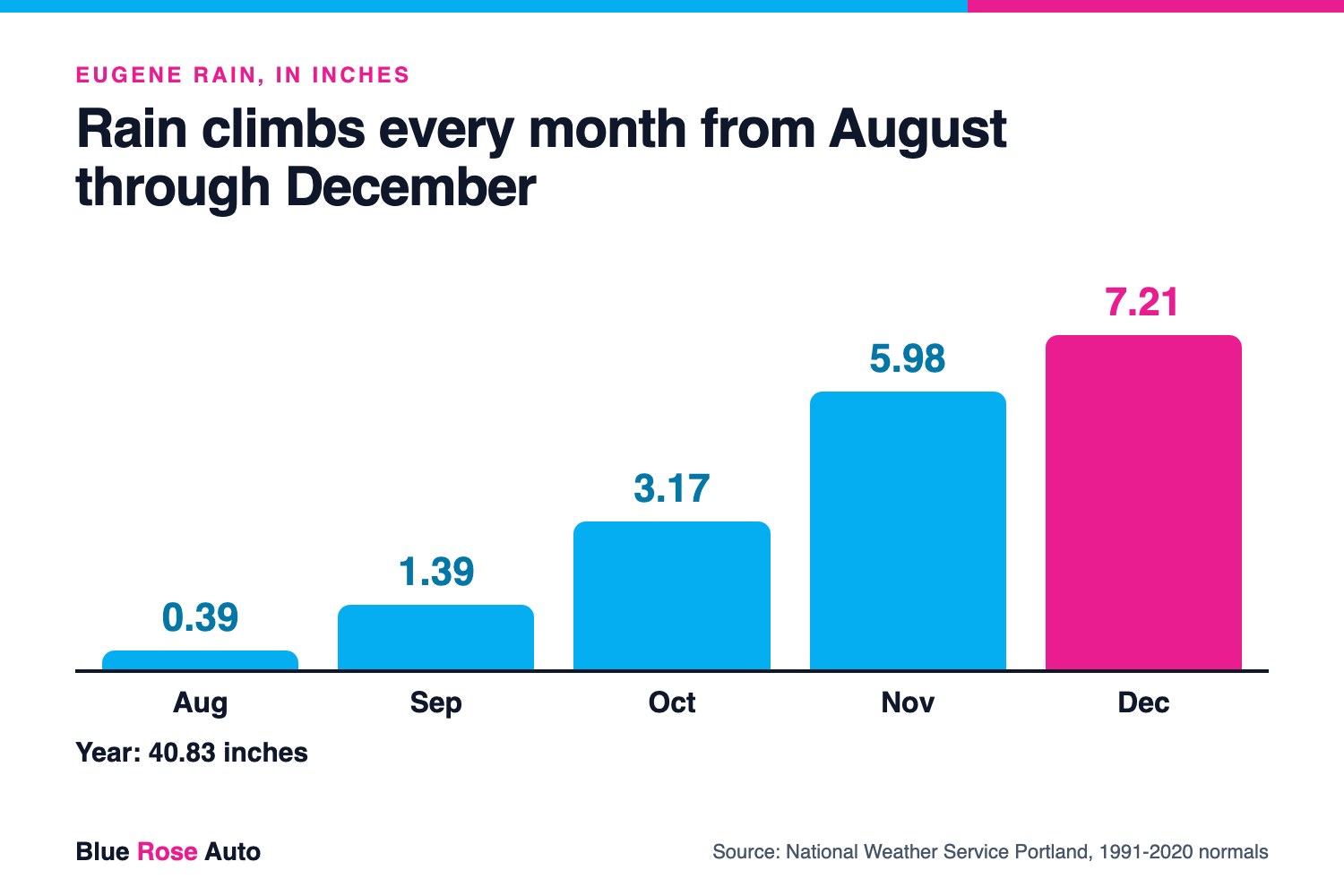
| Month | Aug | Sep | Oct | Nov | Dec | Year |
|---|---|---|---|---|---|---|
| Inches | 0.39 | 1.39 | 3.17 | 5.98 | 7.21 | 40.83 |
Eugene precipitation normals, 1991-2020, National Weather Service Portland.
A routine that fits the season:
- Pull leaves off the hood, roof and cowl whenever you see them, not only on wash day.
- Wash the outlines before they have a chance to sit through another wet week.
- Do the bagged-fingertip test once a month and clay if the paint feels rough.
- Top up wax or sealant before November’s heavier rain, unless the car is ceramic coated, since Ceramic Pro tells owners not to layer wax over a coating.
- Look at window seals and sunroof drains when you check your wipers.
Leaves clog drains, on streets and on cars. Wash timing through an Oregon winter is covered in how often you should wash your car, and the rest of a fall car-care checklist handles tires and batteries.
Fall paint questions drivers ask us
Can tree sap permanently damage car paint?
It can, but fresh sap usually doesn’t. A sap remover made for car paint or a lubricated clay bar typically lifts fresh drops cleanly. Trouble starts when sap sits long enough to mark the clear coat, and then the fix is machine polishing instead of another round of remover. Nobody can honestly give you a day count.
Will dish soap or WD-40 take sap off safely?
We don’t recommend either. Household degreasers and lubricants aren’t made for automotive paint, and they can strip the wax or sealant that was protecting the clear coat. Use a product labeled safe for car paint, spot-test it somewhere hidden, then wash the panel and put protection back on afterward.
How can I tell a leaf stain from etched paint?
Wash the panel, then look across it at an angle toward a light. If the outline is gone, it was a stain. If it’s still there and feels rough under a bagged fingertip, it’s bonded contamination that needs clay. Smooth paint with the shape still showing in the reflection means the print is etched into the clear coat.
Is the sticky film on my car sap or honeydew?
Under maples and birches it’s usually honeydew, the sugary waste of sap-feeding insects such as aphids. It falls as a fine mist over paint and glass. Real sap or pitch shows up as distinct drops that harden, often near conifers. Honeydew can also grow a gray-black sooty mold if rain doesn’t wash it off.
How do I get moss off my car’s window seals?
Use a soft brush and a mild, car-safe cleaner, let it soak briefly, then rinse with low-pressure water and dry the channel. Don’t aim a pressure washer at rubber seals or use harsh solvents. While you’re there, check the nearby sunroof or door drains, because moss and needles tend to collect in the same places.
Do bird droppings etch paint because of acid?
Not mainly. Autoglym’s research says the damage comes from the clear coat contracting and molding to the dried deposit as it cools, especially overnight, rather than from corrosive droppings. Soak droppings with water or a quick detailer and lift them off instead of dry-wiping, which can drag grit across the paint.
Should I park under trees in the fall?
Avoid it if you have a choice. Trees drop honeydew, pitch and leaves, and the leaves pack into cowls and drains. If a tree-lined street is your only option, wash more often through the rainy months, pull leaves off the paint when you see them, and clear the cowl below the windshield every week or two.
Can fall leaves clog a car’s cowl and drains?
Yes. Leaves and needles collect in the cowl below the windshield and in sunroof and door drains. Packed litter can block those drains and push water into the cabin. Check them after a windy week, and treat a damp footwell weeks after leaf season as a possible sign of a clogged drain.
Does a ceramic coating make a car leaf-proof?
No. A ceramic coating helps leaf residue and sap release faster at wash time, but it is not armor, and leaves left on a coated car can still mark it. Think of the coating as making cleanup easier, then keep washing leaves off on a regular schedule.
When should you bring it to Blue Rose Auto?
If a leaf print, sap spot or green seal survived a proper wash, bring it by our Springfield shop at 3436 Olympic St. We’ll inspect it and tell you whether it needs a wash, a clay, or polishing. Call (541) 641-8877, or use the contact form to book a full exterior and interior detail.
Sources
- National Weather Service Portland, Eugene precipitation normals, 1991-2020
- Iowa State Extension, honeydew and aphids on trees
- PNW Insect Management Handbook, birch aphid
- Oregon Department of Forestry, Douglas-fir
- OSU Extension, EM 9175 and EM 9176
- Autoglym, bird dropping damage research
- City of Eugene, leaf collection and delivery
- Ceramic coating and wax figures from Jalopnik, February 2026, as cited in our ceramic coating vs wax guide
Blue Rose Auto opened in 1994. Our ASE-certified technicians work at 3436 Olympic St, Springfield, OR 97478.
0 Comments