
Blue Rose Auto repairs car water leaks for drivers in Eugene and Springfield, Oregon, by finding the entry point with a water test or smoke test, fixing the seal or drain, and drying the interior. The first 15 minutes of diagnosis are free, then it is $100 an hour, and we credit that time to the repair if you approve it. Eugene gets 40.83 inches of rain in a normal year, about 70 percent of it from November to March (National Weather Service). Water that sits in carpet and padding past 24 to 48 hours can grow mold (EPA), so the first few days matter. We handle water leak repair for cars at our shop at 3436 Olympic St in Springfield.
Last updated October 2026
Key takeaways
- Eugene averages 40.83 inches of rain a year, and December is the wettest month at 7.21 inches (NWS, 1991 to 2020 normals).
- Dry wet carpet and padding within 24 to 48 hours to head off mold (EPA and CDC).
- Sunroof drain clearing runs about $100 to $250 and sunroof seal or leak repair about $150 to $600 on the national market (Empire Auto Protect, 2026).
- Our diagnosis is free for the first 15 minutes, then $100 an hour, credited to the repair if you approve it.
- Clear water dripping under the car after you run the AC is normal condensation, not a leak.
Car water leaks show up more often around here than many drivers expect. Steady rain in Eugene, Springfield and the towns nearby soaks seals, clogs drains and finds every weak spot in a body. Once water gets inside, it does not leave on its own. It settles into carpet, under seats, behind panels and under trim, and that brings damp smells, mold, stains and sometimes electrical faults. Below we cover how a leak happens, how to tell it from other fluids, how we find the source and what repairs tend to cost.
Why Car Water Leaks Happen in Eugene and Springfield
A car is sealed in many places, and those seals wear out. Rain can get in through a door seal, window trim, a roof seam, a loose windshield bond or a clogged drain, and the car can look fine from the outside while the carpet underneath stays wet. Seven common entry points are marked on the diagram below.
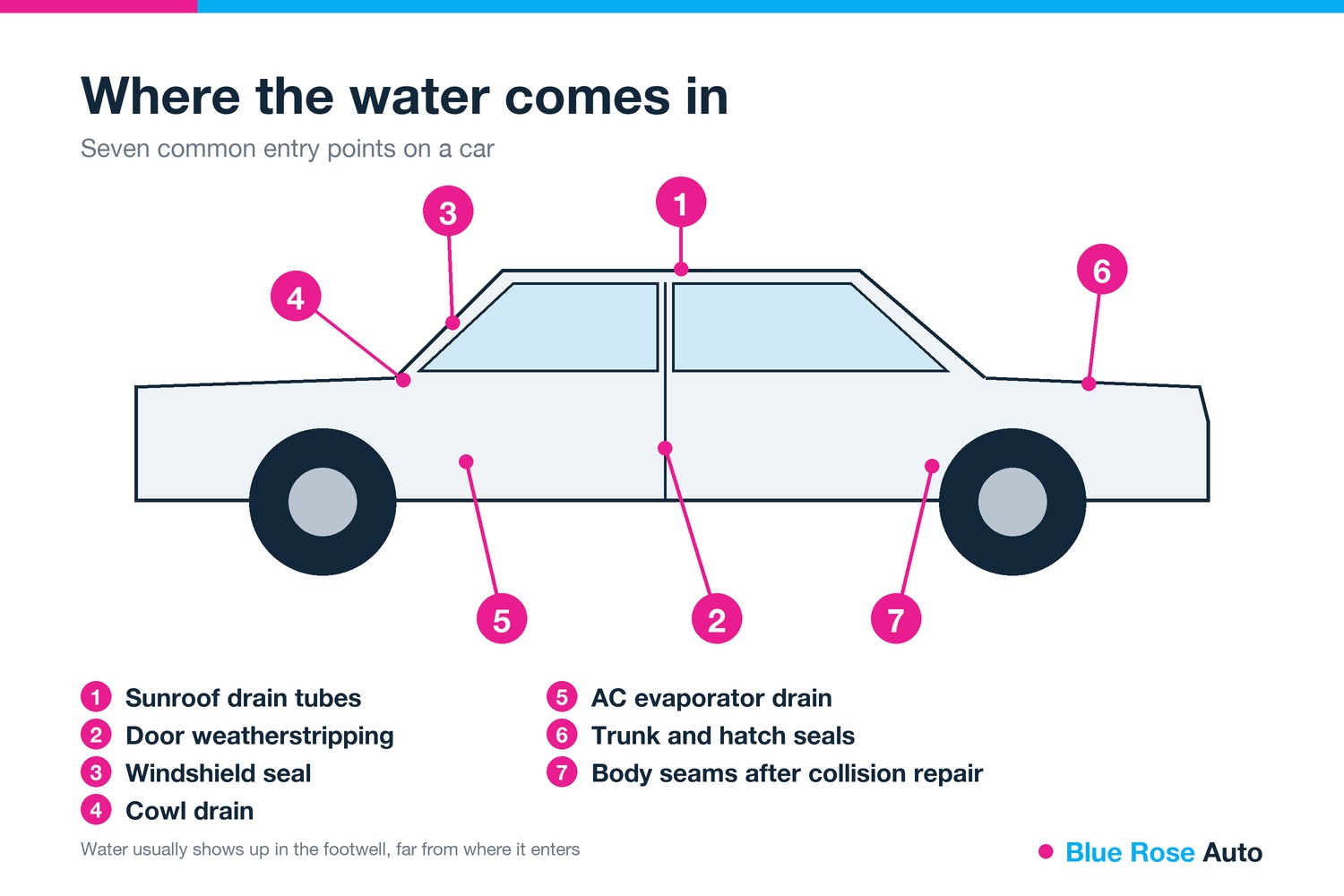
Seven common entry points on a car are marked above. Water usually shows up in the footwell, far from where it enters. Weatherstripping, sunroof drains and windshield seals are the usual causes of a water leak in a car, and these are the ones we find most.
- Door weatherstripping and trunk and hatch seals get stiff or cracked with age. Once they stop sealing tight, rain runs along the inside of the panel and into the floor.
- Sunroof drain tubes are small. Leaves and dust clog them, and the water backs up into the headliner and down the pillars.
- The windshield seal and the cowl drain sit at the base of the glass. A weak bond lets rain slide in behind the windshield, and a cowl drain packed with leaves overflows toward the footwell.
- The AC evaporator drain carries condensation outside. When it blocks, water pools on the passenger side floor inside the car. We repair car A/C systems, including clogged evaporator drains.
- Body seams after collision repair, or after any impact, can open up. Even a small impact can twist a panel just enough to break a seal, and our collision repair team works on body damage that shifts seals.
Each of these can start small. Oregon rain keeps the interior damp for days at a stretch, so a slow drip can go unnoticed for weeks.

Water Leak, Coolant Leak or Condensation
Not every wet floor is rain, so ask what kind of wet is it. Three look-alikes, three different fixes. The table below separates them. Rainwater is clear and has no smell. Coolant smells sweet, may be green, orange or pink, and often leaves an oily film on the glass, which points to the heater core. We repair the heater core and the rest of the climate control system.
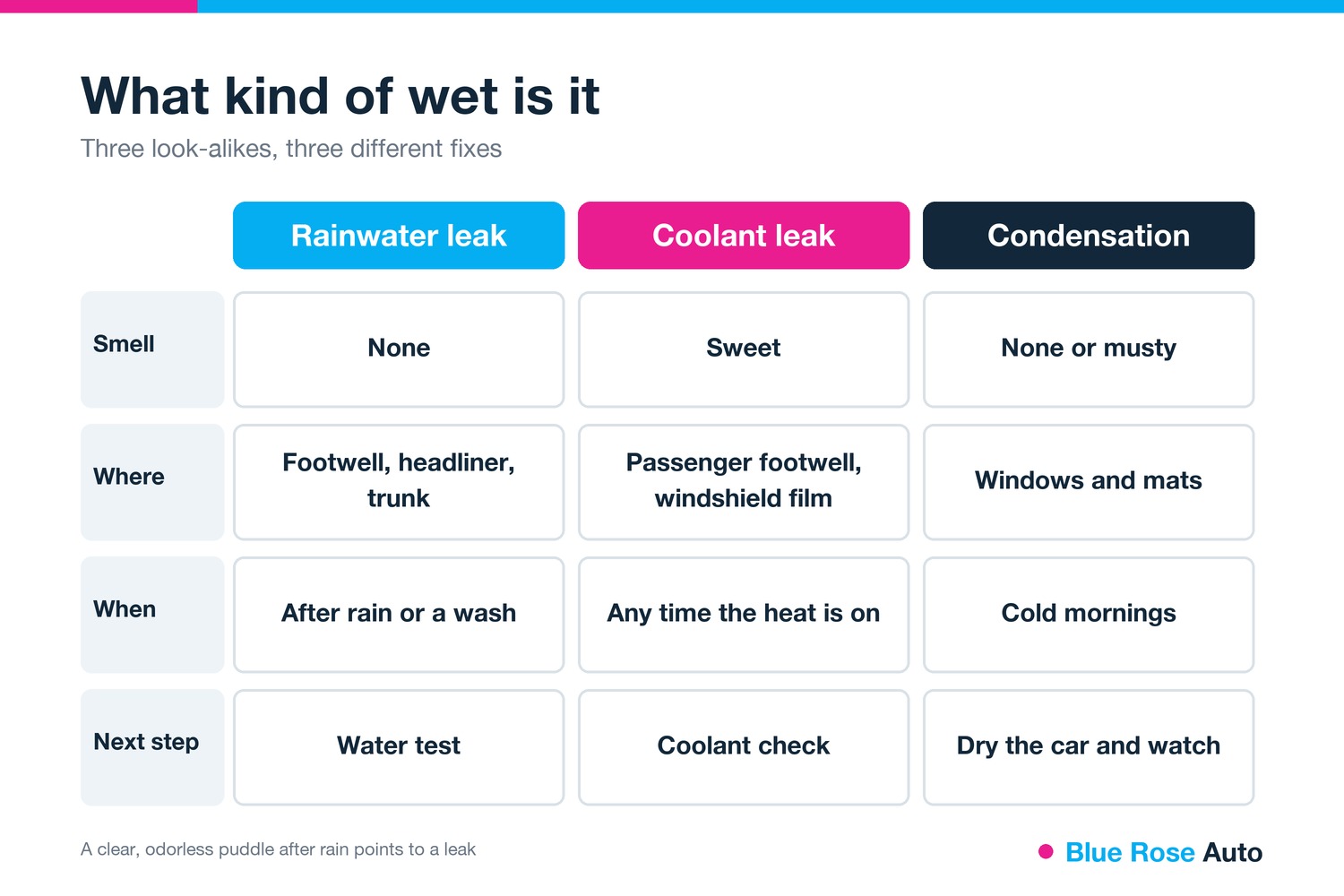
| Clue | Rainwater leak | Coolant leak | Condensation |
|---|---|---|---|
| Smell | None | Sweet | None or musty |
| Where | Footwell, headliner, trunk | Passenger footwell, windshield film | Windows and mats |
| When | After rain or a wash | Any time the heat is on | Cold mornings |
| Next step | Water test | Coolant check | Dry the car and watch |
A clear, odorless puddle after rain points to a leak. One more thing that trips people up. Clear water dripping onto the ground under the car after you run the AC is normal condensation leaving through the drain, so it is not a leak at all. Water on the passenger footwell inside the car is the problem, and that means a blocked AC drain or a leak.
Condensation Inside the Car Overnight
Breath, wet coats and damp floor mats raise the humidity in a closed car, and the glass fogs on a cold night. If the fog clears quickly with the defroster and the carpet is dry, you have condensation and not a leak. To check, press a dry paper towel into the carpet corners and under the mats. Dry paper means the moisture is in the air. Damp paper means water is getting in, and the car needs a leak test.
Signs You Have a Car Water Leak
People usually notice moisture first, but the signs can be quiet. These are the ones drivers report most.
- Foggy windows inside. Trapped moisture rises, and the glass fogs more than usual, mostly in the morning.
- A musty or damp smell. A stale smell appears even after cleaning, and the carpet may feel cool to the touch.
- A wet floor under the mats. The surface can look dry while the padding underneath is soaked, so lift the mat.
- A wet passenger footwell. This points to a blocked AC drain, a clogged sunroof drain or a cowl leak.
- Stains on the headliner or door panels. Water that travels through insulated areas leaves faint rings or dark patches.
- Window switches or locks that act up after rain. Water in a door panel can reach the wiring.
- A smell that returns after cleaning. Damp padding holds odor, and a deep clean will not hold if the leak is still active.
If one or more of these show up, a leak is likely.
Why a Car Water Leak Needs Fast Repair
Water inside a vehicle does not dry quickly. Fabric and padding hold it, and a parked car has little airflow. The EPA says that if wet or damp materials are dried within 24 to 48 hours after a leak or spill, mold will not grow in most cases. The CDC gives the same 24 to 48 hour window for cleaning up after a flood, and it lists a stuffy nose, sore throat, coughing or wheezing, burning eyes and skin rash as mold symptoms for some people. People with asthma, a mold allergy, a weakened immune system or chronic lung disease are at higher risk.
Left alone, a leak causes damage that gets pricier with time.
- Carpet padding rots and holds odor.
- Metal floor panels can rust.
- Mold can grow in the padding and under the seats. We handle mold removal from the interior when it has set in.
- Air quality in the cabin drops.
Electrical parts are the other risk. Many vehicles run modules, wires and connectors under the carpet, and moisture can corrode them. One verified example is NHTSA recall 23V-337, which covers 2007 to 2014 MINI Cooper Hardtop and Clubman models. The footwell module can become susceptible to moisture and corrosion, and the repair includes new sunroof drain tube outlet hoses and a water soak test. Your car may be built differently, but the point holds. When we see electrical faults that start after rain, we run diagnostics on the electrical faults alongside the leak search, and if water reached the electrical system we also test the battery and charging system.
How We Test for a Car Water Leak
We take leak diagnosis one step at a time. Guesswork costs you hours and tears into the interior without a plan, while careful testing points to the source. These are the steps we use.
Visual Inspection
We start with a close look at door seals, sunroof seams, window trim, AC drain tubes, the cowl and body seams. Many leaks start at one of these points, and the staining on the carpet and headliner shows us which way the water traveled.
Controlled Water Test
We run water in a slow, controlled flow, starting low on the car and working up so we see the highest wet spot. A heavy blast of water hides the leak. A slow flow lets the leak show where it enters.
Smoke Test to Find a Water Leak in a Car
Sometimes the path hides inside the body. A smoke test to find a water leak in a car lets us watch air movement, and water follows the same path air would take. It works well on tricky leaks that a water test does not reveal.
Pressure and Drain Tests
Sunroofs and cowls have to move water out. If a drain is blocked, we clear the blockage and then check the drain flow.
Interior Drying and Odor Treatment
Once the entry point is closed, the wet carpet and padding still have to dry. We pull back mats and trim where needed so air can reach the padding, and our detailing team dries and deodorizes the interior so a damp smell does not linger.
What a Repair Visit Looks Like
- You tell us when it leaks, whether that is in rain, at the car wash or with the AC on.
- We run the diagnosis, and the first 15 minutes are free.
- We use a water test or smoke test to find the entry point.
- You approve the repair. We seal, replace or clear the source and run the test again to confirm the water no longer gets in.
- We dry the interior, or hand it to detailing if the carpet needs a deeper cleaning.
The $100 an hour after the free 15 minutes is credited to the repair when you approve it. Our shop is at 3436 Olympic St in Springfield.
Car Water Leak Repair Near Me in Eugene and Springfield
Many drivers search for car water leak repair near them after they find a wet carpet. We repair cars at our Springfield shop at 3436 Olympic St, and we take in repair work from Springfield drivers and drivers coming over from Eugene. Drivers also come from Junction City, Coburg, Santa Clara, Veneta, Cottage Grove, Creswell, Harrisburg and Lowell. If you are unsure what you are seeing, call (541) 641-8877 and tell us when the water shows up.
Car Water Leak Repair Cost in Eugene and Springfield
The price depends on where the water gets in, how much got inside and what it takes to reach it. These are the four things that move it.
- The source of the leak
- How much water is inside
- Whether drying or mold cleaning is needed
- Whether seals or drain lines must be replaced
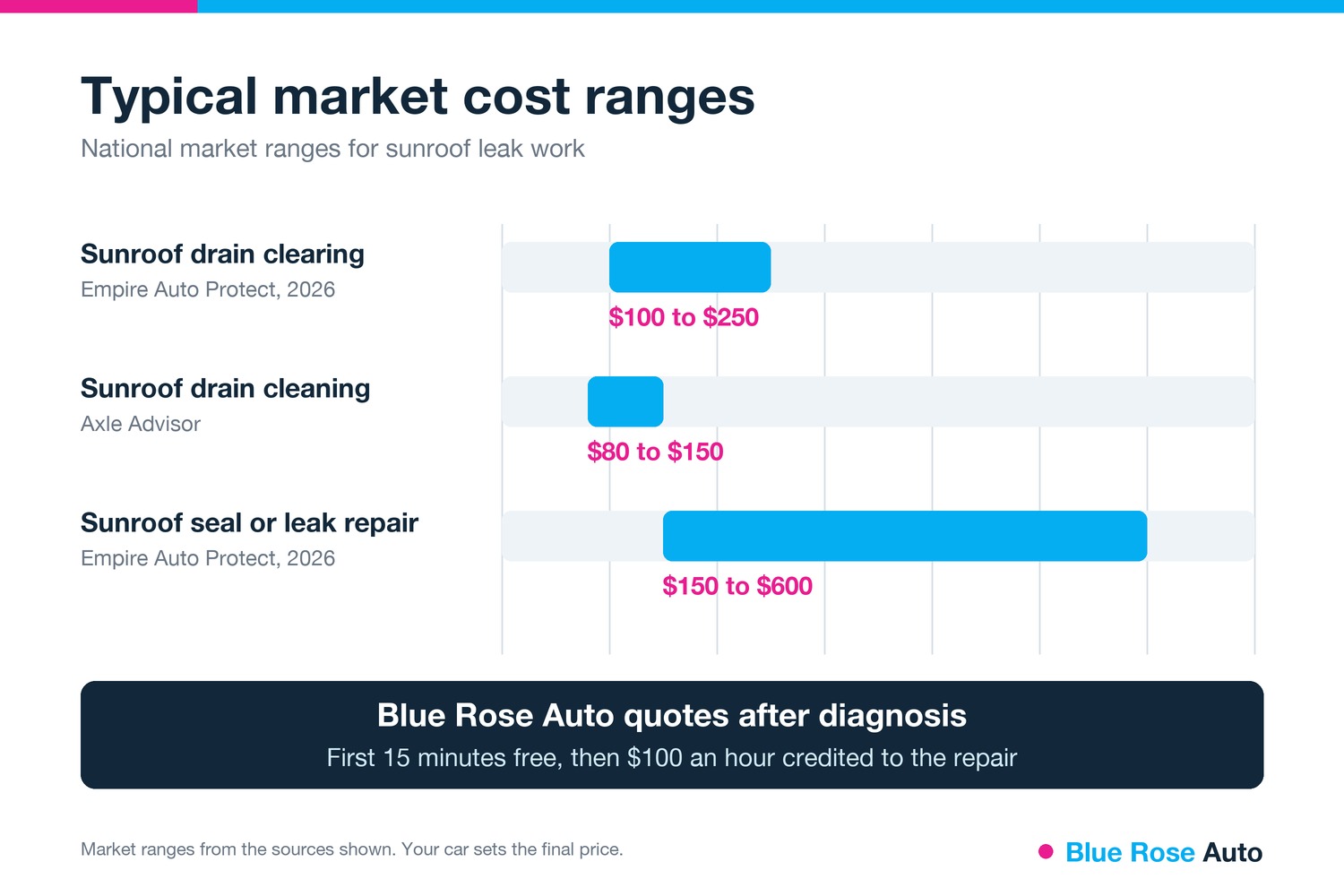
The chart above shows typical market cost ranges. National market ranges for sunroof leak work come from two published sources, and they are not a Blue Rose quote.
| Repair | Market range | Source |
|---|---|---|
| Sunroof drain clearing | $100 to $250 | Empire Auto Protect, 2026 |
| Sunroof drain cleaning | $80 to $150 | Axle Advisor |
| Sunroof seal or leak repair | $150 to $600 | Empire Auto Protect, 2026 |
Empire Auto Protect puts typical sunroof work at 3 to 5 labor hours at $100 to $185 an hour. The range is wide because some repairs mean removing the headliner to reach the drain tube, and that adds labor. We do not publish figures for door seals, trunk seals, cowl drains or heater cores, because those depend on the car and on where the water is coming from. We quote them after we find the leak. Blue Rose Auto quotes after diagnosis. First 15 minutes free, then $100 an hour credited to the repair. Market ranges from the sources shown. Your car sets the final price.
What Happens When Water Gets In During Rain in Eugene
Water leaks in a car when it rains are the most common complaint we hear. Rain flows along the roof channels and down the body, and if any seal is weak, water slips in. Sometimes it drips slowly and spreads through the padding where no one sees it for weeks. That is 40.83 inches a year, and the chart below, Eugene rainfall by month, shows normal rainfall in inches, 1991 to 2020, from NWS Portland, Eugene climate normals 1991 to 2020. December is the wettest month at 7.21 inches, and November brings 5.98. November to March totals 28.55 inches, about 70 percent of the year, while April to October brings the other 12.28 inches. That is why is why a leak that stayed quiet in August can flood a footwell by December.
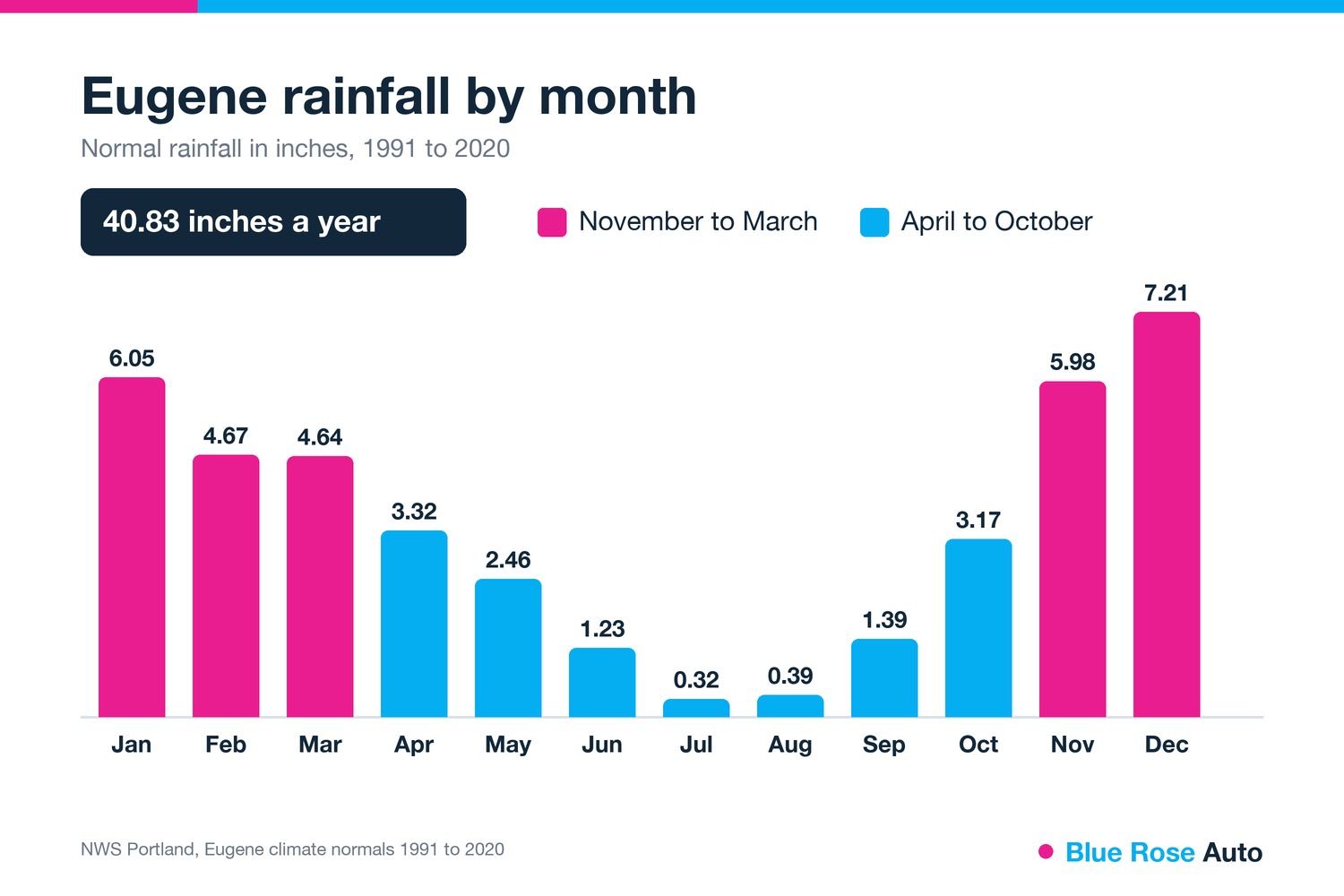
| Month | Inches | Month | Inches |
|---|---|---|---|
| January | 6.05 | July | 0.32 |
| February | 4.67 | August | 0.39 |
| March | 4.64 | September | 1.39 |
| April | 3.32 | October | 3.17 |
| May | 2.46 | November | 5.98 |
| June | 1.23 | December | 7.21 |
If the leak is recent, drying the interior and sealing the source usually fixes it. If moisture has sat longer, we may need to remove some interior pieces to reach it. A short fall checklist helps before the wet season starts.
- Clear leaves from the cowl and from the sunroof drain before October.
- Check door and trunk seals for cracks, flat spots and gaps.
- Lift the mats and feel the carpet for damp spots.
Our winter car maintenance checklist covers the rest of what a car needs before the rain settles in.
Why Professional Car Water Leak Testing Beats a Garden Hose
Running a garden hose is the common home test. The trouble is that leaks can be very fine, and the water path does not always show from outside. A hose also soaks everything at once, so you cannot tell which seal let water in. Controlled, slow testing lets the leak show exactly where it enters. Professional testing also does three things.
- It avoids mistakes from guessing.
- It prevents damage to interior panels.
- It saves time tracking down the real cause.
If the leak path is narrow, slow testing finds it, and fast water flow can hide it. There is plenty you can do first. Blot standing water with a towel, run a fan, lift the mats so the carpet can breathe and take photos of when the leak shows up. Dry wet materials within 24 to 48 hours, as the EPA advises.
Keeping Moisture Out After a Repair
Once the leak is fixed, a few habits keep the interior dry.
- Clear the sunroof and cowl drains once a year, and again after a windy fall.
- Check weatherstripping for cracks, and wipe it clean so it seals.
- Dry floor mats before putting them back, and do not leave wet coats, umbrellas or gear in the car.
- Run the defroster to clear fog and keep the cabin air moving.
Frequently Asked Questions
How do I know if my car has a water leak?
Look for wet carpet or padding under the mats, windows that stay fogged, a musty smell that returns after cleaning, or stains on the headliner. After rain, press a dry paper towel into the carpet corners. If it comes up wet, water is getting in and a leak is likely.
Why is my car floor wet when it rains?
Rain is usually getting past a door or window seal, a clogged sunroof or cowl drain, or a loose windshield bond. The water often runs along the body and shows up far from where it entered, so the wet spot is rarely the entry point. A water test finds the highest wet spot.
Who fixes water leaks in cars near Eugene and Springfield?
Blue Rose Auto repairs car water leaks at 3436 Olympic St in Springfield, Oregon, for drivers across Eugene, Springfield and the towns around them. The first 15 minutes of diagnosis are free, then it is $100 an hour, and we credit that time to the repair if you approve it.
How much does car water leak repair cost?
It depends on where the water gets in. Market ranges for sunroof drain clearing run about $100 to $250 and sunroof seal or leak repair about $150 to $600 (Empire Auto Protect, 2026). For door seals, trunk seals and other sources, we quote the price after we find the leak.
How do you find a water leak in a car?
We start with a visual check of seals and drains, then run a controlled water test from low to high, add a smoke test when the path is hidden, and check that drains flow. You can start yourself by finding the highest wet spot and working upward from it.
Can a car water leak cause mold?
Yes. The EPA says that if wet materials are dried within 24 to 48 hours, mold will not grow in most cases. Carpet padding that stays damp longer can grow it. The CDC lists a stuffy nose, coughing and burning eyes among mold symptoms for some people.
Can a water leak damage a car’s electrical system?
Yes. Control modules and connectors often sit under the carpet, where water can corrode them. NHTSA recall 23V-337 covers the footwell module on 2007 to 2014 MINI Cooper models for exactly this reason. Not every car is built that way, but drying the car quickly lowers the risk.
Is water under my car after using the AC a leak?
No. Clear water dripping onto the ground under the car after you run the AC is normal condensation leaving through the drain. Water inside the passenger footwell is different. That points to a blocked AC evaporator drain or a leak, and it needs a look.
Is the water in my car rainwater or coolant?
Rainwater is clear and has no smell. Coolant smells sweet, can be green, orange or pink, and often leaves an oily film on the inside of the glass. A wet passenger footwell with a sweet smell and a fogging windshield points to the heater core, which we diagnose.
Can Blue Rose Auto fix a leaking windshield?
We find out whether the windshield seal is where the water comes in. Blue Rose Auto does not do auto glass, so a glass specialist reseals or replaces the windshield when that is the source. We handle the rest of the leak, from drains and door seals to drying the interior.
Call to Schedule Car Water Leak Repair
A car water leak can seem small at first, and it turns into a bigger repair if the water stays inside. Blue Rose Auto repairs car water leaks for drivers in Eugene and Springfield, finds the source with a water test or smoke test and dries the interior afterward. Our shop is at 3436 Olympic St in Springfield, Oregon. Call (541) 641-8877 or contact us online.
Sources
- NWS Portland, Eugene climate book, daily precipitation normals 1991 to 2020
- EPA, A Brief Guide to Mold, Moisture and Your Home
- CDC, About Mold and Your Health
- NHTSA, Recall 23V-337, 2007 to 2014 MINI Cooper footwell module
- Empire Auto Protect, Sunroof Repair Cost 2026, published July 2026
- Axle Advisor, Sunroof Repair Cost
Related Guides
- Car Mold Removal Services in Eugene, Oregon
- Deep Interior Detailing
- Car AC Repair Near Me for Eugene, Springfield and Nearby Oregon Cities
- Springfield Climate Car Maintenance Tips
- RV Painting Services in Oregon, What To Know Before You Schedule Work
- Does Insurance Cover Rodents Eating Car Wires?
- How a Mobile Mechanic Can Get You Back on the Road Fast in Oregon
- How Ceramic Coating Protects Your Car
0 Comments