Ceramic coating vs wax comes down to how long you want the protection to last. A professional ceramic coating lasts about 2 to 5 years and typically costs about $800 to $2,000 on a car, while a traditional wax lasts about 1 to 3 months and costs under $10 to apply yourself or $50 to $100 from a pro (Jalopnik, February 2026). Ceramic wax, nano wax and sealant sit in between and do not bond to the paint the way a coating does. Blue Rose Auto is a Ceramic Pro Certified Elite Dealer in Springfield, Oregon, and below we explain which option fits a Eugene daily driver and when wax is still the right call.
Last updated October 2026
Key takeaways
- A professional ceramic coating lasts about 2 to 5 years and a traditional wax about 1 to 3 months (Jalopnik, 2026).
- A pro coating runs about $800 to $2,000 and a pro wax application $50 to $100, so four pro waxes a year for five years cost about what one coating does (Jalopnik, 2026, and our calculation).
- Ceramic Pro tells owners not to put wax or paint sealant on a coated car, and to wait at least two weeks before the first wash.
- A 9H rating describes hardness, not damage proofing. Ceramic Pro itself says its coating “is not bulletproof.”
- About 78% of Eugene’s yearly rain falls from October to March (NWS 1991 to 2020 normals, our arithmetic), which is the season a coating helps most.
Drivers bring this question to our shop all the time. They want the car to look sharp and stay protected from Oregon rain, road grime and tree debris, and they cannot tell whether a newer ceramic coating is worth more than the classic wax their dad used. We explain it the way we do at the front counter, with plain numbers and an honest view of when the cheaper option wins.
What Separates Ceramic Coating From Traditional Wax
A traditional wax sits on top of the paint as a thin, temporary layer, while a ceramic coating is a liquid polymer that bonds to the clear coat and cures into a hard layer. That one difference drives everything else, from lifespan to price to how you wash the car.
What Wax Is and How It Protects
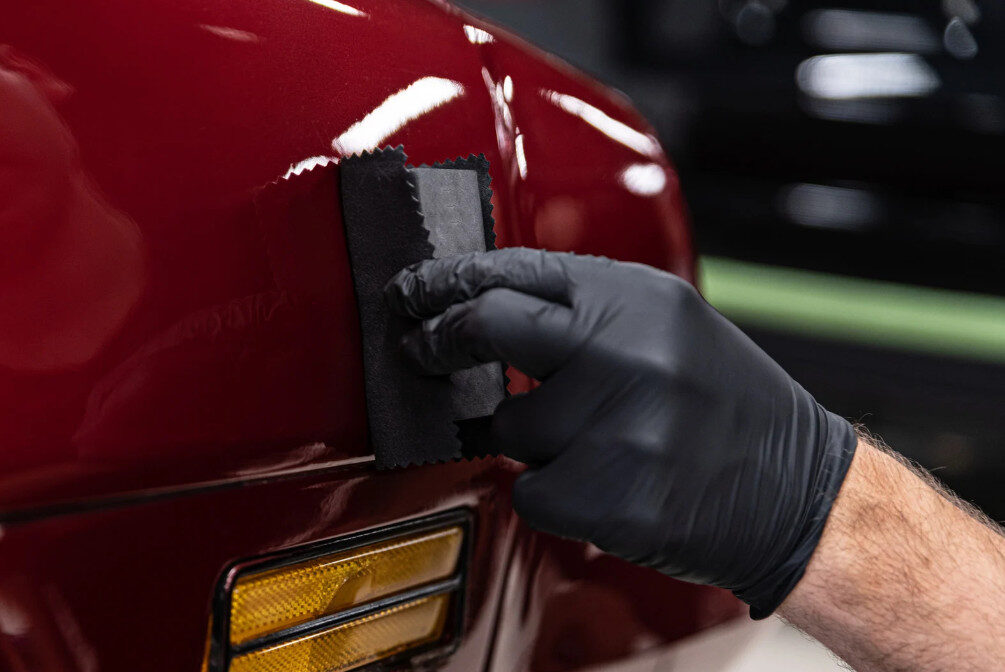
Traditional wax, whether carnauba or synthetic, adds a thin protective layer that gives a warm, glossy shine and makes water bead for a while. It cures in a few hours (Jalopnik, 2026). Washing, rain and road film wear it away, which is why it gets reapplied through the year.
What a Ceramic Coating Is
A ceramic coating is built on silicon dioxide, which Jalopnik says is derived from quartz or sand. Applied as a liquid, it bonds to the clear coat and cures to a hard, semi-permanent layer. That is why water beads tightly on a coated car and dirt has a harder time sticking. The short version follows.
- Wax gives short-term shine and protection.
- Ceramic coating gives long-term protection and gloss.
At Blue Rose Auto we apply professional ceramic coatings, and we work with Ceramic Pro, System X and Gtechniq products.
How Long Each One Lasts
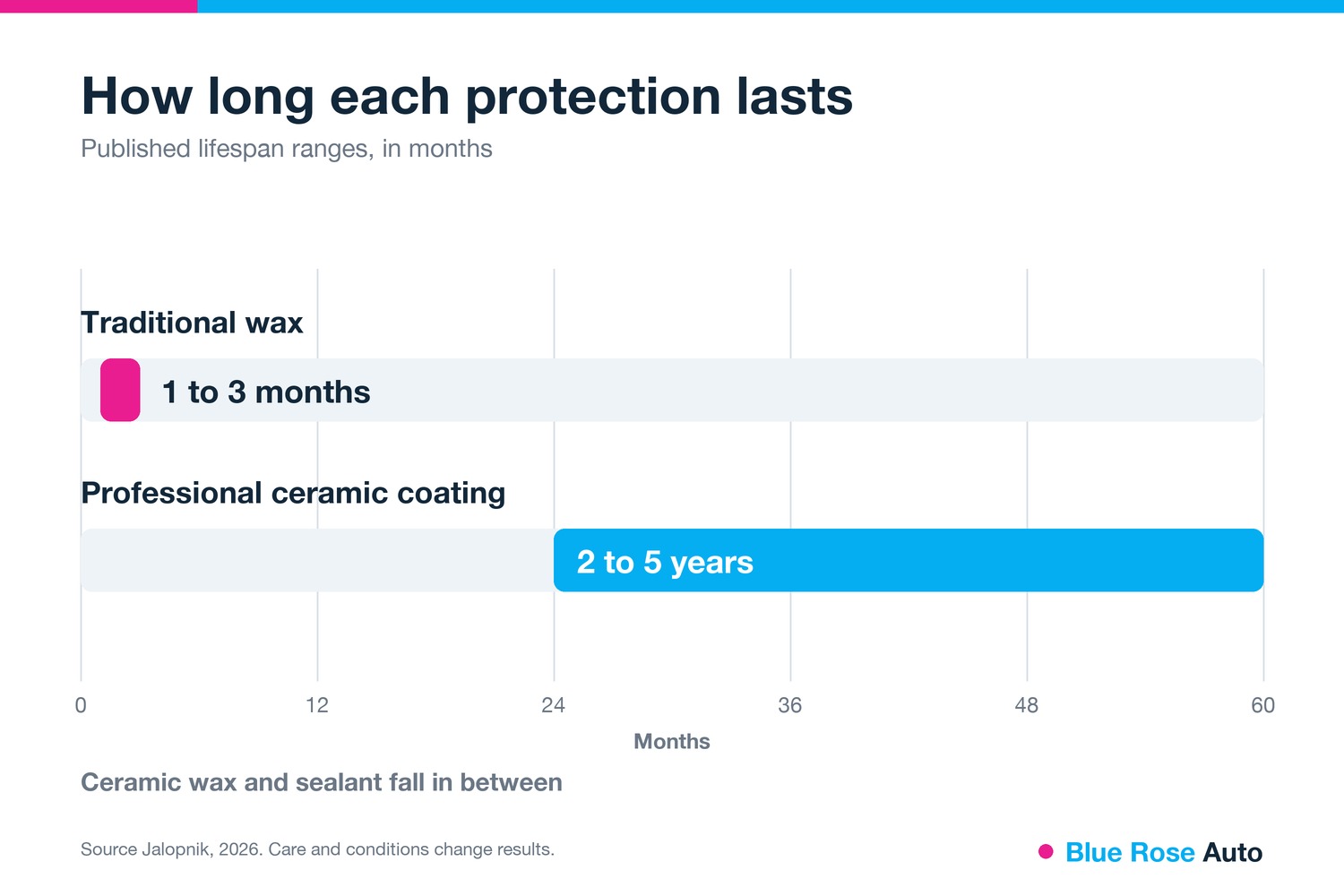
A professional ceramic coating lasts about 2 to 5 years, and a traditional wax may last just 1 to 3 months (Jalopnik, 2026). The chart below puts both on the same months scale, so the gap is easy to see.
Wax Lifespan
- About 1 to 3 months, depending on the product and how often you wash.
- Needs to go back on several times a year.
- Ceramic wax and sealant fall in between, lasting longer than plain wax and shorter than a coating, and the label on the product is the best guide for a specific one.
Ceramic Coating Lifespan
- About 2 to 5 years, with the position in that range set by how you wash and where you park.
- Resists road film and washes off more easily than bare paint.
- Our 3-year, 36,000-mile warranty covers ceramic coatings, and it is separate from the coating maker’s own warranty.
We see cars come through our auto detailing department that were waxed regularly and still show swirl marks and dull paint. Coated cars hold their finish better when they are washed correctly.
Why Coatings Fail Early
A coating wears out early when the car is neglected. Ceramic Pro says sap, bird droppings, bug splatter and pollen should not sit for more than a few days, that brush car washes and washing in direct sun harm the finish, and that owners should wash about every two weeks. A coating that skips that care tends to land at the short end of the 2 to 5 year range.
Ceramic Coating vs Wax Cost Over Five Years
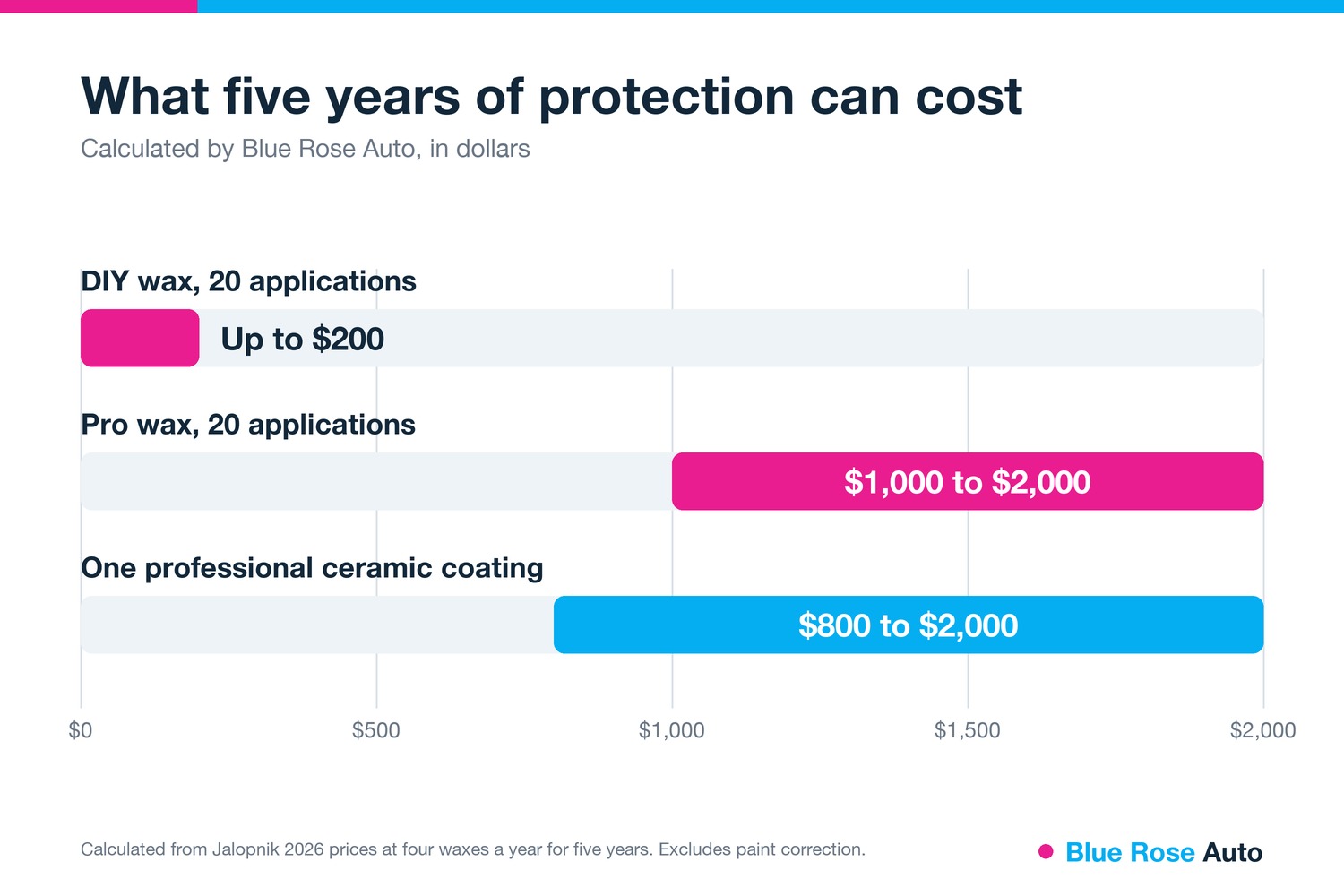
One professional coating costs about $800 to $2,000, and keeping a car waxed by a pro for five years costs about $1,000 to $2,000, so the long-run gap is smaller than the sticker price suggests. The chart below shows the five-year math, and the assumptions are listed under it.
What Each Costs Per Application
These are national market ranges, not Blue Rose Auto prices, and we quote a coating after we inspect the paint.
| Option | Typical cost | Source |
|---|---|---|
| Name-brand wax, applied yourself | Under $10 | Jalopnik, 2026 |
| Wax applied by a professional | $50 to $100 | Jalopnik, 2026 |
| Professional ceramic coating | $800 to $2,000 | Jalopnik, 2026 |
| Average professional ceramic job | About $2,000 | Car and Driver, 2026 |
Method note. These are national figures from published guides, shown as ranges and not as quotes. Large trucks and SUVs, multi-layer coating packages and heavy paint correction can push a professional job above the top of these ranges. The exact price depends on the vehicle, the condition of the paint and the coating.
What Five Years Looks Like
We calculated this ourselves. Waxing four times a year for five years is 20 applications, which is the long end of Jalopnik’s 1 to 3 month range. At Jalopnik’s prices that is up to $200 for do-it-yourself wax and $1,000 to $2,000 for pro wax, against one coating at $800 to $2,000.
| Scenario | Five-year cost |
|---|---|
| DIY wax, 20 applications | Up to $200 |
| Pro wax, 20 applications | $1,000 to $2,000 |
| One professional ceramic coating | $800 to $2,000 |
The numbers exclude paint correction. If you sell the car in a year or two, wax costs less. If you keep it and park it outside, the coating tends to win on both price and effort.
Costs a Quote May Add
- Paint correction, which some shops price separately when the paint has swirls or scratches.
- Extra surfaces such as glass or wheels, when you want them coated too.
- Prep time on a car with heavy contamination.
Pros and Cons of Ceramic Coating and Wax
A coating wins on lifespan and easy washing, and wax wins on price and simplicity. The four lists below cover both.
Ceramic coating pros
- Long-lasting protection. It bonds to the clear coat and does not wash away like wax.
- Water and dirt resistance. Mud, road grime and bird droppings wipe off more easily.
- Clear coat protection. Ceramic Pro says its coatings help protect the factory clear coat.
- High gloss finish. It gives the deep, mirror-like look most drivers want.
Ceramic coating cons
- Higher cost upfront. It costs more than wax on day one.
- Needs professional application. DIY kits can leave streaks.
- Paint prep required. The surface needs to be clean and corrected before the coating goes on, because the coating locks in what is under it.
- Does not stop rock chips or dents. A clear paint protection film does that job.
Traditional wax pros
- Affordable and simple. It is easy to apply and reapply at home.
- Rich, warm shine. Carnauba in particular gives a warm glow.
- Forgiving. It is easy to strip and redo, which Jalopnik lists as a plus.
- Good for short-term touch-ups. It works well before a car show or a sale.
Traditional wax cons
- Wears off fast. Rain, washing and road film remove it quickly.
- Little scratch resistance. It is a soft layer, so swirl marks still show.
- Regular reapplication. It takes time and effort to maintain.
Customers often ask about putting wax on first, or wax on top of a coating. We advise against wax over a coating. Ceramic Pro tells owners not to use wax or paint sealant on a coated car, and the coating already gives you the beading wax is meant to give. If you will not coat the car, wax is the right first step. If you will coat it, skip the wax.
Ceramic Wax and Hybrid Ceramic Wax Explained
Ceramic wax is not a ceramic coating. It adds silicon dioxide to a wax or polymer base, and it sits on the paint and wears off, while a professional coating bonds to the clear coat and cures.
Is Ceramic Wax the Same as Ceramic Coating
No. Ceramic wax, also sold as hybrid ceramic wax, has less of the active ingredient than a professional coating and relies on a wax or polymer carrier. It gives better beading and a stronger shine than plain wax, and it does not form the bonded, hardened layer of a coating. It also needs regular reapplication.
Ceramic Wax vs Carnauba Wax
Carnauba is made from palm leaves and is known for a rich, glossy glow. Many enthusiasts still love it for that warm shine. It is softer and breaks down faster than synthetic wax, ceramic wax or a coating. If your car stays in a garage most of the time, carnauba can look excellent. For a daily driver parked outside in Eugene, a coating is the more practical choice. Hybrid ceramic wax is the middle ground, stronger than carnauba and still easy to apply, and it suits owners who want more than wax but are not ready for a full ceramic job.
Pros and Cons of Ceramic Car Wax
Pros
- Adds a measure of ceramic protection.
- Goes on by hand or by spray.
- Gives strong shine for a few months.
Cons
- Does not last nearly as long as a full ceramic coating.
- Needs regular reapplication to keep its protection.
- Does not bond chemically like a professional coating.
How to Use Ceramic Wax
Wash and dry the car, remove bonded contamination, work in the shade on a cool panel, apply a thin coat, and follow the buff and cure times on the label. Thin coats are easier to remove and leave fewer streaks. Product directions differ, so the label overrides general advice.
Nano Wax vs Ceramic Coating
Nano wax is not a ceramic coating. It is a wax or sealant sold with a nanotechnology label, and it wears off like other wax rather than curing to a bonded layer.
The name refers to very small particles meant to help the product spread and bond better to paint. In our experience it gives better shine and beading than standard wax and still does not last like a coating. A coating chemically bonds and hardens on the surface, so the gap is in how it is made, not only how it is marketed.
Paint Sealant and the Side by Side Comparison
Paint sealant is a synthetic polymer layer that typically lasts longer than wax and shorter than a coating. It sits on the paint and does not bond like a coating, and it asks for less prep than a coating does. The table puts all five options together.
| Option | Typical durability | Finish | Bonds to paint | Effort and cost | Source |
|---|---|---|---|---|---|
| Carnauba wax | 1 to 3 months | Warm, wet look | No, sits on top | Under $10 DIY, $50 to $100 pro | Jalopnik, 2026 |
| Synthetic wax | 1 to 3 months | Sharp, slick | No, sits on top | Under $10 DIY, $50 to $100 pro | Jalopnik, 2026 |
| Ceramic or hybrid wax | Longer than wax, shorter than a coating | High gloss | No, sits on top | Low cost, DIY friendly | Product labels |
| Paint sealant | Longer than wax, shorter than a coating | Sharp, slick | No, sits on top | Low to moderate cost | Product labels |
| Professional ceramic coating | 2 to 5 years | Deep, glassy | Yes, bonds to clear coat | $800 to $2,000, professional install | Jalopnik, 2026 |
The finish column reflects what we see in the shop and not a measured test.
What a 9H Rating Does and Does Not Mean
A 9H rating describes how hard the cured coating is, and it does not make paint scratch-proof. Ceramic Pro says its paint coatings deliver 9H-rated hardness, and the same company says a coating “is not bulletproof” and needs routine aftercare. Jalopnik makes the same point, writing that a coating gives some protection against minor marring but is not invulnerable to scratches and dings.
In practice, hardness helps against light marring from washing and wiping. It does not stop a rock chip on the highway or a door ding in a parking lot. If you drive fast roads and want chip protection, paint protection film in Eugene is the product built for it.
How a Professional Ceramic Coating Is Applied at Blue Rose Auto
A professional coating goes on in a fixed order, and the prep matters more than the product because the coating locks in whatever is under it. The steps below are standard practice for a professional job, with the cure rule taken from the coating maker.
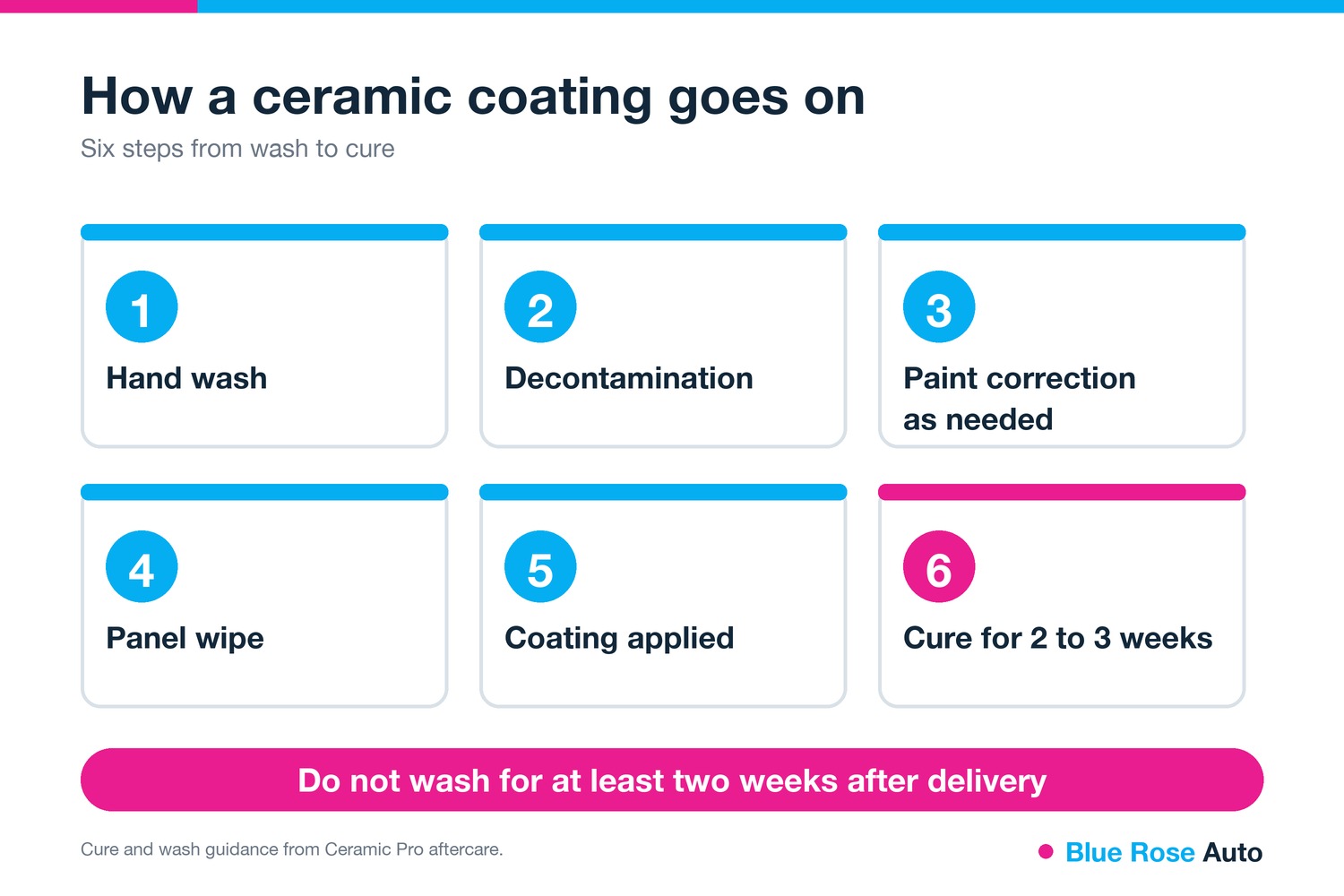
- Hand wash. We wash the car by hand to remove surface dirt and road film.
- Decontamination. We use a chemical decontamination and iron and fallout removal to pull bonded contamination out of the paint.
- Paint correction as needed. If the paint has swirls or scratches, we do paint correction first, since a coating over defects makes them permanent.
- Panel wipe. We wipe each panel to remove polishing oils so the coating can bond.
- Coating applied. We apply the coating panel by panel and level it.
- Cure for 2 to 3 weeks. Ceramic Pro says full cure takes 2 to 3 weeks depending on humidity and temperature, and the car should avoid water and rain exposure early on.
Do not wash the car for at least two weeks after delivery, per Ceramic Pro. Our exterior detailing and decontamination work is the same prep we do before any finish, and the 3-year, 36,000-mile warranty covers ceramic coatings.
What Eugene and Springfield Weather Means for Wax and Coatings
Eugene’s rain is the main reason a coating pays off for a car parked outside. The area gets about 40 inches of rain a year. About 78% of the year’s rain falls October to March (NWS 1991 to 2020 normals, with the share calculated by Blue Rose Auto).
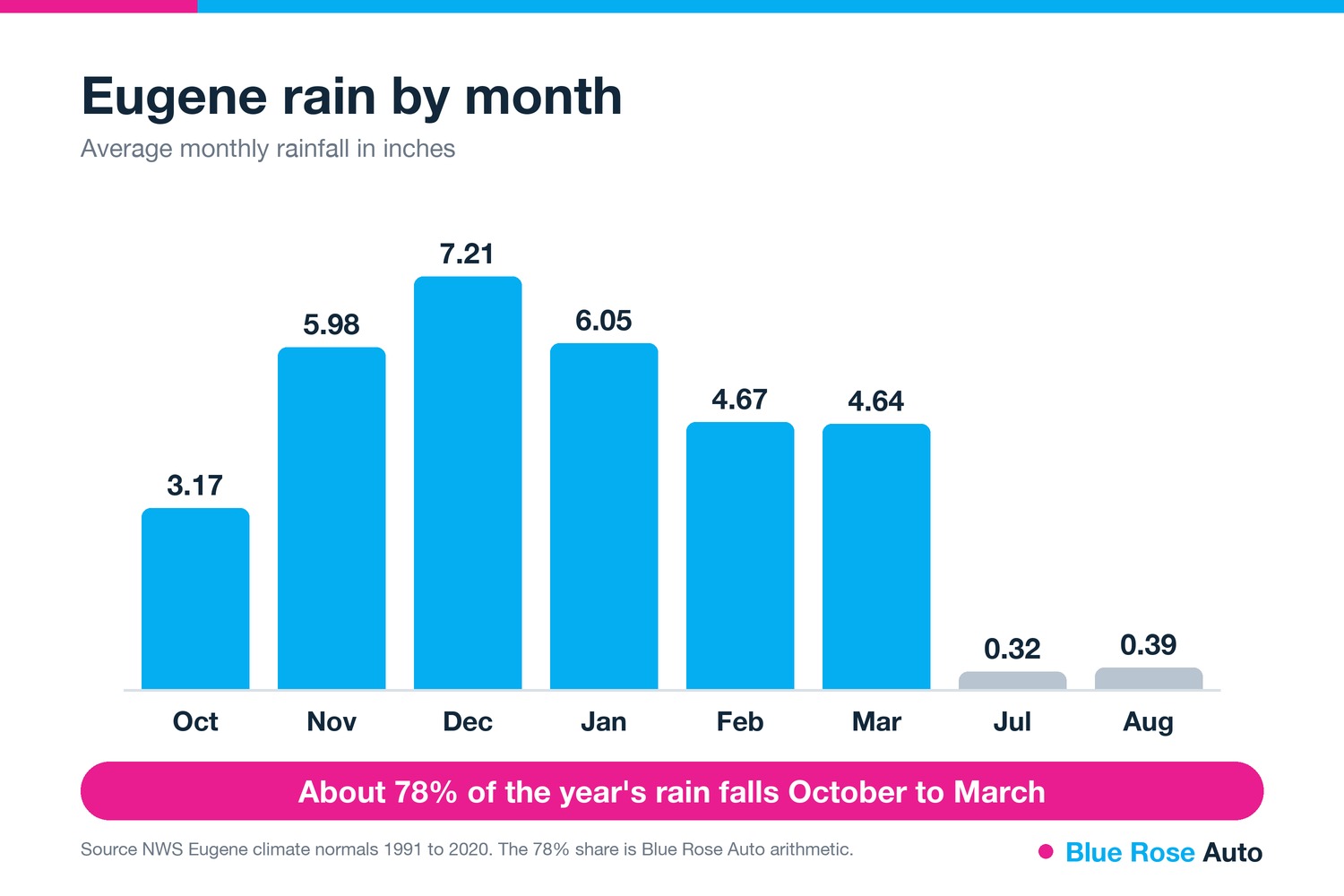
| Month | Inches |
|---|---|
| Oct | 3.17 |
| Nov | 5.98 |
| Dec | 7.21 |
| Jan | 6.05 |
| Feb | 4.67 |
| Mar | 4.64 |
| Jul | 0.32 |
| Aug | 0.39 |
Heat is a smaller problem here than in the Southwest. The normal high in July is about 84 degrees F and in January about 48, and December and January each bring 11 to 12 nights at or below freezing. Jalopnik puts the melting point of wax near 180 degrees F, so what wears wax on an Oregon car is the wet season, road film and sap.
Sap and pollen deserve a plan. Ceramic Pro says not to leave sap, droppings, bugs or pollen on the finish for more than a few days, and that sticky debris in sun can bond. We tell Eugene owners to avoid parking under trees when they can and to rinse the car after a windy week. Blue Rose Auto does ceramic coating in Eugene for cars that sit outside all winter. Our shop at 3436 Olympic St also handles ceramic coating in Springfield.
If you wash at home, mind where the water goes. The City of Eugene says driveway wash water typically flows along the gutter into a storm drain and then to a creek or river, and it asks for phosphate-free, biodegradable soap.
Caring for a Coating or a Wax Finish
A coating needs a wash about every two weeks with a gentle soap, and a wax needs more frequent redoing. Either finish lasts longer when it is washed the right way.
- Use pH-neutral soap. Ceramic Pro says to avoid soap with wax, petroleum distillates, or a pH below 5 or above 9.
- Skip brush car washes. Hand wash with two buckets or use a touchless wash, and never wash in direct sun or on a hot panel.
- Dry with microfiber. It prevents swirl marks and spotting.
- Park under cover. Shade keeps sap, leaves and sun off the finish.
That guidance comes from Ceramic Pro for its coatings. For a System X or Gtechniq coating, follow that maker’s sheet. Our auto detailing washes and dries cars with these methods, and window tinting cuts the sun that reaches the interior.
Which One Should You Choose
Choose a coating for a car you will keep and park outside, and choose wax for a car you will sell soon or show. For a daily driver in Eugene’s wet season, a coating is the practical choice. If you want an occasional shine or you are prepping for a show, wax is enough.
- Coat the car if you keep it for years and it lives outdoors.
- Wax or ceramic wax the car if you are selling soon or it stays in a garage.
- Add film and a coating if the car is new and sees fast roads, as covered in car paint protection methods.
We offer professional coating and detailing for customers around Springfield, we install paint protection film in Springfield, and we handle collision repair and paint correction when a car needs bodywork before any finish goes on.
Frequently Asked Questions About Ceramic Coating vs Wax
How long does ceramic coating last compared with wax?
A professional ceramic coating lasts about 2 to 5 years, while a traditional wax lasts about 1 to 3 months (Jalopnik, 2026). Upkeep decides where in that range a coating lands. Ceramic Pro says to wash about every two weeks with a pH-neutral soap and to avoid brush washes.
Can I apply wax over a ceramic coating?
We advise against it. Ceramic Pro tells owners not to use wax or paint sealant on a coated car, and the coating already provides the water beading wax is for. Wash with a pH-neutral soap, and use the coating maker’s own maintenance products if you want extra gloss.
How often should I wax my car?
Plan on waxing about every 1 to 3 months with traditional wax, since that is how long it may last (Jalopnik, 2026). Ceramic wax and sealant can stretch longer, and the product label is the best guide. A coated car should not be waxed at all.
Can ceramic coating fix scratches?
No. A coating does not repair damage, and it is not scratch-proof even at a 9H rating. It adds some resistance to minor marring. We recommend paint correction before coating, because a coating over scratches seals them in rather than removing them.
What is better for Oregon weather, coating or wax?
For a daily driver parked outside, a coating, because about 78% of Eugene’s rain falls from October to March and a coating sheds water and road film more easily. Wax is a fine choice for a garaged car or one you plan to sell soon.
Is ceramic wax or nano wax the same as ceramic coating?
No. Ceramic wax adds silicon dioxide to a wax or polymer base, and nano wax is a wax or sealant sold with fine particles. Both sit on the paint and wear off. A professional ceramic coating bonds to the clear coat and cures to a hard layer.
Does ceramic coating stop water spots?
It helps water bead and sheet off, but minerals can still leave spots if water dries on the surface. Standing water and sprinkler overspray can spot even a coated car, so dry the panels or rinse them off soon after the water lands.
How long does a ceramic coating take to apply and cure?
Prep and application time depends on the size of the car and how much paint correction it needs. Ceramic Pro says full cure takes 2 to 3 weeks depending on humidity and temperature, and the car should not be washed for at least two weeks after delivery.
Is ceramic coating worth the money compared with wax?
Over five years, pro wax at four applications a year costs about $1,000 to $2,000, against $800 to $2,000 for one coating (our calculation from Jalopnik’s 2026 prices). A coating also washes more easily. If you sell within a year or two, wax costs less.
Can a ceramic coating be removed?
Yes, by polishing it off. Polishing removes some clear coat along with the coating, so it is a job for a professional rather than a weekend project. A pro can judge how much clear coat the car can spare before removal starts, and that limit is why we do not coat over problems.
Talk Through Coating or Wax With Blue Rose Auto
If you are leaning toward a professional ceramic coating, wax or something in between, bring the car by 3436 Olympic St in Springfield and we will look at the paint and tell you which one fits your car, your schedule and your budget. Blue Rose Auto is a Ceramic Pro Certified Elite Dealer, and our 3-year, 36,000-mile warranty covers ceramic coatings. We quote after inspection. Call (541) 641-8877 or send us a message.
Sources
- Jalopnik, Ceramic Coating Vs. Waxing, February 21, 2026. Lifespans, price ranges, wax melting point, quartz or sand origin.
- Ceramic Pro, Aftercare for Ceramic Coatings, 2026. Cure time, first wash, no wax or sealant, pH range, wash schedule, sap and pollen.
- Ceramic Pro, Ceramic Coating for Cars, 2026. The 9H hardness claim.
- Car and Driver, Best Ceramic Coatings Tested, 2026. Average professional job near $2,000.
- NOAA National Weather Service, Eugene climate normals 1991 to 2020, precipitation and temperature. Rain by month, July and January highs, freezing nights.
- City of Eugene, Car Wash Fact Sheet, 2020. Storm drain runoff and soap advice.
0 Comments