
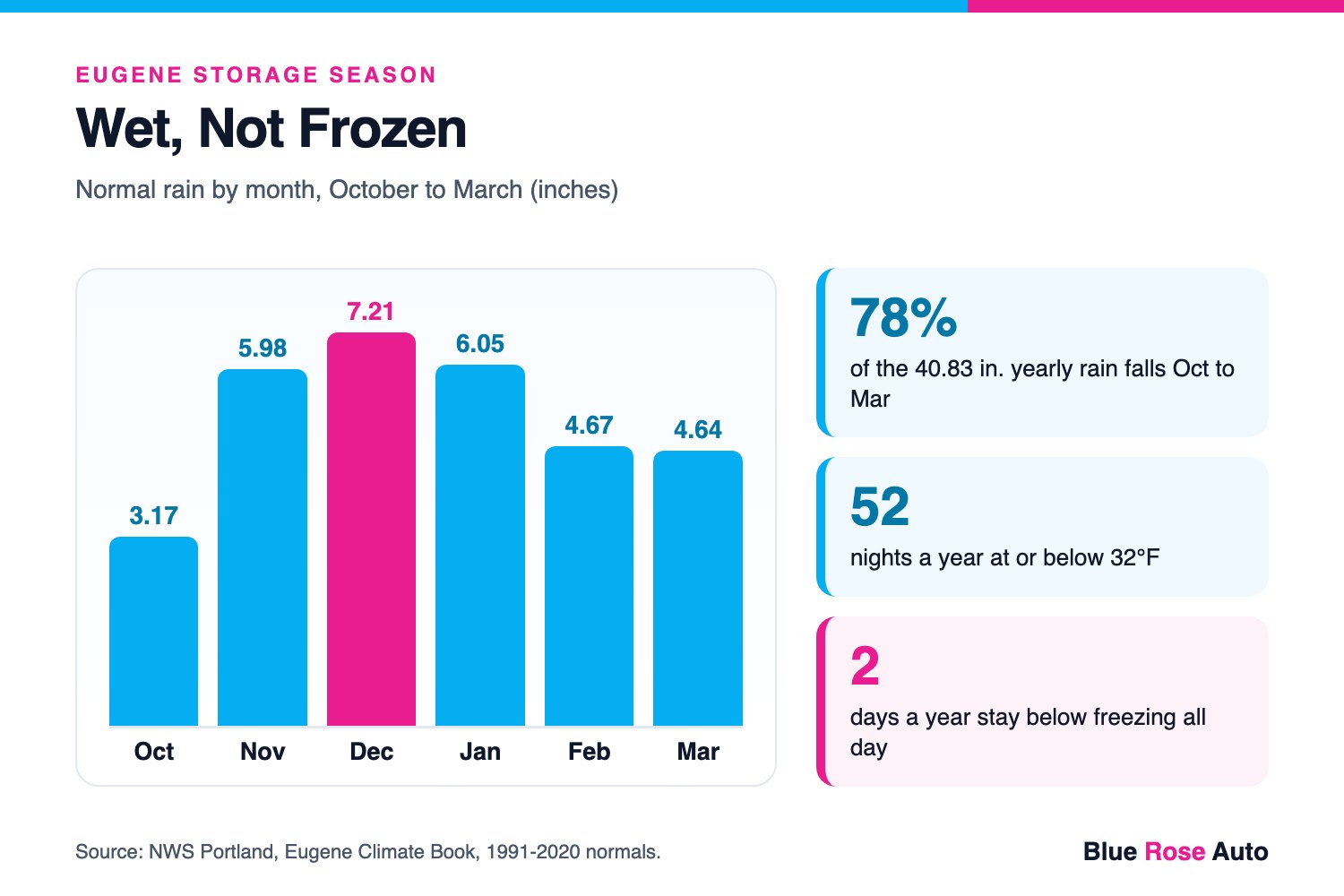
To store an RV for winter in Oregon’s Willamette Valley, plan for rain before ice. Eugene gets about 78% of its 40.83 inches of yearly rain from October to March, and only about 2 days a year stay at or below freezing all day. Wash and seal the exterior, check the roof seams, keep the inside dry, and block mice.
What follows covers travel trailers, fifth wheels, motorhomes, campervans and trailered boats, written for the valley floor with a note for anyone storing at elevation. Storing a car instead? Read how often to start a stored car. And if you’d rather hand off the wash-and-protect step, we do that through our boat and RV detailing, paint and repair work.
By the Blue Rose Auto team, Springfield, OR. Last reviewed October 8, 2026.
Is Oregon’s winter wet or freezing for RVs?
Mostly wet. National Weather Service normals for 1991-2020 put Eugene’s yearly rain at 40.83 inches, and by our math about 78% of it falls between October and March. The same NWS Portland records show 52 nights a year at or below 32°F, yet only about 2 days a year stay below freezing all day. Snow is light. The NWS lists a normal of 6.1 inches a year, using its 1961-1990 normals because those years have more reliable snow records. So on the valley floor, moisture does more harm to a parked RV than ice does. Roof seams let water in, condensation builds inside a closed rig, and mildew follows. Freezing still matters. Frosty nights are routine from November through February, so most owners drain or winterize their water lines anyway. Blue Rose Auto in Springfield, OR handles the wash, protection and spring repair side of RV and boat care, so call (541) 641-8877 with questions.
Where the RV spends the winter changes which risk comes first.
| Stored on the valley floor (Eugene-Springfield) | Stored at elevation or towed over the passes in winter | |
|---|---|---|
| Main threat | Water from rain, condensation, leaks and mildew | Frozen lines and tanks, snow load |
| Freezing | 52 nights a year at or below 32°F; about 2 all-day freezes | Colder and longer |
| Water system | Drain or winterize anyway | Full winterizing is a must |
| Cover choice | Breathable cover or roofed carport; never a tarp on the roof | Breathable cover rated for snow, or indoor storage |
| Check-ins | Monthly checks for leaks, humidity and mice | Before and after any trip; clear snow |
Most of this post covers the left column. If yours winters near Willamette Pass (OR-58) or crosses Santiam Pass (US-20), start from the right one. The numbers come from NWS Eugene precipitation normals and freezing-day counts. The 78% is our arithmetic, since October through March adds up to 31.72 of the 40.83 inches.
How do you store an RV for winter?
Store an RV for a wet winter in this order, which is to empty it, clean it, seal the exterior, check the roof, deal with the water, then park it where it drains. A cover or sealant over a dirty, damp rig locks the problem in for five months.
- Empty it. Food and anything scented come out, since that draws mice. Take bedding, cushions and towels home, because fabric holds moisture.
- Clean the inside. Wipe surfaces, clean the fridge and prop its door open, and rinse the holding tanks.
- Wash the outside, roof included. Fir needles, moss and sap hold water against the finish all season. Do the underbody and wheel wells too, because a full exterior and undercarriage detail keeps fall mud from sitting there until April.
- Treat oxidation, then seal. Correct chalky gelcoat or faded paint first, then apply a wax, sealant or ceramic coating. A coating seals in whatever is on the surface, which is why we usually recommend correction before we coat anything.
- Inspect the roof and seals, using the roof checklist below.
- Handle the water system, by draining it or having it winterized, as covered further down.
- Battery. Disconnect it or keep it on a maintainer. Flooded lead-acid, AGM and lithium packs each have their own storage steps, so follow the battery maker’s sheet. A flat lead-acid battery can freeze.
- Tires. Inflate to the pressure on the tire placard (not the sidewall maximum), chock them, and shade them from sun. Keep them out of standing water and soft mud, which a valley lawn turns into by December.
- Propane and fuel. Close the propane valve. For a motorhome, the Oregon State Marine Board’s boat advice carries over, and it says to “Top off fuel tanks, leaving a little room for expansion. Add a fuel stabilizer.”
- Bring the slide-outs in on a dry day before the first frost, as the FAQ below explains.
- Pick the cover and the spot. Gravel or pavement beats grass. Open sky beats a dripping fir.
Short on time? Spend your one dry weekend on steps 3 and 4. In our view they decide what the rig looks like in spring.
When should each step happen in the valley?
The dry window closes fast. The calendar below lines each step up with the same NWS Eugene normals used throughout this post, so the sealant cures before the rain and the lines are empty before the first frost.
| When | Why then | What to do |
|---|---|---|
| Late September to early October | Still dry enough for sealant to cure | Wash, correct oxidation, seal; inspect and reseal the roof |
| Early October | October averages 3 freezing nights | Drain or winterize the water system; bring slides in |
| November to March | December and January are the wettest months (7.21 and 6.05 in), with November close behind (5.98 in) | Monthly check of leaks, humidity, mice and cover |
| April | Freezing nights drop to 2 on average | Spring inspection before the first trip |
How do you keep a stored RV mold-free?
Mold in a stored RV comes down to water and humidity. Pull the fabrics, absorb the moisture, let some air move, and dry any leak within a day or two. Skip those steps and a shut trailer sitting through a valley winter has all the damp that mildew needs.
The EPA’s mold guide is written for homes, but its targets fit an RV. It says “If possible, keep indoor humidity below 60 percent (ideally between 30 and 50 percent) relative humidity.” It adds that if damp materials “are dried 24-48 hours after a leak or spill happens, in most cases mold will not grow.”
- Remove what soaks up water, like curtains, towels and cardboard.
- Absorb it. A desiccant tub per room needs no power. The common calcium chloride kind pulls water from the air and turns to brine, so set each one on a flat surface away from carpet and swap it once the crystals have dissolved. Plugged in? A small dehumidifier draining into the sink does far more.
- Measure it with a cheap humidity meter.
- Let it breathe. A roof vent with a rain-proof cover keeps condensation off cold walls.
- Dry leaks fast. That 24 to 48 hour window is the whole game.
Mildew already in fabric or behind trim is a cleanup job, and we do rodent and mold cleanup in vehicles.
What should a monthly storage check include?
Ten minutes a month catches a small leak before it becomes a soft floor.
- Read the meter and empty the desiccant.
- Look at every ceiling corner, vent and window frame for stains.
- Open the cabinets and sniff. Musty smells show up before spots do.
- Check floor edges and drawers for droppings.
- Walk around outside and confirm the cover is snug and the roof is clear of branches.
Should you check RV roof seals before winter?
Yes, and do it before the rains, not after the first stain. NWS normals put December at 7.21 inches and January at 6.05, Eugene’s two wettest months, with November close behind at 5.98. Summer cracks get tested exactly when nobody wants to climb a wet ladder to look at them.
The places water usually gets in are the roof seams, the corners around vents and windows, and the slide-out seals. From the roof (or a ladder, if the roof isn’t rated to walk on), check these spots.
- Lap sealant around vents, skylights and antenna bases, looking for cracks, gaps and lifting edges.
- The AC shroud and its gasket.
- Front and rear cap seams, where roof meets wall.
- Window frames and sidewall clearance lights.
- Slide-out seals, which tear or flatten with age.
Fresh sealant needs time to cure before it’s soaked, so follow the maker’s temperature range and get up there in early October. Recoating is its own job, and RV roof coatings and rubber roof paint deserve a careful read first. Already have a drip? Start by tracking down where water is getting in; it often shows up far from where it enters.
Should you cover your RV, tarp it, or neither?
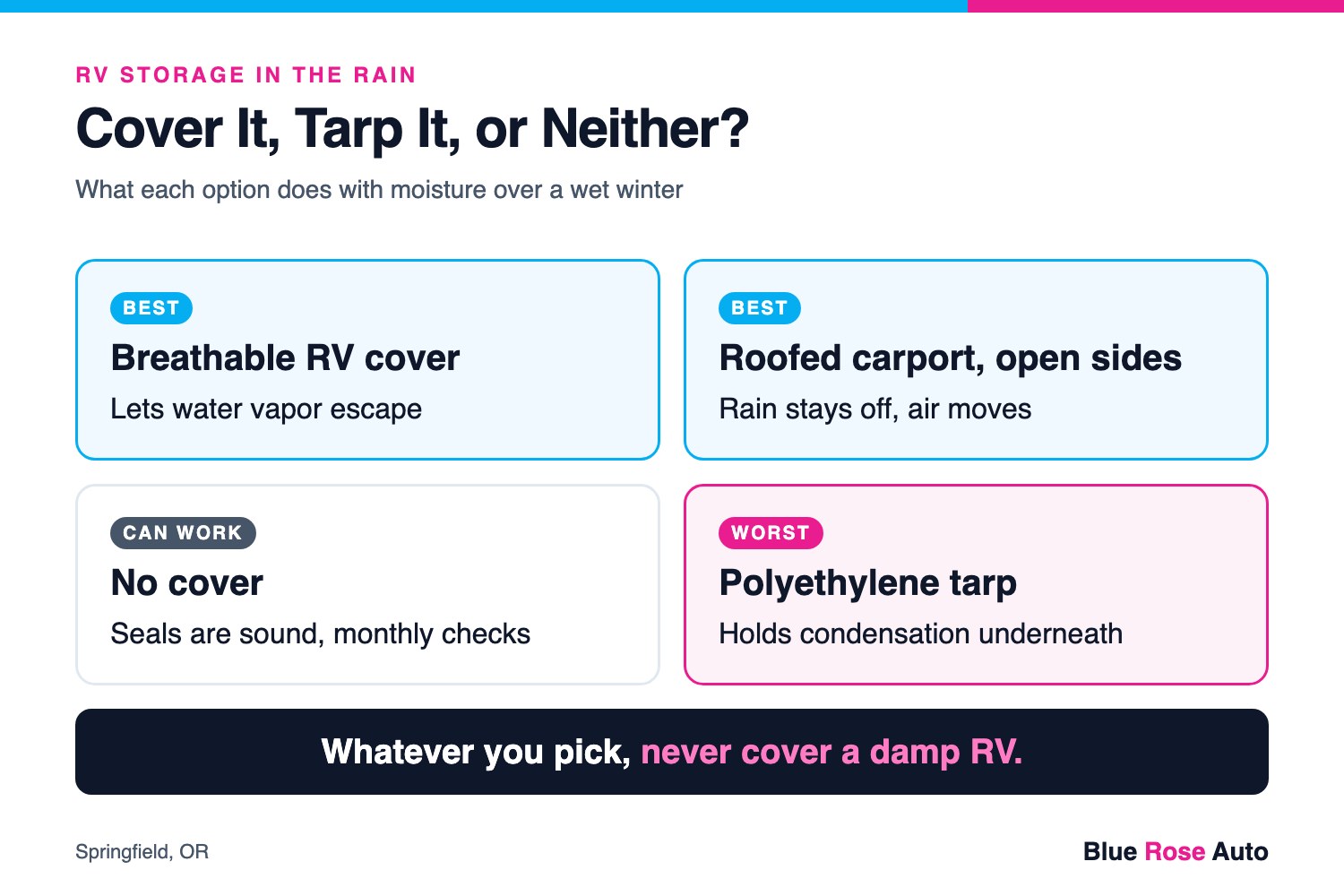
A breathable RV cover or a roofed carport is the best choice for a wet Oregon winter. Tarps are the worst. Plastic traps condensation against the roof, right on top of the seams you’re trying to protect, while going uncovered can work if the seals are sound and you check monthly. Whatever you pick, never cover a damp RV. The cover only holds the water in.
The clearest guidance comes from boating. The Oregon State Marine Board advises “Canvas is best because it breathes. If you use plastic, make sure you leave vents in it to allow any moisture to escape.” An RV, with far more roof, needs it even more.
| Option | What happens to moisture | Works best when | Watch out for |
|---|---|---|---|
| Breathable RV cover | Lets water vapor escape | The RV goes under it clean and dry | Rubbing at corners; flapping in wind |
| Polyethylene tarp | Holds condensation underneath | Short-term emergency only | Traps water; scuffs the finish |
| Roofed carport, open sides | Rain stays off, air moves | You have the space | Blowing rain still hits the sides |
| No cover | Gets wet, dries in the open | Seals are sound, monthly checks | Moss and UV on the roof |
A common view on Pacific Northwest RV forums is that good roof seals matter more than any cover, and we’d mostly agree. A cover buys time. It won’t close an open seam.
How do you keep mice out of stored RVs?
Starve them and lock them out with no food inside, every floor gap closed and a look for droppings once a month. A parked RV is exactly what the CDC describes, since “Rodents may build their nests in cars, trucks, campers, and other vehicles,” and idle ones are likelier targets.
- No food at all, pet food and the crumbs under the dinette cushions included.
- Look underneath with a flashlight for gaps where plumbing and wiring pass through the floor.
- Pack openings with steel wool or metal mesh. Mice chew through foam.
- Set traps and check them. The CDC says “Snap traps and poison baits are effective in stopping rodents access into vehicles.”
There’s a health reason too, because the CDC says the most common hantavirus that causes hantavirus pulmonary syndrome in the United States is spread by the deer mouse. For more than a few droppings, we handle rodent cleanup and sealing entry points on vehicles, and it’s worth checking whether insurance covers rodent-chewed wiring.
How do you clean up droppings safely?
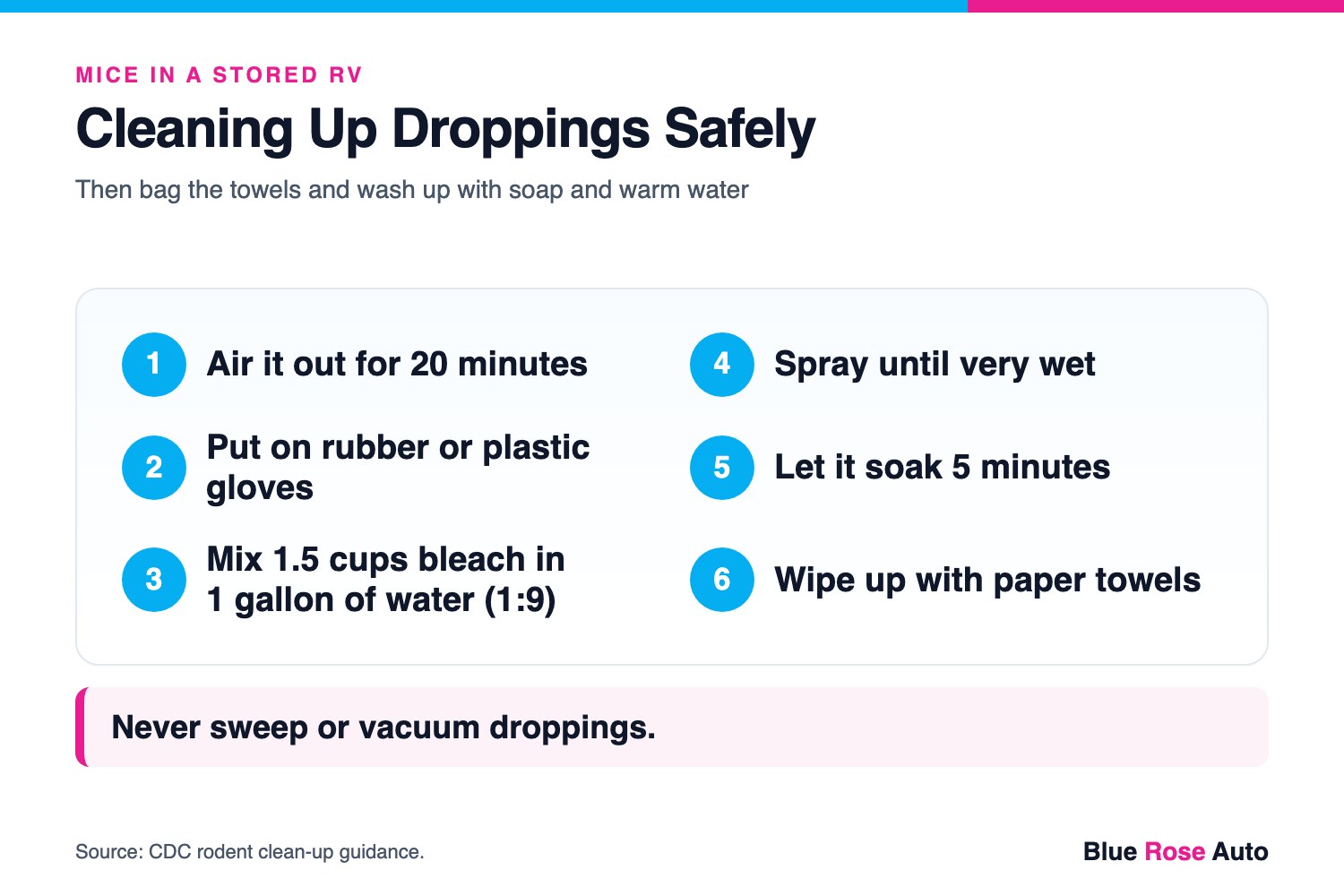
Never sweep or vacuum, because that puts the dust in the air. These steps follow the CDC’s rodent clean-up guidance.
- Air it out. Open the doors (and the engine hatch on a motorhome) for 20 minutes first.
- Put on rubber or plastic gloves.
- Mix the bleach solution fresh, using 1.5 cups of household bleach in 1 gallon of water, or 1 part bleach to 9 parts water.
- Spray until very wet and let it soak 5 minutes, or as long as the disinfectant label says.
- Wipe up with paper towels and throw them, and any nesting material, in a covered garbage can.
- Wash up, starting with the gloves. Wash the gloves with soap and water before taking them off, then wash your hands with soap and warm water.
Do you need to winterize RVs in western Oregon?
Most valley owners still do, because freezing nights are routine even when the days are mild. Eugene’s normals show 12 nights at or below 32°F in December, 11 in January and 10 in February. One of those nights can be enough to split a fitting.
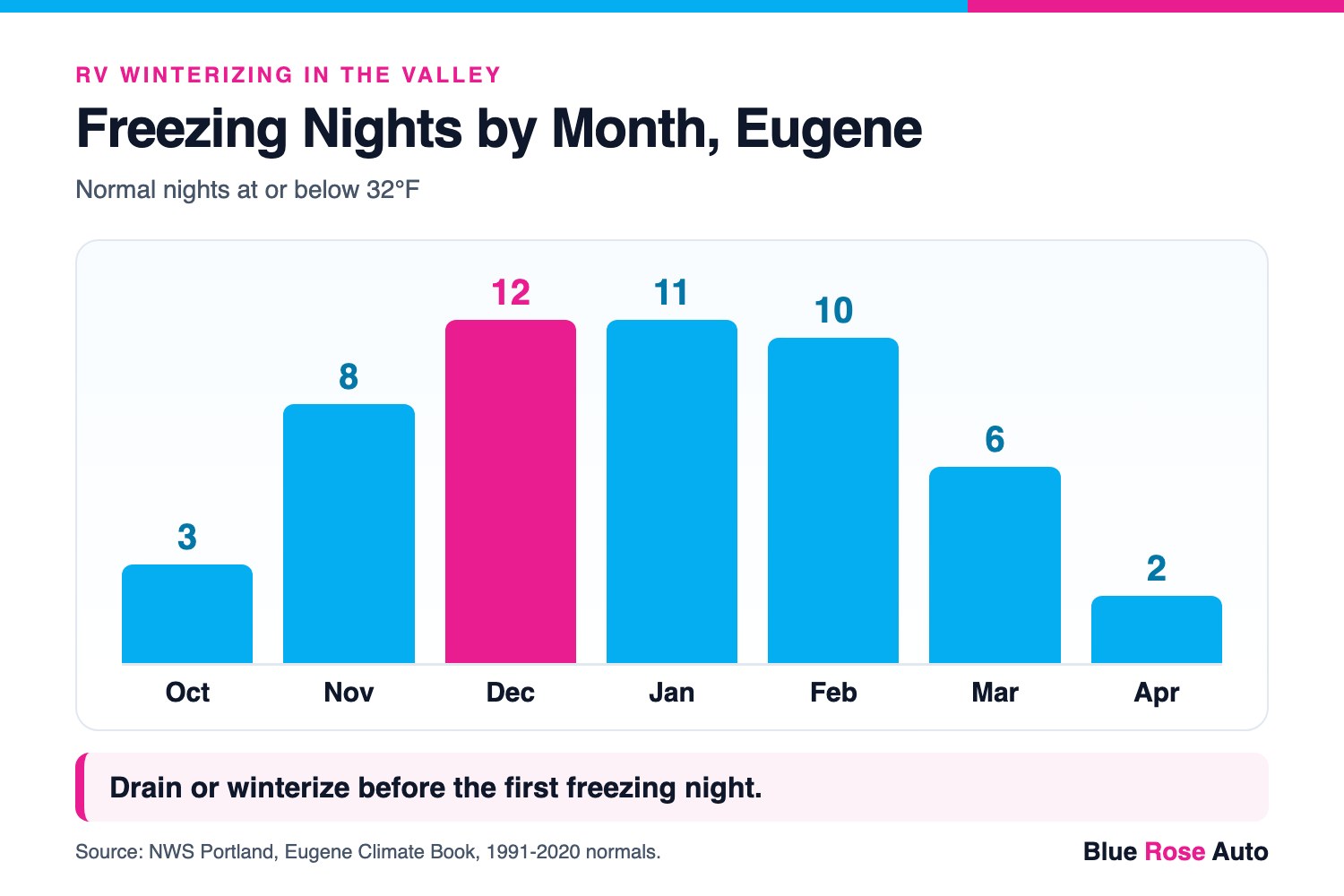
| Month | Nights at or below 32°F | Normal rain (in) |
|---|---|---|
| Oct | 3 | 3.17 |
| Nov | 8 | 5.98 |
| Dec | 12 | 7.21 |
| Jan | 11 | 6.05 |
| Feb | 10 | 4.67 |
| Mar | 6 | 4.64 |
| Apr | 2 | 3.32 |
1991-2020 normals, National Weather Service Portland, Eugene Climate Book. On average only 2 days a year stay at or below 32°F all day, and the normal December high is 45.6°F.
That pattern, frosty nights and mild wet days, is why valley owners deal with water first and freezing second. At minimum, drain the fresh tank, the water heater and the low-point drains, and leave the faucets open. The fuller job is having an RV service center blow out the lines or add RV antifreeze. To be plain, plumbing winterizing isn’t on Blue Rose Auto’s service list, so that step goes to you or an RV service center.
Caught by a cold snap before you’ve drained anything? Go RVing’s storage guide suggests running the interior heater and unhooking any outside water hose so ice can’t build in it. That holds for a night or two, not a winter.
Storing at elevation or towing over a pass in January? Winterize fully first; mountain nights run colder and longer.
How should you store a boat for winter?
Winter a boat much like an RV by cleaning it, sealing the gelcoat, handling fuel, water and battery, then covering it over a frame so rain runs off. For the engine and cooling system, follow the Oregon State Marine Board’s checklist.
The OSMB’s winterizing advice on covers is worth quoting in full.
“Use a frame under the cover to prevent water from pooling or tearing the cover. Canvas is best because it breathes. If you use plastic, make sure you leave vents in it to allow any moisture to escape. Allow for drainage if you’re storing outside.”
| Step | RV / trailer | Boat on a trailer |
|---|---|---|
| Wash, treat oxidation, seal | Yes, roof included | Yes, hull and deck |
| Fuel | Top off, add stabilizer (motorhome) | Top off, leave room for expansion, add stabilizer (OSMB) |
| Water and cooling | Drain or winterize lines | Drain the cooling system and add antifreeze, with non-toxic antifreeze in tanks and toilets (OSMB) |
| Battery | Disconnect or keep charged | Store it warm and dry, or keep it fully charged (OSMB) |
| Cover | Breathable cover or carport | Frame under the cover; vent any plastic |
| Trailer | Hitch and tires | Bearings, lights, tires, winch strap |
Engine steps belong to you or a marine mechanic, following the OSMB checklist. One OSMB line is worth taping to the garage wall, and it reads “Never use engine antifreeze in a freshwater system.” The hull is our side of it, since sun-faded gelcoat goes chalky just like an RV sidewall and needs the same correction before sealing.
Before the trailer sits for months, spend twenty minutes checking trailer bearings, lights and tires first. If the boat spends summers in the water, read up on bottom paint for freshwater boats over the off-season. Our Springfield shop handles boat detailing and trailer repair for recreational, fishing and power boats.
What should you check when storage season ends?
Look for water damage, mold, mice and oxidation before the first trip, and air out any engine compartment before starting it. Grab a flashlight, because ten minutes finds most of it, and the table below pairs each sign with a next step.
| What you find | What it may mean | Next step |
|---|---|---|
| Musty smell, spots on fabric | Humidity stayed high or a leak got in | Dry it, find the source, mold cleanup if it spread |
| Stain or soft spot at a window, vent or ceiling corner | A seal or seam let water in | Have it checked for leaks before the wood rots |
| Bubbles or waves in the sidewall | Possible delamination | Get it inspected now, not in July |
| Droppings, nests, chewed wiring | Mice got in | CDC clean-up first, then wiring and entry points |
| Chalky, faded gelcoat or paint | Oxidation | Paint correction to remove oxidation, then re-seal |
| Flat-spotted or cracked tires | A long sit, plus UV | Inspect before you tow |
Before starting a motorhome or boat engine that sat all winter, air the compartment out, then follow the CDC’s advice to “Inspect the air intakes and filters before starting the engine.” Nests end up there.
For bigger problems, we cover roof leaks, soft floors and fiberglass cracks and when faded RV paint needs a repaint in detail. Find a stain, a soft spot or chalky paint? Have someone look before camping season.
What else do Oregon RV and boat owners ask?
Is it okay to cover my RV with a tarp?
Not straight on the roof for a whole wet season. A polyethylene tarp holds condensation underneath and can scuff the finish as it moves in the wind. A breathable cover or a roofed carport is the better choice. The Oregon State Marine Board’s boat advice applies here, because canvas breathes and plastic needs vents so moisture can escape.
Should RV vents be open or closed during winter storage?
Cracked open, but only under a rain-proof cover. A little airflow helps a closed-up RV stay dry. Without a vent cover, keep it shut and rely on a desiccant or a dehumidifier. Aim for the EPA’s home target of 30 to 50 percent relative humidity, and keep it under 60.
Should I use DampRid in my RV?
Yes, it’s a reasonable no-power option for a parked rig. DampRid is a calcium chloride absorber, and its maker lists stored campers, RVs and boats among the intended uses. Per the product directions, set it on a flat surface and replace it once the crystals have completely dissolved. Check it at every monthly visit, and pair it with a humidity meter.
Should I store my camper with the slides in or out?
In. A retracted slide keeps its seals out of the weather and leaves no slide roof for rain and fir needles to sit on. Slide maker Lippert notes that in cold weather “Ice can also freeze behind gaskets or along the slide roof” (Lippert’s slide-out guide). Bring the slides in on a dry day before the first frost, not on a January morning.
Is it safe to leave bedding in my RV over winter?
Better to take it home. Fabric holds moisture, and the CDC notes that rodents nest in campers that sit unused, so a bed full of blankets is an invitation. If bedding has to stay, seal it in bags or bins and keep the humidity down.
At what temperature does an RV need to be winterized?
Water freezes at 32°F, so drain or winterize before the first freezing night. Go RVing’s rule of thumb is to winterize once temperatures sit at or below freezing for about 24 hours, but Eugene rarely gets a full day that cold (about 2 a year), while freezing nights are common. October is the time, with 3 normal freezing nights, rising to 8 in November.
Can I leave my boat outside in an Oregon winter?
Yes, if it’s winterized and covered over a frame so water can’t pool. The Oregon State Marine Board also says to allow for drainage when storing outside. Check on it now and then through the wet months to make sure the cover is tight and the bilge stays dry.
Is shrink wrap or a cover better for a boat?
Either works if moisture can escape. Shrink wrap is plastic, so it needs vents, and the Oregon State Marine Board says plastic covers should have vents “to allow any moisture to escape.” A fitted canvas cover over a frame breathes on its own. Pick the one you’ll actually keep tight all winter.
When should you bring it to Blue Rose Auto?
The best time to protect an RV or boat is before the rain, not after the leak. If you’d like the wash, oxidation correction and sealant or coating done before it goes into storage, or a spring once-over when it comes out, bring it to our shop at 3436 Olympic St in Springfield (open Monday to Friday 8 AM to 5 PM and Saturday 10 AM to 5 PM, closed Sunday). Blue Rose Auto opened in 1994, and our ASE-certified technicians do the work. Plumbing winterizing isn’t on our service list, but we’ll tell you straight what the outside needs. Call (541) 641-8877 to book pre-storage RV wash and protection.
0 Comments