Last reviewed October 2026 · Statutes as of the 2025 ORS edition · General information, not legal advice
In Oregon, your car is totaled when the insurer covering the loss declares it a total loss or takes possession of or title to it. The 80 percent test in ORS 801.527 applies only to damage no insurer covers, meaning estimated repairs of at least 80 percent of the car’s pre-damage retail value. For insured claims, the statute sets no percentage.
So if you’re asking “is my car totaled?” after an Oregon crash, the honest answer is that your insurer’s own valuation decides it. Not a fixed 80% line. Below we walk through how that valuation works, what you’re owed, the title rules, and when repair still beats taking the check.
This is general information about Oregon law, not legal advice. For a dispute about your claim, contact the Oregon Division of Financial Regulation or a licensed Oregon attorney.
Does Oregon’s 80% rule decide if my car is totaled?
Oregon law defines “totaled” three ways in ORS 801.527. A car is totaled when the insurer obligated to cover the loss declares it a total loss, or takes possession of or title to it. A stolen car counts as totaled if it isn’t recovered within 30 days and no insurer covers the loss. A car with uninsured damage is totaled when the repair estimate reaches at least 80 percent of its pre-damage retail market value, as “reflected in publications relied upon by financial institutions doing business in this state.” That has a big consequence. When an insurer covers the loss, the statute sets no percentage, so a car can be totaled well below 80% or repaired above it. The Oregon Division of Financial Regulation (DFR) says insurers usually total a car because “the cost of repair is impractical.” Source ORS 801.527, Oregon Revised Statutes, 2025 Edition.
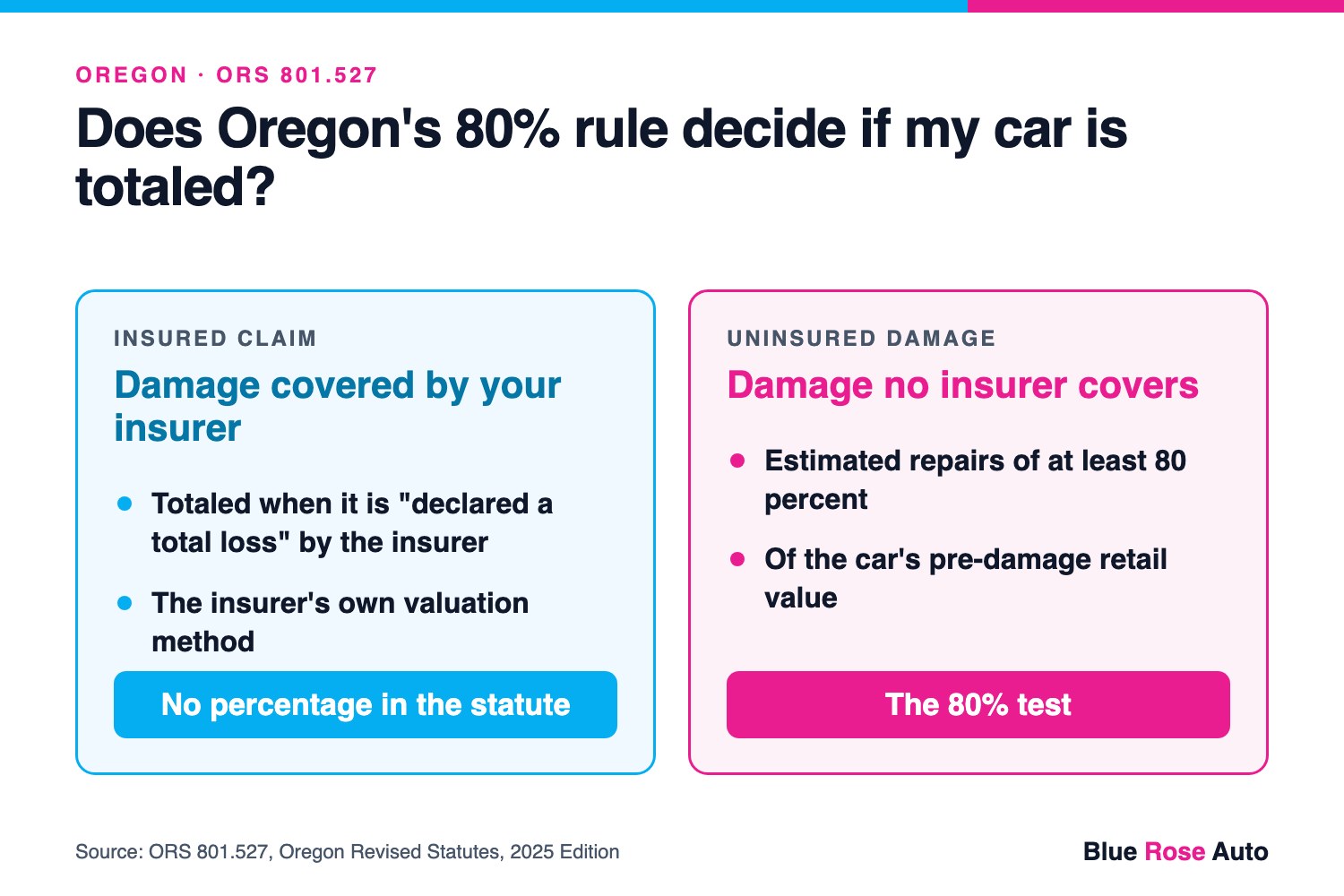
Here is the full definition from ORS chapter 801, 2025 Edition.
“Totaled vehicle” or “totaled” means: (1) A vehicle that is declared a total loss by an insurer that is obligated to cover the loss or that the insurer takes possession of or title to. (2) A vehicle that is stolen, if it is not recovered within 30 days of the date that it is stolen and if the loss is not covered by an insurer. (3) A vehicle that has sustained damage that is not covered by an insurer and that is such that the estimated cost to repair the vehicle is equal to at least 80 percent of the retail market value of the vehicle prior to the damage. For purposes of this subsection, “retail market value” shall be as reflected in publications relied upon by financial institutions doing business in this state.
Read subsection (3) twice. Five words, “not covered by an insurer,” do all the work.
Law versus practice for a car totaled in Oregon.
| Situation | What ORS 801.527 says | What actually decides it |
|---|---|---|
| Damage covered by your insurer | Totaled when it is “declared a total loss” by the insurer, or the insurer takes possession or title | The insurer’s own valuation method (often a total loss formula or an internal threshold). No percentage in the statute |
| Damage no insurer covers | Totaled when estimated repair cost is “at least 80 percent of the retail market value” before the damage | The 80% test, using values “in publications relied upon by financial institutions doing business in this state” |
| Stolen car | Totaled if not recovered within 30 days and the loss is not covered by an insurer | Uninsured, the owner notifies DMV within 60 days of the theft (Form 735-32N). Insured, the insurer’s settlement |
Sources ORS 801.527, Oregon Revised Statutes, 2025 Edition; DMV Form 735-32N (rev. 1-25).
So the 80% line is real. It only governs cars no insurance is paying for. Many websites describe 80% as the point where Oregon insurers must total a car. The statute doesn’t say that. DMV’s Totaled Vehicle Notice (Form 735-32N) even lists the three situations as separate definitions, and its title instructions treat insured and uninsured totals as different cases.
How do insurers decide a car is a total loss?
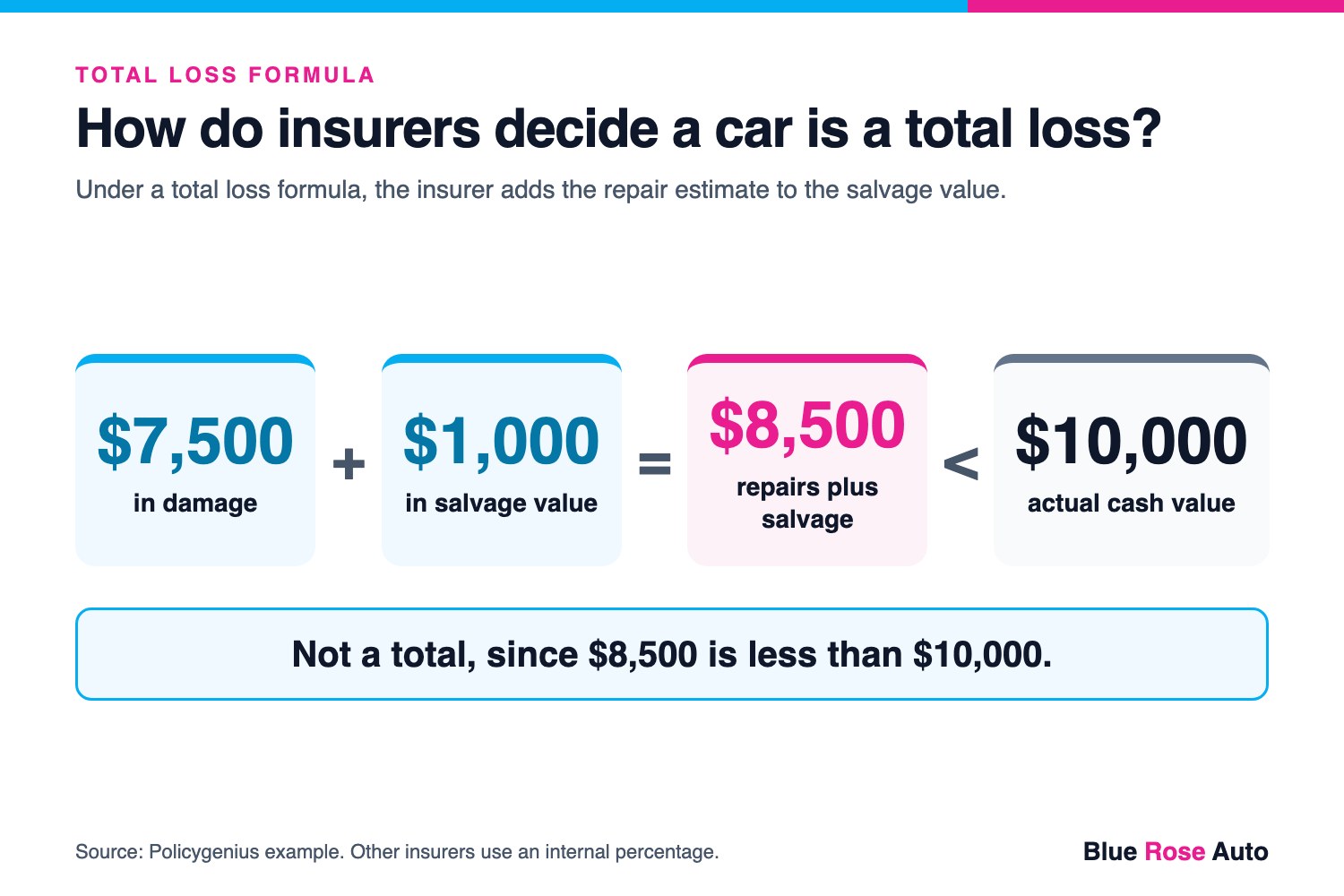
Most insurers compare the cost to repair the car with its actual cash value, the price a comparable car would sell for before the crash. Many also count the salvage value, what the wreck is worth at auction. If repairs plus salvage reach or pass the car’s value, the insurer usually totals it.
Actual cash value (ACV) is what the car was worth the moment before the crash. Not what you paid. Not what you owe.
Under a total loss formula, the insurer adds the repair estimate to the salvage value and then compares that sum with the car’s ACV. Policygenius uses a $10,000 car with $7,500 in damage and $1,000 in salvage value. Not a total, since $8,500 is less than $10,000. Other insurers use an internal percentage, and Oregon law doesn’t choose for them.
What Oregon does regulate is the valuation. When an insurer values the car with a computerized database, OAR 836-080-0240(3) requires the source to rely on vehicles available within the last 90 days from the date of loss and to “give primary consideration to the values of vehicles in the local market area.” Whatever method it uses, deductions “must be measurable, discernible, itemized and specified as to dollar amount.” So question any condition adjustment that has no dollar figure. If your car is garaged in Lane County and the report leans on comparables from Portland or out of state, ask the adjuster in writing why closer listings weren’t used.
DFR’s Vehicle Total Loss Notice lists what insurers weigh. Mileage and options are on it, and so are recent upgrades “such as a rebuilt engine or new transmission.” Got a receipt for that transmission? It belongs in the file.
Why do insurers total cars with little damage?
CCC reports a record 23.1% of claims were total losses in 2025. Usually the car’s value is low, not the damage big. ACV drops as a car ages and repair costs don’t, so on an older car a few panels of work plus salvage value can reach its worth fast. Then add airbags. Crash sensors and bumper cameras push the bill higher still.
What does the insurer owe you after a total loss?
When an Oregon insurer totals your car and offers cash, ORS 742.554 requires it to give you “any valuation or appraisal reports relied upon by the insurer to determine value,” plus the state’s written total loss notice. Under OAR 836-080-0240(3), a cash settlement must also include taxes and transfer fees, less any policy deductible.
Before you sign, get these in writing.
- The valuation report and the comparable vehicles behind it (ORS chapter 742, section 742.554).
- DFR’s Vehicle Total Loss Notice, which explains valuation and how to reach the Division of Financial Regulation.
- Taxes and fees in the number. OAR 836-080-0240(3) says a cash settlement includes “all applicable taxes, license fees and other fees incident to transfer of ownership.”
- Every deduction itemized, each with a dollar amount.
Your deductible still comes off a first-party claim, and what collision coverage pays for shapes how. An insurer can offer a replacement car instead, which under OAR 836-080-0240(2) must be the same make, the same year or newer, and in as good or better condition.
With a loan, DFR says “the check will probably be made out to you and the lienholder,” and “The lienholder may not allow you to keep your damaged vehicle.” Owe more than the settlement? Gap insurance fills that hole only if you bought it. Washington’s insurance commissioner defines it as “coverage you can buy that covers the difference between what you owe on your vehicle or motorhome and what it’s worth” (WA OIC).
Your insurer or the other driver’s?
If the other driver caused the crash, DFR says you can claim with their insurer or your own. Their company “has the right to investigate the accident facts and accept or deny responsibility.” Go through your own collision coverage and you pay the deductible, though you “should get the deductible back from the other company if the other company accepts responsibility.”
| Claim route | Deductible | Speed and control | Watch for |
|---|---|---|---|
| Your own collision coverage | You pay it up front, may be refunded later | Doesn’t hinge on the other insurer accepting fault | The same valuation rules and reopen rights apply |
| At-fault driver’s liability insurer | None | Waits on their investigation, and they can deny responsibility | The 35-day reopen right covers first-party claims only |
| Uninsured motorist property damage | First $200 not covered ($300 for a hit-and-run) | Only if you bought this coverage | Doesn’t pay for loss of use |
Sources: DFR, totaled vehicle; OAR 836-080-0240(6); ORS 742.510, 2025 Edition.
ORS 742.510 requires Oregon insurers to offer that uninsured-driver property coverage, not to include it, so check your declarations page before you count on it.
Storage fees and rental cars
Storage is the bill people forget. DFR says, “Usually, the company pays the storage fees up to the day it makes an offer. If you do not accept the offer, you may be responsible for the fees from that time forward.” It adds that a rental from the other driver’s insurer typically runs “until one or two days after the company makes an offer on the totaled vehicle.”
What if the total loss offer is too low?
No, you don’t have to accept the first offer. Oregon’s DFR says you can keep negotiating with evidence such as local comparable cars. Under ORS 742.558, if you can’t agree, the insurer must still pay the undisputed amount, and taking it doesn’t waive your right to pursue more.
Start with the valuation report, where wrong trim, missing options or wrong mileage usually hide. Then find comparables that truly match and call each seller for the cash price. DFR explains why in one line. “The company will not pay the advertised price.”
Oregon law also hands you four tools.
- The undisputed amount. ORS 742.558 says accepting it “neither waives the rights of the insured or third-party owner under the policy nor prevents the insured or third-party owner from pursuing a claim for additional amounts.” The insurer doesn’t have to pay it until you agree to transfer the car and let it move the car, at its expense, to a place where it stays available “for not fewer than 14 calendar days” before any salvage sale.
- The 35-day reopen right. Under OAR 836-080-0240(6), if you tell the insurer “within 35 days of the receipt of the claim draft” that you can’t buy a comparable car for that amount, “the insurer shall reopen its claim file.” It covers first-party claims only, and not settlements that already named a specific comparable car.
- Appraisal. ORS 742.466 makes your policy’s appraisal clause apply, with appraisers who hold a vehicle appraiser certificate. If the final appraisal beats the insurer’s last offer, it reimburses your reasonable appraisal costs. Per DFR, each side pays its own appraiser and you split the umpire.
- Deadlines on the insurer. OAR 836-080-0235 gives it 30 days after proofs of loss to accept, deny or explain the delay, then written updates every 45 days (or on a date it sets, no more than 90 days out).
DFR also warns, “do not cash a check that says anything like ‘full and final settlement.'”
Keep the car check separate from any injury claim
A total-loss payment settles the car. It shouldn’t settle your injuries. Oregon’s personal injury protection (PIP) under ORS 742.524 pays injury costs such as medical bills and lost income, not the car’s value, so PIP won’t close a gap in the total-loss offer.
Read every release before you sign it. Under ORS 742.548, when an insurer’s representative gets a bodily-injury release from you in person, it must warn you in capital letters that you “WILL NOT BE ABLE TO MAKE ANY FURTHER CLAIM(S),” and you can rescind with written notice “no later than five business days” after signing. If a property-damage form mentions “all claims,” stop and ask what it covers.
What to do this week
- Ask for the valuation report in writing.
- Check options, trim, mileage and condition line by line against your own records.
- Collect local comparable listings and call for cash prices.
- Note the storage cutoff date, since fees can shift to you after you turn down an offer.
- Don’t cash or sign anything marked “full and final” until you agree with the number.
- Call the DFR Consumer Hotline at 888-877-4894 if you’re stuck, or file a complaint online.
This is general information about Oregon law, not legal advice. For a dispute about your claim, contact the Oregon Division of Financial Regulation or a licensed Oregon attorney.
Can I keep my totaled car in Oregon?
Often, yes, if no lienholder objects. The insurer pays the car’s value minus its salvage value, and you keep the car. Oregon then requires the title to go to DMV within 30 days, and the car must be re-titled as totaled even if you never repair it.
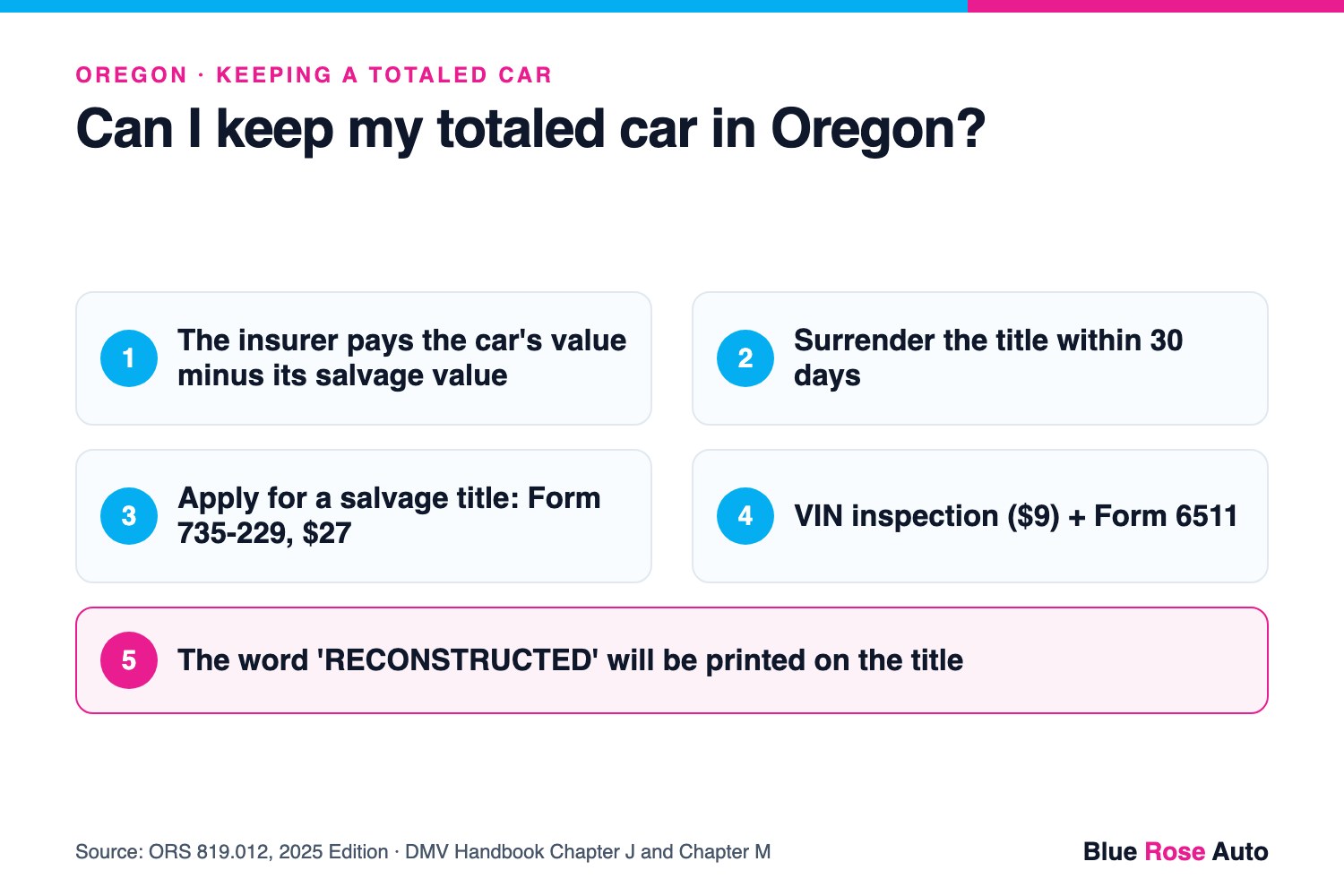
DFR runs the numbers on a car “worth $10,000 before a crash and has a $1,000 salvage value, the insurance company will pay $9,000.”
The title deadline has teeth. ORS 819.012 (2025 Edition) requires the owner to surrender the title “either to the Department of Transportation or to the insurer within 30 days of the declaration by the insurer.” Missing it is a Class A misdemeanor. DMV’s titles page adds, “Even if no repairs are done, the vehicle must be re-titled due to the totaled status.” Under ORS 819.016(3), you can skip the salvage title if you won’t rebuild, transfer or reuse the frame, or if you rebuild and title the car as assembled, reconstructed or replica.
These are the Oregon DMV forms and fees for keeping a totaled car.
| Step | Form or item | Fee | Source |
|---|---|---|---|
| Report totaled status, surrender title | Form 735-32N, Totaled Vehicle Notice (rev. 1-25) | None listed | DMV Form 32N |
| Apply for a salvage title | Form 735-229, Application for Salvage Title (rev. 1-26) | $27 | Form 229; Chapter M |
| Certify a rebuilt vehicle | Form 6511, Assembled, Reconstructed or Replica Vehicle Certification (or the back of Form 226) | None listed | Form 6511; Chapter J |
| VIN inspection for a first reconstructed title | DMV or a designated law enforcement agency | $9 | Chapter M |
| New passenger title | Title application | $101 (0-19 MPG), $106 (20-39), $116 (40+), $192 (electric) | Chapter M |
Registration fees are separate. Fees from DMV Handbook Chapter M, rev. 07/01/26; check with DMV before you file.
What is a salvage title in Oregon?
It’s the title for a totaled car that hasn’t been rebuilt, applied for on Form 735-229 with the $27 fee. Registration is cancelled when it issues. DMV Handbook Chapter J says salvage-titled vehicles “may not be operated on the highways of the state, unless the vehicle has a valid trip permit.” Mail it to the Totaled Vehicle Desk at 1905 Lana Avenue NE in Salem, since Chapter J says other routing takes longer.
How do you get a reconstructed title?
Chapter J asks for five things.
- The title or salvage title for the frame.
- “Original bills of sale, title, MCO, or equivalent documents for each major part.”
- A VIN inspection by DMV or designated law enforcement ($9).
- Form 6511, or the certification on the back of Form 226.
- The title fee, set by the car’s MPG rating.
The title then “will show the original year model and make of the body. The word ‘RECONSTRUCTED’ will be printed on the title.” Keep every parts receipt.
Which title brands does Oregon use?
Brands include Totaled, Reconstructed, Replica, Branded-(state) and Flood-(state). One surprises people. “Oregon does not use a flood brand. If a vehicle is flooded in Oregon and meets the Totaled definition, the title will have a Totaled brand.” A car another state has declared junk or non-repairable can’t be titled here unless that state removes the junk status.
When does repairing a near-total car still make sense?
Repair can still make sense when the estimate sits just under the insurer’s line, the car is mechanically sound, and the structure can be measured back to factory spec. It makes less sense when airbags deployed, the frame or unibody is badly kinked, or hidden damage keeps growing at teardown.
Here’s how we’d sort it, honestly.
Repair tends to make sense when
- the estimate lands just under the line, not far over it
- the car runs well and has low miles for its age
- damage is mostly bolt-on panels, not structure
- you’d struggle to buy a comparable car with the settlement
- you’d keep the car either way
It tends not to when
- airbags deployed
- there’s badly kinked frame and chassis damage
- it sat in floodwater
- more damage turns up with every panel removed
- parts for that model are slow or scarce
Most owners don’t hear this until it happens. A first estimate is often written before anyone takes the bumper or panels off. Once a car is opened up, it’s common to find more, such as bent brackets, a pushed radiator support or damaged sensors, and that added work can move a borderline car over the insurer’s line. So treat the first number as a starting point.
Structure decides most near-total repairs. Our order of work is simple. “We measure, we align, and we tell you what we find before any part gets ordered.” Then, “We bring the structure back to factory spec and confirm the safety features, from crumple zones to driver-assist sensors.” Blue Rose Auto opened in 1994, our auto body and collision repair work is done by ASE-certified technicians, and Blue Rose Auto is a Tesla Approved Body Shop for collision and structural repair on Teslas.
Is body work on an older car still worth it? Often yes. “We will give you an honest read on whether it makes sense for your car.” Sometimes that read is no.
One more catch. A repaired car with a crash in its history can sell for less than an identical car without one, and that drop, usually called diminished value, sits outside the total-loss rules above entirely. Was the other driver at fault? Ask their insurer whether it will consider a diminished value claim, and keep the repair invoice and your pre-crash photos. Whether a claim holds up depends on the facts. That’s a question for an Oregon attorney.
Get a repair estimate before you decide
A written estimate from a shop that measures structure gives you a second number to set beside the insurer’s. Ask about teardown, too. How does the shop handle damage it finds after the panels come off, and how will you hear about it? Our collision repairs carry a 3-year/36,000-mile warranty, and we explain what to expect once repairs start.
If your car is close to the line and you’d rather fix it, call us for a written collision repair estimate that measures the structure and an honest read before you decide. From downtown Eugene, the shop is about 15 minutes east via I-105.
Should you buy a car with a reconstructed title?
A reconstructed title means the car was once totaled and later rebuilt, and Oregon prints “RECONSTRUCTED” right on it. That alone isn’t a dealbreaker. It does mean the repair quality matters more than usual.
Oregon DMV can brand titles based on the National Motor Vehicle Title Information System (NMVTIS), and Chapter J says NMVTIS “will have a more extensive vehicle brand history than other providers.” Before you buy, work through this list.
- Pull an NMVTIS report and compare its brands with the seller’s story.
- Ask for the repair paperwork and the parts receipts DMV required.
- Get an independent post-repair inspection from a shop you choose.
- Ask your insurer about coverage on that exact car.
A seller who can’t produce the parts receipts is telling you something.
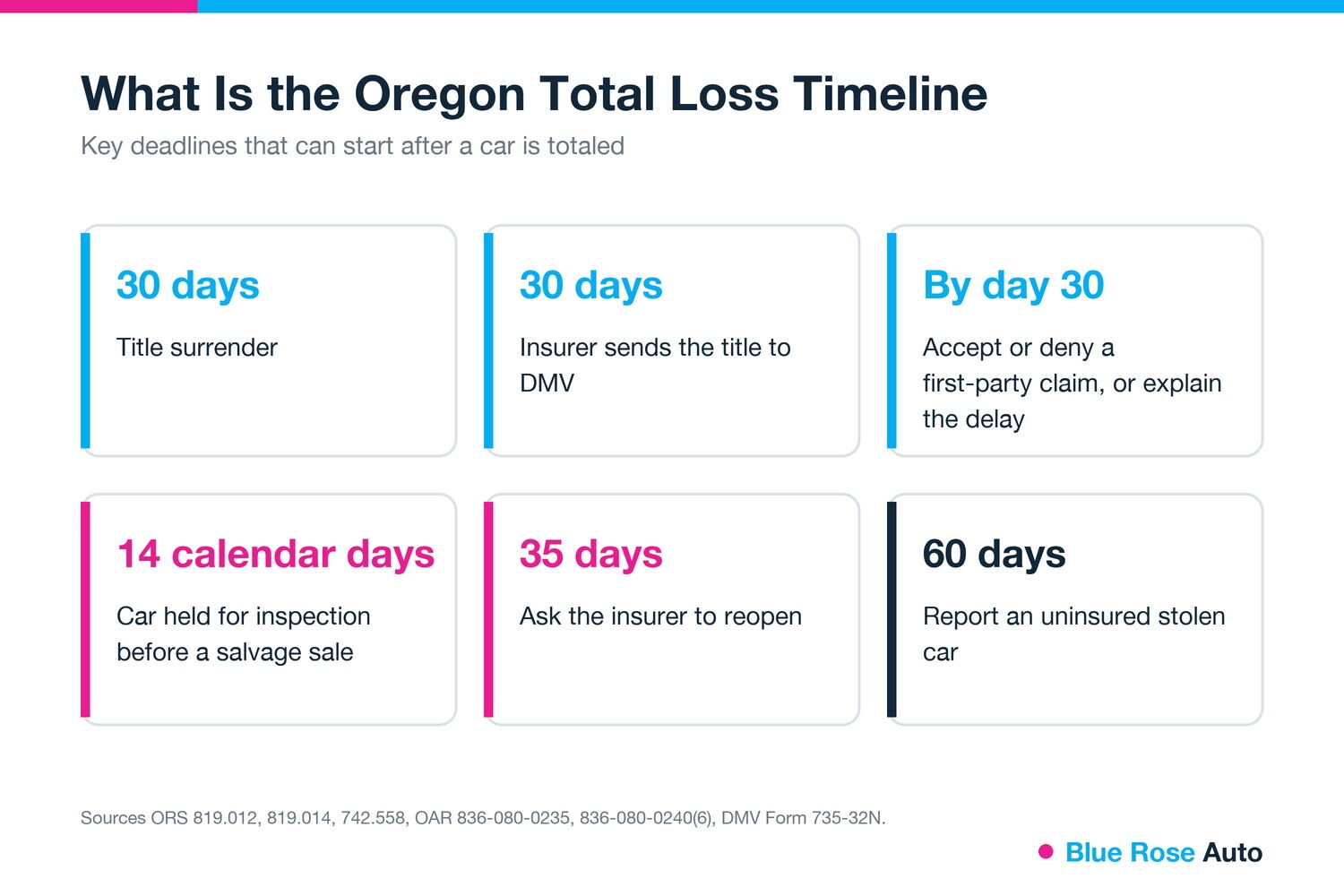
What is the Oregon total loss timeline?
Seven clocks can start after a total, each from a different event, such as a declaration, a claim draft, a theft. Here they are in one place.
| Clock | Deadline | Who acts | Source |
|---|---|---|---|
| Title surrender after an insurer declares a total | Within 30 days of the declaration | Owner (to DMV or the insurer) | ORS 819.012(1)(a) |
| Title surrender, uninsured damage at 80% or more | Within 30 days of the date it became totaled | Owner (to DMV) | ORS 819.012(1)(c) |
| Insurer sends the title to DMV | Within 30 days of receiving it | Insurer | ORS 819.014(1)(a) |
| Accept or deny a first-party claim, or explain the delay | By day 30 after proofs of loss, then written updates every 45 days | Insurer | OAR 836-080-0235 |
| Car held for inspection before a salvage sale (undisputed-amount payment) | Not fewer than 14 calendar days | Insurer | ORS 742.558(2)(b) |
| Ask the insurer to reopen if you can’t buy a comparable car | Within 35 days of receiving the claim draft | Owner | OAR 836-080-0240(6) |
| Report an uninsured stolen car | Within 60 days of the theft | Owner (to DMV) | DMV Form 735-32N |
Dates run from different starting points, so write each one down the day it starts.
Frequently asked questions
What is the total loss threshold in Oregon?
For an insured claim, Oregon law sets no percentage, so your insurer decides using its own valuation, often a total loss formula that adds repair cost to salvage value. The 80% figure in ORS 801.527(3) applies only to damage that no insurer covers, such as a car with no collision coverage.
Do I have to accept the insurance company’s total loss offer?
No. DFR’s Vehicle Total Loss Notice states, “You do not have to accept the insurer’s offer.” Under ORS 742.558 the insurer still pays the undisputed amount once you agree to transfer the car, and taking it doesn’t waive your rights. Your policy’s appraisal clause, if it has one, and the 35-day reopen request are two more options.
Who gets the check if I still owe money on a totaled car?
Often both you and the lender. DFR says “the check will probably be made out to you and the lienholder,” and the lienholder may not let you keep the car. If the settlement falls short of the loan balance, gap insurance may cover the difference, but only if you bought it. Check your loan and policy.
Can I drive a car with a salvage title in Oregon?
No, not without a valid trip permit, according to DMV Handbook Chapter J. To drive it normally again, the car must be repaired and retitled as reconstructed, which takes a VIN inspection, Form 6511 and receipts for the major parts. The reconstructed-title steps above list each one.
Can a totaled car still have a clean title in Oregon?
No. Oregon DMV says, “Even if no repairs are done, the vehicle must be re-titled due to the totaled status,” and a rebuilt car’s title carries a brand such as Reconstructed. If DMV cancelled the title on a totaled notice you believe was a mistake, ORS 819.030(6) entitles the owner to an administrative review.
How can I check if a car has been totaled?
Look at the title first. A totaled Oregon car carries a Totaled brand, or Reconstructed once rebuilt. Then pull an NMVTIS report with the VIN, since DMV Handbook Chapter J says NMVTIS “will have a more extensive vehicle brand history than other providers.” A brand carried over from another state, such as Flood-(state), is reason enough for an independent inspection.
What should I avoid saying or signing after a total loss?
Don’t guess about fault or injuries, and don’t sign anything you haven’t read to the last line. DFR warns against cashing a check marked “full and final settlement” while you still dispute the value. Keep the car payment apart from any injury release, and ask for each offer in writing with the storage cutoff date on it.
Can hail damage total a car?
Yes. Any covered damage, hail included, can end in a total loss if the insurer decides repair isn’t practical for the car’s value. Older cars are most at risk. Picture dents on nearly every panel of a car whose value has already dropped, and the math tips fast. When the numbers do work, hail damage repair can bring the panels back.
What happens if my car is totaled but still drivable?
Its status doesn’t change. “Totaled” depends on the insurer’s declaration, or the 80% test for uninsured damage, not on whether the engine starts. You still surrender the title within 30 days and the car still gets re-titled, and if you keep it and plan to drive it anywhere before it’s rebuilt, check with DMV first, because a salvage-titled car needs a trip permit.
Car near the total-loss line?
Blue Rose Auto opened in 1994 and repairs wrecked cars with ASE-certified technicians at 3436 Olympic St in Springfield. If the insurer’s number and your gut disagree, get a second opinion on a borderline total before you sign. Call (541) 641-8877 to book a time.
0 Comments