
Why is my steering wheel shaking? Usually because something that spins is spinning unevenly, either a front tire or wheel that’s out of balance or damaged, or brake rotors worn to uneven thickness. When it shakes tells you which. Shaking only while braking points to the brakes. A band around 50 to 70 mph points to wheel balance.
By Blue Rose Auto. Last reviewed October 2026. General information only, since a road test and an inspection confirm the cause.
The table below matches when you feel it to where a technician looks first. Further down are two myths, the fixes, and when to pull over.
Why is my steering wheel shaking, and when?
Timing is the diagnosis. A wheel and tire out of balance shakes “in a specific speed range and fades above and below it,” according to BFGoodrich, and RealTruck puts that range at 50 to 70 mph. A shake that appears only under braking is a rotor problem. The Disc Brakes Australia (DBA) technical bulletin explains that when rotor thickness varies “by as little as 20 microns,” the pads oscillate and pulse the pedal, and the uneven braking force “is typically noticed in the steering wheel.” If the shake keeps growing the faster you go, suspect a damaged tire, a bent rim or worn parts. If it shows up only when accelerating, look at the driveline (CV axle, driveshaft or mounts). Alignment rarely causes a shake directly. Our ASE-certified technicians in Springfield road-test the car, check tires, wheels, brakes and suspension, and give you a written estimate before any work starts. The first 15 minutes of diagnosis are free. Call (541) 641-8877.
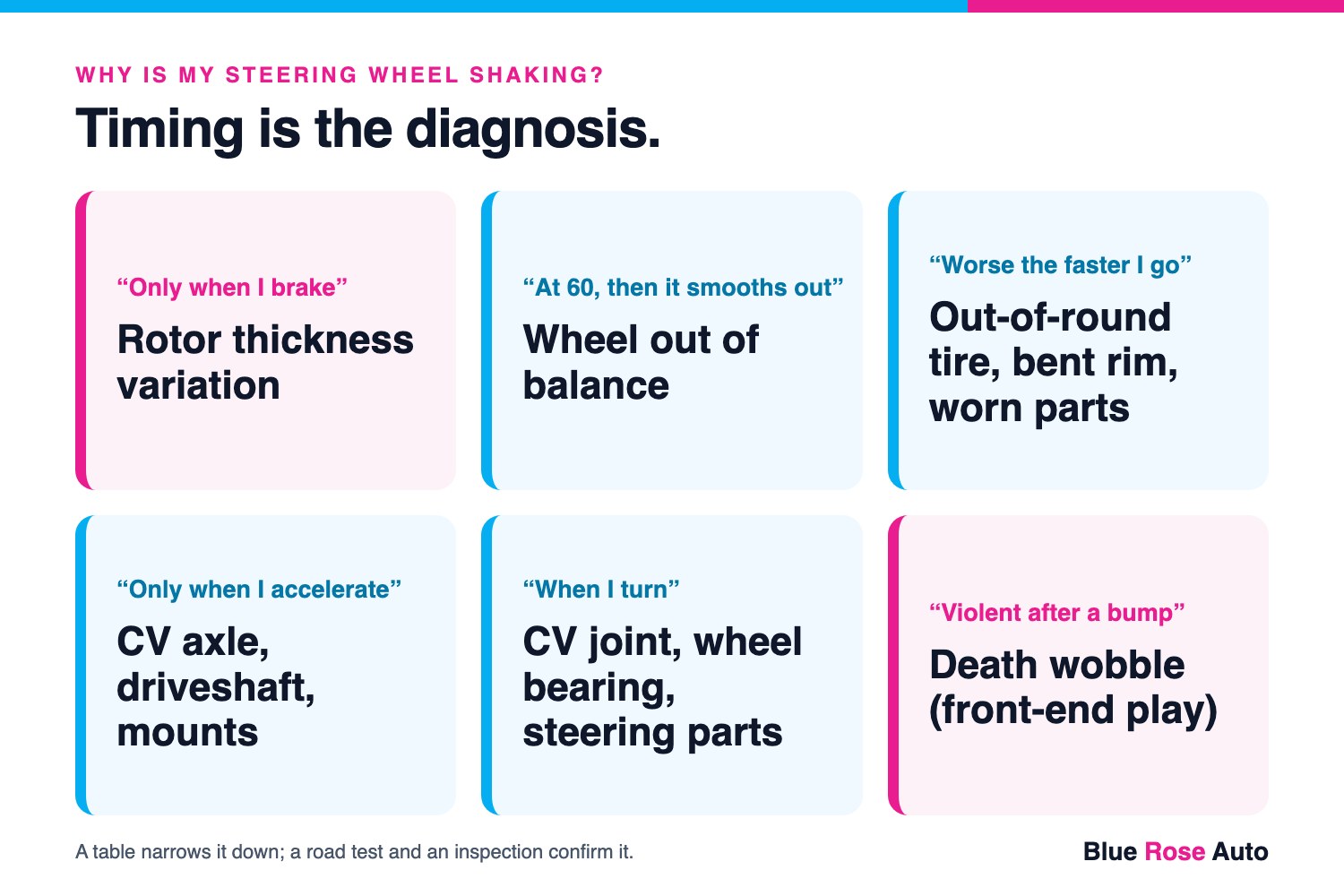
Find the row that matches when you feel it.
| When you feel it | What else you notice | Most likely cause | What the fix involves | How urgent |
|---|---|---|---|---|
| “Only when I brake” | Pedal pulses | Rotor thickness variation, pad deposits or worn suspension bushes (DBA) | Measure rotors, resurface or replace | Book soon |
| “When I brake, and it pulls” | Hot wheel, burning smell | Sticking caliper | Brake inspection | Stop soon, since AAA calls a stuck caliper “unsafe to drive” |
| “At 60, then it smooths out” | Wheel points to the front, seat points to the rear (BFGoodrich) | Wheel out of balance | Balance check | Book soon |
| “Worse the faster I go” | Uneven or cupped tread | Out-of-round tire, bent rim, worn parts | Runout and suspension check | Book soon |
| “Wobbling at low speed” | A wobble you can see | Bent wheel, damaged tire, loose lug nuts | Stop and inspect | Stop now |
| “Only when I accelerate” | Gone when coasting | CV axle, driveshaft, mounts | Driveline inspection | Book soon |
| “When I turn” | Clicking or growling | CV joint, wheel bearing, steering parts | Lift inspection | Book soon |
| “Violent after a bump” | Solid-axle truck or Jeep | Death wobble (front-end play) | Front-end inspection | Slow down now |
| “Right after tire or brake work” | Any speed | Lug torque, fallen weight, hub debris | Re-torque, rebalance | Check now |
| “After a gravel or snow trip” | Highway speeds | Mud or dirt packed in the rim (AA1Car) | Clean the wheels, re-test | Check yourself |
| “First few miles after it sat, then gone” | Parked overnight or for weeks | Temporary tire flat spots (AAA, Audi bulletin) | Drive it warm, re-test | Check yourself |
| “Parked or at idle” | The whole car shakes | Engine side, such as worn engine mounts | Engine diagnosis | Book an engine check |
A table narrows it down; a road test and an inspection confirm it.
Why does it shake between 50 and 70 mph?
A shake that builds around 50 mph and smooths out again above 70 is the classic sign of a wheel out of balance. BFGoodrich says balance vibration shows up “in a specific speed range and fades above and below it.” It doesn’t take much. AA1Car notes that “only 1/4 ounce of imbalance can produce a noticeable vibration.”
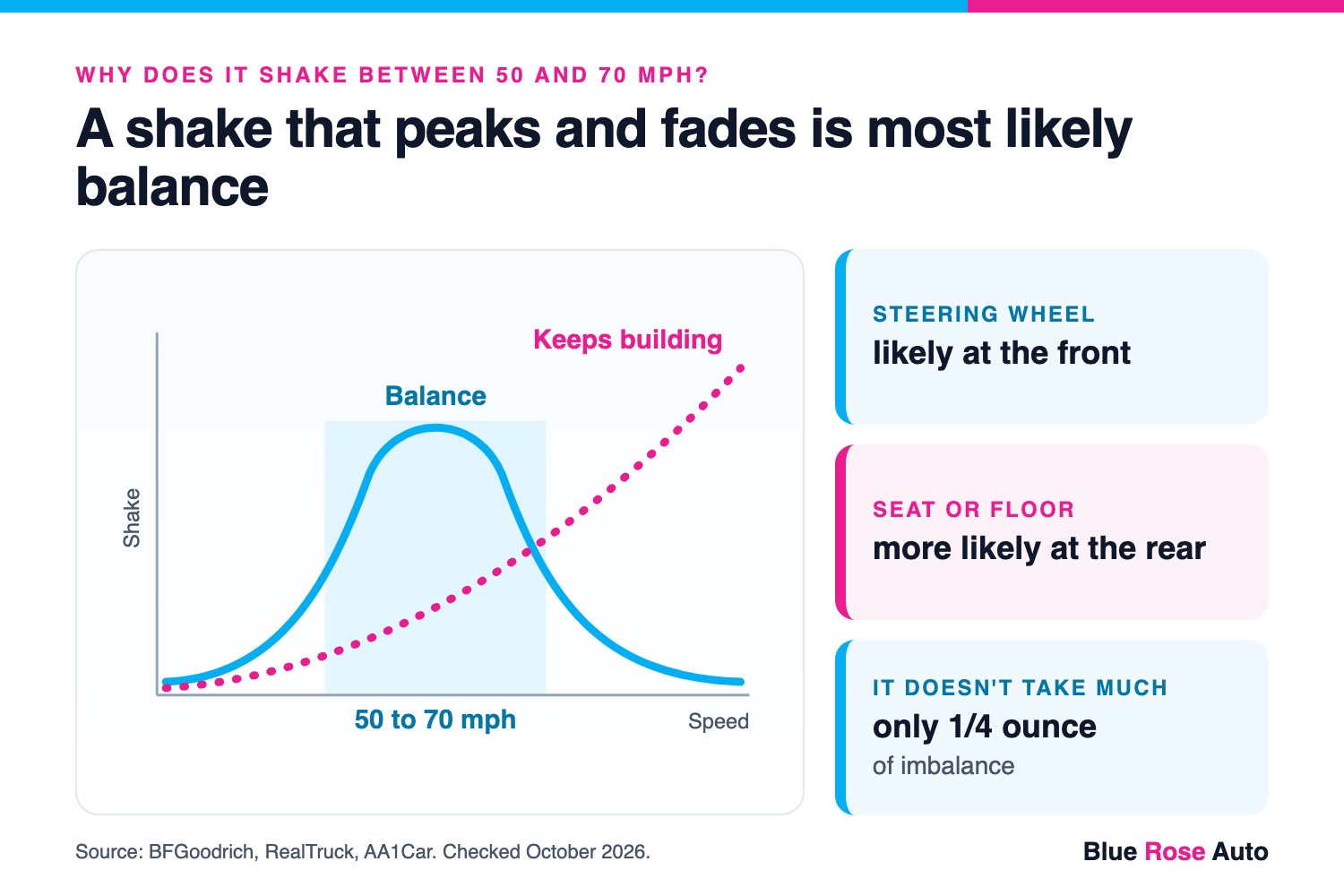
The band isn’t always neat. AA1Car says imbalance vibration “usually starts at 40 to 50 mph and increases in intensity as the speed goes up.” So watch the shape. A shake that peaks and fades is most likely balance. One that keeps building points at the tire or wheel itself, meaning an out-of-round tire, a tire defect or a bent rim.
AA1Car also gives two shop numbers. Most tires should have “less than .050 inch of radial runout,” and a tread-depth difference “of more than about 1/16 inch would indicate an out-of-round condition.” Low-profile tires (aspect ratio 50, 40 or even 30) feel imbalance sooner. Cupped tread is one of the signs your shocks are worn.
Steering wheel or seat?
BFGoodrich spells it out. “Felt through the steering wheel, the imbalance is likely at the front. Felt through the seat or floor, it is more likely at the rear.” Tell the shop which. It saves guessing.
Balanced it and it still shakes?
Then the tire itself may be the problem, even with perfect weights on it. An Audi service bulletin for its 2008 to 2017 models (TSB 44 16 63, on file with NHTSA) traces vibration “at highway speeds” of 55 to 80 mph to either imbalance or “radial force variation (RFV) of the tires.” Picture the tire as a ring of springs. If some are stiffer than others, it pushes on the axle unevenly every turn, and a standard spin balancer doesn’t measure that. More weights won’t cure it. The bulletin calls for a road-force measuring machine and, where needed, rotating the tire on the rim.
Two more details from that bulletin help. Temporary flat spots form when “a warm tire has cooled down after a stationary period of a few hours.” So a car that shakes for the first few miles and then smooths out may just need driving, and Audi’s procedure test-drives “at least 12-15 miles” before checking balance. The bulletin also says this vibration “does not lead to any handling concerns or loss of vehicle control.” That’s Audi’s finding for its own cars. Still, it fits what the other sources say, since a steady highway buzz is usually a tire matter, not a front end about to fail.
Why does the steering wheel shake when braking?
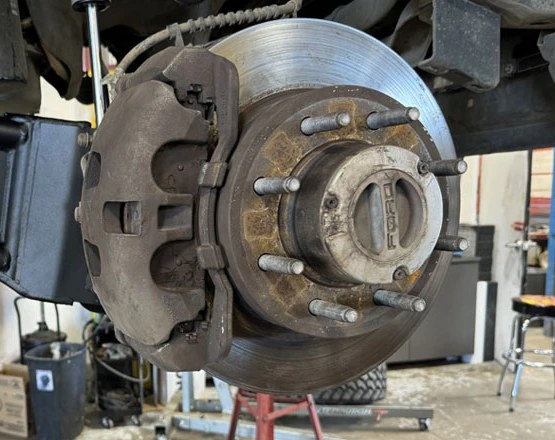
A wheel that shakes only when you brake usually means the rotors have worn to uneven thickness, not that they’ve “warped.” The DBA bulletin says a variation of “as little as 20 microns” (0.02 mm) makes the pads oscillate, which pulses the pedal and reaches the steering wheel because the left and right brakes grab unevenly.
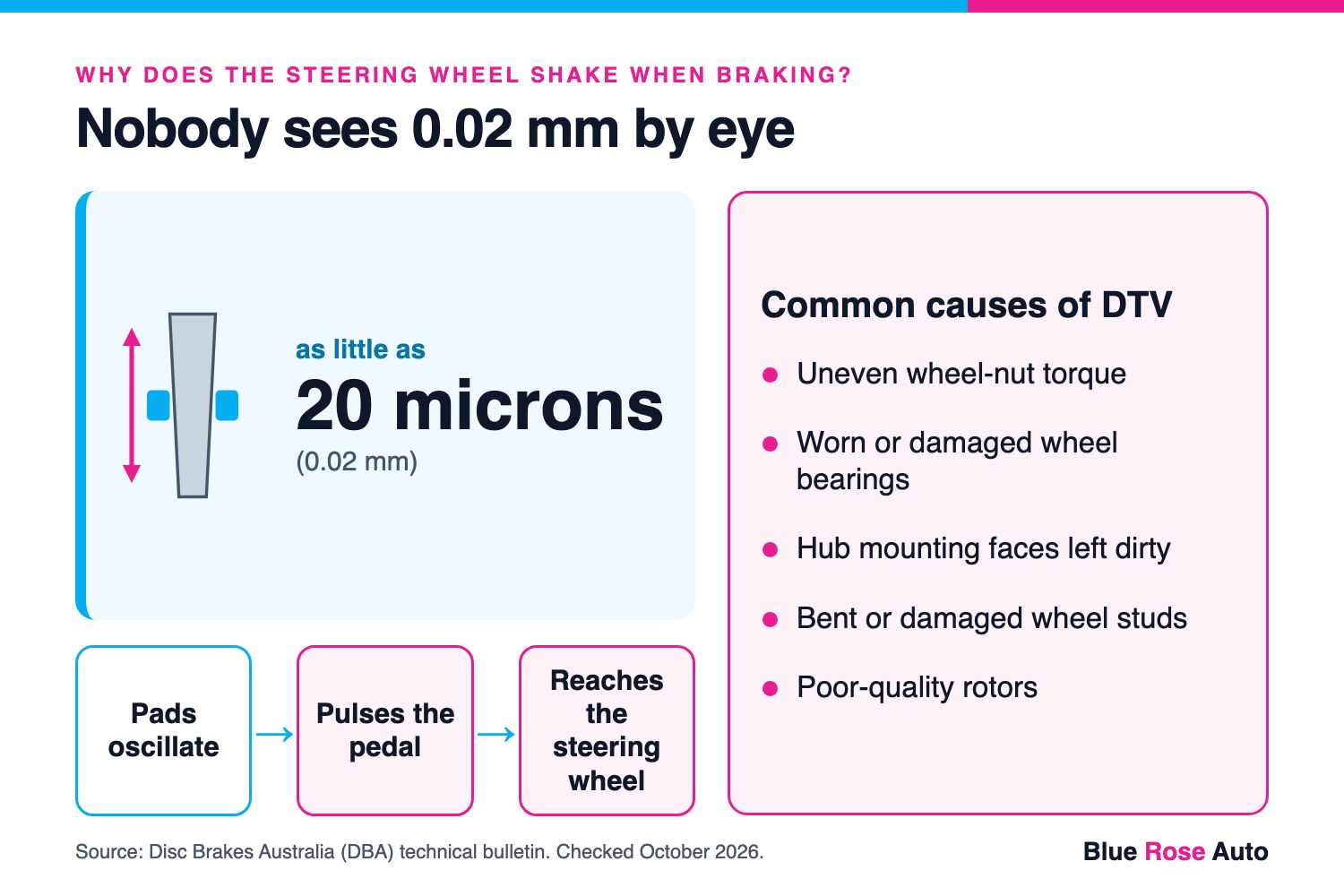
Nobody sees 0.02 mm by eye, which is why “warped” stuck. DBA adds that “Brake pad material deposits are often mistaken for DTV,” and “Both issues may cause steering wheel vibration.” Among the common causes of DTV, the bulletin lists these.
- Uneven wheel-nut torque, which DBA ties to “pneumatic rattle gun misuse”
- Worn or damaged wheel bearings
- Hub mounting faces left dirty, scored or corroded
- Bent or damaged wheel studs
- Poor-quality rotors that are out of spec
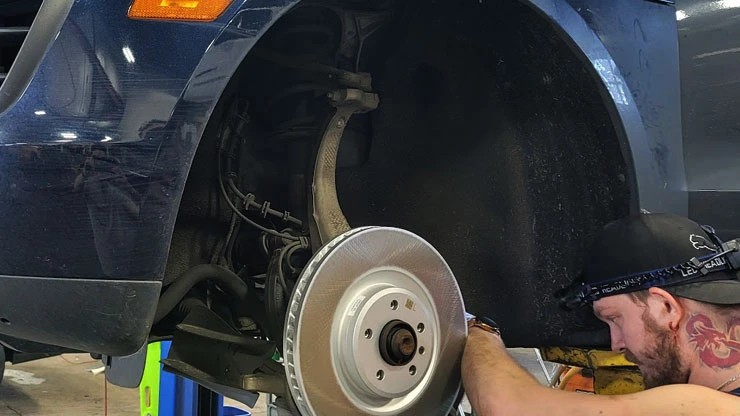
Skip those and new rotors can shudder all over again, so with the wheel off we measure the rotors before anyone says the word warped. Rotors still in spec “can sometimes be resurfaced instead of replaced,” and we do that as part of our brake inspection and rotor measurement work.
Rotors measure fine and it still shakes? DBA says “Worn or damaged suspension bushes can also simulate the vibrations associated with DTV,” because the loose assembly rocks as the brakes bite.
Brakes pulling to one side or a hot smell?
That’s a sticking caliper until proven otherwise. AAA Club Alliance (Matt Hill, March 25, 2026) is blunt about it. “A stuck caliper can make your vehicle unsafe to drive.” Don’t sit on that one. If one wheel is far hotter than the others after a short drive, or the car seems to drag when you coast, book the brake inspection now instead of waiting to see whether it gets worse. The other brake warning signs are worth knowing too.
What if it shakes only when accelerating or turning?
Shakes under throttle, smooth when you coast? That’s a load problem, not a balance problem. Balance doesn’t care whether the engine is pushing. CV axles, a driveshaft and the engine or transmission mounts do. RealTruck describes worn driveline parts as vibration with “audible clicking or growling” at highway speed or while turning.
Drive layout narrows it. AA1Car says an out-of-balance rear-wheel-drive driveshaft can cause a speed-sensitive vibration, while “FWD shafts usually do not rotate fast enough to cause vibration problems.” We handle CV axle and driveline repair too.
Turning gives its own clues.
- Clicking on tight turns, like a parking-lot U-turn, usually means a CV joint. RealTruck notes that worn CV axles often show torn boots leaking grease, which you can sometimes spot behind the front wheel.
- A growl that changes with speed or steering suggests a wheel bearing. RealTruck’s rule of thumb is that a bad bearing gets louder when you turn away from it, so a growl in left turns points at the right side.
- A groan when you turn the wheel while parked belongs to the power-steering side. See what to do if power steering cuts out.
Will an alignment fix a shaking steering wheel?
Usually not on its own. Alignment angles don’t make a wheel shake directly. A bad alignment wears the tires unevenly, and as Eric the Car Guy puts it, “it’s the tire that’s causing the vibration at that point, not the alignment.” Fix the tire or balance first. Align afterward, so the new tires don’t wear the same way.
An alignment is the upsell people are right to doubt, so these are the common claims and how they hold up.
| What people say | What actually happens | Source |
|---|---|---|
| “Bad alignment makes the wheel shake” | Off angles wear the tire until the tire shakes | Eric the Car Guy |
| “Loose parts cause the vibration” | They “can aggravate a vibration, but they are not the cause of the vibration” | Eric the Car Guy |
| “An alignment will fix a highway shake” | Balance and tires first, with alignment and loose parts “at the very bottom of the list” | Eric the Car Guy |
| “So skip the alignment” | Align after the fix so new tires don’t wear the same way | Standard shop practice |
So why book one at all? Whatever wore the old tire will chew through the new one. We set camber, caster and toe with computerized alignment equipment and check the steering and suspension components while the car is on the rack. That check matters, because a worn tie rod throws fresh angles straight back out. A before-and-after readout and a road test close the job. Book an alignment and steering check after the shake is fixed, not instead. Not sure how rotation and alignment differ? That post explains it.
Started after a pothole or new tires?
When a shake starts right after a pothole, a tire swap or a brake job, whatever was hit or touched last is the prime suspect. Good news, really. It narrows the search to one corner or one job.
After a pothole
A hard hit can bend a rim, bulge a tire, knock the alignment out or damage a bearing at that corner. If the shake wasn’t there yesterday, have that corner checked for worn tie rods, ball joints or bushings along with the tire and rim.
Winter is pothole season here. Back in 2019, NBC16 reported that “Eugene Public Works patches around 5,000 potholes each year, with winter being the busiest time of year.” If you want a pothole patched, report it to the city, and ask your own insurer about any damage claim, because city pothole claims are rarely a sure thing. That is general information, not legal or insurance advice.
After new tires, a tire swap or a brake job
When a shake shows up right after tire work, the first things we check are lug-nut torque and a missing wheel weight. BFGoodrich says to balance “Every time a tire is mounted on a wheel” and again “after a wheel weight falls off.”
Oregon’s calendar makes this a fall and spring issue. Under ORS 815.165(7), studded tires are allowed “Between November 1 of any year and April 1 of the following year,” though the statute lets ODOT shorten or lengthen that window. If your studs get remounted on the same wheels each season, that’s a fresh mounting, so it needs a fresh balance.
Studs also explain a feel people mistake for a shake. They carve ruts into highway pavement, and the Oregon Capital Chronicle, via OPB (March 30, 2026), reports they “reduce asphalt life by six to eight years,” with most of the damage in the Portland Metro region. A car that wanders or tugs as it tracks in a rut, then settles when you change lanes, is reacting to the road. A rhythmic shake that follows you onto fresh pavement is the car.
After gravel, a forest road or a snowy pass
Look inside the wheels before paying anyone. AA1Car’s first step is to check for “missing weights, mud or dirt packed in the back of the rim or debris embedded in the tread.” A clump of mud on the inner barrel throws the balance off. Hose it out and drive it again.
What is death wobble on trucks and Jeeps?
Death wobble is a violent shake of the front wheels on solid-front-axle trucks and Jeeps, usually set off by a bump at highway speed. RealTruck lists it as happening “After bumps (solid axle vehicles),” with “Violent shaking, requires slowing down to stop.” Slow down until it stops. Then get the front end inspected.
People argue about the cause. On MotorWeek’s Goss’ Garage, the host says it is common “especially on Jeeps,” checks the track bar, and calls the steering damper “the number one problem” on the truck he is showing. Other owners blame the track bar or worn ball joints instead.
Either way, the track bar, ball joints and tie rods still need checking for play. A new damper that hides the wobble without fixing the loose part is a cover-up. See also these common suspension problems.
When should you stop driving?
Pull over and stop if the shake is violent, you can see a wheel wobble, it started right after wheel or tire work, or the car pulls with a hot or burning smell when braking. AAA warns that a stuck caliper “can make your vehicle unsafe to drive.” A mild, steady highway shake can usually wait for a booked inspection.
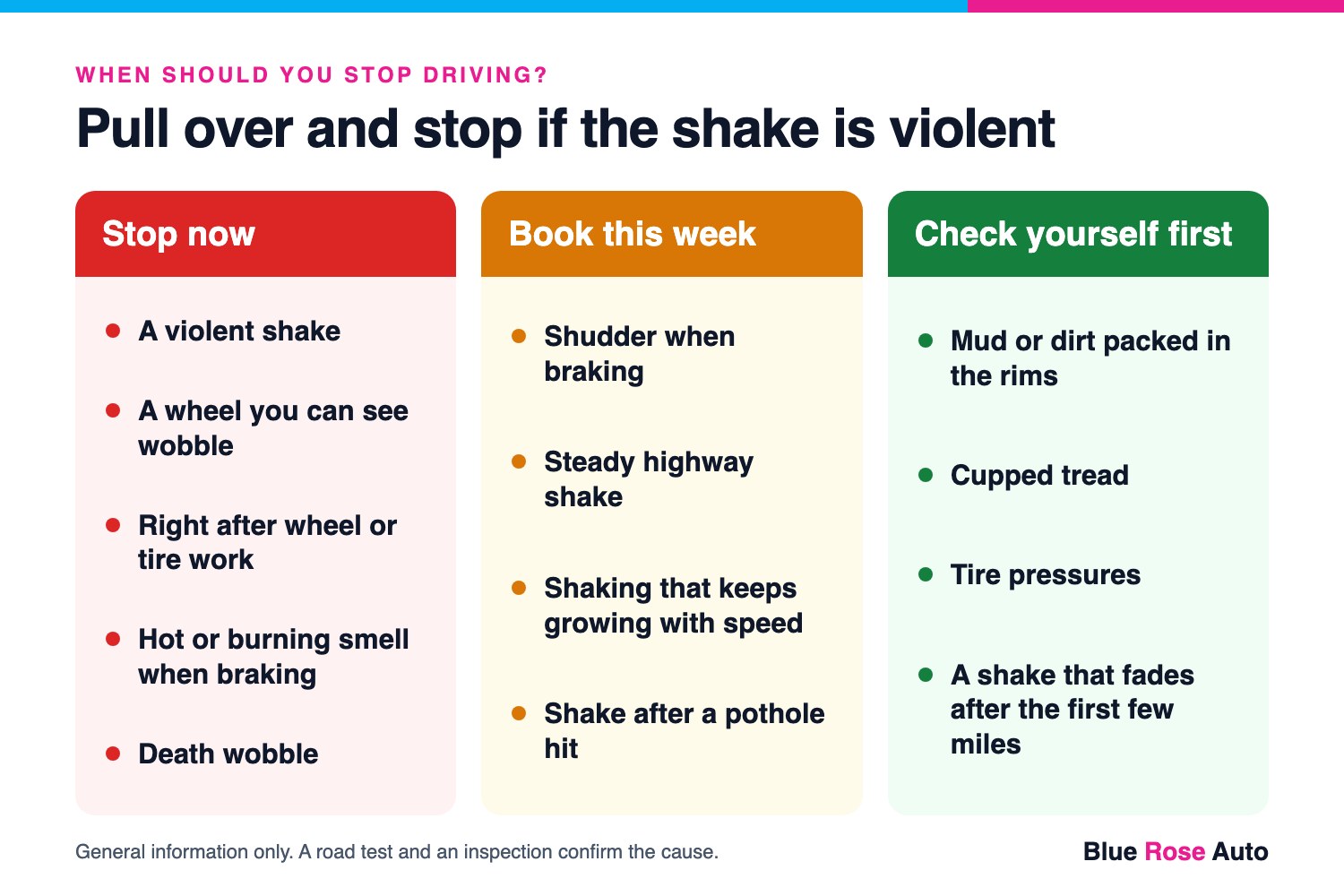
Stop now
- A violent shake, or a wheel you can see wobble
- Any shake that starts right after wheel or tire work (check the lug nuts first)
- Pulling with a hot or burning smell when braking
- Death wobble, so slow down until it stops
Book this week
- Shudder when braking
- Steady highway shake
- Shaking that keeps growing with speed
- Shake after a pothole hit
Check yourself first
- Mud or dirt packed in the rims after gravel or snow driving
- Cupped tread you can feel by hand
- Tire pressures set to the spec on the door-jamb sticker or in the owner’s manual
- A shake that fades after the first few miles from a parked start
Under Oregon’s ORS 815.020, driving a vehicle “in such unsafe condition as to endanger any person” is “a Class B traffic violation.” (General information, not legal advice.)
How do you fix a shaking steering wheel?
You fix the part causing it. Balance the wheel, replace the damaged tire, measure and resurface or replace the rotors, or replace the worn joint, then align last. Each cause has its own repair, and nobody can honestly price it before finding the cause. Cost depends on which part, one corner or a pair, and whether rotors can be resurfaced. The first 15 minutes of our diagnosis are free, then it is $100 per hour and credited to an approved repair, and you get a written estimate before any work starts. For a sense of scale, these are typical ranges for the repairs a shake most often leads to.
| Cause | What the shop does | Typical scope and cost |
|---|---|---|
| Wheel balance | Road test, spin-balance, check for missing weights | Per wheel. Balancing is usually one of the lowest-cost fixes, and we quote it after the road test |
| Damaged tire or bent rim | Check runout and tread depth; replace the tire, repair or replace the rim | One corner, sometimes a pair. Tire and rim cost depends on the size |
| Rotor thickness variation | Measure; resurface or replace with pads; clean hubs, torque lugs evenly | Per axle. Pads and rotors together run $250 to $600 per axle in Eugene and Springfield, and pads alone $150 to $400 nationally |
| Sticking caliper | Inspect slides and piston; repair or replace | One corner, priced by whether the caliper needs service or replacement |
| Worn suspension or steering parts | Check for play in tie rods, ball joints, bushings, struts | Part by part. Struts run $500 to $1,350 and a wheel bearing $300 to $800 nationally |
| Driveline | Inspect CV axles, driveshaft, mounts | Varies by part |
| Alignment, after the fix | Camber, caster, toe; steering check; before-and-after report; road test | Alignment runs $100 to $275 nationally |
People skip the last row, yet it pays to book an alignment once the cause is fixed, so new tires wear evenly.
What to tell the shop
- The speed it starts and stops. “From 55 to 70” beats “on the highway.”
- What you’re doing. Braking, accelerating, coasting or turning.
- Where you feel it. Steering wheel, or seat and floor.
- When it began. After a pothole, a tire swap, a brake job or a gravel trip?
- Any noise with it. Clicking, growling or grinding.
- Any pull to one side, and whether it only happens under braking.
Bring that list when you call Blue Rose Auto at (541) 641-8877, and we will road-test the car and give you a written estimate before any work starts.
Frequently asked questions
What is the most common cause of steering wheel shaking?
For a shake at highway speed, shops check the front wheels and tires for imbalance or damage first. For a shake only while braking, it’s rotor thickness variation or pad deposits. There’s no reliable percentage, so go by timing and the table at the top.
Is it safe to drive with a shaking steering wheel?
A mild, steady shake in one speed band is usually safe to drive to a booked inspection. Stop if the shake is violent, a wheel visibly wobbles, it began right after tire or wheel work, or the car pulls with a hot smell when braking, because AAA warns a stuck caliper “can make your vehicle unsafe to drive.”
Why does my steering wheel shake at 60 mph but not at higher speeds?
That pattern points to wheel balance. BFGoodrich says balance vibration shows up in a specific speed range “and fades above and below it,” so it can come in around 60 and smooth out by 70. If it keeps building instead, suspect a damaged tire or a bent rim.
Why does my steering wheel shake after installing new tires?
Most often it’s balance or mounting, such as a weight that moved or fell off, uneven lug-nut torque, or dirt on the hub face. BFGoodrich says to balance every time a tire is mounted and “whenever a new vibration appears.” A runout check catches an out-of-round tire.
Can warped rotors cause steering wheel shake when not braking?
Usually not. The thickness-variation shake DBA describes comes from the pads clamping an uneven rotor, so you feel it when you brake. Cruising with your foot off the pedal, look at tires and wheels first. A sticking caliper is the exception, since AAA notes one can grab the rotor “even after you have taken your foot off the brake pedal.”
Can hitting a pothole mess up a wheel bearing?
It can, so have that whole corner checked after a hard hit, bearing included. AA1Car lists worn bearings as a vibration cause, and a bearing repair runs about $300 to $800 nationally. Eugene drivers can report a pothole to the city, and an insurer can say whether damage is covered.
How much does it cost to fix a shaking steering wheel?
It depends on the cause, and only an inspection finds it. Typical ranges are $250 to $600 per axle for pads and rotors in Eugene and Springfield, $100 to $275 for an alignment and $300 to $800 for a wheel bearing nationally. The first 15 minutes of our diagnosis are free, and you get a written estimate before work starts.
Why does my steering wheel shake when I hit bumps?
A brief shimmy over bumps usually means play in the front end, such as a worn tie rod, ball joint or bushing, which Eric the Car Guy says “can aggravate a vibration.” On a solid-axle truck or Jeep, a violent wobble after a bump that stops only when you slow way down is death wobble. Slow down and get it inspected.
When should you call Blue Rose Auto?
Tell us when it shakes and we’ll know where to look. Blue Rose Auto opened in 1994. Our ASE-certified technicians at 3436 Olympic St in Springfield road-test the car, put it on the lift to check tires, wheels, brakes and suspension, and explain what we find before writing the estimate. Call (541) 641-8877, contact us online, or start with an alignment and steering check.

0 Comments