
The most common failing fuel pump symptoms are sputtering or lost power under load, a hard start or a crank with no start (worst when the tank is low), and a louder whine from the tank. A clogged filter, bad relay or regulator, worn ignition parts or a weak battery can feel the same. Test before you buy a pump.
Last reviewed in October 2026. This is general information, and only testing confirms the cause on your car.
Start with the signs. Then come the five other parts that pass for a dying pump, four recalls to check before you pay for anything, how a shop tests a pump and when to stop driving. If your car has a pile of other complaints too, the broader tune-up warning signs may be the better place to start.
These numbers are worth knowing before you call a shop.
| Fact | Figure | Source |
|---|---|---|
| Fuel level to keep the pump cool | At least a quarter tank | AAA Club Alliance |
| Typical replacement time | 2 to 4 hours; 5+ if the tank comes out | AAA |
| Market replacement cost | AAA says $1,150 to $1,400 for most vehicles (its vehicle-type table runs $900 to $3,000), and RepairPal lists an average of about $1,344 to $1,513 | AAA, RepairPal (September 2026) |
| Vehicles listed in four 2020 low-pressure pump recalls | More than 3.6 million, combined (Toyota, Lexus, Honda, Acura, Subaru) | NHTSA |
| Share of Eugene’s yearly rain from early October to mid-May | Nearly 90 percent | National Weather Service |
What are the first signs of a failing fuel pump?
A failing fuel pump usually shows itself under load first. The engine sputters or loses power on a hill, while passing or when towing. A weak pump can’t keep up. Hard starts come next, which AAA says happen “especially when the tank is low,” and the end stage is a crank with no start. A louder whine from the tank is a clue too, but a clogged filter makes the pump work harder and can cause the same noise. That overlap is why Delphi, a company that makes fuel pumps, warns that “replacing a fuel pump can become a costly mistake if it is not the true cause.” A proper test checks fuel pressure and volume against the manufacturer’s spec, plus the pump’s electrical supply. Our ASE-certified technicians in Springfield test fuel delivery and ignition before we recommend a pump.
While driving
AAA’s list starts with “engine sputtering or surging at high speeds, loss of power during acceleration or when climbing hills, decreased fuel economy.” Passing a truck on I-5 or pulling a long grade is when the engine wants the most fuel, so that’s when a tired pump falls behind. On the flat, it can feel fine.
A surge feels like the car lunging ahead with your foot steady, then settling. Uneven fuel delivery does that. The other pattern to note is timing. A car that drives fine for the first half hour and then stumbles or stalls after a long run, then restarts once it has cooled, points to a heat-related fault. Tell the shop exactly that. It rarely shows up on a short test drive.
When starting
A long crank before the engine catches is an early hint. It shows up most on a low tank. Later the engine cranks at normal speed and never fires, because the pump can’t build enough pressure.
Sounds, gauges and warning lights
A new, louder whine from under the back seat is worth noting, though it proves nothing on its own. On most modern cars the pump shares a module with the fuel level sender, so a gas gauge that goes haywire alongside the drivability trouble points at that module. AAA adds that the check engine lamp can come on “from fuel pressure-related diagnostic codes.”
In short, these are the signs to watch for.
- Sputter or surge at highway speed. This is often the first thing you feel.
- Power loss uphill or when passing, recovering on the flat.
- Hard starts on a low tank. They get worse as the gauge drops.
- Crank with no start, usually late in the failure.
- Stalls that clear after the car sits.
- A louder whine from the tank. It is a clue, not a verdict.
- Check engine light or an erratic gas gauge. Either can mean fuel pressure codes or a failing sender in the module.
Don’t count on a polite warning. AAA’s line is that a partly failing one “will worsen with time and eventually leave you stranded, usually at an inconvenient time and place.”
What can be mistaken for a bad fuel pump?
A clogged fuel filter, a failing fuel pump relay, a bad pressure regulator, worn spark plugs or coils, and a weak battery or starter can all mimic a bad fuel pump. AAA says shops run a diagnostic to confirm the pump is the problem, “not just a clogged filter or faulty relay.” The table below shows how each one gives itself away.
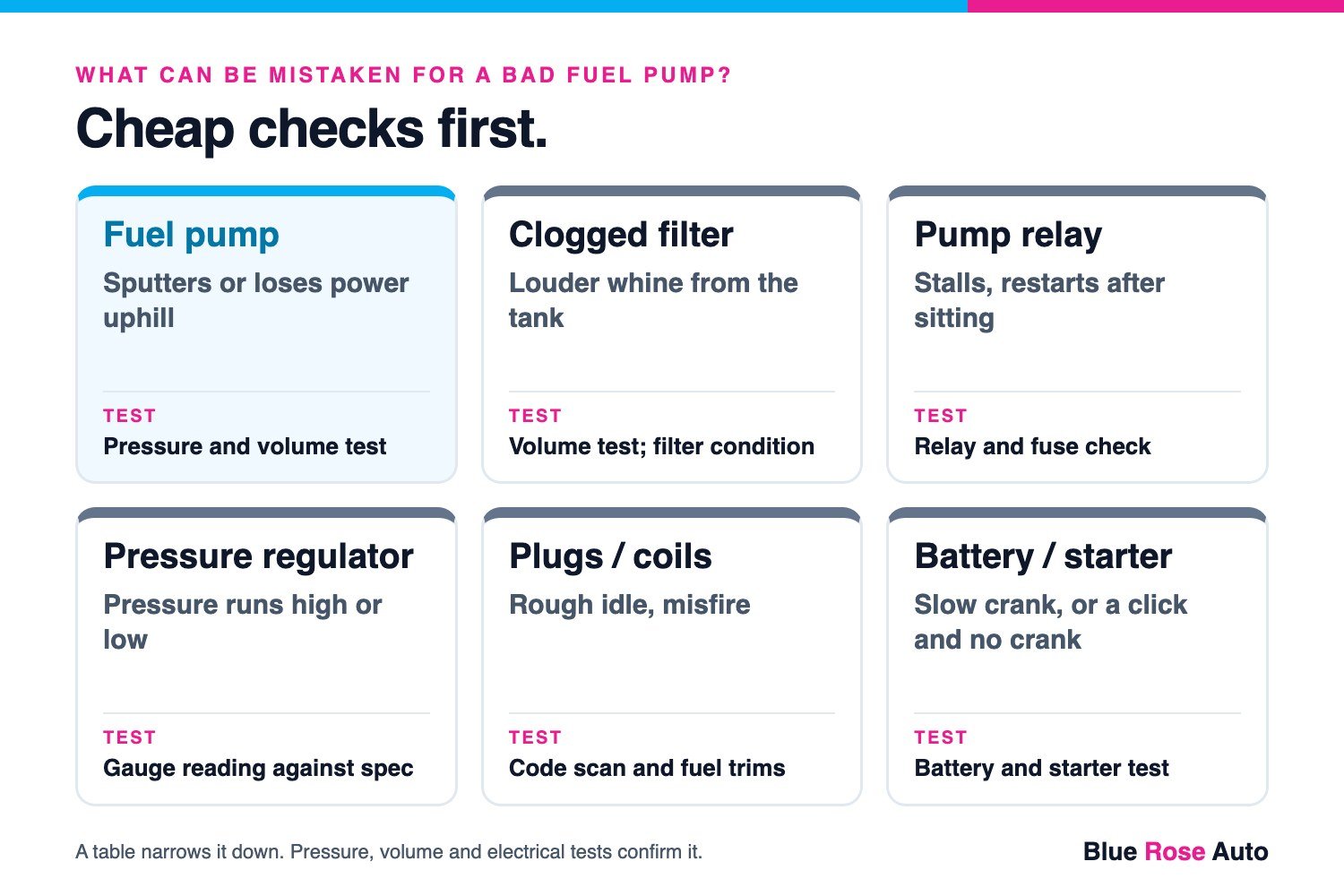
Find the symptom you have, then read across. ✓ = where a shop looks first, ~ = possible, blank = unlikely.
| What you notice | Fuel pump | Clogged filter | Pump relay | Pressure regulator | Plugs / coils | Battery / starter | Test that separates them |
|---|---|---|---|---|---|---|---|
| Sputters or loses power uphill, passing or towing | ✓ | ✓ | ~ | ✓ | ✓ | Fuel pressure and volume vs spec; misfire check | |
| Hard start, worst when the tank is low | ✓ | ~ | ~ | ~ | ~ | Pressure and volume test; battery test | |
| Cranks at normal speed but won’t start | ✓ | ~ | ✓ | ~ | ✓ | Check for fuel pressure and for spark; relay and fuse check | |
| Slow crank, or a click and no crank | ✓ | Battery and starter test (not a fuel problem) | |||||
| Stalls, restarts after sitting | ✓ | ✓ | ~ | Electrical check at the pump and relay; pressure when it acts up | |||
| Louder whine from the tank | ✓ | ✓ | Volume test; filter condition | ||||
| Rough idle, misfire, flashing check engine light | ~ | ~ | ~ | ✓ | Code scan and fuel trims; ignition check |
A table narrows it down. Pressure, volume and electrical tests confirm it.
Clogged fuel filter
A restricted filter starves the engine just like a weak pump. Replacement intervals vary widely by vehicle, and some newer cars have a filter built into the pump module, so check your owner’s manual. A clogged filter makes the pump work harder, so you can get the whine without a bad pump.
Fuel pump relay
The relay is the switch that powers the pump. A worn one can cut the pump out for a second or for good, which looks like a stall or a crank-no-start. Small part, quick check. A shop tests the relay and fuse before anyone lowers a tank.
Fuel pressure regulator
The regulator holds fuel pressure where the engine designers set it. When it fails, pressure runs high or low, and only a gauge reading against spec separates it from a weak pump.
Spark plugs and coils
From the driver’s seat, a misfire under load feels a lot like fuel starvation. Worn spark plugs or a bad coil usually leave misfire codes that a scan picks up.
Battery and starter
This one fools people on cold mornings. A slow turnover, or a click and nothing, isn’t the pump. a click or no crank usually points to the starter or battery. A normal-speed crank with no start is the real fuel-or-spark question. On a crank-no-start we first check that the engine is getting spark and fuel at all, and look at the battery and starter, before anyone blames the pump. Cheap checks first. It’s the same order we follow for all engine diagnostics and repair.
Is there a recall on your fuel pump?
Before paying for a pump, check your VIN for an open recall. The lookup is free. NHTSA lists four 2020 recall campaigns for low-pressure fuel pumps that together cover more than 3.6 million Toyota, Lexus, Honda, Acura and Subaru vehicles. Each one says the pump can fail and the engine can stall, and dealers replace the part free of charge.
| NHTSA campaign | Maker | Example models (not complete; check your VIN) | Vehicles | What NHTSA says |
|---|---|---|---|---|
| 20V-012 (Jan 13, 2020; later expanded) | Toyota / Lexus | 2018-2019 Camry, Corolla, Avalon, Tacoma, Tundra, Highlander; 2017-2019 Sienna; many 2013-2019 Lexus models | 1,830,752 | “The low-pressure fuel pump inside the fuel tank may fail.” |
| 20V-682 (Nov 4, 2020) | Toyota / Lexus | 2019-2020 RAV4; 2017-2020 Tacoma and Sienna; 2018-2020 Camry; 2020 Corolla | 1,525,742 | The engine “can stall while driving, increasing the risk of a crash.” |
| 20V-314 (May 28, 2020) | Honda / Acura | 2018-2019 Accord, Civic Hatchback, Civic Type R, HR-V; 2019 Fit; 2019-2020 Insight; Acura NSX, RDX, RLX | 135,995 | “The low-pressure fuel pump inside the fuel tank may fail.” |
| 20V-218 (Apr 16, 2020) | Subaru | 2019 Impreza, Outback, Legacy, Ascent | 188,207 | The engine “may stall without the ability to restart the vehicle.” |
Each campaign’s remedy is a free replacement at the dealer. Enter your VIN in NHTSA’s recall lookup at nhtsa.gov/recalls to see whether your car is included and whether the work was already done. Being on this list doesn’t mean your car is affected; the lookup goes by VIN. If it is, the repair is free.
Do wet winters and low tanks hurt fuel pumps?
Low tanks do, and a wet Willamette Valley winter adds a reason to keep fuel in the car. According to AAA Club Alliance (James MacPherson, April 6, 2026), running near empty is hard on an in-tank pump in three ways, which are heat, sediment and water.
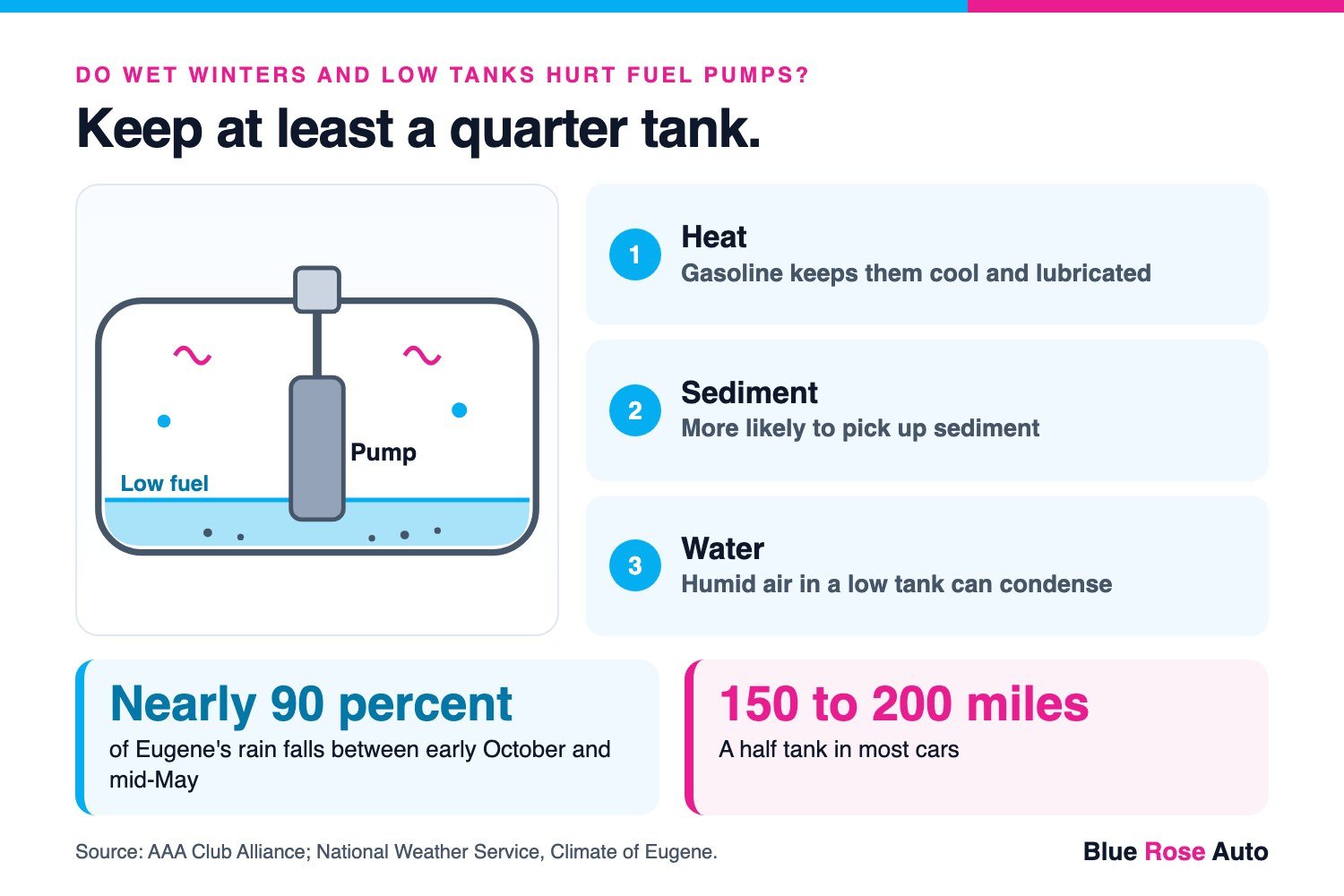
Heat. “Modern fuel pumps are often located inside the gas tank, where gasoline keeps them cool and lubricated. Running low on fuel can cause the pump to overheat, which shortens its lifespan.”
Sediment. When fuel runs low, AAA says the pump “is more likely to pick up sediment that accumulates at the bottom of the fuel tank. This can clog fuel filters, resulting in rough running or preventing the engine from starting.”
Water. “Low fuel levels leave more space in the gas tank, which can allow humid air to enter. If this moisture condenses, water can form in the gas tank.”
That last one matters here. The National Weather Service’s Climate of Eugene says that “Nearly 90 percent of the annual rainfall occurs between early October and mid-May.” More than seven months of damp air is a long time to leave an empty tank breathing it. AAA’s rule of thumb is to keep at least a quarter tank. For scale, “a half tank in most cars provides 150 to 200 miles of travel, or more.”
Cold mornings set a different trap. The same NWS page says “it is common to see overnight winter low temperatures into 20s,” and cold exposes weak batteries. A slow crank on a frosty morning is a battery question first, so start with battery and charging system testing and read up on how often a car battery needs replacing.
As for the fuel itself, ORS 646.913 (2025 edition) requires gasoline sold in Oregon to contain “at least 10 percent denatured fuel ethanol by volume,” with a few exceptions, including unblended gas with an octane rating “of 91 or above.” We’ve found no source showing E10 wears out pumps, so we won’t claim it. Diesel owners get one extra rule from AAA. Never run dry, or “the fuel pump may need priming.” For the rest of the season, see our winter maintenance checklist.
How does a shop test a fuel pump?
Good shops test, then replace. Delphi Technologies puts it bluntly. “A fuel system should be carefully tested for pressure, volume, and electrical integrity before condemning the fuel pump.” When a car comes in with a highway sputter, we check fuel pressure and volume before anyone orders a pump.
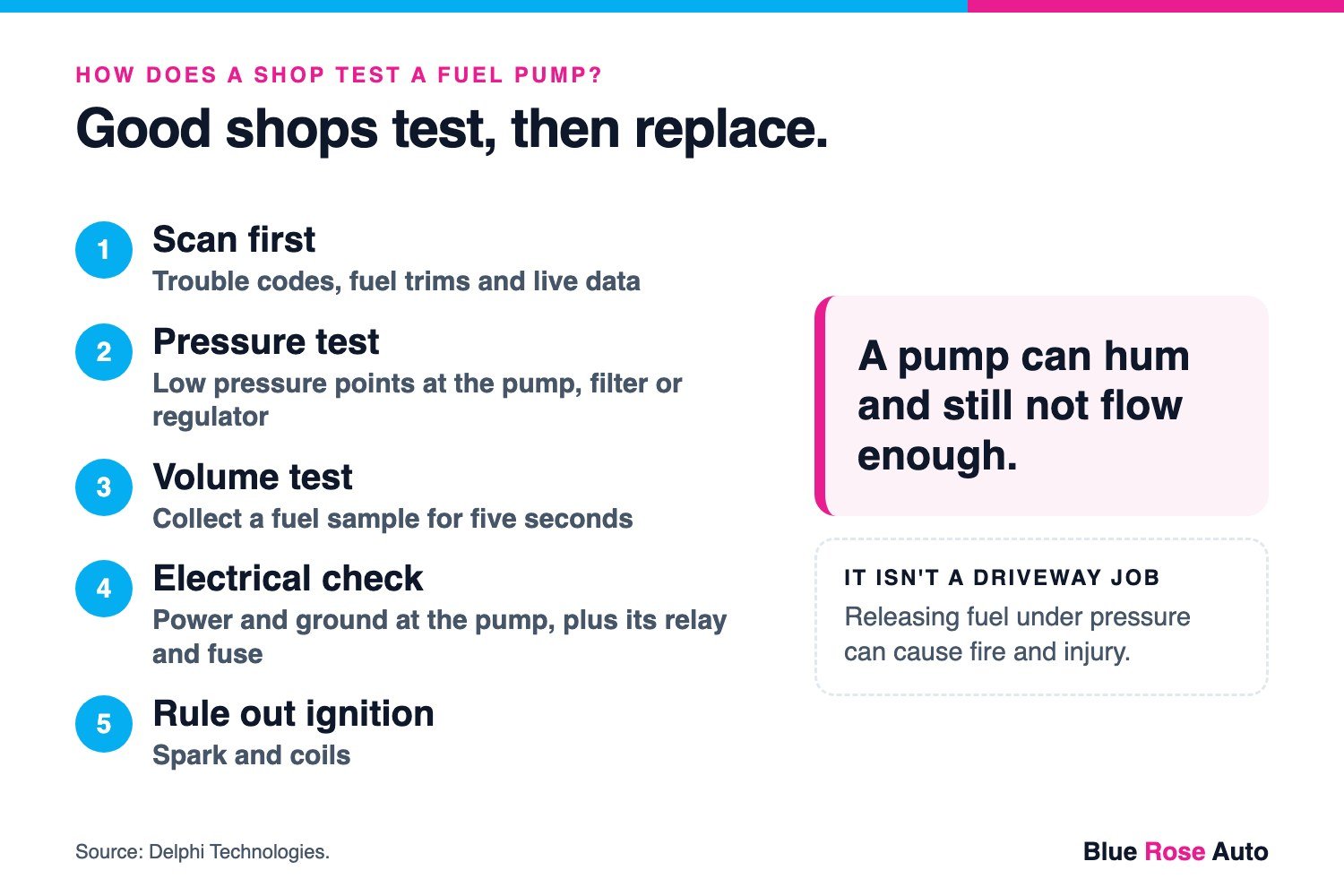
The usual sequence has five steps.
- Scan first. Trouble codes, fuel trims and live data come before any gauge. Large positive fuel trims, where the computer keeps adding fuel, hint that the engine is running lean.
- Pressure test. With a gauge on the system and the pump running, compare the reading “to the manufacturer specification,” as Delphi puts it. Low pressure points at the pump, filter or regulator.
- Volume test. “Collect a fuel sample for five seconds with the pump running” and compare the amount to spec. This catches the pump that passes on pressure and still can’t deliver enough fuel.
- Electrical check. Power and ground at the pump, plus its relay and fuse. New pumps don’t fix bad connectors.
- Rule out ignition. Spark and coils, so a misfire isn’t mistaken for fuel starvation.
Driveway diagnoses go wrong because a pump can hum and still not flow enough. It can hold pressure at idle and come up short on volume under load, so “I can hear it running” doesn’t clear it.
It isn’t a driveway job anyway. Delphi warns that “releasing fuel under pressure can cause fire and injury.”
Many newer direct-injection (GDI) engines also have a second, high-pressure pump on the engine. This post is about the low-pressure pump in the tank.
We run all five checks as part of engine diagnostics, and diagnosis starts with 15 free minutes, then $100 an hour, credited to an approved repair. If you’d rather not guess, call Blue Rose Auto at (541) 641-8877 and we’ll test fuel delivery and ignition before anyone orders a pump.
Can you keep driving with a failing fuel pump?
If the engine stalls while driving or won’t restart, stop driving it and arrange a tow. NHTSA’s recall notices describe exactly that risk. In their words, “the engine can stall while driving, increasing the risk of a crash.” A mild sputter can usually wait for a booked test, but AAA warns the problem “will worsen with time.”
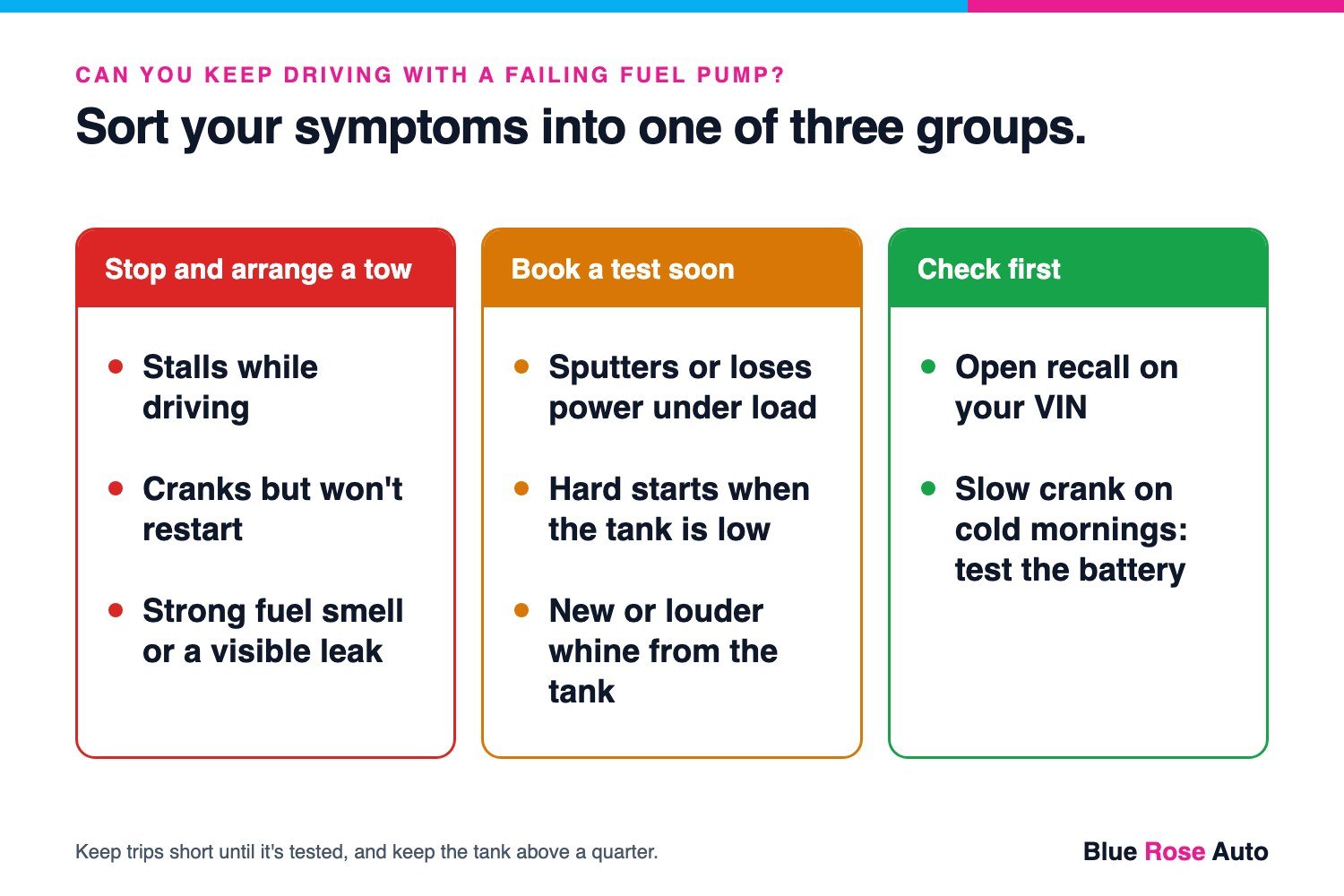
Sort your symptoms into one of three groups.
- Stop and arrange a tow
- Stalls while driving
- Cranks but won’t restart
- Strong fuel smell or a visible leak
- Book a test soon
- Sputters or loses power under load
- Hard starts when the tank is low
- New or louder whine from the tank
- Check first
- Open recall on your VIN
- Slow crank on cold mornings, so test the battery
The middle group is where people push their luck. A car that stumbles on a climb isn’t one to take over a mountain pass or out to the coast. Keep trips short until it’s tested, and keep the tank above a quarter.
If it restarts after a tap on the tank or after cooling down, that’s a clue worth telling the shop, not a fix. Intermittent faults rarely heal themselves. We also won’t explain relay bypass tricks, because they hide the symptom and leave the cause.
What does fuel pump replacement involve?
On most modern cars the job means replacing the whole module, not just the pump. AAA explains that “mechanics rarely replace just the fuel pump in modern vehicles,” and most “replace the entire fuel pump module – an assembly that includes the pump, the fuel level sensor (sending unit), a strainer or filter and related electrical connections.”
That’s why the gauge and the pump can act up together. Access depends on the car. Some have a panel under the rear seat or trunk floor, others need the tank lowered. AAA’s time estimate reflects the split. Replacement “usually takes two to four hours,” while jobs “that require a full fuel tank removal can take upwards of five.”
| Step | What happens | Source |
|---|---|---|
| Confirm the diagnosis | Pressure, volume and electrical tests rule out the filter, relay and regulator | AAA and Delphi |
| Reach the pump | Through an access panel on some vehicles; others need the fuel tank lowered | General shop practice, with AAA noting tank-removal jobs take longer |
| Replace the module | Pump, fuel level sender, strainer and wiring connections as one assembly | AAA |
| Time | “Two to four hours,” tank-removal jobs “upwards of five” | AAA |
| Verify | Re-check pressure and the gauge reading, then road-test | General shop practice |
Can the pump be repaired instead? Rarely, on a modern in-tank module. The price depends on the vehicle and how hard the tank is to reach, so testing comes first, and the cost question in the FAQ gives market figures.
Frequently asked questions
Does a fuel pump give warning before going out?
Often, yes, with sputtering under load, hard starts on a low tank or a louder whine. But it can also quit with little notice. AAA says a partly failing pump “will worsen with time and eventually leave you stranded,” and NHTSA’s recall notices describe stalls while driving. Book a test at the first signs.
Can a bad fuel pump cause a crank but no start?
Yes. The starter still turns the engine, but without fuel pressure it won’t fire. A failed relay, blown fuse or missing spark does the same, so a shop checks for pressure and spark before condemning the pump. A slow crank or a single click is a battery or starter problem instead.
Does running low on gas damage your fuel pump?
It can shorten the pump’s life. AAA explains that fuel cools and lubricates an in-tank pump, so running low “can cause the pump to overheat,” and a low tank makes it likelier to pick up sediment. AAA’s advice is to keep at least a quarter tank.
Will a bad fuel pump throw a code?
Sometimes. AAA lists a check engine light “from fuel pressure-related diagnostic codes” among the usual symptoms, and a starving engine can also log a lean-running code. But a code describes a condition, like low pressure or too little fuel, not a part, and a pump that is only weak under load may not set one at all. A clear scan doesn’t clear the pump; a pressure and volume test does.
How long does a fuel pump last?
There’s no fixed replacement interval. Unlike spark plugs, the in-tank pump is replaced when testing shows it has failed. Mileage claims online vary widely. We haven’t found a maker-published figure, so we won’t quote one. What AAA does say is that habitually running low can make the pump overheat, “which shortens its lifespan.”
Is it my fuel pump or my spark plugs?
Not by feel alone. Both cause sputtering and power loss. Ignition faults usually leave misfire codes in a scan, while a fuel problem shows up as low pressure or low volume on a gauge test, which is why testing fuel delivery and ignition together is the quickest way to know.
How do I know if it’s the fuel filter or fuel pump?
Often you can’t tell from symptoms. A clogged filter starves the engine the same way and makes the pump work harder and noisier. Filter intervals vary widely by vehicle, and some newer cars have no separate serviceable filter. A fuel pressure and volume test settles it, which is cheaper than guessing with parts.
Does cold, wet weather affect fuel pumps?
No source we found says cold itself harms a pump. The season does expose weak spots. Nearly 90 percent of Eugene’s rain falls between early October and mid-May (NWS), and AAA notes humid air in a low tank can condense into water. Cold mornings also expose weak batteries, which can pass for a fuel problem.
How much does it cost to replace a fuel pump?
It varies by vehicle and by whether the tank has to come out. AAA says costs “usually range between $1,150 and $1,400 for most vehicles,” with its vehicle-type table running $900 to $3,000, and RepairPal lists an average of about $1,344 to $1,513. Those are market figures. We quote after diagnosis, which starts with 15 free minutes.
Have it tested before you buy a pump
Our ASE-certified technicians at 3436 Olympic St in Springfield scan the codes, check fuel pressure, volume and the pump’s electrical supply, then rule out ignition and the battery before we walk you through the findings. Blue Rose Auto opened in 1994. We’re open weekdays 8 to 5 and Saturdays 10 to 5. We’re closed Sundays. Call (541) 641-8877, book a fuel delivery test before you buy a pump, or request a diagnostic appointment online.

0 Comments