Brakes squeak after rain because the iron rotors grow a thin film of surface rust overnight, and the pads scrape it off on your first few stops. That squeal or brief scrape is normal and usually fades within a few stops. If the noise is still there on a dry day, it isn’t the rain.
By Blue Rose Auto · Last updated October 2026 · General information only. An inspection is what confirms the cause.
Mid-October is when we start hearing about it. Normal rainfall at Eugene Airport more than doubles from September to October, according to NOAA. What follows is a test you can run on the way to work, what Oregon’s driving guidance says about wet brakes, and the signs that point somewhere other than the weather.
Why do brakes squeak after rain?
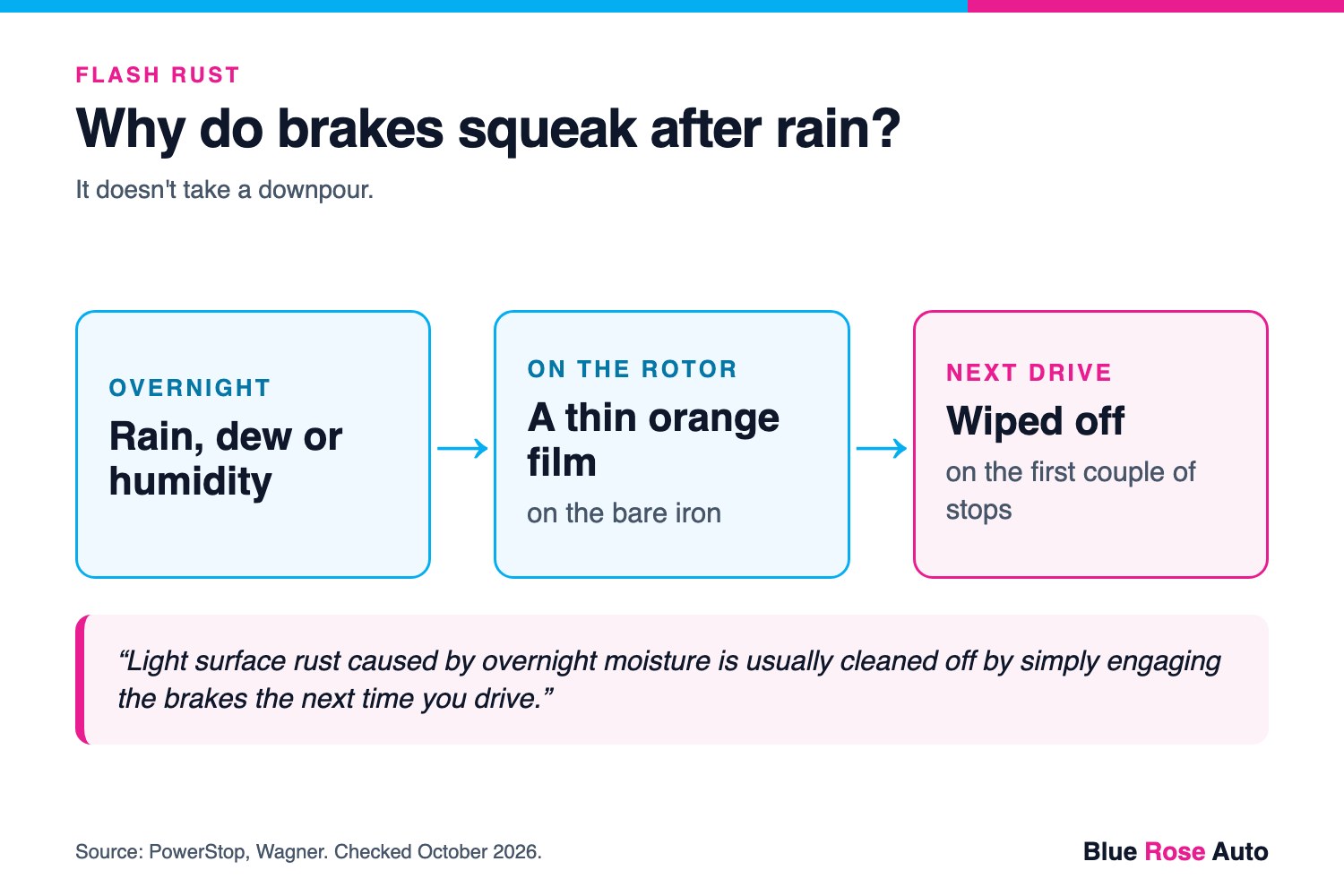
The rotor’s braking surface is bare cast iron, and bare iron rusts fast, which is why brakes squeak after rain. One damp night leaves a thin orange film on it. The pads scrape it off. That scraping, on the first couple of stops out of the driveway, is the squeal you hear, and it doesn’t take a downpour, because dew or a humid night does the same thing.
Think of an unpainted cast-iron pan left to air-dry in the dish rack. Rusty by morning. A rotor is the same metal with no seasoning on it, and the pads wipe it clean every time you brake.
Brake maker Wagner puts the trigger list plainly. “Rain, dew, snow and even humid conditions can cause rust to form on brake pads and rotors” (Wagner). So brakes squeaking in rain, after rain or after a foggy night are one and the same event. Wagner also says that with frequent driving the rust “is cleaned off” and “typically is not a cause for concern.”
PowerStop, another brake manufacturer, describes the noise itself. “Light surface rust caused by overnight moisture is usually cleaned off by simply engaging the brakes the next time you drive,” and rusty rotors “can cause brief squeaking that often disappears when the brake pads wipe them clean” (PowerStop). That’s why brakes squeal when wet, then go quiet two blocks later.
Rust can sit on the pad’s friction surface as well. Wagner treats corrosion on the pad’s steel backing plate as a separate, slower problem, one that “can cause delamination of the friction material” over time. You won’t hear that one on a wet morning.
Why does October feel worse than January? Our read (a read, not a measurement) is a dry summer followed by sudden damp nights, landing on plenty of cars that live in driveways instead of garages.
Why do brakes grab or feel weak when wet?
Brakes can grab on the first wet stop because the light rust film on the rotors adds friction until the pads wipe it off, and feel weak when water sits between pad and rotor after a puddle or car wash. Both should fade within a few gentle stops. A grab that stays, or pulls the car sideways, needs an inspection.
No brake maker spells out the grab mechanism word for word, but what we see on wet mornings is consistent with the PowerStop and Wagner explanation of flash rust. A rough film bites harder for a stop. Then it’s gone. One grabby stop followed by normal braking isn’t a repair ticket.
Weak is the opposite feeling. Water between the pad and the rotor acts like a thin lubricant for a second or two, and the first press does less than you expected.
Brakes squeal after a car wash or a deep puddle?
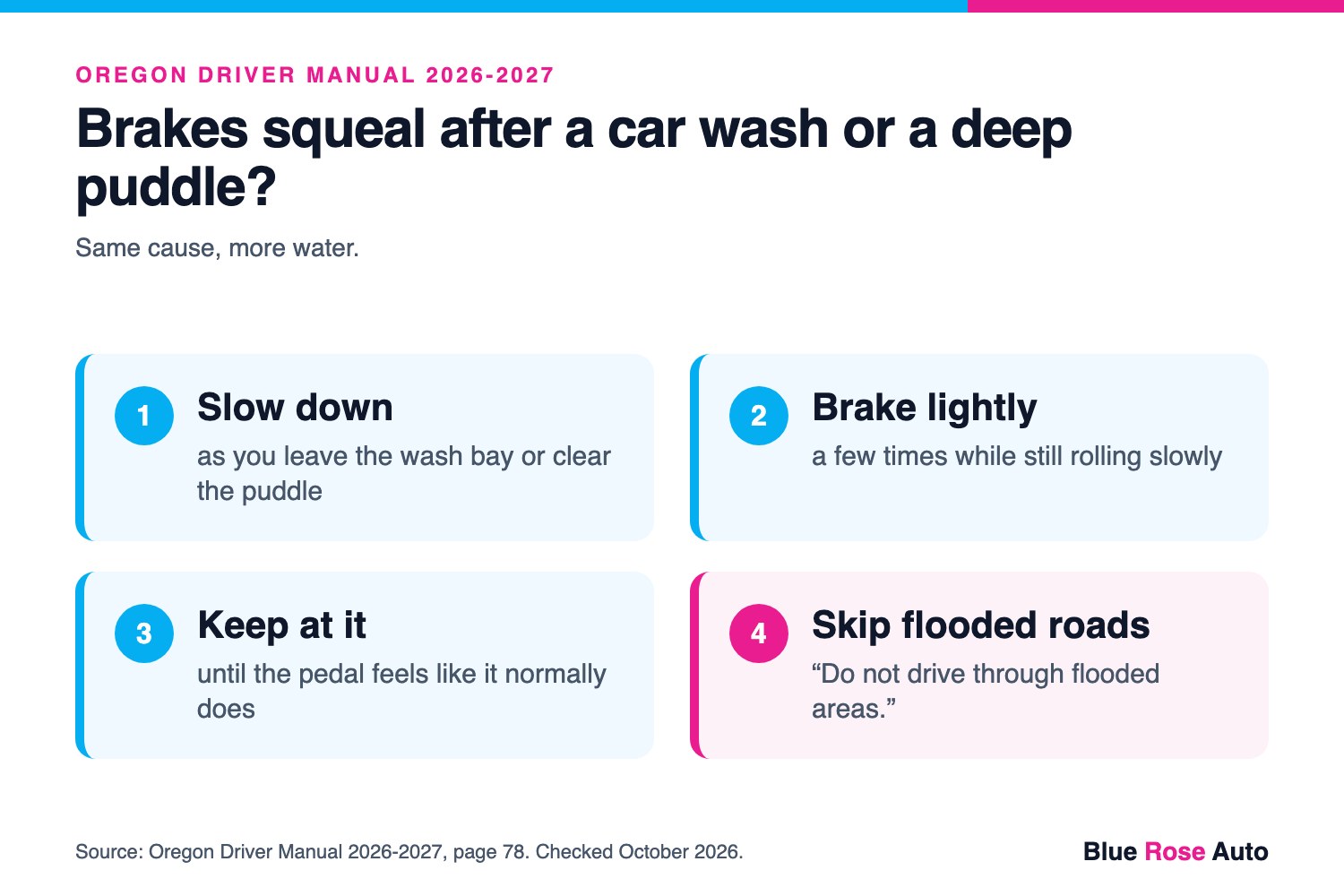
Same cause, more water. An automatic wash with an undercarriage spray soaks the rotors, pads and calipers all at once. The Oregon Driver Manual 2026-2027 covers it on page 78. “If you drive through water and the brakes get wet, gently apply the brakes while driving slowly until they begin to respond. It is best to do this as soon as you can after driving through water.”
Leaving the wash bay, the routine runs in four steps.
- Slow down as you leave the wash bay or clear the puddle.
- Brake lightly a few times while still rolling slowly.
- Keep at it until the pedal feels like it normally does.
- Skip flooded roads altogether. The manual says it directly. “Do not drive through flooded areas.”
Pedal buzzing on a hard wet stop?
On slick pavement, a hard stop can make the pedal pulse or buzz under your foot. Odd feeling. Usually fine. That buzz is typically the anti-lock braking system (ABS) doing its job, and your owner’s manual should describe how it feels on your car, but a pulse during gentle stops on dry roads is a different story. That one isn’t the rain.
How can you tell rain noise from a real problem?
The simplest check is the three-stop test. Drive normally and brake gently for your first few stops, because rain noise fades and a real problem doesn’t. Flash rust wipes off with ordinary braking, and wet pads after a puddle respond again within a few light presses. Some signs are never the rain. Noise on dry roads, grinding that persists, a pull to one side, a soft or sinking pedal, or a brake warning light all need an inspection. Our ASE-certified technicians in Springfield inspect the brakes and give you a written estimate before any work starts. Call (541) 641-8877.
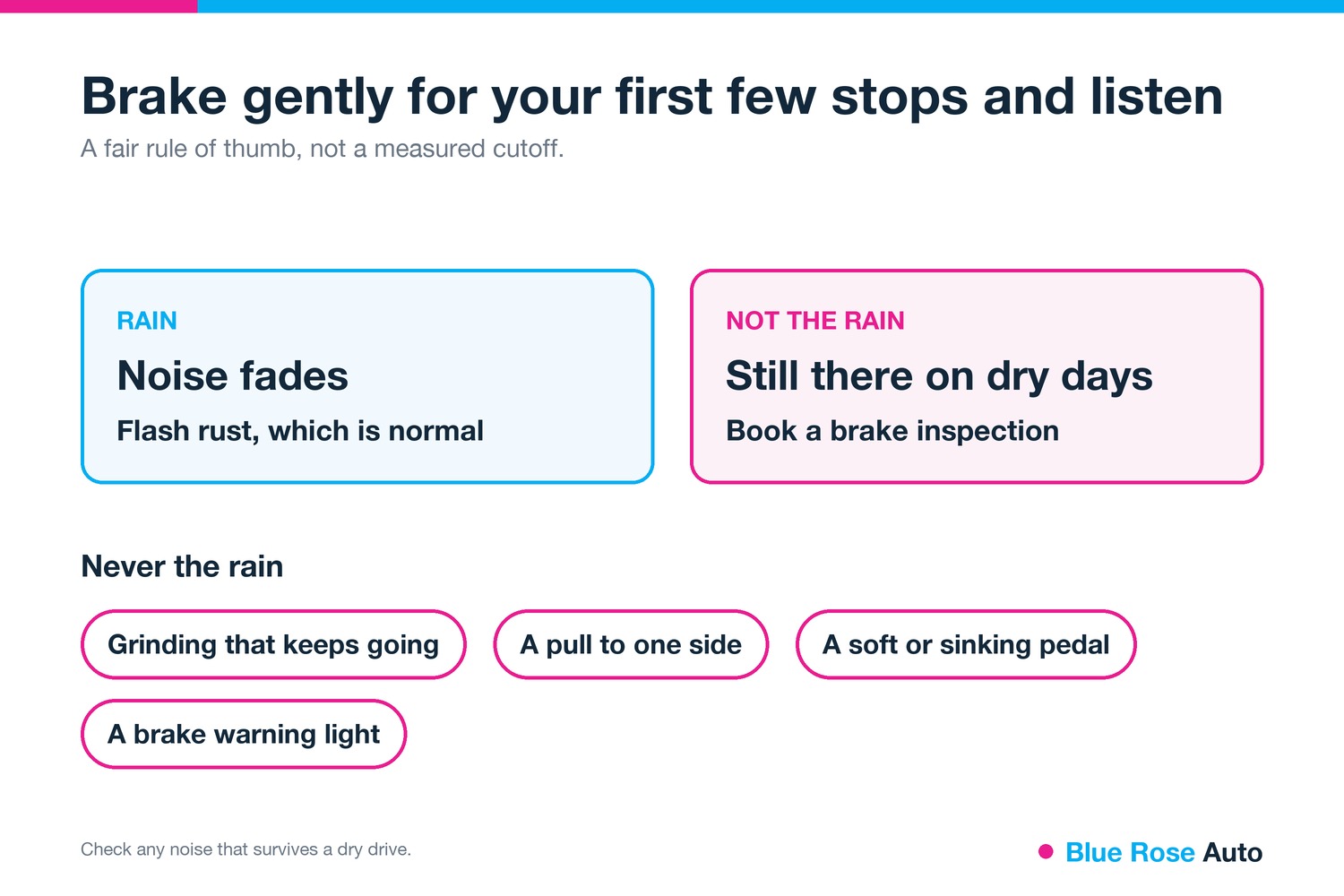
Give it a few normal, gentle stops on your way out. Three is a fair rule of thumb. It isn’t a measured cutoff. Plenty of rain squeal is gone after one stop. If your brakes squeak after rain or do something else odd on a damp morning, find your row in the three-stop test table below.
| What you notice | Normal after rain? | Likely cause | What to do |
|---|---|---|---|
| Squeal on the first 1-3 stops of a damp morning, then quiet | Yes | Flash rust being wiped off | Nothing |
| One or two scrapes or a light grind on the first stop, then gone | Yes | Heavier overnight rust film | Nothing; brake gently the first few stops |
| Grabby first stop, normal after that | Usually | Rust film adds friction briefly | Nothing if it clears |
| Weak first stop after the car wash or a puddle | Yes, briefly | Water between pad and rotor | Brake gently while driving slowly until they respond (Oregon Driver Manual) |
| Pedal buzz on a hard stop on a slick road | Usually | ABS working | Normal; check your owner’s manual |
| Squeal still there on dry days | No | Often worn pads or the wear indicator | Book a brake inspection |
| Grinding that doesn’t go away | No | Often metal on metal | Book soon; don’t keep driving on it |
| Pedal pulses on dry roads too | No | Rotor or other brake issue | Inspection |
| Car pulls to one side when you brake | No | Caliper, pad or tire issue | Inspection (brakes and alignment) |
| Soft, spongy or sinking pedal, or a brake warning light | No | Hydraulic or system fault | Stop driving if the pedal sinks; call a shop |
| Squeal when you start the engine or rev it, with your foot off the brake | Not a brake noise | Often a slipping drive belt (Dayco) | Have the belt and tensioner checked |
Everything above the “Squeal still there on dry days” row clears up by itself, which is the whole point of the test, but a table only narrows it down. An inspection confirms it.
Squeaking after rain, but not when you brake?
Then it probably isn’t your brakes. Brake noise follows the pedal. It starts when you press and stops when you let go. A squeal that shows up at startup, or climbs as you press the gas, follows the engine instead. Belt maker Dayco describes a belt squeal that gets louder as engine speed rises and is typically caused by slip between the belt and its pulleys. A short, repeating chirp is a different fault. We check belts and tensioners as part of alternator belt replacement, because a belt that lets go can stop the alternator from charging.
When is it not the rain?
It isn’t the rain when the noise or the feel survives a dry drive. Away from a damp morning, a squeal usually comes down to wear, grit or hardware, and rain is the exception that fades on its own. If any of the six signs below shows up on a dry day, have the brakes looked at. Don’t wait on the weather.
Most squeal means wear, and our longer post on the warning signs that point to worn brakes covers that side in detail. These signs separate wear from weather.
- Squeal on dry days too. Many pads carry a small metal wear indicator that squeals on purpose once the friction material gets thin. Here’s how long brake pads usually last.
- Grinding that persists. Grinding is usually metal on metal, which means the pads are gone and it isn’t safe to keep driving. We do brake inspections and repair for drivers across Eugene and Springfield, so don’t wait it out.
- A pedal that pulses during gentle stops on dry pavement, where ABS has no reason to kick in. The rotors or another part are the suspects.
- Pulling to one side under braking. A sticking caliper, uneven pads or a tire problem can each cause it, which is why a brake and alignment inspection checks both systems.
- Soft, spongy or sinking pedal. That points at the hydraulic side, not the pads.
- Brake warning light still on after the parking brake is fully released.
When a car comes in with a squeal the owner only hears on wet mornings, the first thing we check is whether it’s still there after a dry drive. If it’s gone, we tell them so.
If it fails the three-stop test, call Blue Rose Auto at (541) 641-8877 and we will look at the brakes.
Is rust on rotors from sitting a problem?
Surface rust from one wet night is not a problem. Rust from weeks or months of sitting can be, and that’s the version worth a closer look. PowerStop says rotor pitting “usually takes months of a car sitting,” and Wagner warns that “a prolonged break in driving can cause pitting in the rotor.” The difference is that pitting is still there after a drive, while flash rust is gone.

Oddly, the car you drive every day is the least likely to have a rust problem, because every stop scrubs the rotor. Park it for weeks and the scrubbing stops.
| Surface (flash) rust | Pitting | |
|---|---|---|
| How it forms | Overnight rain, dew or humidity (Wagner) | A car sitting a long time; PowerStop says it “usually takes months” |
| What it looks like | An even orange film | A rough, pocked friction surface “instead of smooth and shiny” (PowerStop) |
| What you hear or feel | A brief squeak or scrape | Noise and braking problems that don’t clear (Wagner) |
| After a few miles of driving | Wiped off | Still there |
| What to do | Nothing | Have the rotors measured; resurface if in spec, otherwise replace |
On cars that have sat for weeks, we look at the friction surface where the pads ride. PowerStop’s rule is that if the surface still looks “corroded and pocked instead of smooth and shiny” after a drive, “the rotor will need to be turned or replaced.” At our shop we measure the rotors and tell you honestly whether resurfacing or replacement makes sense, because a rotor still within spec can sometimes be resurfaced.
Got a second car that will sit through the wet season? Drive it now and then. Short of a dry garage, that’s the cheapest rust prevention there is.
Why do EV and hybrid brakes squeak more after rain?
Electric cars and hybrids do much of their slowing with regenerative braking, so the pads touch the rotors less often and the rust film has longer to build up between cleanings. That can make the first-stop squeal after rain more noticeable on an EV, and it’s still normal if it fades. Lingering corrosion isn’t.
Tesla’s Model Y owner’s manual makes the same point. It explains that regenerative braking means the brake pads are used less often than in a conventional car, and that a Brake Disc Wiping feature lightly applies the brakes in cold or wet weather to clear water off the discs. It still cautions that rust and corrosion can build up, and it recommends using the brake pedal regularly or burnishing the brakes when needed (Tesla Model Y Owner’s Manual, Braking and Stopping).
Rear brakes get it worst. A December 2025 piece in the trade magazine Tire Review explains that regenerative braking does most of the slowing, so the rear pads and rotors seldom get hot enough to dry out. Shops report corroded rotors, seized calipers and uneven rear pad wear, and a look through the wheel often misses the damage. That’s the reason an EV brake check should be done with the wheels off.
On an EV that squeaks after every wet night, the habit is simple. Use the brake pedal for some of your stops instead of letting regen do all of it, which is what Tesla’s manual asks for. Blue Rose Auto services EVs as well as gas cars, so a squeak that outlasts a dry week is worth bringing in either way.
Can you spray WD-40 on squeaky brakes?
No. Never spray WD-40 or any lubricant on brakes to stop a squeak. Brake maker PowerStop says to “never apply lubricant to the rotors or the friction side of the brake pads,” because anything slippery on the friction surfaces cuts stopping power. Rain squeal clears on its own within a few stops.
A quieter brake that stops worse is a bad trade, and it’s a bad idea we still hear about at the counter.
Brake cleaner is a different product. Technicians use it as a solvent during brake work to strip dust and residue, and it isn’t a driveway squeak cure. Anti-squeal paste, if you’ve heard of it, goes on the back of the pads during a brake job and never touches the friction face. A squeak that keeps coming back on dry days has a cause. Fix that, not the noise.
How much do wet roads change stopping distance?
Wet roads can take two to three times the stopping distance of dry ones, according to ODOT, and the first rain after a dry spell is especially slick because oil and grease have built up on the pavement. Worn tires make it worse. AAA measured 87 feet more wet stopping distance on tires worn to 4/32 inch.
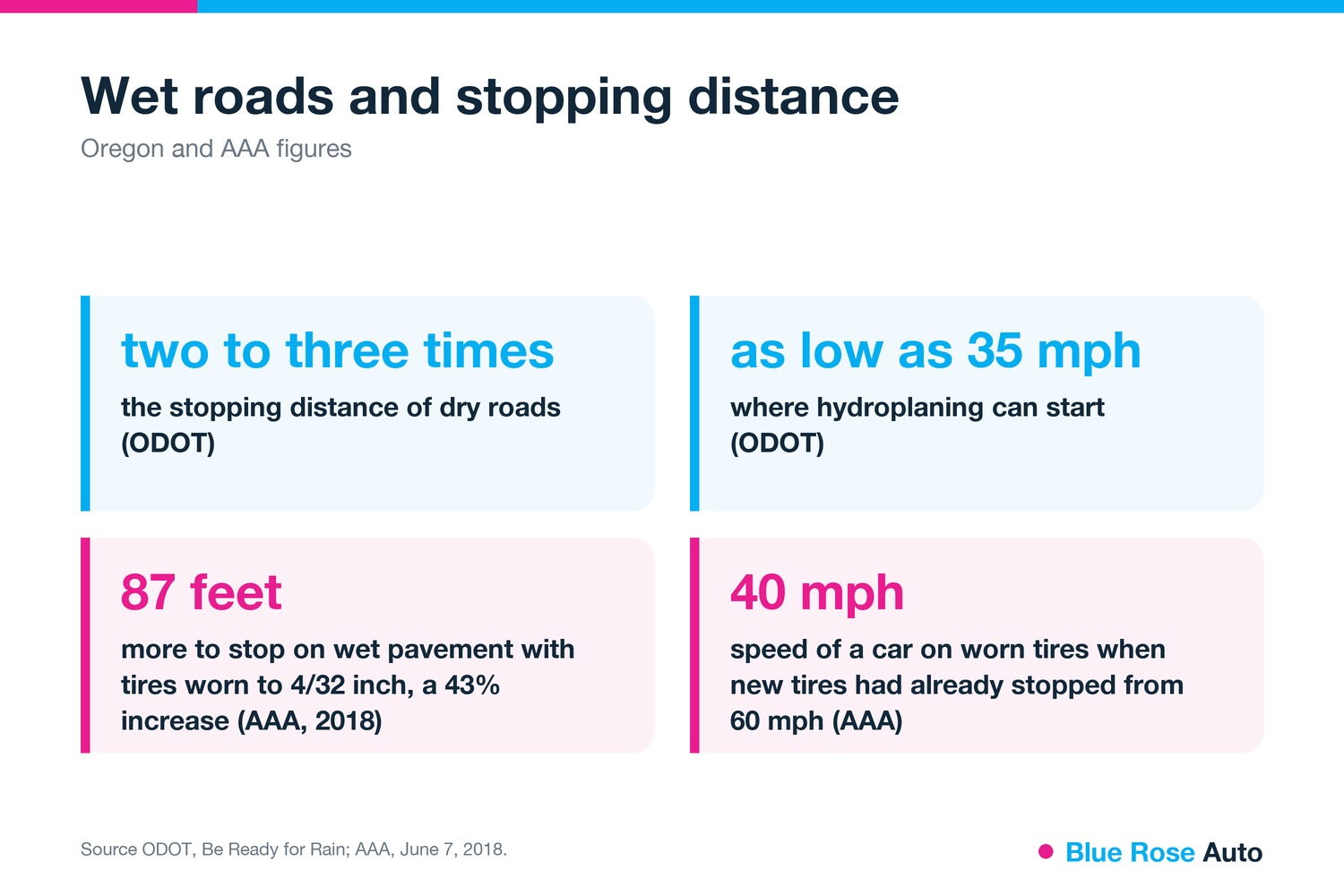
The Oregon Department of Transportation singles out the first storm of the season. “If it hasn’t rained in a while, expect road surfaces to be especially slick. Engine oil and grease build up on the road over time. The first few hours of a fresh rain can be the most dangerous” (ODOT, Be Ready for Rain). Its distance rule is the one to remember. “A car needs two to three times more stopping distance on wet roads.”
Here, the switch is abrupt. NOAA’s 1991-2020 normals for Eugene Airport show 0.32 inches in July, 0.39 in August and 1.39 in September, then 3.17 in October, 5.98 in November and 7.21 in December (NOAA NCEI U.S. Climate Normals). Add it up and the airport gets 40.83 inches in a normal year, spread across 145.7 days with measurable rain, and by our math about 92% of that falls between October and May. Summer barely registers.
The Driver Manual’s habit, on page 77, is short. “When roads are wet, apply the brakes sooner and more gently than usual. Even summer showers can cause slippery roads when rain mixes with oil and dirt.” Oregon’s basic speed rule, ORS 811.100, lists “Weather” among the conditions your speed has to account for, so it can apply even below the posted limit. (General information, not legal advice.) More wet-season prep lives in our seasonal car care guide.
What if you hydroplane?
ODOT’s instruction is specific. “If you hydroplane, ease off the gas, gently apply the brakes and steer straight ahead. Hydroplaning occurs when your front tires ride on a film of water. It can occur at speeds as low as 35 mph, especially if tires are worn.” Some brake-parts blogs tell you to stay off the brakes entirely. We’d follow ODOT. Both ODOT and AAA also say to turn off cruise control on wet pavement.
Are your tires half the problem?
Often, yes. Brakes stop the wheels, but only the tires stop the car. In AAA research released June 7, 2018, tires worn to 4/32 inch needed an average of 87 feet more to stop on wet pavement than new tires on a passenger car, and 86 feet more on a light truck, a 43% increase (AAA newsroom).
Megan McKernan, who manages the Automobile Club of Southern California’s research center, put it in speed terms. “If tested side-by-side at 60 mph, vehicles with worn tires would still be traveling at an alarming 40 mph when reaching the same distance it takes for vehicles with new tires to make a complete stop.”
You can check your own tread with a quarter. AAA’s wet-weather tips say to put a quarter upside down into a tread groove, and if you can see the top of Washington’s head, it is time to shop for new tires. If the car also tugs one way when you brake on wet pavement, book wheel alignment and brake checks so both get looked at in one visit.
Does rain get into brake fluid?
Not from driving in it. The brake hydraulics are a sealed system, so a rainy commute doesn’t pour water into the lines. The real issue is slower. Common glycol-based brake fluids such as DOT 3 and DOT 4 are hygroscopic, meaning it pulls moisture from the air over time, and fluid with water in it boils at a lower temperature than fresh fluid does.
Federal Motor Vehicle Safety Standard No. 116 sets the minimum boiling points for brake fluid, both fresh and after it has absorbed water (eCFR, 49 CFR 571.116), and the table lists them.
| Grade | Dry minimum boiling point | Wet minimum boiling point |
|---|---|---|
| DOT 3 | 205 °C (401 °F) | 140 °C (284 °F) |
| DOT 4 | 230 °C (446 °F) | 155 °C (311 °F) |
| DOT 5 | 260 °C (500 °F) | 180 °C (356 °F) |
Federal minimums from 49 CFR 571.116. “Wet” is a lab test of fluid that has absorbed water, not rain.
For DOT 3, the wet minimum sits 65 °C (117 °F) below the dry one. That gap matters when brakes get hot, which is why a brake inspection can include a look at the fluid’s condition. None of it explains this morning’s squeal, though.
What does a brake fix cost if it is not the rain?
Brake pads alone run about $150 to $400 per axle nationally, based on RepairPal figures. Blue Rose Auto’s Eugene-Springfield range for pads and rotors together is $250 to $600 per axle, and we confirm the exact figure after we inspect the brakes. Our breakdown of major car repair costs shows how those ranges compare, and brake pad replacement costs in Eugene and Springfield explains what moves a quote up or down.
Frequently asked questions
Is it safe to drive if my brakes are squeaking after rain?
Usually yes, if the squeak shows up on the first few stops after rain or heavy dew and then goes quiet. That is flash rust coming off the rotors. A squeal that is also there on dry days, or one that turns into grinding, points to worn pads, so get those checked soon.
Is it safe to drive with grinding brakes after it rains?
One or two scrapes that clear on the first stops are flash rust. Grinding that keeps going is different. It usually means metal on metal, so the pads are worn through and the rotors are taking damage. That is not safe to keep driving on, so book a brake inspection as soon as you can.
How do you dry wet brakes?
Follow the Oregon Driver Manual and gently apply the brakes while driving slowly until they begin to respond, as soon as you can after driving through water. A few light presses at low speed usually do it. Better still, skip deep water, because the manual says not to drive through flooded areas.
Why do my brakes squeak after a car wash?
Same reason they squeak after rain. The wash soaks the rotors and pads, an undercarriage spray especially, water sits between them for a moment, and a quick film of rust can start on the bare iron. Brake gently on the way out of the bay, and the noise should fade within a few stops.
Should you replace rotors if they are rusty?
Not for surface rust, which wipes off with normal braking. Rotors need attention when months of sitting have pitted the friction surface, leaving it rough and pocked instead of smooth and shiny. Even then, a rotor still within spec can sometimes be resurfaced, and one that is out of spec gets replaced.
Why are my brakes squeaking when the pads are fine?
Moisture is the most common cause with no wear involved, since flash rust does not care how much pad is left. Road grit trapped between pad and rotor, worn or loose clips and shims, dry hardware and new pads that are still breaking in can also squeak. If it continues once the brakes are dry and warm, get it looked at.
What is the stopping distance at 60 mph in wet conditions?
There is no single number. ODOT says a car needs two to three times more stopping distance on wet roads than on dry ones, and tires change it a lot. In AAA testing from 60 mph, cars on worn tires were still doing about 40 mph at the point where cars on new tires had already come to a stop.
Can I spray WD-40 on squeaky brakes?
No. Never spray WD-40 or any lubricant on the rotors or the friction side of the pads, because anything slippery there cuts stopping power. Rain squeal clears on its own within a few stops. A squeak that keeps returning on dry days has a cause, and an inspection will find it instead of masking it.
Why do EV and hybrid brakes squeak more after rain?
Electric cars and hybrids slow down with regenerative braking, so the pads touch the rotors less often and rust has longer to build between cleanings. The first-stop squeal after rain is normal if it fades. Using the brake pedal for some stops helps, and corrosion that lingers deserves an inspection with the wheels off.
When should you call Blue Rose Auto?
Most brake noise after rain is harmless and gone by the end of your street. If yours isn’t, or it grinds, pulls or the pedal feels soft, our ASE-certified brake technicians at 3436 Olympic St in Springfield will inspect it and give you a written estimate before any work starts. Blue Rose Auto opened in 1994. Call (541) 641-8877 or request a brake inspection through our contact form, and for the rest of the car, our winter car maintenance checklist covers the wet months.
0 Comments