
Heading up OR-58 to ski? Willamette Pass winter driving comes down to two Oregon rules most people half remember. Studded tires are legal in Oregon from Nov. 1 through March 31, and on Willamette Pass (OR-58) or Santiam Pass (US-20) you only have to use chains or traction tires where signs say so. An AWD car skips chains only if it meets six conditions, including carrying chains and having traction or M+S tires on all four wheels. Below you’ll find the statutes behind those rules and the OR-58 versus US-20 choice. After that comes the part we know best, which is what a mechanic checks on a car before a 5,000-ft winter pass. For the valley side of the season, we cover how Springfield’s climate wears on a car too.
By Blue Rose Auto. Rules checked October 2026. Last updated October 22, 2026.
When are studded tires and chains legal in Oregon?
Oregon’s stud season runs Nov. 1 through March 31 (the statute’s wording is “Between November 1 of any year and April 1 of the following year”), and that window applies statewide. Chains and traction tires follow a different rule. You need them only where the highway is posted, either on fixed signs or on the variable message boards ODOT switches on as the weather turns.
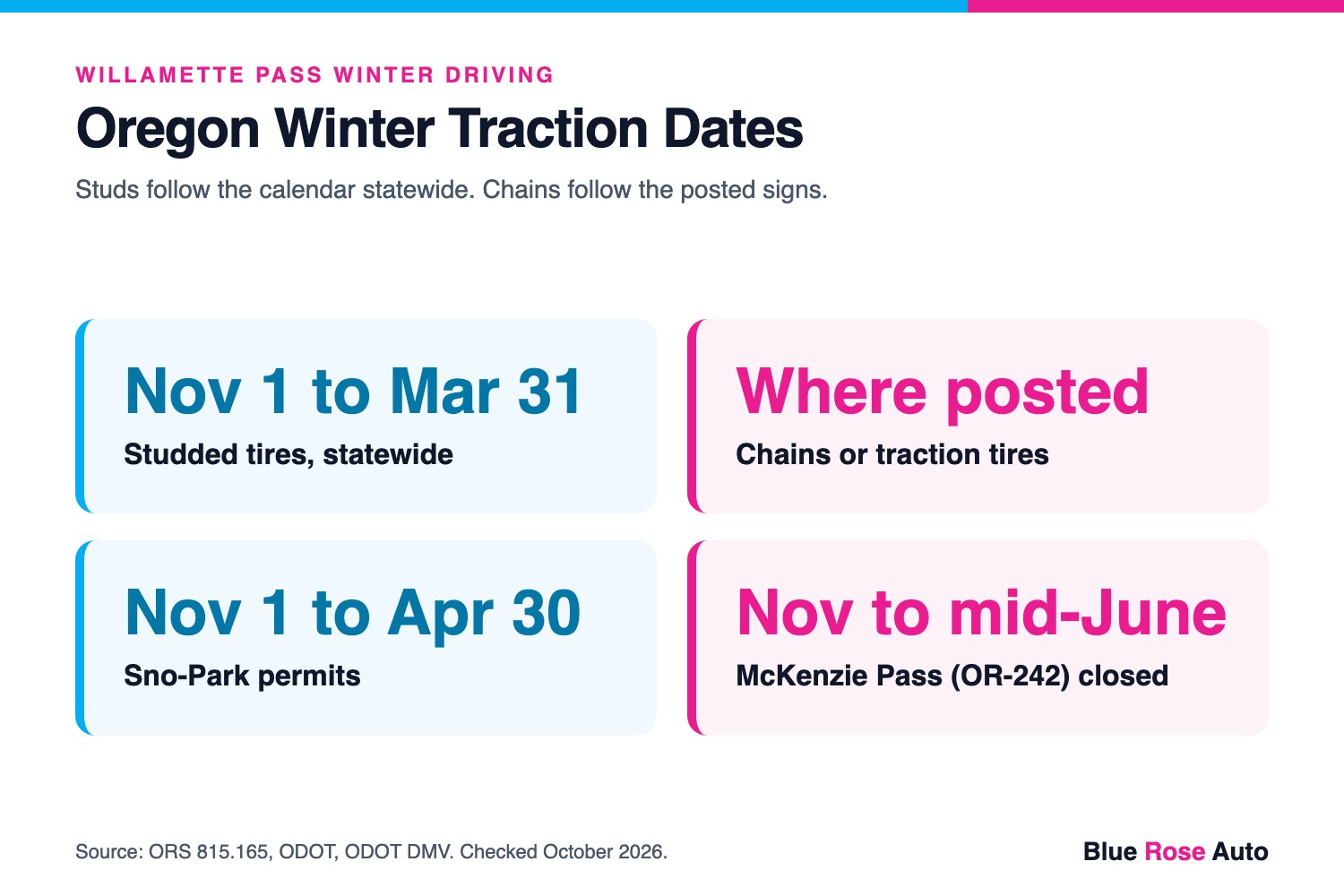
Two footnotes on studs. ORS 815.165 lets ODOT shorten or lengthen the window in areas it specifically designates, and TripCheck’s chain law page asks drivers to use studded tires “only when necessary,” since they tear up pavement.
Oregon’s chain rule is a posted-sign rule. Under ORS 815.140, the offense only exists where a highway is signed for traction tires or chains, and failing to use them there is a Class C traffic violation with a presumptive fine of $165 before court surcharges. And the $880 figure people quote? That applies to commercial vehicles registered under ORS chapter 826, not to a passenger car. A traction tire means a studded tire or one with the three-peak mountain and snowflake symbol. All-season and M+S tires only count when they sit on an AWD or 4WD vehicle that meets every condition of ORS 815.145, which are 6,500 lb or less unloaded, power to both axles, chains carried, traction tires on all wheels, not towing, and no loss of traction. A front-drive sedan on M+S tires still needs chains when signs say traction tires are required. Check TripCheck.com or call 511 before you leave.
That M+S point is a common source of confusion in online chain-law threads.
Which route works in winter, OR-58, US-20 or McKenzie?
From Springfield there are two winter routes over the Cascades, plus one that isn’t open. OR-58 climbs to Willamette Pass at 5,128 ft, and OR-126 joins US-20 to cross Santiam Pass at 4,817 ft. McKenzie Pass on OR-242 stays closed all winter, so it is not a shortcut to Sisters.
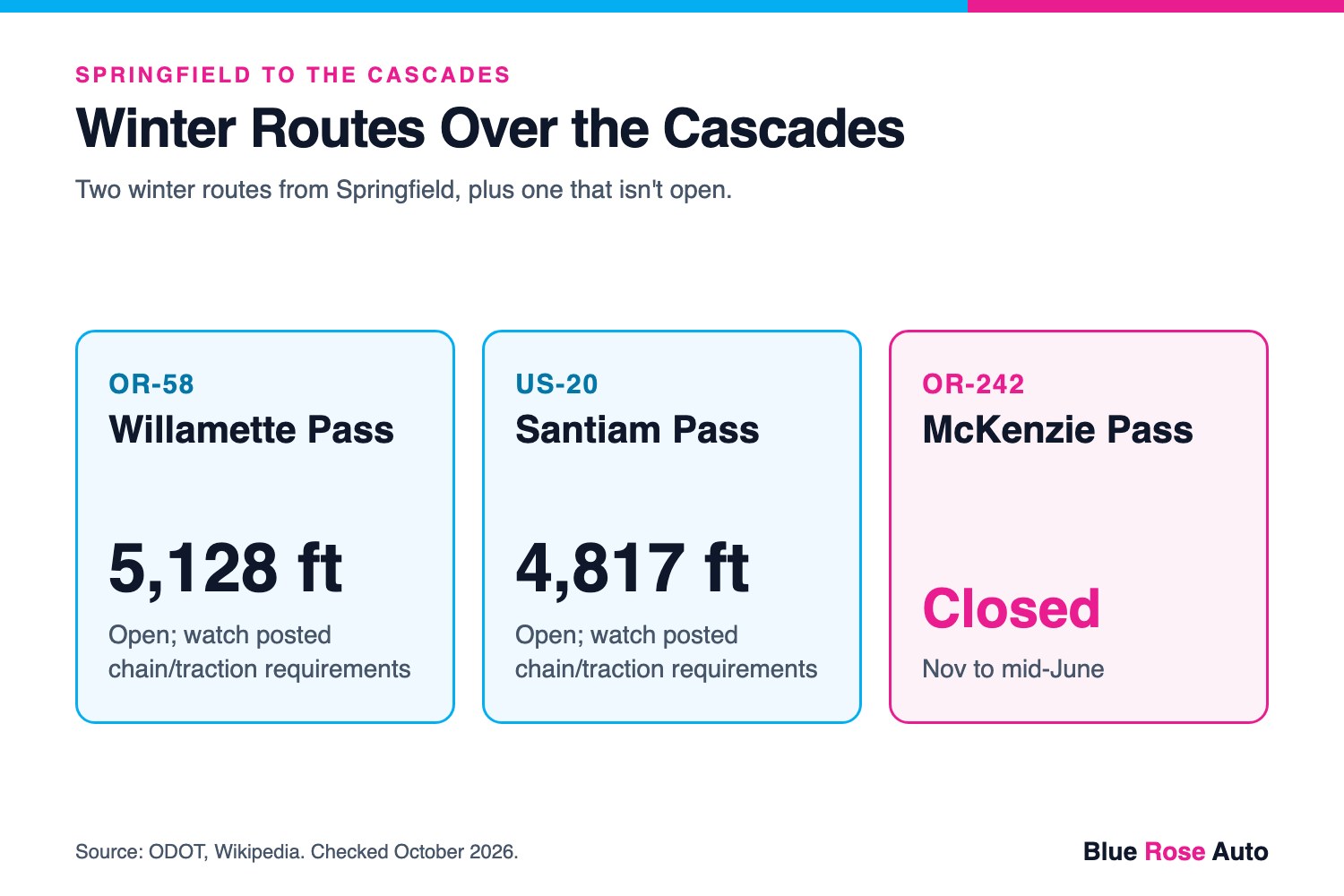
Here is how the three routes compare for Willamette Pass winter driving and the trip east.
| Route | Pass | Elevation | Winter status | Ski area on the route |
|---|---|---|---|---|
| OR-58 (Willamette Highway) | Willamette Pass | 5,128 ft | Open; watch posted chain/traction requirements | Willamette Pass Resort (milepost 62) |
| OR-126 to US-20 | Santiam Pass | 4,817 ft | Open; watch posted chain/traction requirements | Hoodoo |
| OR-242 (McKenzie Highway) | McKenzie Pass | Not needed (closed) | Closed Nov to mid-June | None |
Both open routes can be posted for chains or traction tires on any given morning.
Willamette Pass Resort, at milepost 62, has no public transportation, and its getting-here page asks visitors to “monitor Highway 58 snow conditions and chain/4WD advisories.” The resort reports an average of over 430 inches of snow a year. Wikipedia puts Santiam’s snowfall at about 450 inches. Hoodoo warns that “Weather and road conditions on the Santiam Pass can change quickly” and tells skiers to have traction tires or devices on board regardless of the forecast.
McKenzie is out until summer. ODOT says OR-242 “is seasonally closed from November to mid-June,” and the earliest it can reopen is the third Monday in June.
Some drivers on travel forums say they pick OR-58 on snowy days because one Santiam crash can stall the road. That’s driver opinion, not data.
What counts as a traction tire in Oregon?
In Oregon, a traction tire is a studded tire, a retractable-stud tire, or a tire carrying the three-peak mountain and snowflake (3PMSF) symbol on its sidewall. Mud-and-snow (M+S) and all-season tires count only when they’re mounted on an AWD or 4WD vehicle that qualifies for the chain exemption.
M+S on the sidewall isn’t enough on a front-drive car.
Oregon sorts the tires and devices on the store shelf like this.
| Tire or device | Counts as a traction tire? | Source |
|---|---|---|
| Three-peak mountain and snowflake (3PMSF) tire | Yes | TripCheck traction tires page |
| Studded tire (Nov 1 to Mar 31 only) | Yes | OAR 734-017-0005, TripCheck |
| Retractable-stud tire | Yes | OAR 734-017-0005, TripCheck |
| M+S, all-season or all-weather radial | Only on an AWD/4WD vehicle that meets the ORS 815.145 exemption | OAR 734-017-0005, ODOT snow-zone page |
| Snow socks | Not a traction tire; ODOT says “only intended for short stretches of road” | ODOT winter tires page |
| Chains | Not a tire, but satisfies a chain requirement; ODOT says chains are “more effective than studded tires” | ODOT, OAR 734-017-0005 |
The fourth row is where people get caught. TripCheck lists tires marked with “a mountain/snowflake emblem on the sidewall,” and OAR 734-017-0005 adds tires the Rubber Manufacturers Association rates above mud-and-snow.
ODOT’s winter tires page says traction tires “work about as well as studded tires on ice, but work better than studded tires or regular tires in most other winter conditions.” OAR 734-017-0005 defines chains as devices made to augment traction on ice or snow, but ODOT still describes socks as temporary traction for getting out of snow. Buying tires? Ask the dealer to show you the symbol on the sidewall.
Does AWD or 4WD mean you can skip chains?
Sometimes. ORS 815.145 lets an AWD or 4WD passenger vehicle or truck skip chains only when it meets all six conditions below. The exemption is what lets ordinary M+S or all-season tires stand in for chains. Miss one condition, including actually carrying chains, and those tires stop counting.
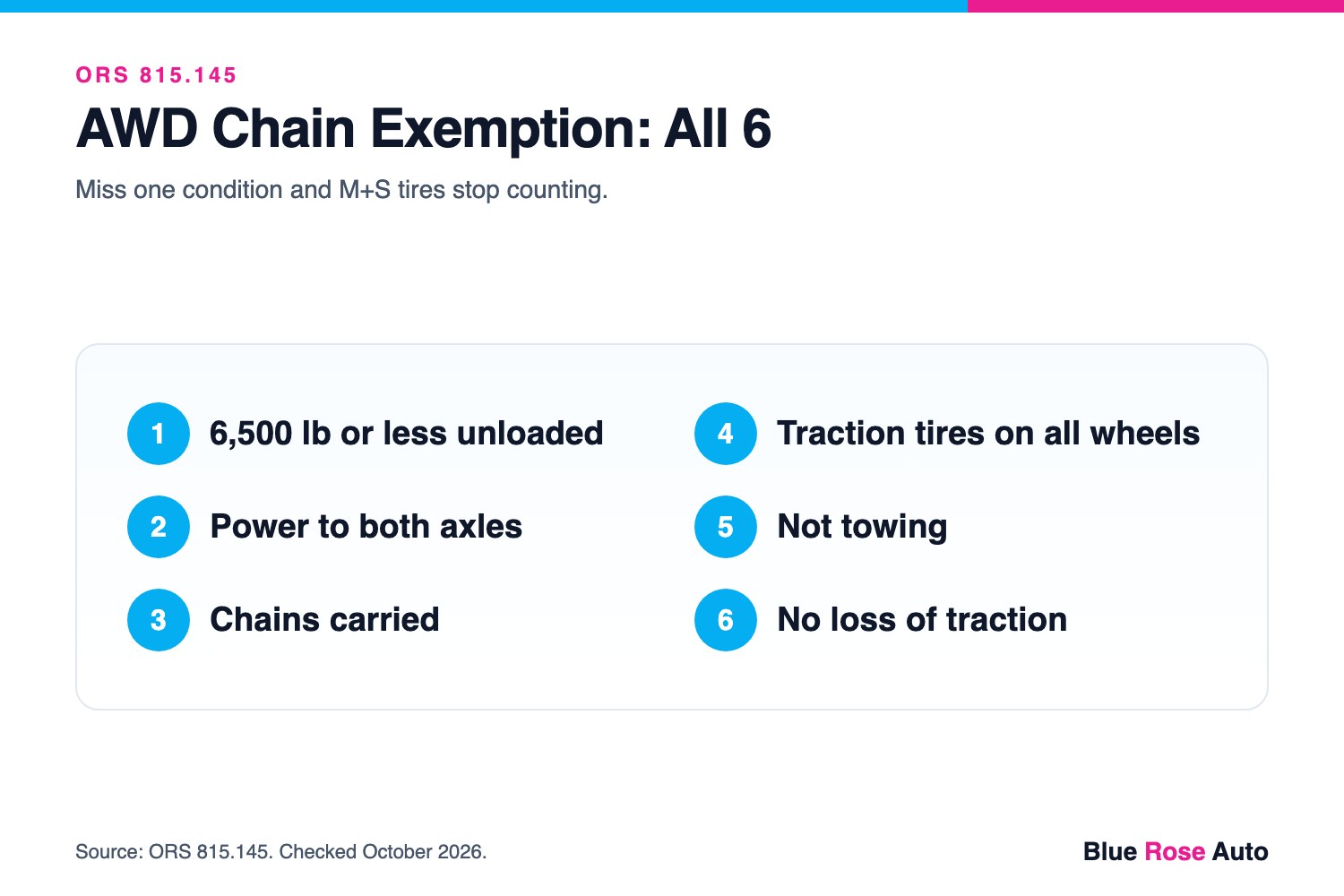
The statute lists them in this order.
- Unloaded weight of 6,500 lb or less. That’s the empty vehicle, not the gross vehicle weight rating on the door-jamb sticker.
- Power to both front and rear wheels. The statute says “equipped and operated,” so a part-time 4WD truck left in two-wheel drive doesn’t qualify.
- Chains carried in the vehicle. You have to carry them even though you’re exempt from mounting them. This is the condition AWD owners skip most.
- Traction tires on all wheels. ODOT’s snow-zone page lists mud and snow, all-weather radial or traction tires, on every wheel.
- Not towing. Hitch up a trailer and the exemption is gone.
- No loss of traction. The car can’t be sliding while stopping, cornering or moving.
Signs can still tighten things. A conditional closure can require chains on more vehicles, and the wording changes by location. TripCheck’s example from Siskiyou Pass on I-5 reads “Chains required on all vehicles excluding four wheel drive vehicles unless towing.” Read the sign in front of you, and use the ODOT snow zone page to decode it.
How do you put chains on, and on which wheels?
Light-duty vehicles, meaning a gross vehicle weight rating of 10,000 lb or less, need chains on one tire on each side of the primary drive axle under OAR 734-017-0010. Front-drive car? Front tires. A rear-drive truck takes them on the rear, and for AWD the owner’s manual names the axle.
- Traction tires may replace chains on these vehicles when you aren’t towing or being towed.
- Towing a trailer means chains when the signs call for them, whatever tires you run.
- Buy the chain type and size your owner’s manual lists.
- Never let air out of the tires to make chains fit, which is one of ODOT’s chain tips as reported by OPB.
- After a short distance, pull over somewhere safe and retighten.
- Keep it under 30 mph on chains.
One tip from the shop side. Fit the chains once in your driveway, dry and in daylight, a few days before the trip, because the shoulder of OR-58 after dark with trucks passing is a poor place to read the instructions for the first time.
What does an Oregon chain or stud ticket cost?
For a passenger car, each of Oregon’s winter traction offenses is a Class C traffic violation with a presumptive fine of $165 under ORS 153.019, and court surcharges may apply. The $880 figure people repeat is real, but ORS 815.140 limits it to commercial vehicles registered under ORS chapter 826.
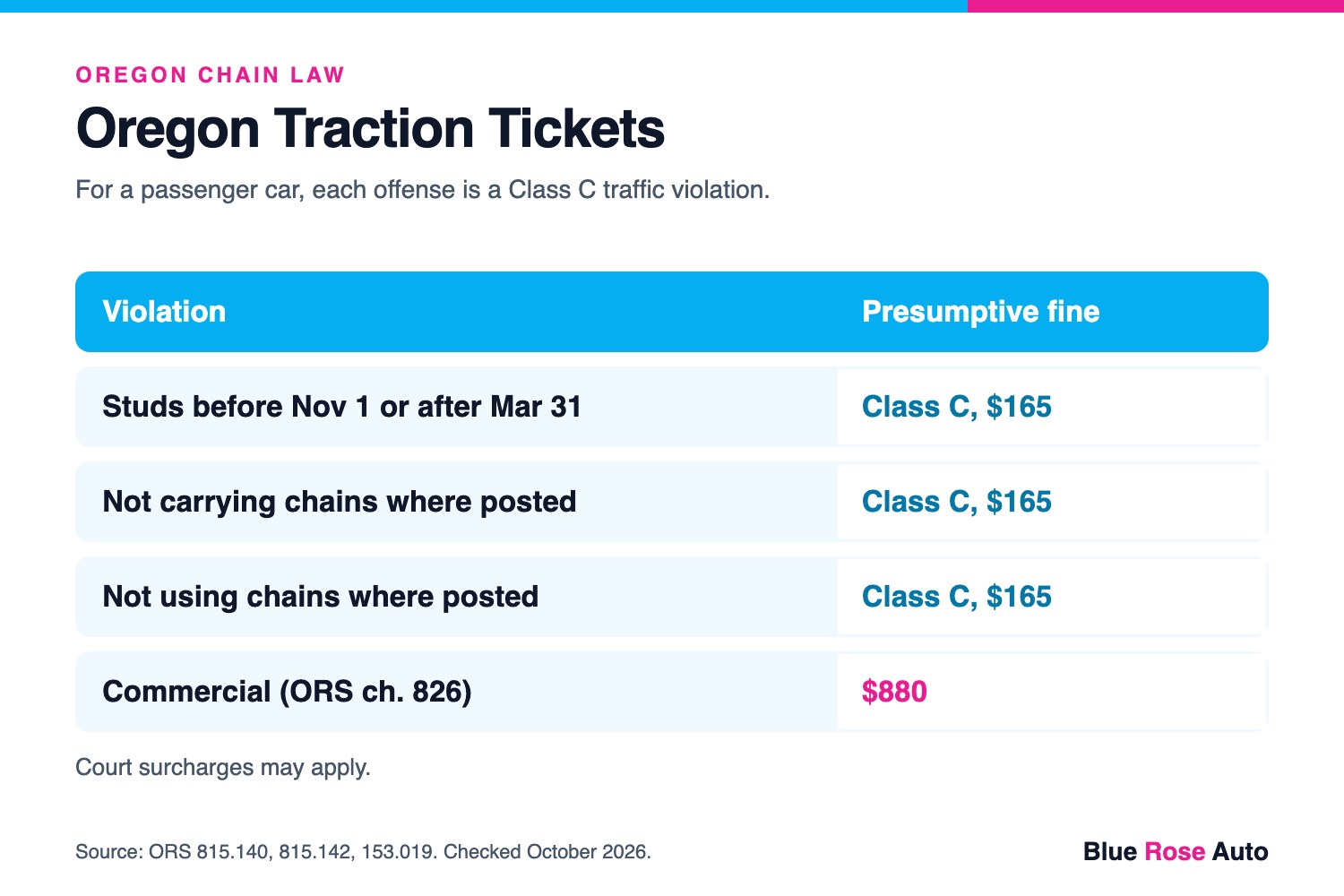
These are the violations a valley driver could pick up on a pass trip.
| Violation | Statute | Class | Presumptive fine |
|---|---|---|---|
| Studded tires before Nov 1 or after Mar 31 | ORS 815.160 / 815.165 | Class C | $165 (ODOT says “nearly $200”) |
| Not carrying chains or traction tires where posted | ORS 815.142 | Class C | $165 |
| Not using chains or traction tires where posted (passenger vehicle) | ORS 815.140 | Class C | $165 |
| Same, vehicle registered under ORS ch. 826 (commercial) | ORS 815.140 | Specific fine | $880 |
ODOT’s winter tire page rounds the stud fine to “nearly $200.” That figure most likely includes surcharges. OPB reported in March 2025 that police “can issue $165 citations” once studs are out of season, which matches ORS 815.140 and the Class C schedule in ORS 153.019.
This section is general information, not legal advice. Statutes and ODOT rules change, so if you’re contesting a ticket, talk to an attorney, and on the road, the posted sign and TripCheck have the final word.
Why is the drive down the real brake test?
A long downgrade turns your brakes into heaters. Every stop converts motion into heat, and over miles of descent that heat builds faster than it can leave, so pads and fluid that cope fine around Springfield start to overheat. The pedal goes soft. Stops get longer. That’s brake fade, and it happens on the way down, not on the climb.
Low gear is the habit people forget. Shift down (manual mode on an automatic) so engine braking does part of the work, then brake firmly in bursts instead of riding the pedal. Oregon OEM tells winter drivers to “Check antifreeze levels, battery, brakes, and tires.”
Condition drives most of the risk. Brake fluid absorbs moisture over time, and wet fluid boils at a lower temperature, which is exactly when the pedal sinks. Thin pads hold less heat. A pulsing pedal or a squeal you’ve been ignoring means something is already worn, and a car loaded with skis and passengers has more weight to stop on the same grade.
When we inspect brakes before a mountain trip, this is our list.
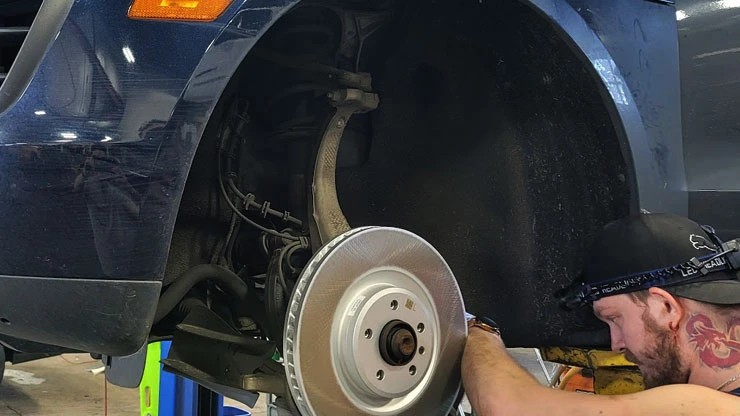
- Pad thickness at all four corners, inner pads included, since those can wear faster than the pad you see
- Rotors, for scoring, heat spots and the uneven wear behind a pulsing pedal
- Brake fluid, judged by age and moisture rather than color alone
- Caliper slides and brake hoses, for sticking, swelling or seepage
- Any brake or ABS warning light on the dash
If any of those sound familiar, schedule a brake and alignment check before a mountain trip. ASE-certified technicians handle every brake inspection at our shop.
Planning a pass trip and your brakes have been noisy? Call (541) 641-8877 and we’ll inspect them and give you a written estimate before any work starts.
Should you check alignment and suspension before snow?
Yes, if the car already pulls or the steering feels vague. Slush ruts grab the front wheels. A car that drifts on dry pavement in Springfield will drift harder in a rut near Santiam Pass, and worn steering or suspension parts make it worse because the tires stop tracking where you point them.
On cars that come in pulling to one side, we check the tire wear pattern and the steering and suspension parts before adjusting anything, since aligning a car with a worn tie rod end doesn’t hold. That’s why our wheel alignment and brake repair work starts with an inspection. Some fixes end up as suspension and steering repair instead.
Uneven wear matters in winter too. A tire worn down on its inside edge has the least tread right where it has to push slush aside.
Which cold-weather checks matter at pass elevation?
The ones that fail when it’s colder than the valley. A ski-area lot below a 5,128-ft pass on a January morning tests a car harder than a Springfield driveway does.
- Battery. Oregon OEM says it should be fully charged, with cables that aren’t loose or corroded. One that starts fine at home may not at a cold trailhead, and a battery and charging system test settles the question in the valley.
- Coolant. OEM’s exact line is “Make sure your antifreeze is good to -25F.” If you don’t know when yours was last changed, book cooling system and antifreeze service and have the mix tested.
- Hoses. A long climb works the cooling system hard, so replace loose or brittle hoses at home, not on the grade.
- Heater and defroster. A windshield that fogs on a two-lane climb is a visibility problem right away.
- Wipers and washer fluid. Fresh blades, plus a washer fluid rated for freezing temperatures.
- AWD or 4WD system. Haven’t had the drivetrain looked at since last winter? Have it checked before you count on it.
Tire pressure, lights and the rest of the general items belong on a winter car maintenance checklist for Eugene drivers, so we only cover pass-specific checks here.
What should you do 48 hours before driving Willamette Pass?
Check the road, fill the tank, practice with the chains, and settle any brake or battery doubts while a shop can still see the car. Two days out leaves time to fix a problem. The morning of the trip doesn’t.
- Check TripCheck.com or call 511. Then check again the morning you leave.
- Fill to at least half a tank and keep it there. Oregon OEM recommends it to keep the fuel line from freezing, and it means heat if a closure holds you up.
- Test-fit your chains at home. Make sure they fit the tires on the car now, not a set you sold last spring.
- Buy a Sno-Park permit if you’ll park in a designated Sno-Park. ODOT DMV requires one from Nov. 1 to April 30, at $25 annual, $9 for three consecutive days or $4 daily, and agents may add a service fee.
- Deal with any brake, battery, coolant or defroster doubt. If something has felt off lately, this is the window to get it looked at.
- Pack the kit. Oregon OEM’s winter list, trimmed for a pass day, is below.
- Blankets, food and water
- An ice scraper, a small shovel and kitty litter for traction
- Jumper cables and a flashlight
- First aid kit, plus flares or reflective triangles
- Tire sealant or a small compressor
- A radio and a backup phone charger
Cell service can drop out on mountain roads, so tell someone your route.
Frequently asked questions
Can I put studded tires on before November 1?
No. Studded tires are legal in Oregon from Nov. 1 through March 31, and running them outside that window is a Class C traffic violation with a presumptive fine of $165 before court surcharges. ODOT can adjust the window in areas it designates, but don’t plan an early trip around a change nobody has announced.
Do I need chains if I have all-season tires?
On a two-wheel-drive car, yes, whenever signs require chains or traction tires. All-season and M+S tires only count as traction tires on an AWD or 4WD vehicle that meets every condition of ORS 815.145. Without studs or the three-peak mountain and snowflake symbol, a front-drive sedan needs chains on. Carry them either way, because failing to carry them where signs require it is a separate violation.
How many chains do I need for a two-wheel-drive car?
Two. Oregon’s rule for light-duty vehicles, those with a gross vehicle weight rating of 10,000 lb or less, is chains on one tire on each side of the primary drive axle under OAR 734-017-0010. That means both front tires on a front-drive car and both rear tires on a rear-drive car.
Do I need chains on all 4 tires with a 4WD truck?
No. A light-duty 4WD truck that has to chain up puts chains on one tire on each side of the primary drive axle, not all four. If the truck meets all six ORS 815.145 conditions, it can skip chains under most postings, but it still has to carry them. Towing changes the answer, because the exemption ends once the truck is towing.
Are chains required on the way up to Willamette Pass from Eugene?
Only when signs are posted. Oregon’s chain rule applies where the highway is signed for chains or traction tires, and on OR-58 that can change during the day. Willamette Pass Resort asks visitors to monitor Highway 58 snow conditions and chain/4WD advisories. Check TripCheck.com or call 511 before leaving, and carry chains regardless.
Is McKenzie Pass open in winter?
No. ODOT closes McKenzie Pass on OR-242 every year from November to mid-June, and the earliest it reopens is the third Monday in June. In winter, the choices from the Eugene-Springfield area are OR-58 over Willamette Pass or OR-126 to US-20 over Santiam Pass, and either can be posted for chains or traction tires.
Do I need a Sno-Park permit to ski Willamette Pass or Hoodoo?
Only if you park in a designated Sno-Park. Oregon requires permits there from Nov. 1 to April 30, at $25 for the season, $9 for three consecutive days or $4 for a day, and agents may add a fee. Whether a resort’s own lot counts is a question for the resort.
Does a three-peak mountain snowflake tire count as a traction tire in Oregon?
Yes. Oregon’s traction tire definition in OAR 734-017-0005 includes studded tires, retractable-stud tires and tires the Rubber Manufacturers Association rates above mud-and-snow, which carry the three-peak mountain and snowflake symbol on the sidewall. TripCheck and ODOT both point drivers to that emblem when they shop for non-studded traction tires.
What is the fine for driving without chains where required in Oregon?
For a passenger car it is a Class C traffic violation with a presumptive fine of $165 under ORS 815.140 and ORS 153.019, before any court surcharges. Commercial vehicles registered under ORS chapter 826 face a specific $880 fine. The offense only applies where the highway is posted for chains or traction tires.
Getting your car ready before the first snow trip
Book a brake, alignment, battery and cooling check before your first trip over the pass. Blue Rose Auto is at 3436 Olympic St in Springfield, our technicians are ASE-certified, and Blue Rose Auto opened in 1994. We inspect and give you a written estimate before any work starts, and our 3-year, 36,000-mile warranty covers mechanical repairs. Call (541) 641-8877 or book a pre-trip check, and we also handle wheel alignment and brake repair. For winter tires or studs, your tire dealer is the right stop.

0 Comments