
When power steering goes out while you drive, the car still steers, but it takes far more effort, especially at low speed. Grip the wheel with both hands, ease off the gas, turn on your hazard lights, brake gently and pull over as soon as it is safe. Do not switch the engine off while the car is moving. Most failures trace to a leak, a worn pump, a slipping or broken belt or, on newer cars, an electric motor, module or sensor fault. Blue Rose Auto repairs steering systems for drivers in Eugene and Springfield, Oregon, from our shop at 3436 Olympic St in Springfield.
Last updated October 2026
Key takeaways
- Steering still works when assist is lost, but it takes much more effort, so grip the wheel with both hands and slow down.
- Never switch the engine off while the car is moving.
- Hydraulic cars tend to whine or leak, and electric cars tend to show a steering light.
- It is safer to tow the car than to keep driving if the light stays on, fluid is pouring out or the steering feels loose.
- National guides put a pump at $668 to $941 and a rack and pinion at $710 to $2,420 (Sunbit, September 2025).
What to Do When Power Steering Goes Out While Driving
Losing assist is startling, but the wheel is still connected to the front tires. On a hydraulic car the pump stops helping, and on an electric one the motor stops helping, so you steer with your own strength. The same seven moves work in either case.
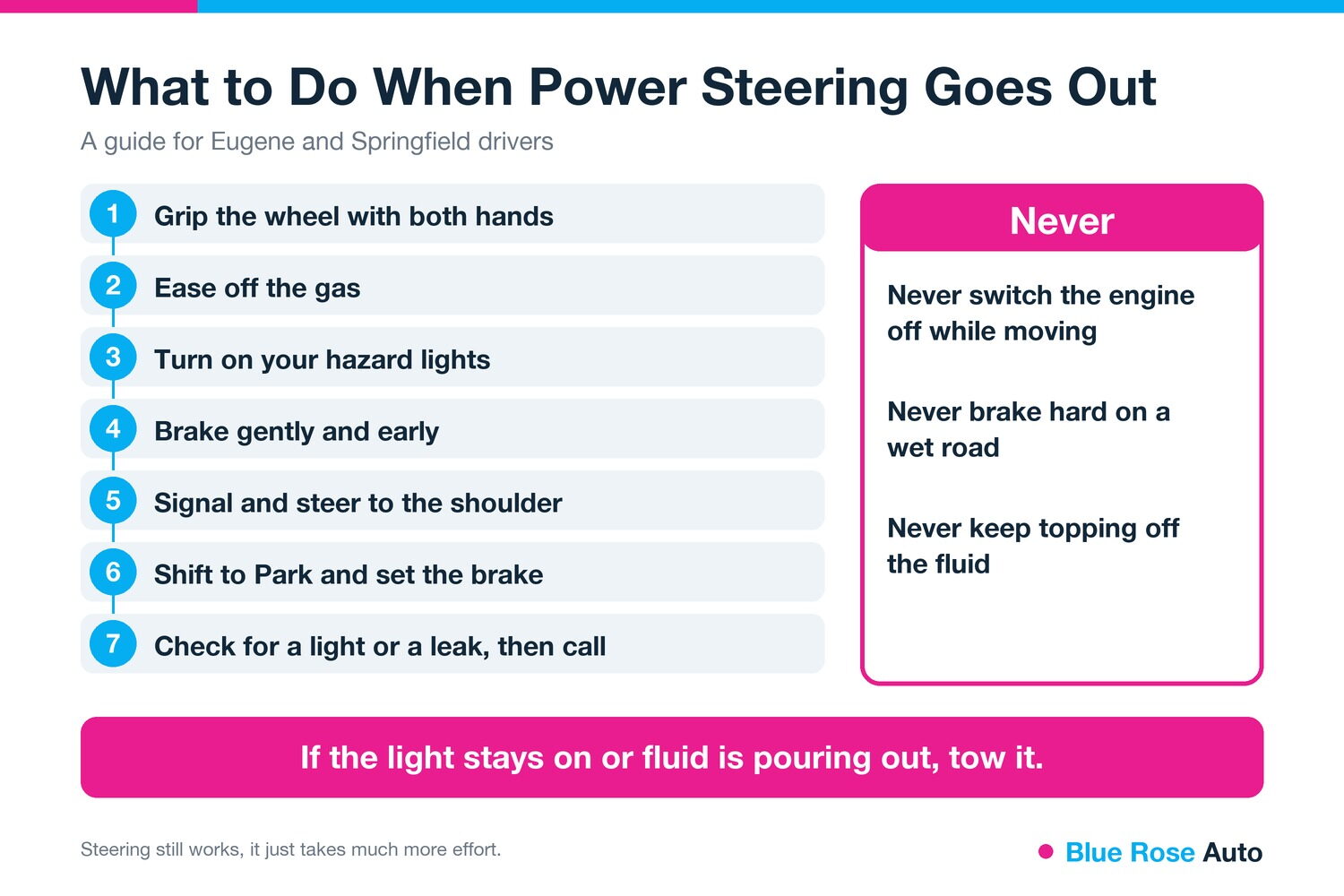
- Grip the wheel with both hands and keep the car pointed straight.
- Ease off the gas instead of stabbing the brake.
- Turn on your hazard lights so traffic knows something is wrong.
- Brake gently and early. If the engine stalled, the pedal can take more force, so leave extra room.
- Signal and steer to the shoulder or the nearest lot with wide, smooth turns.
- Shift to Park and set the parking brake once you have stopped.
- Check for a light or a leak, then call us or a tow company.
Once the car is parked, do not wrench the wheel from lock to lock. That strains the pump and the rack. It is safer to have the car towed or checked than to keep driving it, and the rest of this guide explains how to decide.
Three rules hold in every case.
- Never switch the engine off while moving.
- Never brake hard on a wet road.
- Never keep topping off the fluid.
If the light stays on or fluid is pouring out, tow it. Steering still works, it just takes much more effort.
If You Experience Power Steering Failure, You Should
If you experience power steering failure, you should grip the steering wheel firmly with both hands and keep steering until you can safely get off the roadway. The car stays steerable, but expect to use much more force at low speed. Slow down gradually, signal and stop where you are out of traffic.
Should You Turn the Engine Off
No, not while the car is moving. On a hydraulic car, a stalled engine takes the pump out of the picture, and brake feel can change too. Pull over first, shift to Park and set the brake. After that, check the dash and the ground under the front of the car. Your owner’s manual says what the maker wants you to do about a steering warning light.

Why Power Steering Can Stop Working Without Warning
Power steering relies on either hydraulic pressure or electric assist, and either one can drop out in a moment. On a hydraulic car, pressure disappears when a hose lets go, a seal gives way, the pump seizes or the belt slips off. Electric cars differ. Assist disappears when the motor, the control module, a sensor or a connector faults.
Drivers often describe the loss during a turn or while pulling into traffic, when the system works hardest. A weak part can hold up in easy driving and fail on a bump.
Hydraulic vs Electric Power Steering Failure
Most newer cars use electric assist, while older cars and some trucks still use a hydraulic pump. The two fail in different ways and leave different clues.
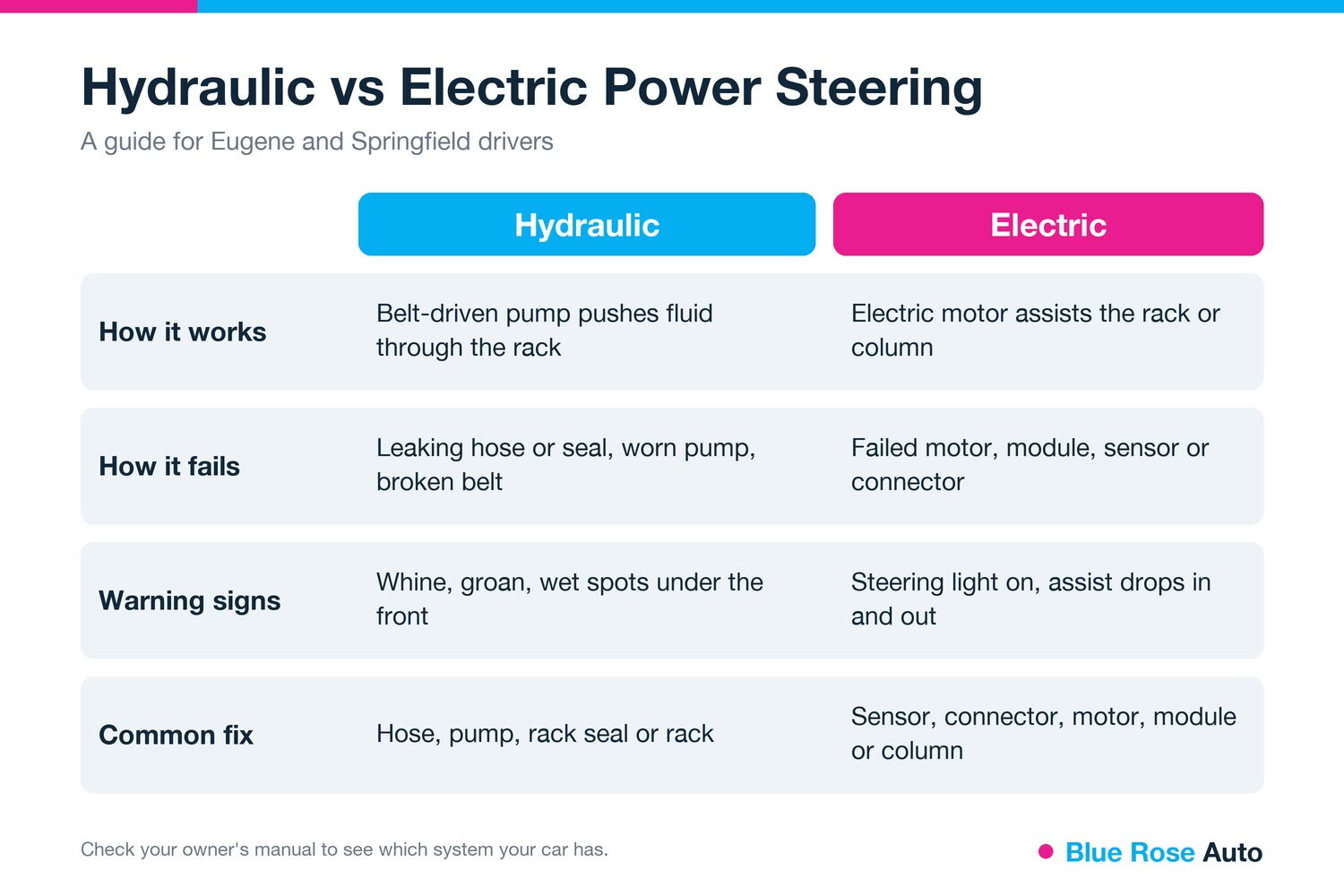
| Hydraulic power steering | Electric power steering | |
|---|---|---|
| How it works | Belt-driven pump pushes fluid through the rack | Electric motor assists the rack or column |
| How it fails | Leaking hose or seal, worn pump, broken belt | Failed motor, module, sensor or connector |
| Warning signs | Whine, groan, wet spots under the front | Steering light on, assist drops in and out |
| Warning light | Rarely | Often a steering wheel icon or an EPS message |
| What stops working | Assist, and sometimes a belt that also drives other parts | Assist only, since the steering stays mechanically connected |
| Common fix | Hose, pump, rack seal or rack | Sensor, connector, motor, module or column |
On an electric system, a steering wheel icon or an EPS message usually means the car found a fault. Many owner’s manuals say assist may be limited or stop while manual steering remains, with more force needed from you. Read yours to learn what the light means for your car, and book a scan if it stays on. Check your owner’s manual to see which system your car has. Hybrids use electric assist too, and we repair hybrids at the shop.
Power Steering Failure Symptoms at a Glance
How the failure feels and sounds points toward the cause. Match what you noticed to a tile, then check the table.
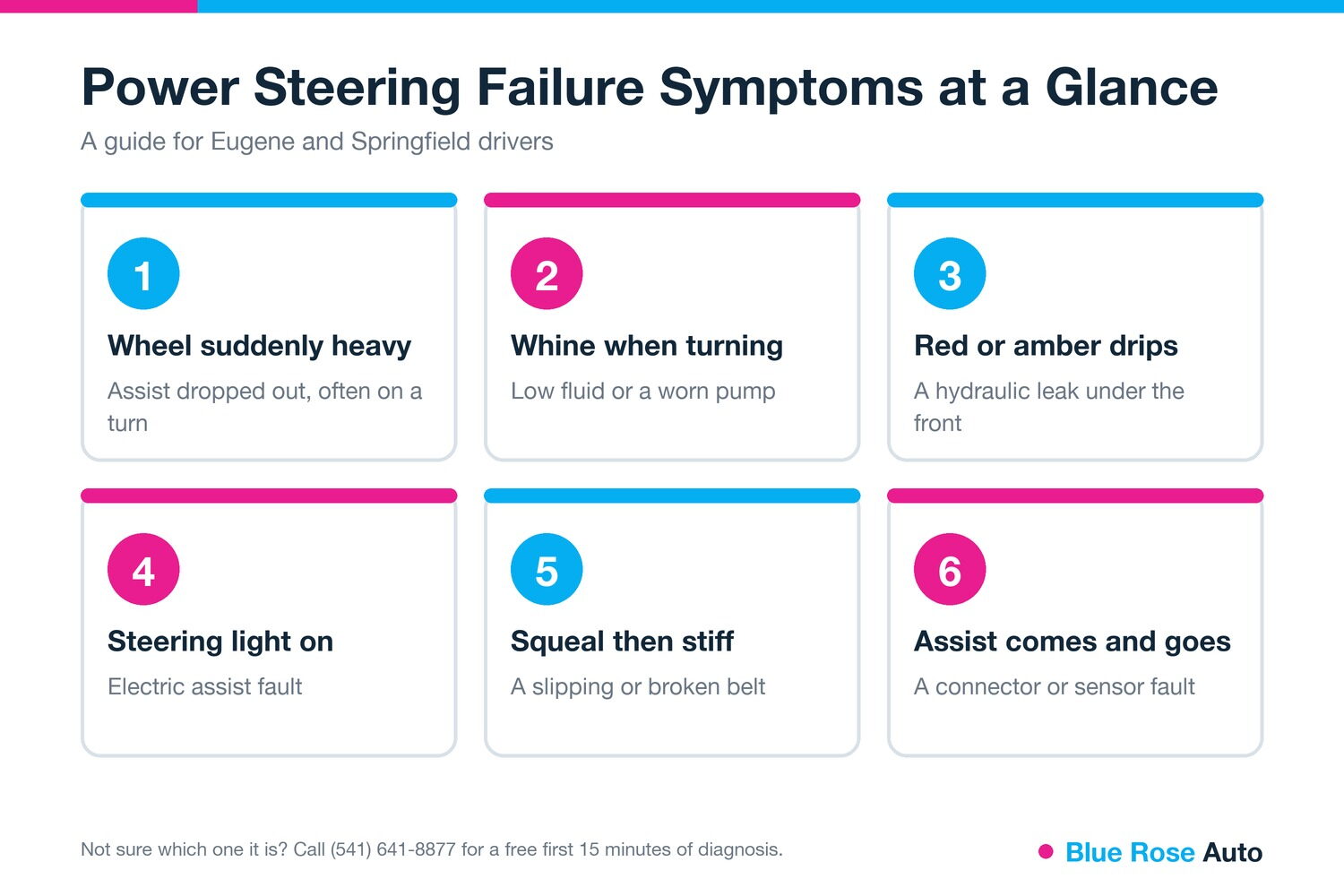
| What you notice | What it usually means | What to do next |
|---|---|---|
| Wheel suddenly heavy | Assist dropped out, often on a turn, from a lost electric assist or a broken belt | Slow down, signal, pull over and get it checked |
| Whine when turning | Low fluid or a worn pump | Check the fluid level when parked, then book a diagnosis |
| Red or amber drips | A hydraulic leak under the front | Do not keep topping off, and tow the car if the puddle is growing |
| Steering light on | Electric assist fault | Read your owner’s manual, then book a scan |
| Squeal then stiff | A slipping or broken belt | Stop, because the belt can drive other parts, and tow if it is gone |
| Assist comes and goes | A connector or sensor fault | Book a scan before it drops out for good |
| Steering heavy only when cold | Thick fluid or a weak pump or battery | Book a pressure and voltage test |
| Steering feels loose or has play | Worn rack, tie rods or joints | Stop driving and tow the car |
Not sure which one it is? Call (541) 641-8877 for a free first 15 minutes of diagnosis.
What Steering Feels Like When Assist Is Lost
The wheel feels heavy, and the car answers more slowly. Parking, backing up and tight turns take far more effort, which is why steering is hard to turn at low speed first. At highway speed the wheel can feel almost normal, and that false comfort is what tempts people to keep driving.
Why Does Power Steering Keep Going Out
When steering assist fails more than once, the first repair usually missed the root cause. Think of a slow leak that keeps draining the reservoir, a failing pump that keeps sending debris through the fluid, a weak connector or a low battery.
Topping off a leaking reservoir only sets up a repeat visit. We find where the fluid or the signal is going before we replace anything, so the repair holds.
What to Do When Power Steering Goes Out in Cold Weather
On a cold morning in Eugene or Springfield, steering that feels heavy until the engine warms up points to a system that is already weak. Fluid that has thickened, a tired pump or a battery with little to spare can all show up first in the cold. If it eases as the car warms up, the problem has not gone away. A winter prep checklist is a good time to have the battery and steering looked at before the wet months.
Immediate Checks After Steering Assist Fails
Once the car is parked safely, a few quick checks tell you what to do next. Look under the front of the car for drips. Power steering fluid can show as amber, pink or red. Look at the dash for a steering light, and listen for a whine or grinding when you turn the wheel.
Check the belt only with the engine off and the key out. A leak gets worse under pressure, and a pump that runs low wears out fast. If anything is off, such as a stalled engine, no steering response, a burning smell, smoke or grinding, stop and arrange a tow.
Common Causes of Power Steering Problems
Most steering failures trace back to a short list of causes, and each one belongs to the hydraulic or the electric side.
- A leaking hose, fitting or seal lets pressure and fluid escape on a hydraulic car.
- Low or dirty fluid makes the pump work harder and wear faster.
- A worn pump fails under load and can contaminate the whole system.
- A slipping or broken belt stops the pump from turning, and a failing drive belt can affect other parts it drives.
- A failed rack seal lets fluid leak inside the rack and gives an uneven feel.
- An electric motor or module fault removes assist with no fluid involved.
- A sensor or connector problem makes electric assist drop in and out.
- Low battery voltage can trip an electric steering system.
Power Steering Loss Is a Known Recall Category
Loss of assist is a documented safety recall category, so it is not always plain wear. Three NHTSA campaigns show the pattern.
- Campaign 14V719000 covers certain 2015 Chevrolet Silverado, Suburban and Tahoe and GMC Sierra and Yukon XL trucks. The notice says electric assist “may experience a sudden loss of power steering assist that could occur at any time while driving.” Steering control can be maintained, but it “would require greater driver effort particularly at low vehicle speeds, increasing the risk of a crash.”
- Campaign 10V073 covers 2005 to 2010 Chevrolet Cobalt and related models for a loss of assist from the electric power steering motor.
- Campaign 17V159000 covers certain 2017 Kia Niro vehicles with a damaged power steering connector.
You can enter your VIN at nhtsa.gov/recalls to check your own car.
What We Check During a Power Steering Inspection
When a steering complaint comes in, we work through the system in order, and the same checks apply to the steering and suspension parts we inspect and repair.
- Fluid level and condition. Low fluid reduces pressure and raises steering effort, and dark fluid points to heat and wear.
- Hoses and seals. We look for cracks and wet spots, because a small leak can turn into a sudden loss of assist.
- Drive belt condition. We check for glazing, looseness and cracks that keep the pump from turning.
- Pump performance. We listen for whine and run a pressure test when a pump or rack is suspected.
- Steering rack condition. We look for internal leaks and binding that leave an uneven steering feel.
- Electrical components. We scan for steering codes and test the motor circuit, the sensors, the connectors and the battery and charging voltage.
- Tires and tie rods. We check the parts that carry the load, since wear there can feel like an assist problem.
Is It Safe to Drive With No Power Steering
It is controllable but not safe for ordinary driving. Steering takes much more force at low speed, and whatever failed can get worse at any moment. Our default advice is a tow.
Tow the car if the steering light stays on and the wheel is very heavy, fluid is pouring out, you hear grinding or smell burning, the engine stalled, the wheel feels loose, or the trip would put you on I-5 or Beltline. Roads that are wet or busy make the case for a tow stronger.
A short, slow trip is a judgment call if the car steers with only some assist missing, the fluid level looks fine and nothing is leaking, and you can stay on quiet side streets. We still recommend a tow rather than a drive, and in the wet or in traffic we will tell you to tow.
Why Driving Without Power Steering Causes Damage
Driving without assist puts extra strain on the pump and the rack, and it makes the tires scrub harder in turns. Tie rods and other front-end parts can wear faster under that extra load, so a steering problem can grow into a suspension and tire problem.
An alignment check usually follows steering work so the front end is set correctly. If you wonder how that differs from a front-end check, we explain alignment and front-end alignment separately.
What Power Steering Repair Costs
The chart below, titled Typical National Costs for Power Steering Repairs, runs from about $100 for a return hose to $2,420 for a rack and pinion. These are national guide ranges from Sunbit, September 2025. We quote the exact price after diagnosis.
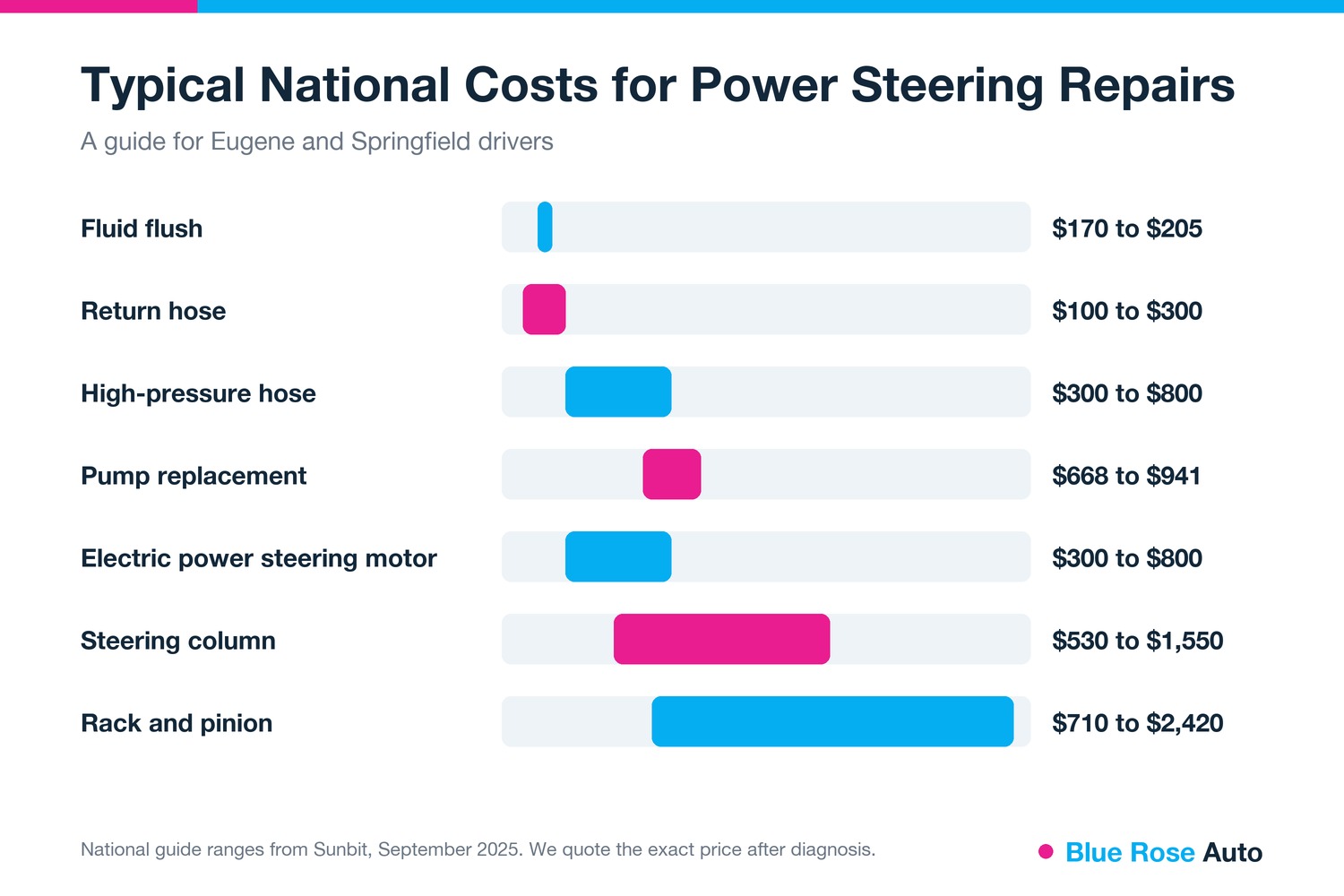
| Repair | Typical national range | Note |
|---|---|---|
| Fluid flush | $170 to $205 | Shop price, and DIY fluid runs $10 to $50 |
| Return hose | $100 to $300 | Installed |
| High-pressure hose | $300 to $800 | Installed |
| Pump replacement | $668 to $941 | Parts $460 to $595 and labor $207 to $304 on most vehicles |
| Electric power steering motor | $300 to $800 | Parts and labor |
| Steering column | $530 to $1,550 | Parts and labor |
| Rack and pinion | $710 to $2,420 | The costliest steering job, since it can mean dropping the subframe |
These ranges do not factor in local labor, and larger SUVs and luxury models cost more. Our first 15 minutes of diagnosis are free, then it is $100 an hour, and we credit that time to the repair when you approve it. We also explain how repair prices add up across the bigger jobs we see.
Preventing Power Steering Failure
Routine checks catch most problems early. On a hydraulic car, look at the fluid level and color now and then, and have the belt inspected. Listen for a whine when you turn, and fix small leaks early.
Avoid holding the wheel at full lock for long, since that loads the pump. On an electric car, keep the battery healthy, because low voltage can trigger steering faults.
Repair Options Based on System Design
Hydraulic systems usually need a hose, a pump, a rack seal or a rack, and often a fluid flush. Electric systems call for a sensor, a connector, a motor, a module or a column. Accurate diagnosis keeps us from replacing parts that were never the problem, and we repair steering and suspension parts with a 3-year, 36,000-mile warranty on the repair.
Long-Term Risks of Ignoring Steering Issues
Ignoring a steering problem raises safety risk, because you need steering control in an emergency swerve or a lane change. Wear can spread into the suspension and tires, and bills grow with it.
Power Steering and Local Oregon Driving Conditions
Driving in Eugene and Springfield means frequent stops, tight turns and parking maneuvers, which is where assist matters most. Runs out to Cottage Grove or Junction City on two-lane roads make a roadside stop harder to find. Wet roads cut traction. A heavy wheel feels worse in the rain.
If assist fails on I-5 or Beltline, signal early, move to the shoulder and call for a tow. Blue Rose Auto repairs steering for drivers across Eugene, Springfield, Junction City, Veneta, Cottage Grove and Lowell, and our shop is at 3436 Olympic St in Springfield.
How We Diagnose and Repair Steering at Blue Rose Auto
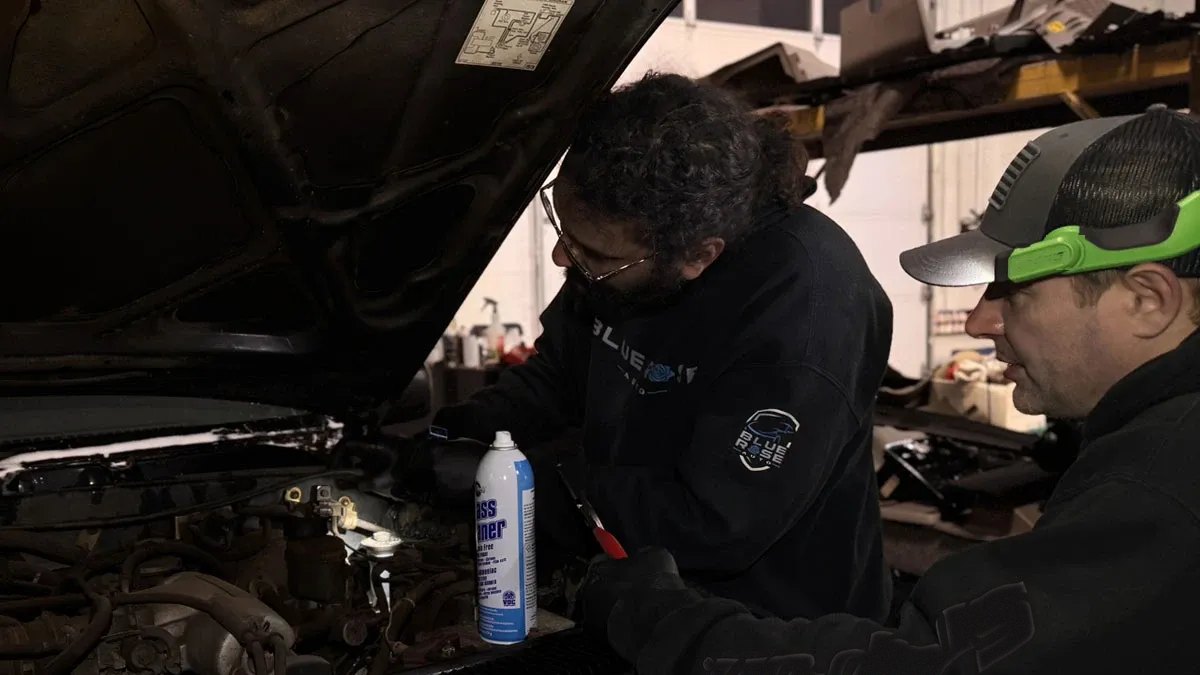
Guessing leads to repeat visits. Our ASE-certified technicians follow a set order, and our diagnosis and scan work covers both hydraulic and electric systems.
- We ask what happened, whether the loss was sudden or gradual, and whether you noticed a whine, a light, a leak or a stalled engine.
- We scan for steering codes, because electric systems log them.
- We check the fluid level and condition and look for leaks at the hoses, the pump, the rack and the fittings.
- We inspect the drive belt for wear, glazing, looseness or a break.
- We pressure-test the hydraulic system when a pump or a rack is suspected.
- We test the electric motor circuit, the sensors, the connectors and the battery and charging voltage.
- We inspect the rack, tie rods, column joints and tires for binding or wear.
- We quote the repair, credit the diagnostic time (free for the first 15 minutes, then $100 an hour) to the repair once you approve it, and cover the work with our 3-year, 36,000-mile warranty.
Frequently Asked Questions About Power Steering Problems
What should you do when power steering goes out while driving?
Grip the wheel with both hands, ease off the gas, turn on your hazard lights, brake gently and steer to the shoulder. The car can still be steered, but it takes far more effort at low speed. Do not switch the engine off while the car is moving. Once you are stopped, it is safer to have the car towed or checked than to keep driving.
Why did my power steering suddenly stop working?
A sudden loss usually points to a broken belt, a fast fluid leak or a failed pump on a hydraulic car, or a motor, module, sensor or connector fault on an electric one. Low battery voltage can also trip an electric system. A scan and a pressure test tell us which one you have.
Is it safe to drive without power steering?
It is controllable but not safe for ordinary driving. Steering takes much more force at low speed, and the cause can get worse without warning. If the steering light stays on, fluid is leaking or the engine stalled, we recommend a tow rather than a drive. Never take a car with no assist onto I-5 or Beltline.
What causes power steering to go out?
Hydraulic cars lose assist from a leak, low or dirty fluid, a worn pump or a slipping or broken belt. Electric cars lose it from a failed motor, module, sensor or connector. Federal recall notices show that electric assist faults also happen on some models without any wear, so check your VIN at nhtsa.gov/recalls.
Why does my power steering keep going out?
Repeat failures usually mean the root cause was never fixed. A slow leak, a pump that sent debris through the system, a loose connector or a weak battery can each bring the problem back. Topping off the fluid hides a leak without repairing it, so the next failure tends to come quickly and cost more.
Can I turn the engine off to reset the power steering?
Not while you are moving. A stalled engine removes pump assist on a hydraulic car and can make the brakes feel heavier. Pull over safely first, shift to Park and set the brake. Your owner’s manual explains what your car’s steering warning means, and a light that returns calls for a scan.
Why is my power steering hard to turn when it is cold?
Cold weather exposes a system that is already weak, such as low fluid, a tired pump or a battery with little to spare. If steering eases as the car warms up, the underlying problem is still there. We run a pressure and voltage test so the failure does not happen on a cold morning.
Can low power steering fluid damage the pump?
Yes. Running low can make the pump overheat and wear, and the debris it sheds can spread to the rack. If the level keeps dropping or you hear a whine when you turn, book a diagnosis instead of topping off again and again. A leak found early is a far smaller repair than a pump and rack.
How much does power steering repair cost?
National guides put a pump at $668 to $941, an electric steering motor at $300 to $800 and a rack and pinion at $710 to $2,420 (Sunbit, September 2025). We quote the exact price after diagnosis. Our first 15 minutes of diagnosis are free, then it is $100 an hour, credited to an approved repair.
How do I know whether my car has hydraulic or electric power steering?
Check the owner’s manual, or look under the hood for a power steering fluid reservoir and a belt-driven pump. Most newer cars have electric assist with no reservoir or pump, while older cars and some trucks use hydraulics. We can tell you within the first minutes of a visit.
Schedule Power Steering Service With Blue Rose Auto
Blue Rose Auto repairs power steering pumps, racks and electric assist motors at 3436 Olympic St in Springfield, and we tell you whether the cause is the pump, the rack, a belt, a connector or just low fluid. You can book through blueroseauto.com or call (541) 641-8877. If your steering has gone heavy and the car is not safe to drive, call us, and arrange a tow for the car.
Sources
- NHTSA, owner notification letter for recall campaign 14V719000, November 2014
- NHTSA, recall report for campaign 10V073, 2010
- NHTSA, recall lookup by VIN, campaign 17V159000 for the 2017 Kia Niro
- Sunbit, Power Steering Repair Cost Complete Price Breakdown, September 2025

0 Comments