Last reviewed in October 2026. Statutes checked against ORS chapter 746, 2025 Edition. General information, not legal advice.
In Oregon, your insurer can’t make a body shop install an aftermarket crash part without your consent unless an independent test facility has certified it as at least equivalent in fit, finish, function and corrosion resistance (ORS 746.287). The law doesn’t require insurers to pay for OEM parts, though. Your policy’s parts language decides that.
So the OEM vs aftermarket parts insurance claim question has two halves. The statute sets what an insurer may require, and your policy sets what it pays for. We cover both below, plus how to spot non-OEM parts on your estimate.
This is general information about Oregon law, not legal advice. For a dispute about your claim, contact the Oregon Division of Financial Regulation or a licensed Oregon attorney.
If you’re still sorting out your coverage, start with what collision coverage pays for in Oregon.
What’s on your estimate, OEM, aftermarket or recycled?
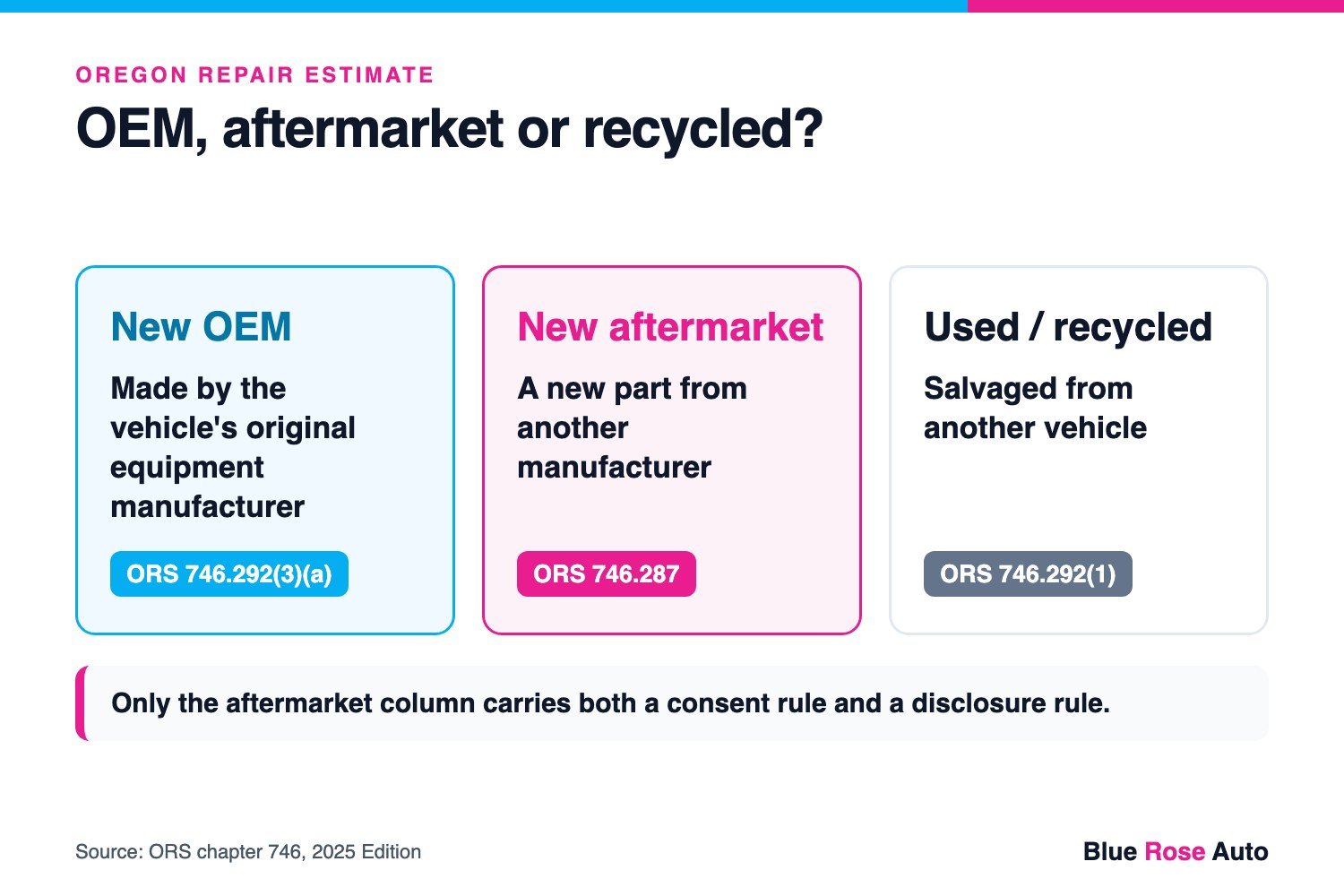
An Oregon repair estimate can list three kinds of replacement parts. OEM parts come from the company that built your car, while new aftermarket parts come from another manufacturer and used or recycled parts come off another vehicle. Oregon treats each one differently. An insurer may write any of the three.
Why pick anything but OEM? Cost. The Oregon Division of Financial Regulation (DFR) says insurers “can opt for aftermarket or recycled parts instead, as a way to help keep your premium costs down.” That isn’t a scandal. It’s a pricing trade-off, and the regulator says so openly.
Here are the three part types on an Oregon estimate and the rule attached to each.
| New OEM | New aftermarket | Used / recycled | |
|---|---|---|---|
| Who makes it | The original equipment manufacturer | Another manufacturer (“not supplied by the original equipment manufacturer” under ORS 746.292(5)) | Taken from another vehicle |
| Oregon rule | Warranty that it meets or exceeds OE manufacturing standards (ORS 746.292(3)(a)) | Can’t be required without your consent unless certified at least equivalent by an independent test facility (ORS 746.287) | Invoice must “clearly state” used parts (ORS 746.292(1)); no used parts where new were to be supplied (ORS 746.292(4)(a)) |
| Estimate flag | None required | Fixed statement (ORS 746.292(3)(b)); each part identified (OAR 836-080-0240(11)) | Shown as used on the invoice |
Only the aftermarket column carries both a consent rule and a disclosure rule. That’s the one worth reading slowly.
| Term on the estimate | What it means |
|---|---|
| OEM | Made by the vehicle’s original equipment manufacturer |
| Aftermarket (often “A/M”) | A new part from another manufacturer |
| Certified | Tested by an independent test facility as at least equivalent. The statute names no certifier, and the Certified Automotive Parts Association (CAPA), a nonprofit founded in 1987 (Wikipedia), is one example |
| LKQ | Insurance shorthand for “like kind and quality,” and also the name of a parts company |
| Recycled / used | Salvaged from another vehicle |
Can your insurer make you use aftermarket parts in Oregon?
Not uncertified ones, unless you agree. ORS 746.287 has two subsections. The first says that without the owner’s consent, an insurer may not require, “directly or indirectly,” that a body shop supply or install an aftermarket crash part unless an independent test facility has certified it as “at least equivalent” to the part being replaced. Subsection (2) defines equivalent as the same kind of part, at least the same quality in “fit, finish, function and corrosion resistance.” Oregon has had this rule since 1987 (history note 1987 c.622 §3). The term “aftermarket crash part” is defined in a different section, ORS 746.292(5), and covers visible exterior sheet metal or plastic panels the original equipment manufacturer didn’t supply. Shops get a matching rule in ORS 746.292(4)(b). What the statute does not do is make your insurer pay for OEM. The source is ORS chapter 746, 2025 Edition, as published on oregon.public.law.
The full text comes from the official text of ORS 746.287.
(1) Without the consent of the owner of the vehicle, an insurer may not require, directly or indirectly, that a motor vehicle body and frame repair shop supply or install any aftermarket crash part unless the part has been certified by an independent test facility to be at least equivalent to the part being replaced.
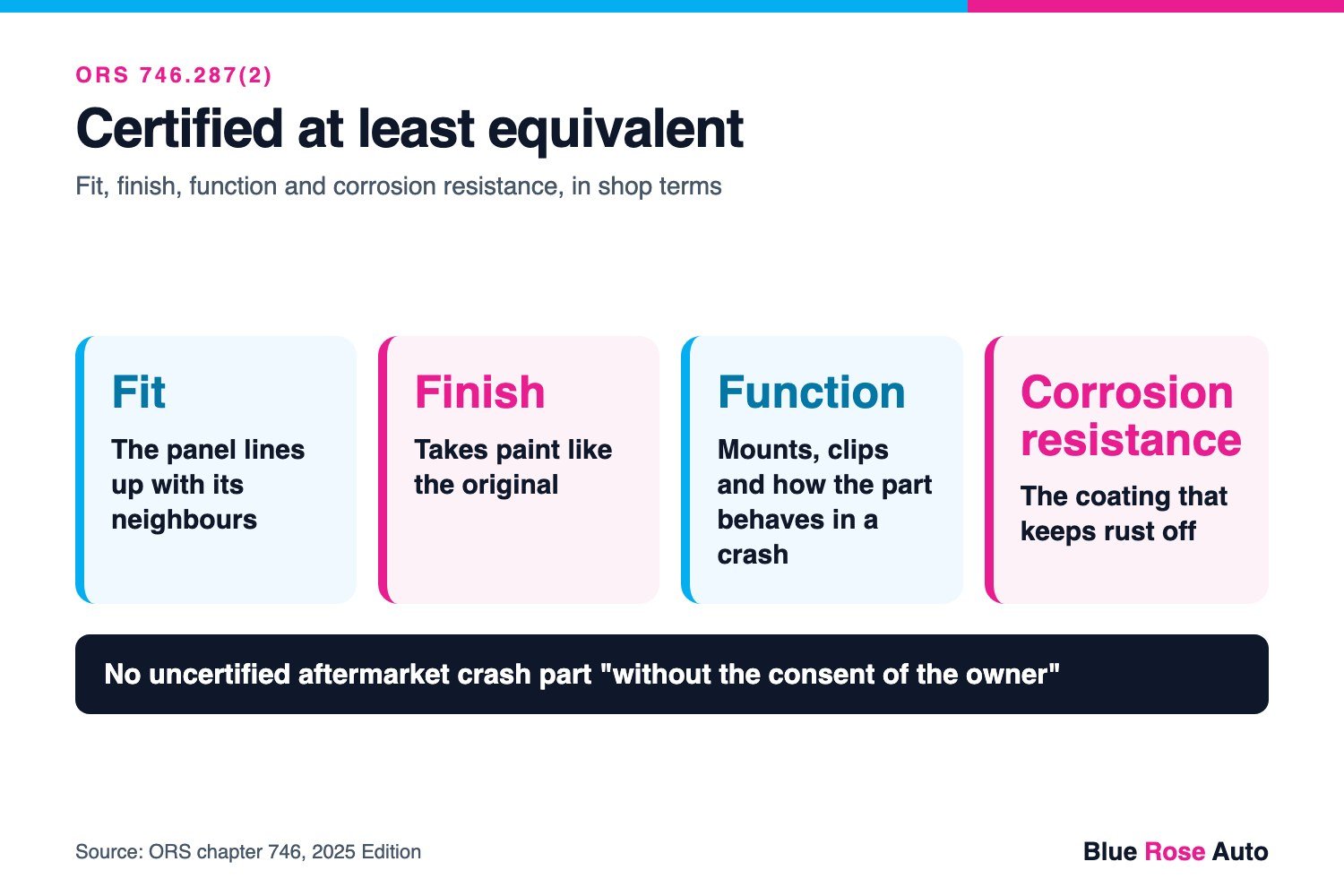
(2) For purposes of this section, an aftermarket crash part is at least equivalent to the part being replaced if the aftermarket crash part is the same kind of part and is at least the same quality with respect to fit, finish, function and corrosion resistance.
In shop terms, fit means the panel lines up with its neighbours. Finish is whether the surface takes paint like the original. Function covers mounts, clips and how the part behaves in a crash, and corrosion resistance is the coating that keeps rust off. That’s a description of the words, not a legal test, and the statute doesn’t say how a facility measures any of them.
What consent means in practice
Consent belongs to the vehicle’s owner. Usually it happens quietly, when you sign off on an estimate that already lists non-OEM parts. So read the lines first. If nobody can tell you an aftermarket part is certified, you can decline it, and the shop is bound by the same rule under ORS 746.292(4)(b).
| Rule | What it says | At the estimate |
|---|---|---|
| ORS 746.287(1) | No uncertified aftermarket crash part “without the consent of the owner” | You can decline uncertified parts |
| ORS 746.287(2) | Equivalent in “fit, finish, function and corrosion resistance” | The four tests a certified part must meet |
| ORS 746.292(5) | Defines aftermarket crash part as a visible exterior sheet metal or plastic panel | Bumper covers, fenders, hoods, doors, quarter panels |
| ORS 746.292(3)(b) | Fixed statement on any estimate using non-OEM crash parts | Look for it |
| ORS 746.292(4)(b) | Same consent rule for the shop | The shop is bound too |
| ORS 746.289 | Warranty available “when the insured requests one” | Ask for it |
| OAR 836-080-0240(11) | Each non-OEM part identified; copy to the claimant | Every part is listed |
Sources are ORS chapter 746, 2025 Edition (ORS 746.292, ORS 746.289) and OAR 836-080-0240 (Oregon Administrative Rules, text via OregonLaws).
Which parts does Oregon’s aftermarket rule cover?
Exterior panels, and not everything else. ORS 746.292(5) limits “aftermarket crash part” to visible exterior sheet metal or plastic that usually gets repaired or replaced after a collision and wasn’t supplied by the original equipment manufacturer.
“As used in ORS 746.287 and this section, ‘aftermarket crash part’ means a motor vehicle replacement part, sheet metal or plastic, that constitutes the visible exterior of the vehicle, including an inner or outer panel, is generally repaired or replaced as the result of a collision and is not supplied by the original equipment manufacturer.”
These parts clearly fit that wording.
- Bumper covers
- Fenders
- Hoods
- Doors, including door skins
- Quarter panels
Mechanical parts aren’t described. A radiator or a suspension arm isn’t visible exterior sheet metal or plastic.
Two grey areas the statute doesn’t settle
Lamps are one. CAPA has a lighting standard (CAPA 301), but the statute speaks of exterior sheet metal or plastic. The other is a recycled panel the OEM originally made, since the definition says “not supplied by the original equipment manufacturer.” The statute doesn’t address either directly. Ask your adjuster how your estimate treats it.
Does your insurer have to pay for OEM parts?
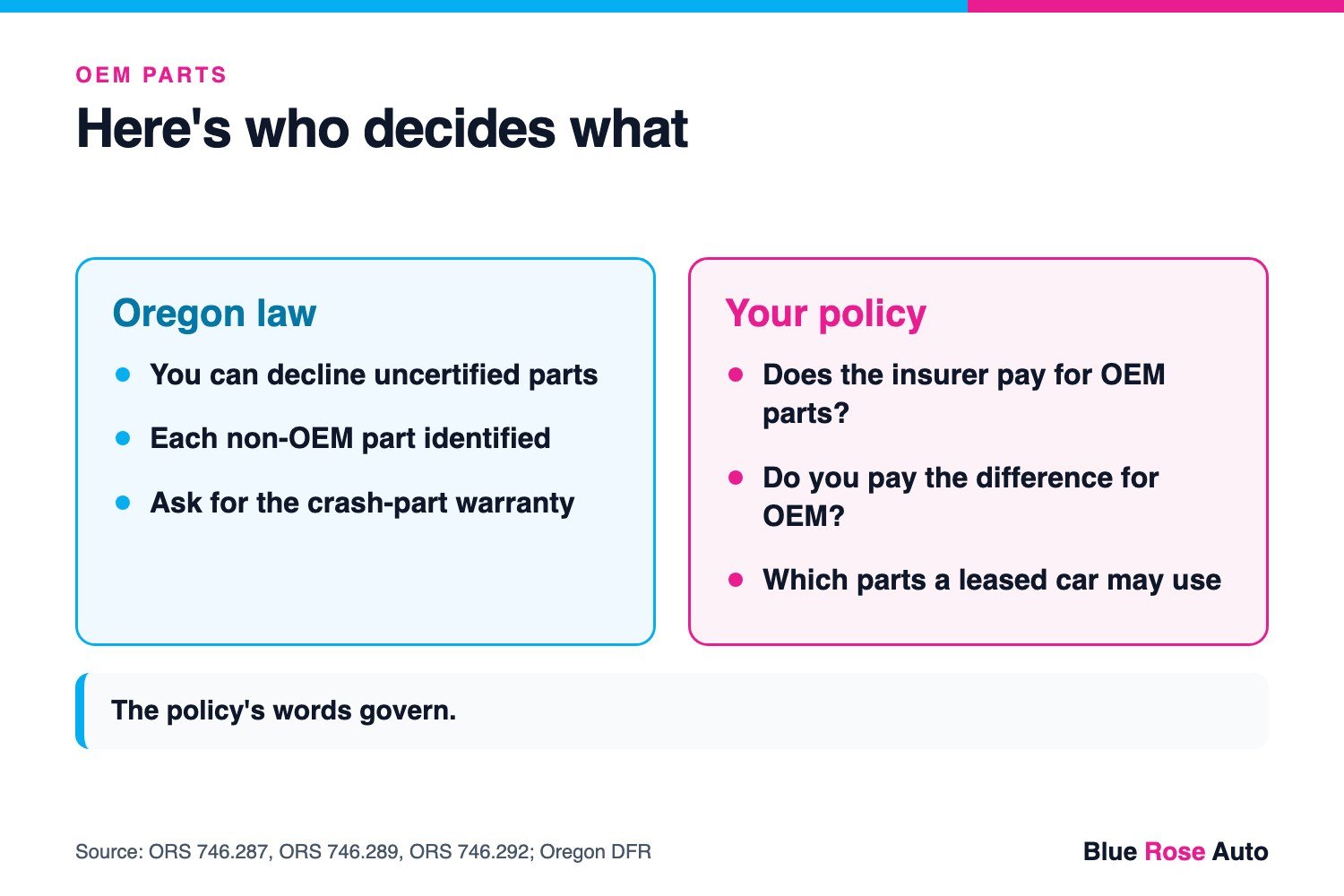
No. Oregon’s Division of Financial Regulation says insurers “can opt for aftermarket or recycled parts instead.” The statute’s protection is about consent and certification, not payment. Whether OEM is paid for depends on your policy, and some insurers sell an OEM endorsement for that.
The DFR’s full answer reads as follows.
“Does the insurance company have to pay for new factory parts to fix my car? Actually, no. Insurance companies can opt for aftermarket or recycled parts instead, as a way to help keep your premium costs down. For your protection, Oregon law requires that aftermarket parts be certified equivalent to factory parts by an independent testing facility.”
ORS 746.280(3) points the same way. If you choose a shop the insurer didn’t recommend, the insurer “may not limit the cost of repairs necessary to return the motor vehicle to a preloss condition relative to safety, function and appearance other than as stated in the policy or as otherwise allowed by law.” Notice the qualifier. The policy’s words govern.
The table below shows who decides each question.
| Question | Decided by | Source |
|---|---|---|
| Can the insurer require uncertified aftermarket crash parts without your consent? | Oregon law says no | ORS 746.287 |
| Must non-OEM crash parts be disclosed? | Oregon law says yes | ORS 746.292(3)(b); OAR 836-080-0240(11) |
| Is a non-OEM crash part warranty available? | Oregon law says yes, on request | ORS 746.289 |
| Does the insurer pay for OEM parts? | Your policy and any OEM endorsement | DFR and ORS 746.280(3) |
| Do you pay the difference for OEM? | Your policy | Policy terms |
| Which parts a leased car may use | Your lease | Lease agreement |
Statute fixes the top three rows. The bottom three change from policy to policy, so your declarations page beats any blog post, this one included.
OEM endorsements and their limits
Some insurers sell an add-on that pays for original parts, often called an OEM endorsement. Terms differ by company and by state. Some limit it to newer vehicles, some require comprehensive and collision coverage, and some don’t guarantee OEM parts in every repair. Ask your agent for the endorsement’s written terms before you rely on it.
Paying the difference
If your policy pays for aftermarket parts and you want OEM, you may be asked to cover the price gap between the two. Get both prices in writing first, and ask the insurer to put in writing what it will pay.
Leased car? Check the lease
A lease agreement can specify which type of parts may be used in repairs. Read it before you approve a non-OEM estimate.
How to spot aftermarket parts on your estimate
Look for a fixed statement. Under ORS 746.292(3)(b), any Oregon estimate based on a crash part not made by the original equipment manufacturer must say so, warn that it may invalidate remaining OEM warranties on that part, and offer a copy of the part warranty. OAR 836-080-0240(11) also requires each such part to be identified.
The statute requires this wording.
“This estimate has been prepared based on the use of a motor vehicle crash part not made by the original equipment manufacturer. The use of a motor vehicle crash part not made by the original equipment manufacturer may invalidate any remaining warranties of the original equipment manufacturer on that motor vehicle part. The person who prepared this estimate will provide a copy of the part warranty for crash parts not made by the original equipment manufacturer for comparison purposes.”
The rule adds that the estimate “shall identify each such part in a clearly understandable manner.” On a real estimate, non-OEM panels usually sit on their own line items, often with an abbreviation such as A/M or a note like LKQ or recycled beside the part name. Abbreviations vary by estimating system, so a blank doesn’t prove OEM.
Work through these six steps.
- Get the written estimate. OAR 836-080-0240(11) gives the claimant a copy, and under ORS 746.292(2) a shop must write one on request before work starts and can’t charge more without your consent.
- Find the fixed statement. Any non-OEM crash part means the ORS 746.292(3)(b) wording belongs on the page.
- Mark every non-OEM line. Note the part and its abbreviation.
- Ask about certification. Which independent test facility certified each aftermarket crash part?
- Check for used parts. The invoice must “clearly state” them (ORS 746.292(1)), and new can’t quietly become used (ORS 746.292(4)(a)).
- Confirm what the insurer pays before you sign. DFR advises you to confirm the payout. Its words are “Before you sign a contract with the repair shop, notify your insurer and make sure you understand what the insurance company will pay.” It helps to know what to expect once your car is in the shop, too.
Ask for the crash-part warranty (ORS 746.289)
ORS 746.289 says an insurer that covers repairs “shall make available” a crash part warranty for non-OEM crash parts “when the insured requests one.” It isn’t automatic. If your estimate uses non-OEM panels, ask your insurer for that warranty in writing, and ask the estimate’s preparer for the part warranty copy the estimate statement promises.
“Any insurer which offers a motor vehicle insurance policy that provides coverage for repair of the vehicle shall make available to its insured a crash part warranty for crash parts not made by the original equipment manufacturer as described in ORS 746.292 when the insured requests one.”
OEM parts carry their own promise. Under ORS 746.292(3)(a) they come with a warranty that they “meet or exceed standards used in manufacturing the original equipment.”
Some write-ups say insurers must hand you the non-OEM warranty. They don’t have to until you ask. Keep it with your repair invoice.
Do aftermarket collision parts void your car’s warranty?
Not the whole warranty. Federal and Oregon law each cover a different layer.
In an April 10, 2018 release, the Federal Trade Commission said that requiring specified parts to keep a warranty is a problem. In its words, “Unless warrantors provide the parts or services for free or receive a waiver from the FTC, such statements generally are prohibited by the Magnuson-Moss Warranty Act.” So a non-OEM fender generally shouldn’t, by itself, void your car’s whole warranty.
Oregon’s estimate statement is narrower. It warns that a non-OEM crash part “may invalidate any remaining warranties of the original equipment manufacturer on that motor vehicle part.” So the OEM coverage on that one panel can go.
Your car’s overall warranty generally survives. The part’s OEM warranty may not, which is exactly why the ORS 746.289 warranty is worth requesting.
What if your estimate uses parts you didn’t agree to?
Start with the adjuster, in writing, and climb the ladder only if you need to. Oregon gives you a regulator to call and the statutes define what a violation is, but none of this predicts how a dispute ends.
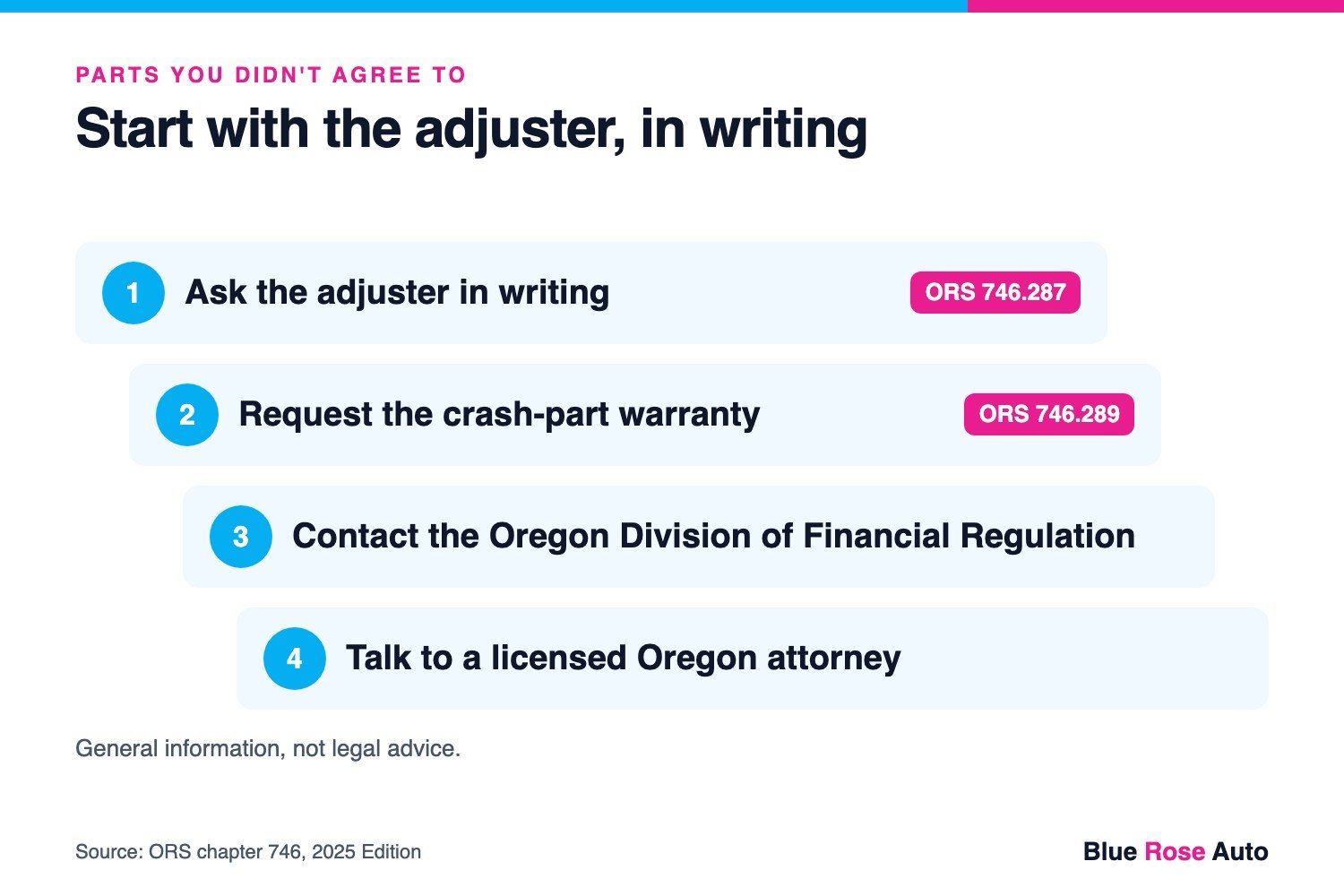
- Ask the adjuster in writing which parts are non-OEM and whether each aftermarket crash part is certified, citing ORS 746.287.
- Request the crash-part warranty under ORS 746.289.
- Contact the Oregon Division of Financial Regulation if the insurer’s conduct still seems wrong. File a complaint online, call the Consumer Hotline at 888-877-4894, or email DFR.InsuranceHelp@dcbs.oregon.gov.
- Talk to a licensed Oregon attorney for advice on your specific claim.
Under ORS 746.991, “Violation of ORS 746.280 to 746.292 is a Class D violation.” ORS 153.018 caps a Class D fine at $250 for an individual and $500 for a corporation. ORS 746.300 lets people file an action over violations of ORS 746.280, 746.290 and 746.292. It does not list ORS 746.287. Insurers keep room to work the claim, too. ORS 746.295 preserves their right to investigate and determine the loss and negotiate the repair.
This is general information about Oregon law, not legal advice. For a dispute about your claim, contact the Oregon Division of Financial Regulation or a licensed Oregon attorney.
What a body shop checks on a replacement panel
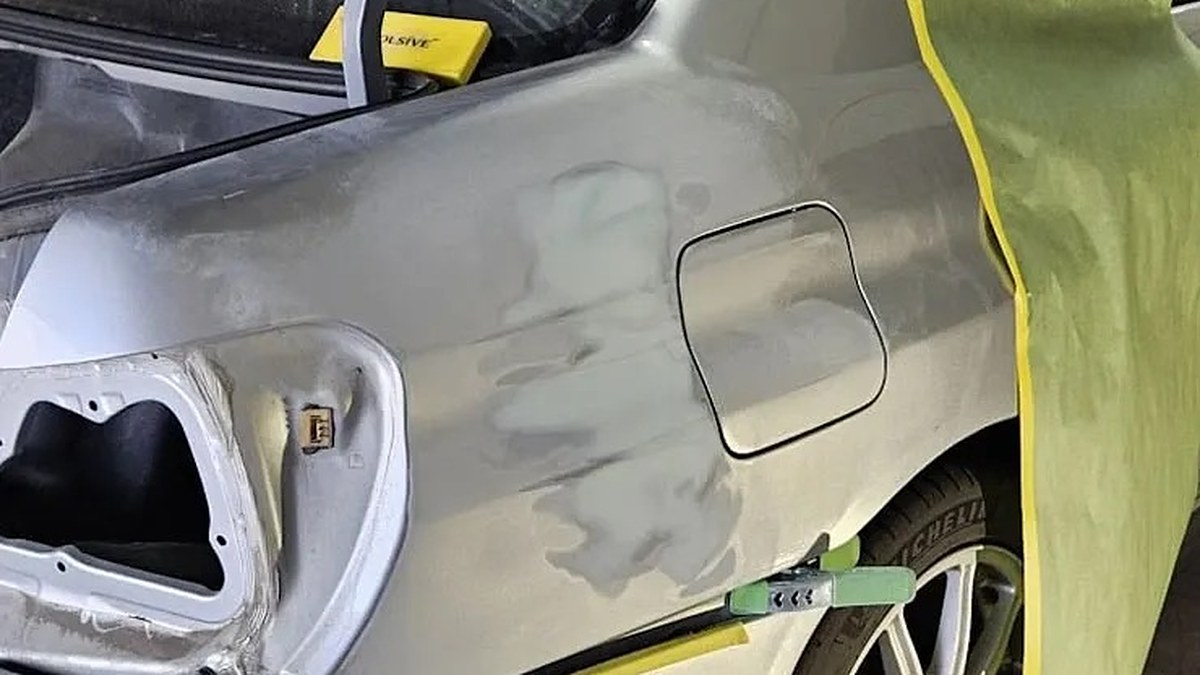
The statute’s four words match what we look at on any panel job, whatever the part’s source. When a replacement fender or bumper cover goes on, we line it up with the panels around it and check the gaps against the factory lines so the doors and hood close the way they should. After that come the mounting points and clips, how the panel takes primer and paint, and corrosion protection on bare edges before the car heads back into an Oregon winter.

Blue Rose Auto opened in 1994, and our ASE-certified technicians in Springfield handle everything from a single fender to structural work. We give you a written estimate and tell you if it changes. Our collision repairs carry a 3-year/36,000-mile warranty. Blue Rose Auto is also a Tesla Approved Body Shop for collision and structural repair. We repair Tesla collision damage too. We handle panel replacement and collision repair for Eugene drivers and run a full auto body and collision repair shop. If you have an estimate with non-OEM lines, call us and we will walk through what each line means for the repair.
Frequently asked questions
Does insurance have to pay for OEM parts in Oregon?
No general Oregon law requires it. The Division of Financial Regulation says insurers can opt for aftermarket or recycled parts, and under ORS 746.287 an uncertified aftermarket crash part needs your consent. Your policy and any OEM endorsement decide who pays for original parts. The policy section above has the detail.
Can I pay the difference to get OEM parts?
Often, yes, if your policy doesn’t cover OEM. Many policies pay only the aftermarket price, so you may be asked to cover the gap. Ask the insurer to put in writing the price it will pay, ask the shop for the OEM price, and compare the two before you agree.
Is CAPA certified the same as OEM?
No. CAPA is a nonprofit, founded in 1987, that certifies aftermarket parts against its own standards, so a CAPA part is still aftermarket. Oregon’s statute doesn’t name CAPA. It requires certification by “an independent test facility” that the part is at least equivalent in fit, finish, function and corrosion resistance.
Can my insurer use used or recycled parts on my car?
Generally, yes. The Oregon DFR says insurers “can opt for aftermarket or recycled parts.” Oregon shops must clearly state used parts on the invoice under ORS 746.292(1), and ORS 746.292(4)(a) bars installing used parts where new ones were to be supplied. Check your estimate and your policy.
Does it change anything if the other driver’s insurer is paying?
ORS 746.287 refers to “an insurer” and the vehicle’s “owner,” with no first-party limit in its text. Whether the other driver’s insurer pays for OEM still depends on the claim, and how these rules apply to a third-party claim is a question for the Oregon DFR or a licensed attorney, not a blog post.
What does “like kind and quality” mean on an estimate?
It’s insurance shorthand for a replacement part of similar type and quality, often used and sometimes aftermarket. LKQ is also the name of a big parts company, which confuses things, so ask the adjuster what the line means for each part on your estimate. The definitions table near the top covers other common terms.
Is OEM coverage worth it?
That depends on your car, your lease and your budget. Terms vary a lot, and some endorsements limit vehicle age or don’t guarantee OEM parts when they’re unavailable. Ask your agent for the cost and the written terms, then compare it with what a typical aftermarket-versus-OEM price gap would be on your car.
How do I know if my estimate uses aftermarket parts?
Look for the fixed statement Oregon requires on any estimate that uses a crash part not made by the original manufacturer, and for each non-OEM part to be identified on its own line. Abbreviations like A/M vary by estimating system, so ask the shop or adjuster to explain every line you don’t recognize.
Where do I complain if my insurer ignores Oregon’s parts rules?
Start with the adjuster in writing, then contact the Oregon Division of Financial Regulation. You can file a complaint online or call its Consumer Hotline at 888-877-4894. For advice on a specific claim, talk to a licensed Oregon attorney, because a blog post can’t tell you how your dispute will end.
Questions about the parts on your estimate?
Blue Rose Auto is at 3436 Olympic St, Springfield, with ASE-certified technicians and a shop that opened in 1994. Call (541) 641-8877 with your estimate questions, contact us online, or schedule collision repair.
0 Comments