Why do mechanics charge a diagnostic fee? Because the fee pays for a technician’s time to confirm what is actually wrong, not for plugging in a scanner. A trouble code only says which system flagged a problem. Finding the failed part takes tests and labor, and in Oregon a shop needs your separate OK before evaluation work over $200. At Blue Rose Auto in Springfield, the first 15 minutes of diagnosis are free, then diagnosis runs $100 an hour, and we credit that charge to an approved repair.
Last reviewed in November 2026
This guide covers the gap between a code read and a diagnosis, how shops bill for it, and Oregon’s estimate rules. It closes with five questions to ask any shop.
Why do mechanics charge a diagnostic fee?
Mechanics charge a diagnostic fee because finding a fault is labor. The FTC’s auto repair guide says “Many repair shops charge for diagnostic time.” Ford describes the dealer version as a fee that “covers the labor cost to determine the cause of a vehicle’s concern.” A code read alone shows which monitor or circuit flagged a fault; the EPA says on-board diagnostics “monitors the emission control and emission-related components/systems,” and it doesn’t name the failed part. That takes testing.

The fee pays for that work, which means a full scan, freeze-frame and live data, a service-bulletin lookup, pinpoint tests and a written estimate. According to the Bureau of Labor Statistics, technicians “identify problems, often by using computerized diagnostic equipment.” In Oregon, evaluation work estimated over $200 needs your separate authorization under ORS 646A.486. Our ASE-certified technicians in Springfield explain what the first charge covers before they start. Call (541) 641-8877 to ask.
Why does an hour of diagnosis cost more than a tech earns in an hour? The BLS puts the median technician wage at $24.34 per hour (May 2025). That’s the paycheck. The shop rate also carries the building, the lifts, scan tool software and repair-information subscriptions.
The tools aren’t the $30 code reader from the parts store. Professional scan tools, oscilloscopes and the software that keeps them current cost a shop far more than a consumer reader, and those subscriptions renew whether the shop finds your fault in ten minutes or two hours.
Diagnosis is also its own skill. ASE’s test series includes an advanced engine performance test, the L1, meant to identify technicians with “the skills required to diagnose sophisticated driveability and emissions-related problems.” The trade treats finding the fault as harder than fixing it. Usually that’s right.
Isn’t the free code read at the parts store the same thing?
No. A free code read at the parts store tells you the trouble code your car stored, while a diagnosis tells you why it stored it and what fixes it. National parts-store chains offer free check engine light code reads. The printout is a fine starting point. It isn’t the finish line.
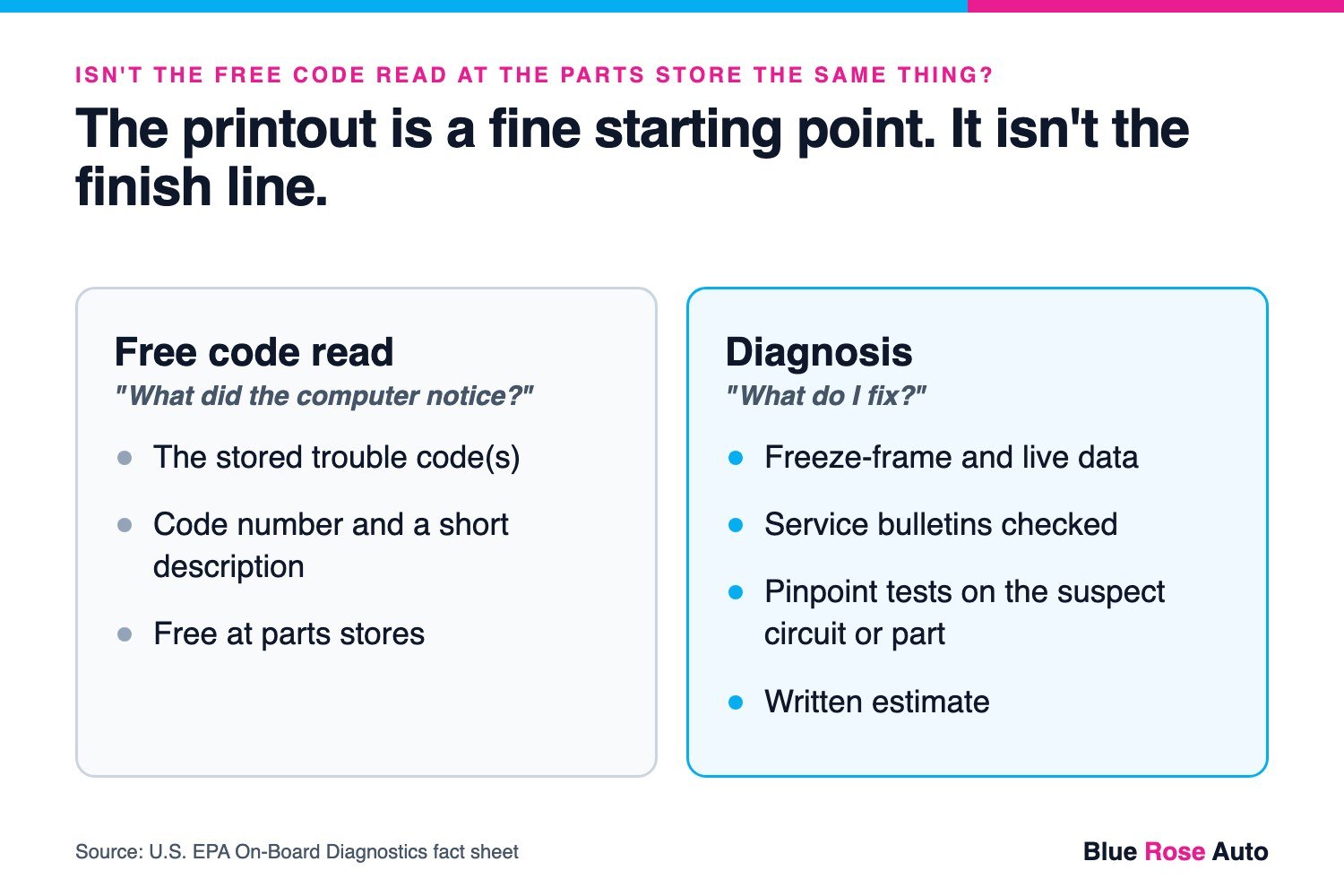
According to EPA’s OBD fact sheet, on-board diagnostics watches emission-related parts and systems and can light the “Check Engine” or “Service Engine Soon” light (the malfunction indicator lamp, or MIL). For gasoline cars and light trucks, full compliance was required from the 1996 model year on.
The system reports by monitor. A P0420 comes from the catalyst efficiency monitor, a P0300 from the misfire monitor, and neither names a part. That P0420 can be a tired converter, an exhaust leak or a lazy oxygen sensor. Buying parts off the code alone is guessing with your own money.
This table compares a free code read with a diagnosis.
| Free code read | Diagnosis | |
|---|---|---|
| What it tells you | The stored trouble code(s) | The cause, and the part or repair that fixes it |
| Tool | Basic code reader at the engine connector | Shop scan tool reading all modules, plus test equipment |
| Data | Code number and a short description | Freeze-frame, live data (e.g. fuel trims), module history |
| Service bulletins checked | No | Yes |
| Hands-on testing | No | Pinpoint tests on the suspect circuit or part |
| Written estimate | No | Yes; required in Oregon before repair work (ORS 646A.482) |
| Cost | Free at parts stores | Billed as a fee or labor time |
A code read answers “what did the computer notice?” A diagnosis answers “what do I fix?” We run that second process on every engine diagnostics and repair job.
What does a proper diagnosis actually include?
A proper diagnosis runs from a conversation about the symptom, through scans, data, a bulletin check and hands-on tests, to a confirmed cause, a written estimate and proof the fix worked. On a check engine light we start with a full scan and the freeze-frame data before anyone picks up a wrench.
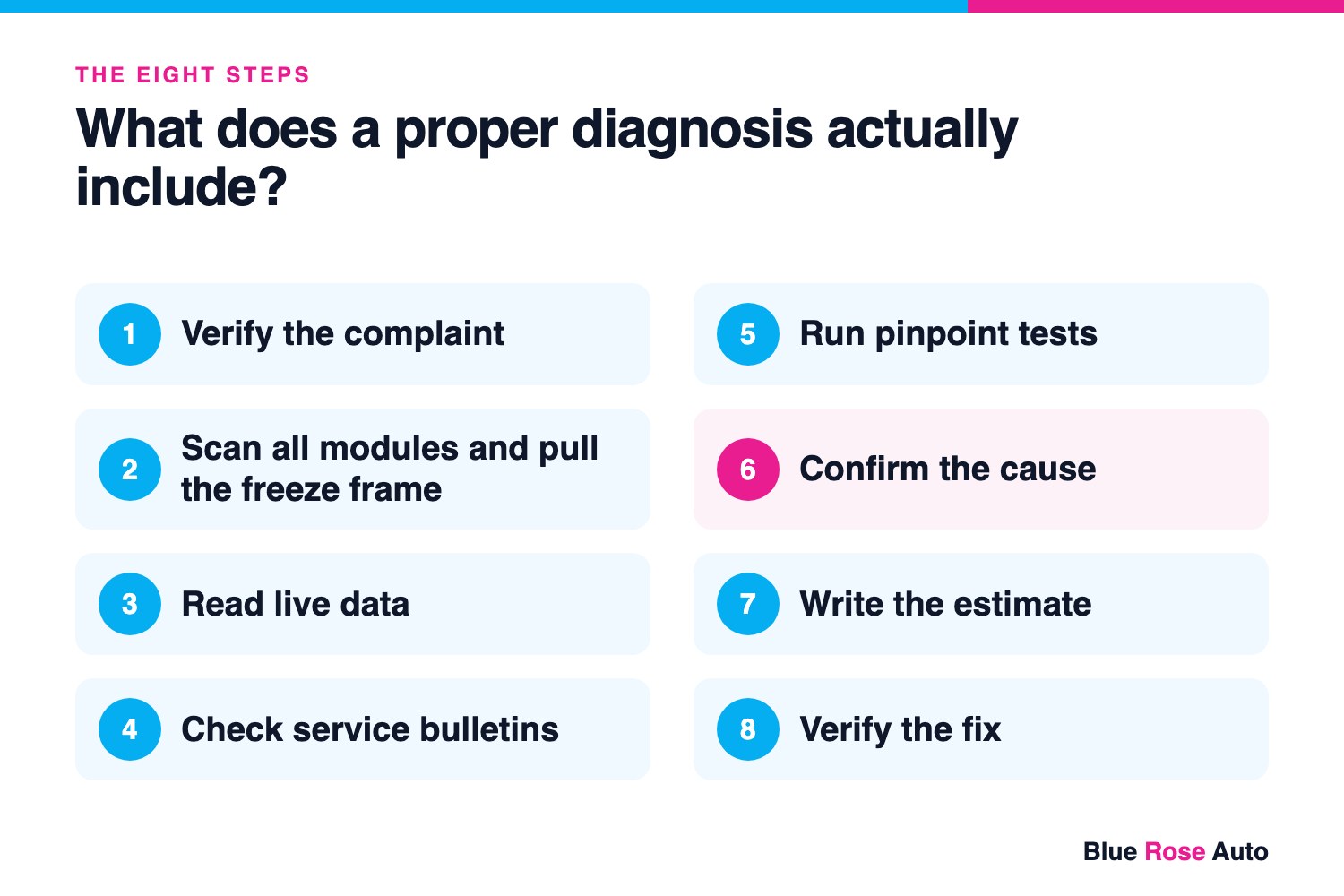
These are the eight steps, and the reason each one is there.
- Verify the complaint. When does it happen, how often, hot or cold? A noise that only shows up on a cold morning needs a different test plan.
- Scan all modules and pull the freeze frame. A full scan reads every module, not just the engine computer. Freeze-frame data is the snapshot stored when the code set (speed, engine temperature, load), which tells the tech what to recreate.
- Read live data. Fuel trims show whether the engine is adding or pulling fuel to make up for something, like a vacuum leak.
- Check service bulletins. Manufacturers publish technical service bulletins (TSBs) for problems they’ve already solved.
- Run pinpoint tests. Voltage drop, smoke, fuel pressure or a scope on a sensor signal, aimed at the suspect circuit or part. A code reader can’t do this.
- Confirm the cause. One answer backed by a test result, not a list of maybes.
- Write the estimate. Oregon’s ORS 646A.482 requires one before repair work begins.
- Verify the fix. Re-scan and drive the car under the conditions that set the code.
That’s why step 2 matters. Some warning lights trace to a module other than the engine computer, and a basic code reader may never see it. Our engine diagnostic visits start with that full-module scan.
Why a service-bulletin check is part of the job
Take GM bulletin 24-NA-170, dated January 2025. It covers the 2023-2024 Chevrolet Colorado and GMC Canyon under the subject “Check Engine Lamp Illuminated with HVAC Related DTC.” GM says the cause “may be software anomalies and that the HVAC module was not previously reprogrammable.” The correction is to “reprogram the Heater and Air Conditioning User Interface to the latest software.”
No part. The light was on and the code pointed at the climate controls, but the fix was a software update. A shop that skipped the bulletin check might have sold a module that wasn’t bad. NHTSA posts copies of bulletins like this online.
How do shops charge for diagnosis?
Shops charge for diagnosis with a flat first fee, billed labor time, a free check followed by paid testing, or a fee credited to the repair. Your car diagnostic cost depends on that structure and how hard the fault is to find. Nationally, a diagnostic typically runs $100 to $200. At Blue Rose Auto, the first 15 minutes are free, then diagnosis is $100 an hour and we credit it to an approved repair.
The FTC notes that “Some shops charge a flat rate for labor on auto repairs,” while “Others charge on the basis of the actual time the technician worked on the repair.” Diagnostic time is often billed the same way as labor.
Rates vary by shop and by how long the fault takes to find, so “starting at” prices are a floor and not a cap. A diagnostic fee is a labor charge, and labor rates are the best guide to what a longer diagnosis costs.
Statewide, Tekmetric’s state labor-rate data (June 30, 2026) puts Oregon’s average labor rate at $150 an hour, and RepairMath (updated July 2026) lists $130 for independents and $160 for dealers. Those are state averages. Closer to home, our general auto repair page notes that independent shops around Springfield bill roughly $100 to $150 per labor hour, with parts on top.
Shops structure diagnostic charges in four common ways.
| Structure | How it works | What to ask |
|---|---|---|
| Flat first fee | Set price for the first round, with more time quoted separately | What’s included, and when does extra time start? |
| Billed labor time | Charged by the hour like repair labor (Oregon averages $130 to $160/hr) | What’s the rate, and how long before you call me? |
| Free check, paid testing | Free code read; deeper testing is paid | Where does the free part stop? |
| Credited to the repair | Fee applied to the repair if you approve it. Our policy is the first 15 minutes free, then $100 an hour credited to an approved repair. Ford dealers usually waive it on warranty or recall work. | Is it credited, and in full? |
None of these is a scam. The FTC also suggests asking about a diagnostic charge “if you decide to have the work performed elsewhere.”
Why doesn’t every shop waive the fee if you approve the repair?
Because waiving it just moves the cost. When a shop credits the diagnosis, the hours it took get folded into the repair ticket. Shops that keep the fee separate argue that finding the fault is the hardest part of the job and should be priced that way. Both models are fair, as long as you know which one you’re agreeing to before the scan tool comes out.
If you decline the repair
You still pay for the diagnosis you approved, since that work was done. What you should leave with is the answer, meaning which part or circuit failed and how it was confirmed. Under ORS 646A.482, the shop has to give you a copy of the estimate no later than when you pay. If you fix it yourself or take it elsewhere, buy a part built to the original spec. A no-name replacement that fails the same test sends you back for the same diagnosis, and you pay for it twice.
Dealers and warranty work
Ford’s explanation of dealer diagnostic fees says a dealership “is entitled to ask for payment of a diagnostic fee.” If warranty, an extended service plan, a recall or a customer satisfaction program covers the repair, “it is customary for the diagnostic fee to be waived.” If not, “the diagnostic becomes part of the repair cost.” Ford adds that these charges aren’t set by Ford and “must be negotiated between the dealer and the customer.” Customary isn’t guaranteed.
What does Oregon law say about diagnostic charges?
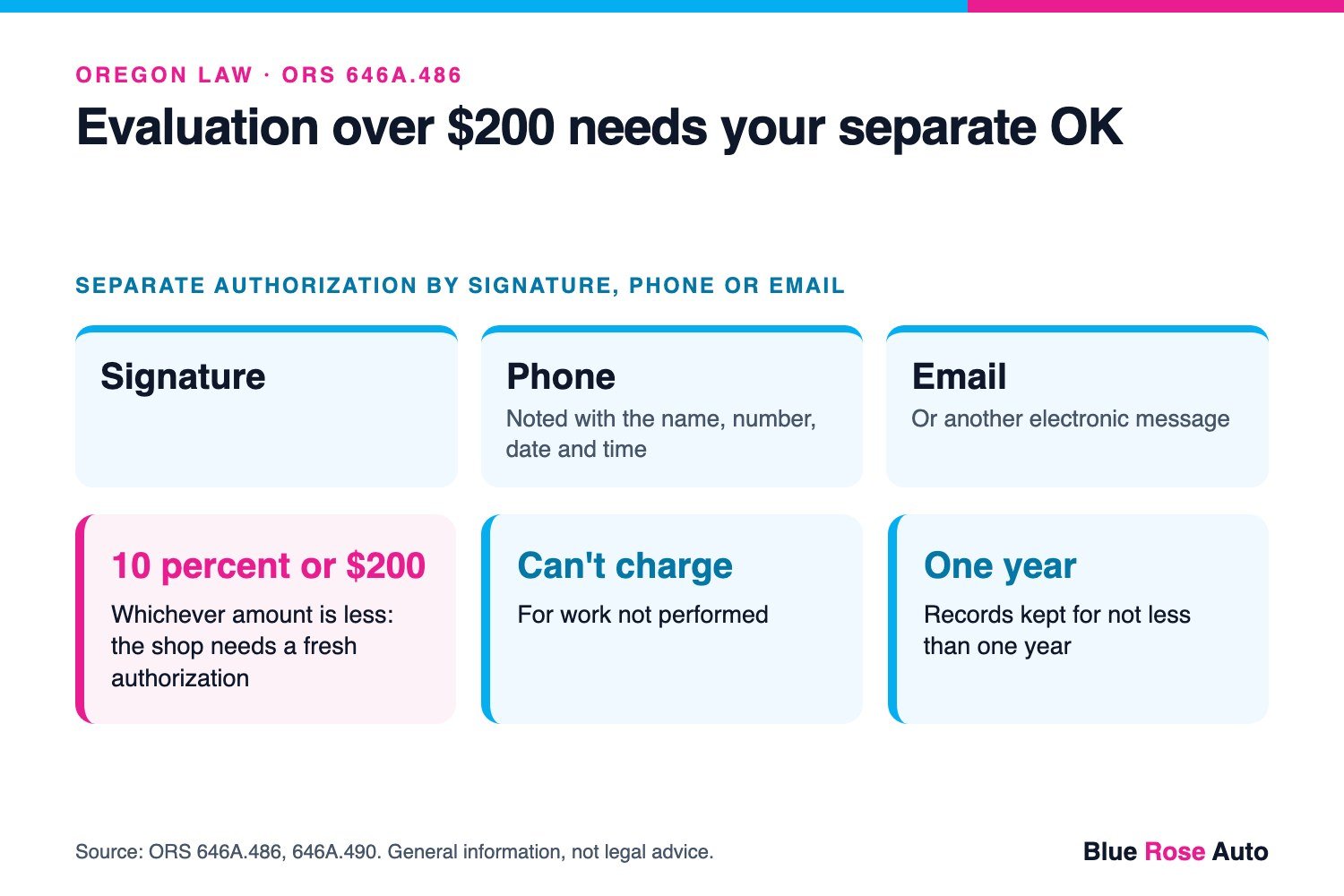
Oregon law treats diagnostic charges much like repair charges. The shop must write an estimate before starting, needs your separate OK for evaluation work over $200, and can’t bill for work it didn’t do. Those rules sit in ORS 646A.480 to 646A.495.
Start with the estimate. Under ORS 646A.482, a repair shop “shall prepare an estimate of the cost of work the vehicle repair shop proposes to perform on a motor vehicle before beginning the work.” The total “may consist of a reasonable range.”
In Oregon, ORS 646A.486 bars a repair shop from evaluating a personal vehicle when the estimate for that evaluation is over $200, unless the owner gives a separate authorization by signature, by phone, or by email or another electronic message.
A phone OK gets noted on the estimate. On a job estimated over $200, if the work changes in a way that raises the cost “by more than 10 percent or by more than $200, whichever amount is less,” the shop needs a fresh authorization. On a $300 job, that line is an increase of more than $30.
Under ORS 646A.490, a shop may not “charge a person for work not performed on a motor vehicle even if the work is shown on an estimate,” and it must keep these records “for not less than one year.”
When the shop has to take something apart
When a fault can’t be found without opening up an engine or transmission, ORS 646A.482(2) requires the estimate to list the disassembly and evaluation cost and “a separate estimate of the cost for reassembly” if you decline the repair, plus roughly how long reassembly takes. ORS 646A.490(2) then requires the shop to put the car back together within about that time if the parts are available. You should know what it costs to get the car back in one piece before anyone pulls it apart.
Can you waive the $200 rule?
Yes, but not by accident. Under ORS 646A.495(2), an owner can waive the authorization requirement only after getting an explanation of it and signing “a separate document directly under a statement that conspicuously identifies the authorization requirement.” Read anything you sign at drop-off. You can also name someone, like a spouse, to approve work for you, but ORS 646A.495(3) says that person can’t be the shop or anyone who works there.
Limits apply. The rules cover vehicles used “for personal, family or household purposes” and don’t apply to motor homes, contract-maintained fleet vehicles or body and frame repair shops. Violations are an unlawful trade practice under ORS 646.608, and you can file a complaint with Oregon DOJ Consumer Protection. This is general information, not legal advice.
Why do some problems take longer to diagnose?
Some problems take longer to diagnose because they won’t show up on demand. A steady fault with a clear code can often be confirmed in the first session. An intermittent stall or a no-start that only happens after rain takes longer, because the tech has to recreate the conditions before testing anything. That waiting is where hours go.
These are the usual suspects.
- Intermittent faults. It stalls once a week, then drives perfectly for the tech. Sometimes it simply has to happen again.
- Electrical problems. A corroded ground can throw codes in several systems at once. These are electrical faults that take longer to trace.
- Conditions that have to be recreated. Cold start, highway speed, a wet morning. If it only acts up after rain, and Willamette Valley winters bring plenty of that, say so at drop-off.
- Symptoms with no code. A slow crank may never set one; see telling a bad starter from a weak battery.
Hybrids add high-voltage systems too (hybrid system diagnostics). This is where Oregon’s $200 authorization line earns its keep, since the shop must stop and ask before evaluation goes past it.
Staying on the 30-60-90 maintenance schedule won’t prevent every fault, but worn plugs cause their share of warning lights.
What should you ask before you approve diagnostic time?
Before you approve diagnostic time, ask what the first charge covers, whether it comes off the repair, and when the shop will call you. These are the questions we’d want answered at any counter, ours included.
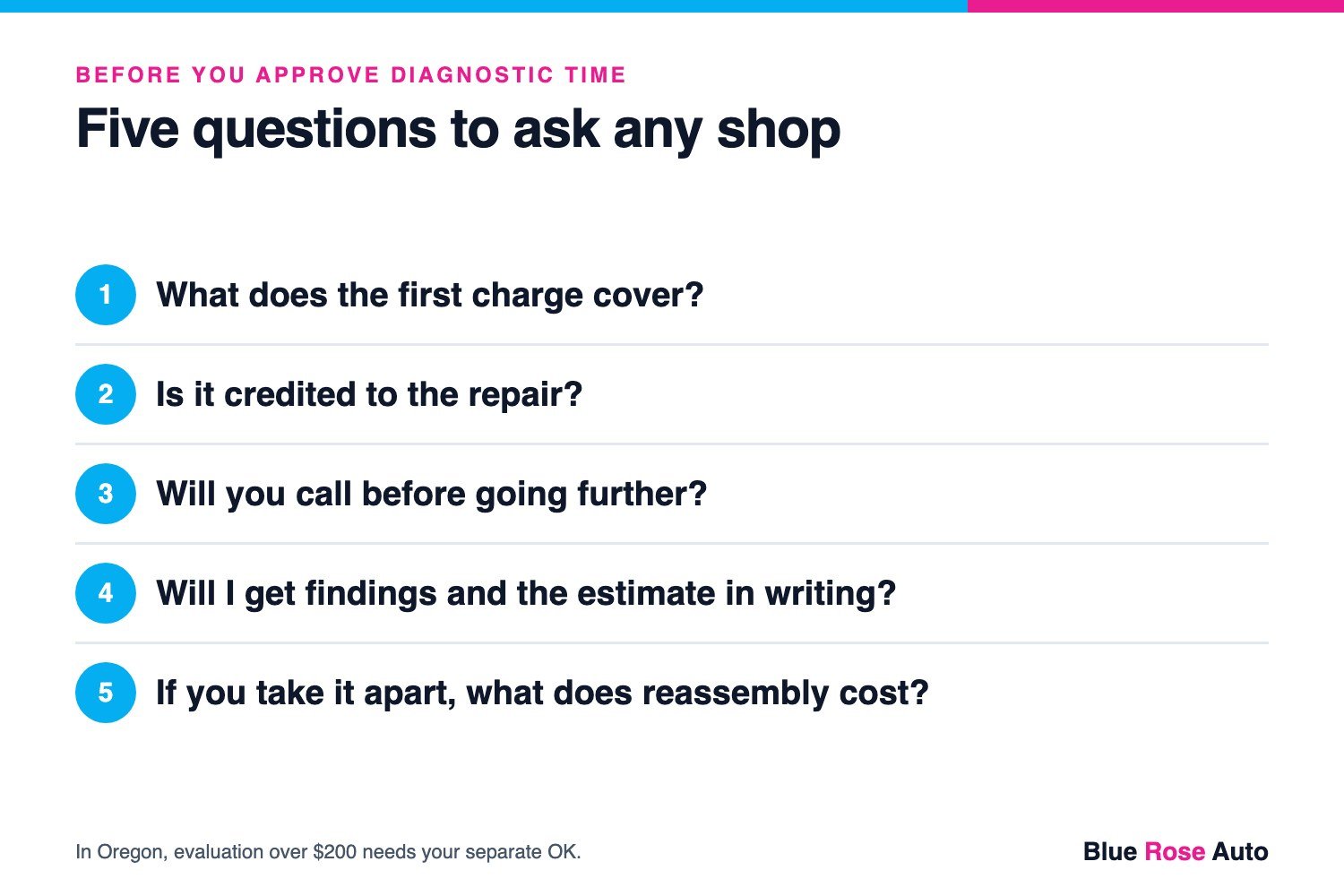
- What does the first charge cover? Flat amount or billed by time?
- Is it credited to the repair? And if so, in full?
- Will you call before going further? In Oregon, evaluation over $200 needs your separate OK.
- Will I get findings and the estimate in writing? The law requires the estimate; asking for test results costs nothing.
- If you take it apart, what does reassembly cost? Oregon requires a separate reassembly estimate for a teardown.
And don’t sign a blanket waiver at drop-off without reading it, since ORS 646A.495 lets a signed separate document waive the $200 rule. We walk through the work with you and get your OK before we start. Our own policy is the first 15 minutes free, then $100 an hour credited to an approved repair.
Want those answers before you hand over the keys? Call Blue Rose Auto at (541) 641-8877 and we’ll tell you what the first round of diagnosis covers.
Frequently asked questions
How much is a typical diagnostic fee?
Nationally, a diagnostic typically runs $100 to $200, and Oregon labor rates average $130 to $160 an hour depending on the source and shop type. At Blue Rose Auto the first 15 minutes of diagnosis are free, then it’s $100 an hour, credited to an approved repair. Harder faults take more billed time.
Is a $200 diagnostic fee normal?
It can be for a hard-to-find fault, but in Oregon $200 is also a legal line. Under ORS 646A.486, a shop can’t evaluate your car when the estimate for that evaluation is over $200 unless you give separate authorization by signature, phone or email. Ask what the first charge covers and when the shop will call.
Does the diagnostic fee go toward the repair?
It depends on the shop. At Blue Rose Auto, the first 15 minutes are free, then diagnosis is $100 an hour and we credit it to an approved repair. Ford says it is “customary” for dealers to waive the fee when warranty, recall or a service plan covers the repair. Ask any shop before you approve.
Do I have to pay if the shop can’t find the problem?
Usually yes for time you authorized, since diagnostic time is labor either way. Oregon law sets limits, though, because a shop can’t charge for work not performed and evaluation over $200 needs your separate OK. Ask for the findings in writing, including what was tested and ruled out.
Can I refuse to pay a diagnostic fee?
If you authorized the diagnosis and the work was done, it’s a legitimate charge. Billed for work not performed, or for evaluation over $200 you never authorized? Raise it with the shop first. Still stuck? You can file a complaint with Oregon DOJ Consumer Protection. This is general information, not legal advice.
What if the repair doesn’t fix the problem?
Ask about this before you approve the repair, not after. Some shops re-check a misdiagnosis without a second fee; get that policy in writing. In Oregon, a shop can’t bill for work it didn’t do, and on a job estimated over $200 a change that raises the cost by more than 10 percent or $200, whichever is less, needs your new authorization.
How long does a car diagnostic take?
A steady fault with a clear code can often be confirmed in one session. Intermittent and electrical faults can take longer, because the condition has to be recreated before it can be tested, sometimes on a cold start or at highway speed. A good shop calls when it reaches the end of the time you approved.
Do dealers charge diagnostic fees on warranty work?
They can ask for one, but it’s often waived. Ford says a dealer may charge a diagnostic fee, and if warranty, an extended service plan, a recall or a customer satisfaction program covers the repair, “it is customary for the diagnostic fee to be waived.” Confirm with the dealer up front.
Will a parts store diagnose my car for free?
National parts-store chains will read your codes for free. A code says which system flagged a problem, not which part failed. Diagnosis adds freeze-frame and live data, a service-bulletin check and hands-on tests on the suspect part. Bring the printout to your shop anyway. It’s a useful starting point.
Sources
- Oregon Revised Statutes, ORS 646A.480 to 646A.495 (vehicle repair estimates and authorization), https://www.oregonlegislature.gov/bills_laws/ors/ors646A.html
- Oregon Revised Statutes, ORS 646.608(1)(mmm), https://www.oregonlegislature.gov/bills_laws/ors/ors646.html
- Oregon DOJ Consumer Protection, file a complaint, https://justice.oregon.gov/consumercomplaints/
- Federal Trade Commission, “Auto Repair Basics”, https://consumer.ftc.gov/articles/0211-auto-repair-basics
- U.S. EPA, On-Board Diagnostics fact sheet (EPA420-F-03-042), https://nepis.epa.gov/Exe/ZyPDF.cgi/P100LW9G.PDF?Dockey=P100LW9G.PDF
- GM Service Bulletin 24-NA-170 (January 2025), hosted by NHTSA, https://static.nhtsa.gov/odi/tsbs/2025/MC-11013080-0001.pdf
- Ford, “What is a diagnostic fee when I take my vehicle to a dealer?”, https://www.ford.com/support/how-tos/ford-services/parts-and-service/what-is-a-diagnostic-fee-when-i-take-my-vehicle-to-a-dealer/
- U.S. Bureau of Labor Statistics, Occupational Outlook Handbook, Automotive Service Technicians and Mechanics, https://www.bls.gov/ooh/installation-maintenance-and-repair/automotive-service-technicians-and-mechanics.htm
- ASE test series (L1 Advanced Engine Performance), https://ase.com/tests/ase-certification-test-series/
- Tekmetric, “Average Auto Repair Labor Rates by State” (June 30, 2026), https://www.tekmetric.com/post/average-auto-repair-labor-rates-by-state
- RepairMath, labor rates by state (updated 07-2026), https://repairmath.com/labor-rates/
Got a warning light you can’t pin down?
Our ASE-certified technicians at 3436 Olympic St in Springfield give you the first 15 minutes of diagnosis free, then charge $100 an hour that we credit to an approved repair. We walk you through what we find and get your OK before any repair starts. Blue Rose Auto opened in 1994. Call (541) 641-8877, read more about our engine diagnostics, or book a diagnosis online.
0 Comments