Last updated October 2026. Statutes checked against the 2025 ORS edition. General information, not legal advice.
In Oregon, the uninsured motorist coverage every auto policy must carry pays for injuries, not car damage. Your repair gets paid by your collision coverage, by optional uninsured motorist property damage coverage that every Oregon insurer must offer (the first $200 isn’t covered, or $300 after a hit-and-run), or by the at-fault driver. PIP covers medical bills, not repairs.
If you’ve just been hit by an uninsured driver in Oregon, that first sentence stings. Most people see “uninsured motorist” on their policy and assume the car is handled. It isn’t. Below is which coverage fixes the car and what you pay first. Then come the deadlines, some of which may already be running by the time you read this.
This is general information about Oregon insurance law from a repair shop’s point of view, not legal advice. For a dispute about your claim, contact the Oregon Division of Financial Regulation (888-877-4894) or a licensed Oregon attorney.
Does uninsured motorist coverage pay to fix my car?
No. Under ORS 742.502(1), every Oregon auto liability policy “shall provide … uninsured motorist coverage.” Its limits match your bodily injury liability limits “unless a named insured in writing elects lower limits,” and they can never drop below $25,000 per person and $50,000 per crash. It “must include underinsurance coverage” too, for the driver whose policy is too small. The catch is the definition. ORS 742.500(5) says uninsured motorist coverage pays what you’re “legally entitled to recover as damages for bodily injury or death.” No bumpers in that sentence. Damage to the car needs a different coverage, either collision or uninsured motorist property damage (UMPD), which Oregon insurers must offer and you’re free to decline. The Oregon State Bar says UMPD is “not required by law, but must be offered.” The source is ORS 742.500 to 742.510, Oregon Revised Statutes, 2025 Edition.

Each coverage that matters appears below, checked against the one question you care about right now.
| Coverage | Required in Oregon? | Minimum | Pays to fix your car? |
|---|---|---|---|
| Bodily injury liability | Yes | $25,000 per person / $50,000 per crash | No. Pays for injuries you cause to others |
| Property damage liability | Yes | $20,000 per crash | No. Pays for damage you cause to others’ property |
| Personal injury protection (PIP) | Yes | $15,000 per person | No. Medical bills and related benefits |
| Uninsured motorist (UM), includes underinsured | Yes | $25,000 per person / $50,000 per crash | No. Bodily injury or death only |
| Uninsured motorist property damage (UMPD) | No. Insurers must offer it | At least $20,000 | Yes, minus the first $200 ($300 hit-and-run) |
| Collision | No | Set by your policy | Yes, minus your collision deductible |
Sources are ORS 806.070, ORS 742.500 to 742.510 and 742.520 to 742.524 (2025 Edition) and Oregon DMV, Insurance Requirements.
Three of the four required coverages protect people. The fourth protects other people’s property. None of them is aimed at your own car.
How often does this come up? The Insurance Research Council estimates 14.7% of Oregon motorists were uninsured in 2023, the 18th-highest rate among the states, against 15.4% nationwide (Insurance Information Institute, citing a 2025 IRC study). Not rare, then. Oregon DMV is blunt about the law. “In Oregon, it is illegal to drive without liability coverage. See ORS 806.010.” True, but that’s between the other driver and the state, and it doesn’t put a single dollar toward fixing your car.
Who pays to fix my car after an uninsured driver hits me?
There are four ways the repair gets paid. Your own collision coverage pays after your collision deductible. Uninsured motorist property damage coverage pays, if you bought it, minus the first $200. The at-fault driver can pay personally. Or you pay. Which one fits depends on what’s on your declarations page and whether the other driver can be identified.
| Path | When it applies | What you pay first | Rental (loss of use) | What it needs |
|---|---|---|---|---|
| Your collision coverage | You carry collision; fault doesn’t matter | Your collision deductible | Only if you bought rental coverage | A claim with your insurer |
| UMPD | You bought UMPD and the uninsured driver is legally responsible | First $200 ($300 hit-and-run or phantom) | Not covered by UMPD (ORS 742.510(3)) | Proof the other vehicle was uninsured, or the 72-hour report + 30-day sworn statement for a hit-and-run |
| The at-fault driver | The driver is identified | Whatever you can’t recover | Depends on what you recover | Talk to an attorney about options and deadlines |
| You | No collision or UMPD, and nothing recovered | The repair bill | Not applicable | A written estimate so you know the number |
Your declarations page tells you which of the first two you have.
Your collision coverage
The Oregon Division of Financial Regulation (DFR) says collision “is usually defined as colliding with another object or overturning.” Another car counts. You pay your collision deductible and the insurer pays the rest of the covered repair. Deductibles and exclusions vary by policy, and what collision insurance covers spells out the common ones.
The at-fault driver
You can ask the driver who hit you to pay. Collecting is another matter. Whether someone with no insurance can actually pay you isn’t something a body shop can predict, so an Oregon attorney is the person to ask about your options and the deadlines that apply.
If you only carry liability
This is the hard one. Liability coverage pays for damage you cause to other people and their property. Not your car. Without collision or UMPD on the policy, the repair comes back to you, or to whatever you can recover from the other driver, and nothing in the statute changes that. Next time can go differently.
How does uninsured motorist property damage work in Oregon?
Oregon UMPD covers damage to your car caused by an uninsured vehicle, up to at least $20,000. By law, the first $200 isn’t covered, or the first $300 if the other car was a hit-and-run or phantom vehicle. It pays only what you’re legally entitled to recover, and it doesn’t pay for loss of use.
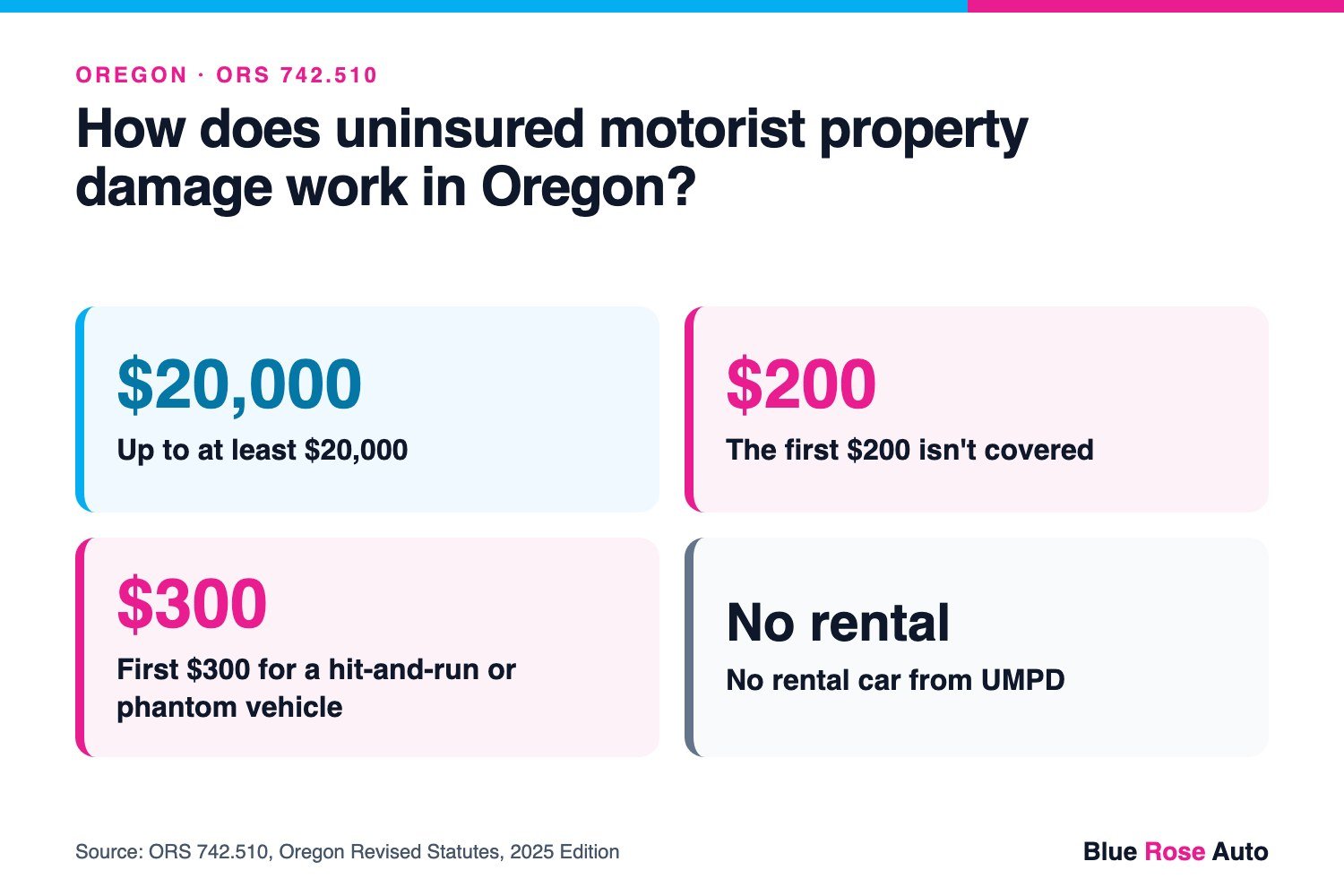
ORS 742.510(1) says every insurer selling private passenger auto liability here “shall have for sale” this coverage, at no less than the $20,000 minimum in ORS 806.070. The rest is short enough to quote.
“(2) A policy with the coverage described in this section does not cover the first $300 of property damage to the covered motor vehicle as the result of an accident with a hit-and-run vehicle or phantom vehicle. In all other cases the first $200 damage is not covered. (3) … (a) Applies only to the amount of damages the insured may be legally entitled to recover. (b) Does not include coverage for loss of use of the covered vehicle.”
ORS 742.510, Oregon Revised Statutes, 2025 Edition
The first $200 or $300 isn’t covered
That gap comes from the law, not from a deductible you picked. Read your own policy anyway. Insurers can word UMPD differently or sell more than the minimum.
No rental car from UMPD
Subsection (3)(b) leaves out loss of use. A rental while the car is in the shop has to come from separate rental coverage.
It only pays if the other driver is at fault
“Legally entitled to recover” means UMPD pays when the uninsured driver is legally responsible. Disputed fault, disputed claim. We can’t predict how that goes, and neither can anyone who hasn’t seen your file.
What counts as uninsured
ORS 742.508(4)(a) reaches past a driver with no policy. A vehicle counts if it has no collectible property damage insurance at the $20,000 level, if its insurer “denies coverage,” or if that insurer goes insolvent within two years of the crash. Hit-and-run and phantom vehicles count as well. If you and your insurer, “after reasonable efforts,” can’t find valid insurance within 90 days, the law presumes the vehicle was uninsured, a presumption that can be disputed.
If your car is older or unusual, ask your insurer whether UMPD is available on it.
Some websites say only “some insurers” offer UMPD in Oregon. The statute says every insurer selling private passenger auto liability here must have it for sale.
This is general information about Oregon insurance law from a repair shop’s point of view, not legal advice. For a dispute about your claim, contact the Oregon Division of Financial Regulation (888-877-4894) or a licensed Oregon attorney.
Should I use collision or UMPD for the repair?
It depends on your deductibles and who was at fault. UMPD’s statutory gap ($200, or $300 for a hit-and-run) is often smaller than a collision deductible, but UMPD only pays when the uninsured driver is legally responsible. Collision pays regardless of fault, minus your deductible. Many drivers carry both, then ask their insurer which one fits the crash in front of them.
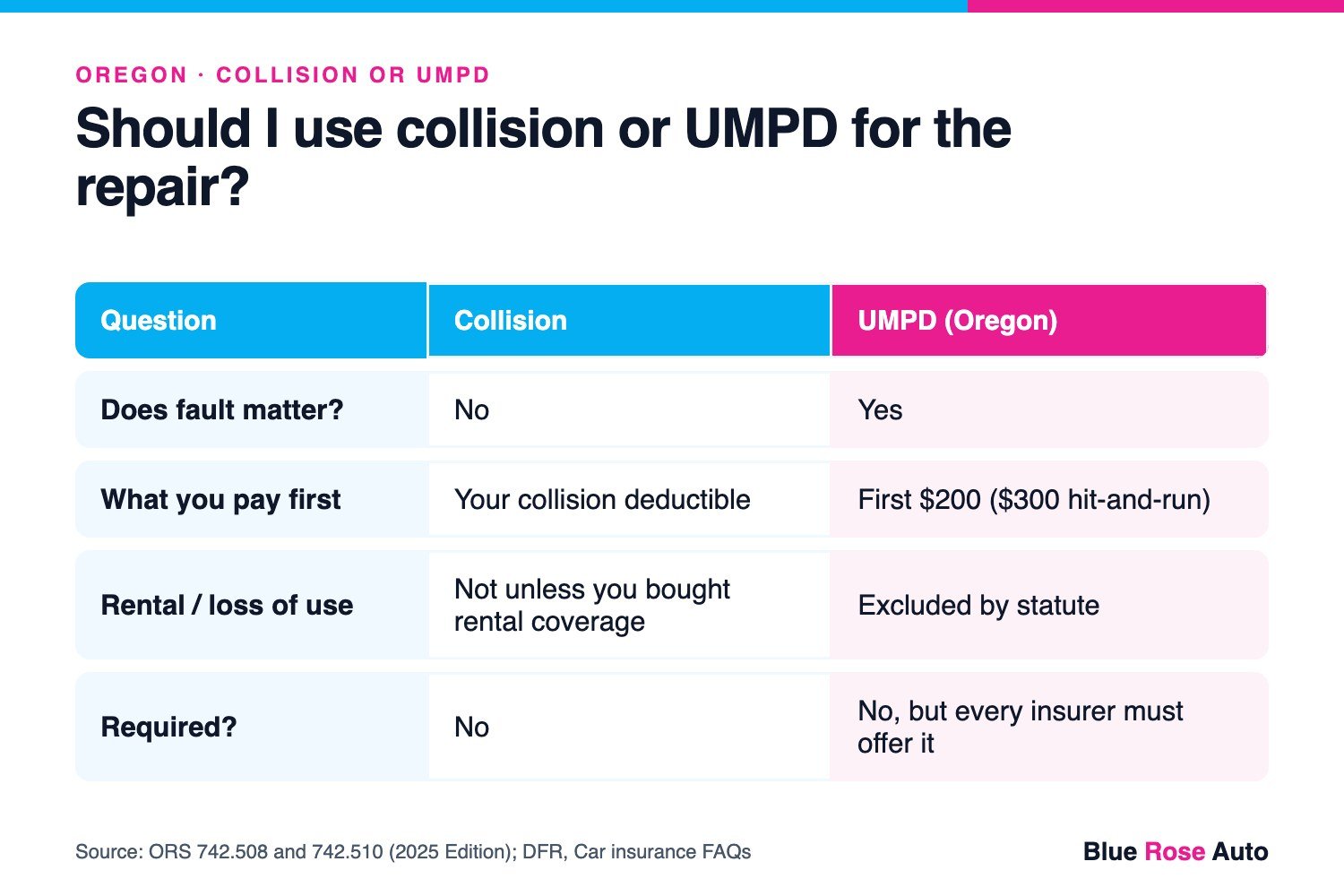
| Question | Collision | UMPD (Oregon) |
|---|---|---|
| Does fault matter? | No | Yes. Pays only what you’re “legally entitled to recover” |
| What you pay first | Your collision deductible (set by your policy) | First $200; first $300 for a hit-and-run or phantom vehicle (set by statute) |
| Coverage amount | Usually up to the car’s value, per your policy | At least $20,000 (insurers can offer more) |
| Rental / loss of use | Not unless you bought rental coverage | Excluded by statute |
| Hit-and-run | Covered as a collision under your policy | Only with the 72-hour report + 30-day sworn statement |
| Required? | No | No, but every insurer must offer it |
Sources are ORS 742.508 and 742.510 (2025 Edition); DFR, Car insurance FAQs.
UMPD isn’t automatically the better deal. If fault is disputed, or the bill you’re worried about is a rental car, UMPD pays nothing at all, and that’s the trade for its smaller statutory gap.
When the uninsured driver is known, a parked-car example
Say your car is hit while parked in Eugene, and the driver stops, admits it and has no insurance. That isn’t a hit-and-run, because the driver is identified. If you carry UMPD, the statutory gap is $200. If you claim under collision, you pay your collision deductible. Your insurer can tell you which applies and whether it will try to recover from the other driver. Don’t budget around getting a deductible back. Collecting from someone with no insurance is never a sure thing.
Does PIP pay for damage to my car?
No. Personal injury protection pays for people. ORS 742.520 requires it on every Oregon policy covering a private passenger vehicle, and the core benefit under ORS 742.524(1)(a) is “reasonable and necessary” medical, hospital, dental, surgical, ambulance and prosthetic expenses incurred within two years of the injury, up to $15,000 per person. DFR’s car insurance FAQs put the same limit in shorter words, “up to $15,000 or your PIP limit.”
The other PIP benefits in ORS 742.524, at the statutory minimums, are these.
- Lost income. 70% of income lost from work, if the disability lasts at least 14 days, capped at $3,000 a month for up to 52 weeks.
- Essential services. For someone who doesn’t usually earn an income, again if the disability lasts at least 14 days, up to $30 a day for up to 52 weeks.
- Funeral expenses. Up to $5,000.
- Child care. For the parent of a minor child who is hospitalized at least 24 hours, $25 a day and no more than $750 in total.
Under ORS 742.524(2), insurers may offer PIP deductibles “of up to $250.” DFR adds that your medical insurance “will usually not cover medical expenses resulting from a car accident until your PIP coverage is exhausted.” That’s where this post stops on injuries. For an injury claim, talk to your insurer or an attorney.
What should I collect at the scene if the other driver has no insurance?
Get the same details you’d get from any driver, plus a record that they have no policy. Oregon law already requires the other driver to hand most of it over. ORS 811.700(1)(b) says a driver in a crash that damages an attended vehicle must stay and give you their name and address, the owner’s name and address, the registration number, and the insurance carrier, policy number and carrier phone number. If they have no carrier to name, that gap is the first piece of evidence your insurer will want.
- Photograph their license plate, driver’s license and registration, with their permission. A name with no plate is hard to trace later.
- Write down what they said about insurance, in their words, with the time. Your adjuster will ask, and memory fades fast after a crash.
- Both cars and the scene, photographed before anyone moves anything. Only if it’s safe.
- Get witness names and phone numbers. UMPD only pays when the uninsured driver is legally responsible, so an independent account of who hit whom matters more here than in an ordinary claim.
- Call your own insurer the same day. With no policy on the other side, the claim runs through yours.
A carrier name doesn’t settle it, either. If that insurer denies coverage, Oregon can still treat the car as uninsured (see what counts as uninsured above).
What if the driver who hit me drove off?
Oregon treats a hit-and-run as uninsured for UMPD only if you report it to police, a peace or judicial officer, or the Department of Transportation within 72 hours, then file a sworn statement with your insurer within 30 days. If the insurer asks, you must make the car available for inspection.
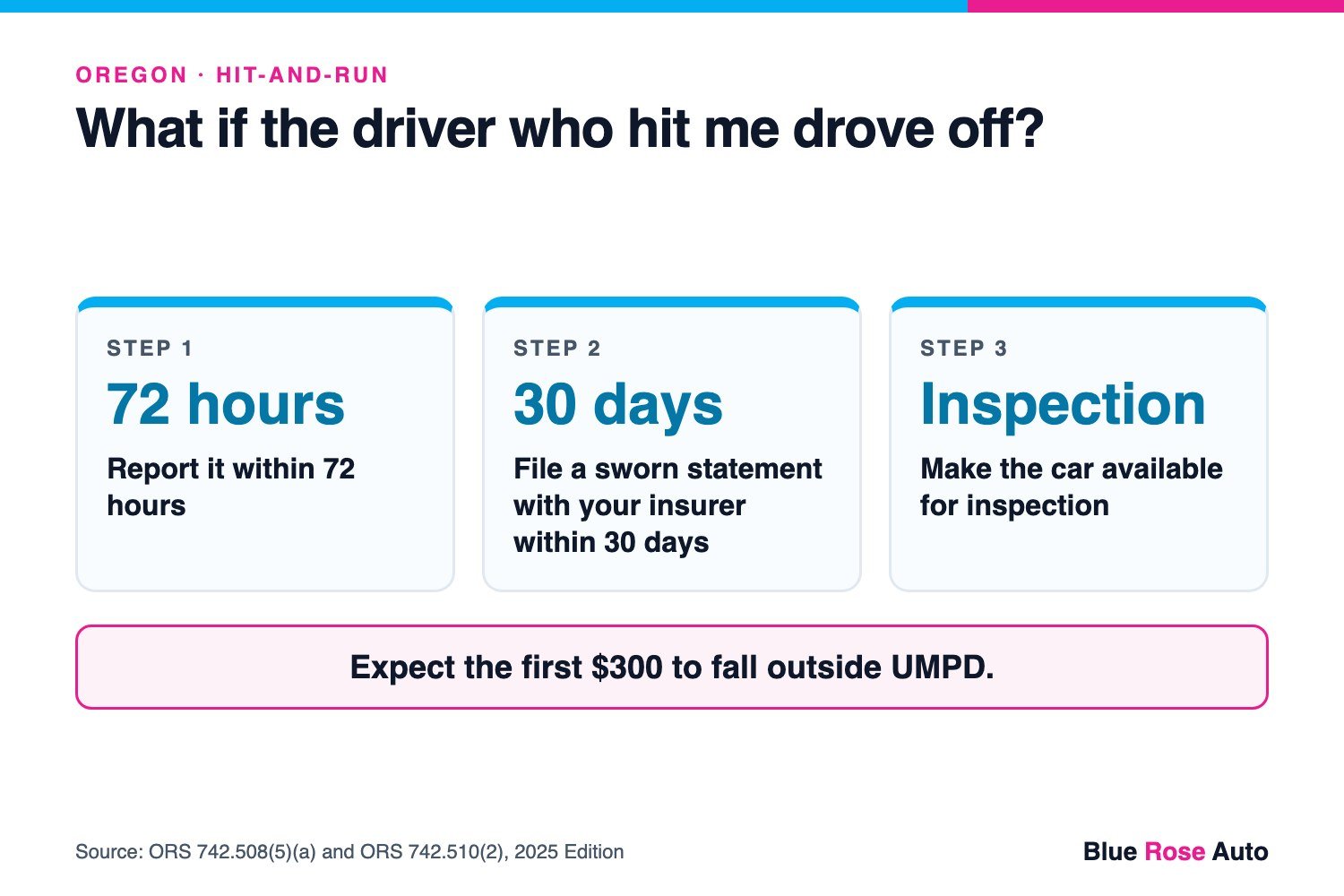
Those conditions are part of the definition of a “hit-and-run vehicle” in ORS 742.508(5)(a). Miss one, and the car may not count as hit by an uninsured vehicle. If it was a hit-and-run, take these steps.
- Photograph everything. DFR’s after-an-accident page says to “take pictures of the accident scene and damage to all vehicles involved, even if it is a one-car accident.”
- Report it within 72 hours to a police, peace or judicial officer, or to the Department of Transportation (ORS 742.508(5)(a)(B)). Don’t wait on a parking-lot dent either.
- File a sworn statement with your insurer within 30 days of that report. The statute calls it “a statement under oath.”
- Keep the car available. At the insurer’s request, the car has to be available for inspection (ORS 742.508(5)(a)(C)). Check with the adjuster before repairs start or the car is scrapped.
- Expect the first $300 to fall outside UMPD. That’s the hit-and-run figure in ORS 742.510(2).
What if nothing touched you? A car swerves at you, you hit the guardrail dodging it, and the other driver keeps going. That’s a “phantom vehicle” under ORS 742.508(5)(b). The driver’s identity has to be unknown, and the facts need “competent evidence other than the testimony of the insured or any passenger.” Your word alone won’t do. The same 72-hour report and 30-day sworn statement apply.
The driver who left also broke the law. Under ORS 811.700, skipping a driver’s duties after a property-damage crash (stopping and giving your details, or leaving a note on an unattended car) “is a Class A misdemeanor” (ORS 811.700). Leaving injured people is a Class C felony, or Class B with serious injury or death (ORS 811.705). Neither fixes your car.
Do I have to report the crash to the DMV?
Often, yes. Oregon DMV wants an Oregon Traffic Collision and Insurance Report within 72 hours when anyone is hurt or killed, when damage to your vehicle is over $2,500, when any vehicle has over $2,500 in damage and any vehicle is towed, or when other property damage tops $2,500 (ORS 811.720 and 811.725). “If you are not able to file within the 72 hours, submit it as soon as possible.” DMV also says “you still need to file a report with the DMV even if a report is filed by law enforcement,” and skipping it means “Oregon law requires DMV to issue a suspension notice.” You can file online through DMV2U. Police need a call too, and when a crash meets these thresholds DMV says to notify them immediately on a non-emergency number.
Watch the dollar figure in older guides. The statute lets ODOT raise it every five years for inflation, so older pages may quote a lower number. The 2025 edition of ORS 811.720 says “in excess of $2,500,” and that’s the line DMV uses today.
A shop can help here. If you believe you didn’t have to report, DMV accepts evidence such as “a repair bill or estimate from an auto repair business.”
What if I was the one without insurance and the other driver was at fault?
You can still ask the at-fault driver’s insurer to pay for your car. Oregon’s “no pay, no play” law, ORS 31.715, stops an uninsured driver from recovering noneconomic damages, such as pain and suffering, in an injury claim. Repair costs are a different category. ORS 31.705 lists “reasonable costs incurred for repair or for replacement of damaged property” as economic damages, which ORS 31.715 doesn’t touch.
That’s the narrow version. You’d also face the penalties for driving uninsured, and ORS 31.715 has exceptions, such as when the other driver was also uninsured. For anything beyond the repair, talk to an Oregon attorney.
| What you lose or face when driving uninsured | Oregon law |
|---|---|
| Pain-and-suffering damages in an injury claim | Barred (ORS 31.715) |
| Repair or replacement cost of your car | Not barred. Listed as economic damages (ORS 31.705) |
| The offense itself | Class B traffic violation (ORS 806.010) |
| Fine | Up to $1,000 for a Class B violation (ORS 153.018) |
| License | Suspended for one year if you’re in a crash while driving uninsured, and not reinstated until you meet future responsibility filing requirements (ORS 809.417(2)) |
| After a conviction | Proof of financial responsibility kept on file with DMV for three years (ORS 806.010(4)) |
Sources are ORS 31.715, ORS 153.018, ORS 806.010 and ORS 809.417, 2025 Edition.
What should the body shop do for your claim?
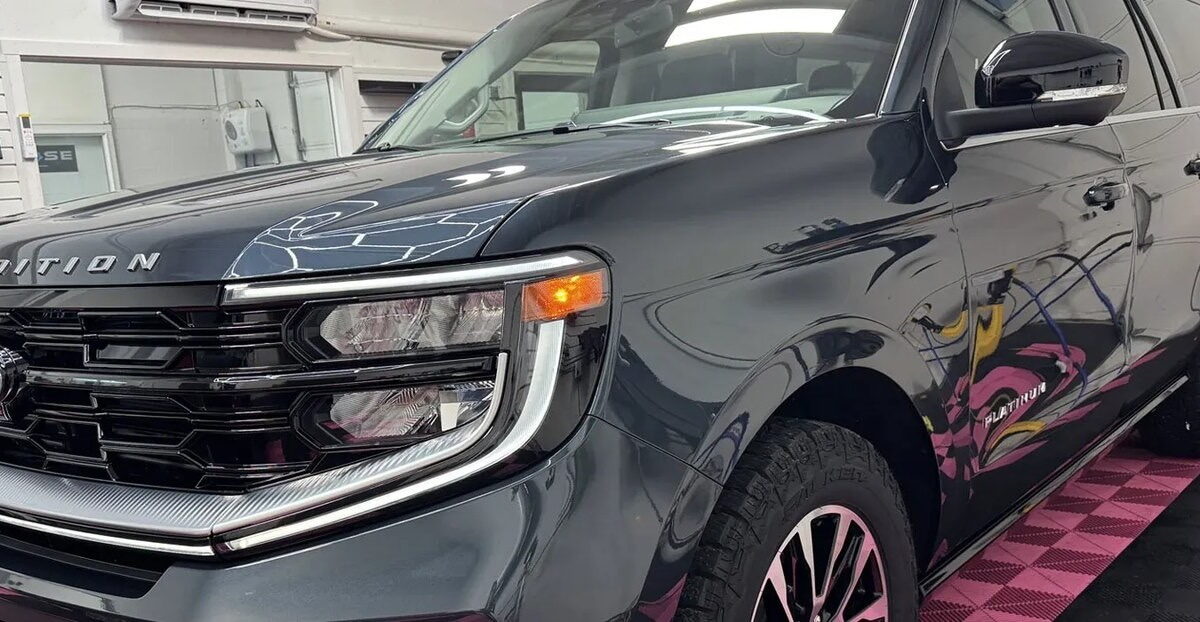
A shop’s part is narrower than people expect. We don’t decide fault or promise what an insurer pays. What we can do is put the damage on record clearly, so you and your insurer are looking at the same car.
- We photograph every damaged panel before anything comes apart.
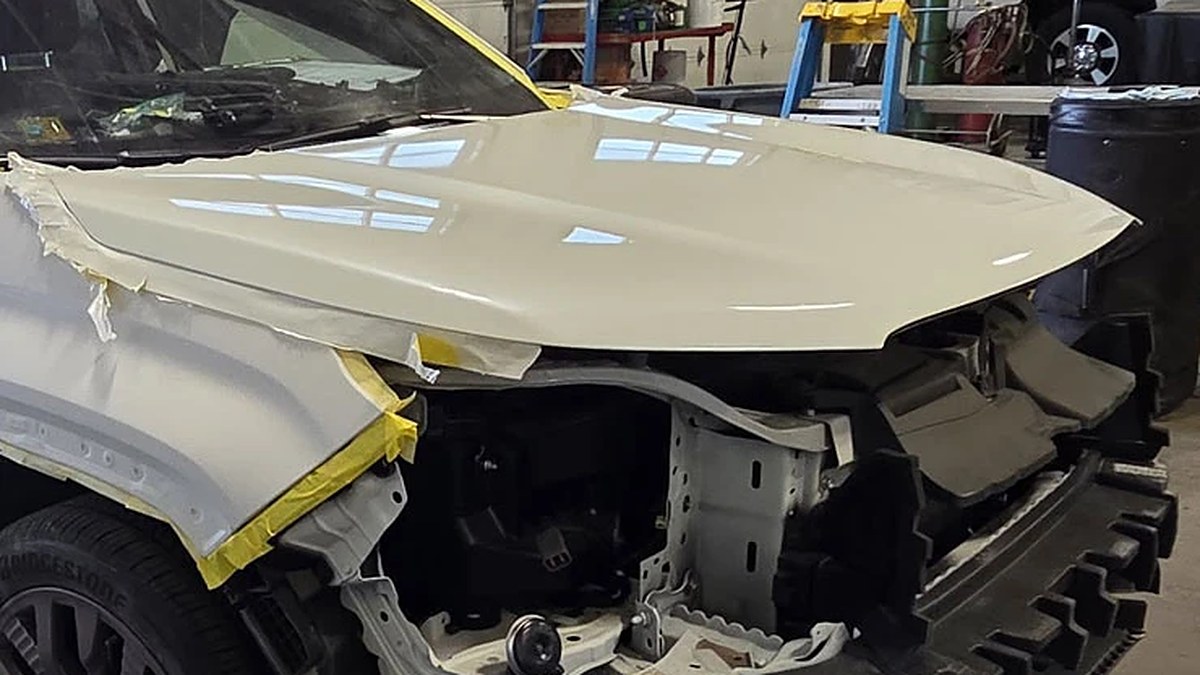
- We take the bumper cover off to check for hidden damage behind it.
- We measure the structure and align it back to spec. Not sure yours is more than cosmetic? Read these signs your bumper needs more than a cosmetic fix.
- We flag blind-spot sensors and forward cameras in the impact zone, because ADAS calibration may be needed after a collision repair.
- If a wheel took the impact, we check it on the wheel alignment and brake service side too, because a bent steering or suspension part can sit behind a panel that looks fine.
- You get a written estimate before we order any parts.
- If that estimate changes once panels come off, you hear about it first.
We work in that order because an insurer’s adjuster may want to see the car before anything comes apart. A hard hit often bends brackets and supports you can’t see from outside, and if that changes the estimate, you hear about it before more parts get ordered.
Our auto body and collision shop works with your insurer on the estimate and the repair plan. Blue Rose Auto opened in 1994, our technicians are ASE-certified, and our collision repairs carry a 3-year/36,000-mile warranty. Blue Rose Auto is also a Tesla Approved Body Shop for collision and structural repair. For the repair itself, what to expect during collision repair runs through each step.
If an uninsured driver left you with the damage, bring the car in before anything gets fixed or scrapped. We’ll photograph it and write up the repair so you and your insurer are working from the same numbers. It’s collision and auto body repair that starts with a written estimate.
What should I check on my policy now?
Pull up your declarations page. DFR’s after-an-accident page says this page “lists each vehicle and the type of coverage you have.” Check five things.
- UM limits. Do they match your bodily injury limits? They should, unless someone chose lower limits in writing.
- UMPD, and on which cars. It’s listed per vehicle, so a second car may not have it even if the first one does.
- Your collision deductible. Compare it with UMPD’s $200 gap ($300 for a hit-and-run). The difference is what one claim costs you over the other.
- Rental reimbursement. UMPD won’t pay for loss of use. Need a car for work while yours is in the shop? Look for this line.
- PIP limit and deductible. $15,000 for medical expenses is the floor.
One last point from DFR, “Most policies require prompt notification of a claim.” Call your insurer soon after a crash, even before you know which coverage applies.
Frequently asked questions
Do I have to pay my deductible if I was hit by an uninsured driver?
Usually something comes out of your pocket first. A collision claim means paying your collision deductible. Under Oregon UMPD, the statute itself leaves the first $200 uncovered, or $300 for a hit-and-run or phantom vehicle (ORS 742.510(2)). Your insurer may try to recover from the other driver later. Don’t count on it, and ask how your claim is handled.
Is uninsured motorist property damage required in Oregon?
Not for you. For your insurer, yes. The Oregon State Bar says it “is not required by law, but must be offered to you by your insurance company as an option when you buy your policy.” The uninsured motorist coverage Oregon does require pays for injuries only. See how UMPD works in Oregon for the $200 and $300 rules.
Will my insurance fix my car if it was a hit-and-run?
It can. If you carry collision, you pay your deductible. If you carry UMPD, the first $300 isn’t covered. For UMPD, Oregon requires a report within 72 hours, a sworn statement to your insurer within 30 days, and the car made available for inspection if the insurer asks. A liability-only policy won’t pay for your own car.
Is it worth reporting a minor hit-and-run?
For a UM or UMPD claim, yes. The 72-hour report is part of what makes the other car a “hit-and-run vehicle” under Oregon law, so skipping it can cost you that coverage. DMV is a separate track and wants its own report within 72 hours when damage to your car is over $2,500. A written estimate shows which side of that line you’re on.
What happens if an uninsured driver hits me and I don’t have collision coverage?
If you bought UMPD, it can pay for the repair minus the first $200, as long as the other driver is legally responsible. If you carry neither collision nor UMPD, your own policy won’t pay for your car. The repair then falls to you, or to whatever you can recover from the other driver, and that part is a question for an attorney.
Why doesn’t uninsured motorist coverage include vehicle damage?
Because ORS 742.500(5) defines it as paying for “bodily injury or death.” Car damage is a separate coverage, UMPD under ORS 742.510, which insurers must offer and drivers can turn down. To protect the car itself, you need UMPD, collision, or both on the declarations page. Adding either one is a call to your insurer.
What if the other driver has insurance, but not enough to fix my car?
Then UMPD usually isn’t the answer. Under ORS 742.508(4)(a), a driver who carries the $20,000 property damage minimum isn’t “uninsured” for UMPD, even if your repair costs more. If they caused the crash, their liability pays up to its limit, and your collision coverage, minus your deductible, is the usual backstop for the rest.
What happens if an uninsured driver gets hit by an insured driver?
The insured driver’s liability coverage can still pay for the uninsured driver’s car repair if the insured driver caused the crash. Oregon’s ORS 31.715 bars an uninsured driver from recovering pain-and-suffering damages, but repair costs count as economic damages under ORS 31.705. The uninsured driver still faces a Class B traffic violation and a possible license suspension. See the table above for the details.
How long does an uninsured motorist claim take?
There’s no fixed answer. UM injury claims run on a clock. Under the policy terms in ORS 742.504(12), no claim accrues unless one of several steps happens within two years of the accident, such as agreeing on the amount owed or formally starting arbitration. Ask your insurer or an attorney early. On an insurance-paid repair, work starts once the claim is approved and the estimate is agreed.
Hit by an uninsured driver?
Bring the car to Blue Rose Auto at 3436 Olympic St in Springfield. Our ASE-certified technicians will photograph the damage and document and estimate it in writing, so you know the number before you talk to your insurer. We’re open Monday to Friday 8 AM to 5 PM and Saturday 10 AM to 5 PM, and closed Sundays. Call (541) 641-8877 or contact the shop.
0 Comments