No. Under ORS 746.280, an Oregon insurer may not require you to use a particular repair shop as a condition of paying your claim. Before recommending one, the adjuster must tell you that you have the right to select the motor vehicle repair shop of your choice. A state rule applies the same limit to the other driver’s insurer.
So if you’re asking “can I choose my own body shop in Oregon when insurance is paying?”, the answer is yes, with strings attached. Below is the statute read plainly, plus the parts people tend to miss when an adjuster is on the phone. Short version first.
By the Blue Rose Auto team. Last updated October 2026. This is general information about Oregon law, not legal advice. For a dispute about your claim, contact the Oregon Division of Financial Regulation or a licensed Oregon attorney.
Can your insurer make you use their body shop?
No. An Oregon insurer can recommend a shop, but it can’t make payment depend on you using that shop. Before naming any shop, the adjuster has to tell you the choice is yours, in wording the legislature wrote into the statute itself.
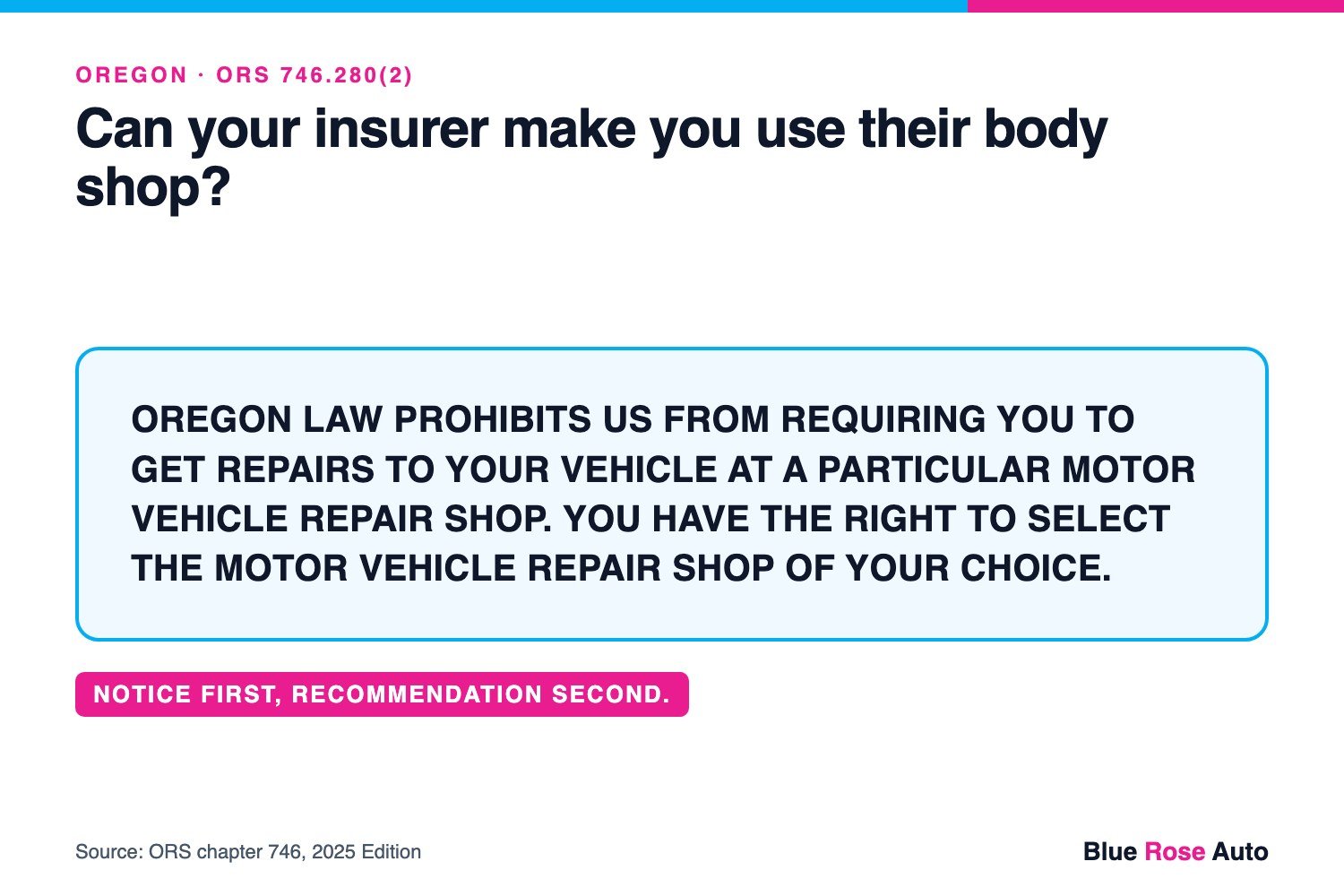
The notice below is the text of ORS 746.280(2), reproduced from oregon.public.law, which mirrors Oregon Revised Statutes chapter 746.
OREGON LAW PROHIBITS US FROM REQUIRING YOU TO GET REPAIRS TO YOUR VEHICLE AT A PARTICULAR MOTOR VEHICLE REPAIR SHOP. YOU HAVE THE RIGHT TO SELECT THE MOTOR VEHICLE REPAIR SHOP OF YOUR CHOICE.
The statute asks for a statement “substantially similar to” that text, so phrasing can vary. Order can’t. Notice first, recommendation second.
ORS 746.290 also tells adjusters to “advise the insured of the provisions of ORS 746.280,” and policies issued after December 31, 1977 must include a statement of it. The Oregon Division of Financial Regulation (DFR) is blunter. Its repair shops page asks, “Do I have to use the repair shop my company recommends?” and answers, “No.”
What does ORS 746.280 actually say?
ORS 746.280 has four parts. Subsection (1) says an insurer “may not require that a particular person make the repairs” as a condition for paying under an auto policy. Next, subsection (2) makes the adjuster tell you about that right before recommending any shop. Under subsection (3), if you pick a different shop, the insurer may not limit the cost of repairs needed to return the car to its preloss “safety, function and appearance,” with a qualifier that matters: “other than as stated in the policy or as otherwise allowed by law.” Subsection (4) covers the opposite choice. Accept the insurer’s shop and you’re owed a written or electronic statement within three business days. The statute’s history line shows the core rule dates to 1977 and was amended in 2007. Two companion sections back it up, the ORS 746.285 shop sign and the ORS 746.290 policy statement. We checked every section quoted here against the current text on oregon.public.law.
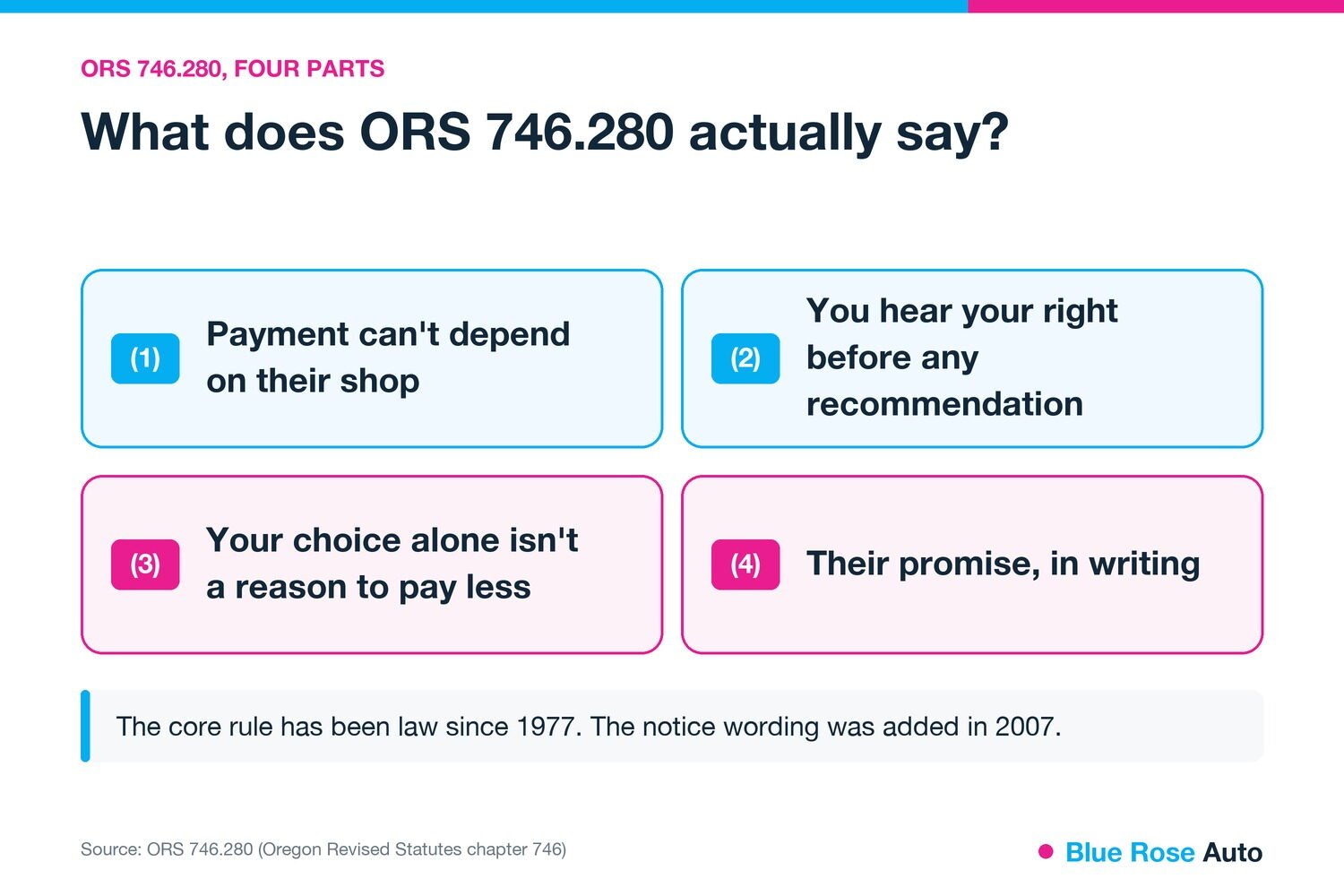
Here is how each part of the law on picking a body shop in Oregon reads at the front counter.
| Subsection | Statute (short quote) | In plain English |
|---|---|---|
| 746.280(1) | “may not require that a particular person make the repairs” | Payment can’t depend on their shop |
| 746.280(2) | A statement “substantially similar to” the notice | You hear your right before any recommendation |
| 746.280(3) | No cost limit “other than as stated in the policy or as otherwise allowed by law” | Your choice alone isn’t a reason to pay less |
| 746.280(4) | A statement “within three business days” | Their promise, in writing |
The short version is that you pick the shop, and the policy still sets the money.
(1) No required shop
Watch the words “as a condition for recovery.” Suggesting a shop is fine. Tying your payment to it isn’t.
(2) The notice before any recommendation
It opens “Prior to providing a recommendation.” Notice first, always.
(3) If you pick a different shop
“If an insured elects to have the motor vehicle repaired at a motor vehicle repair shop other than a shop recommended by the insurer, the insurer may not limit the cost of repairs necessary to return the motor vehicle to a preloss condition relative to safety, function and appearance other than as stated in the policy or as otherwise allowed by law.”
People misread this both ways. It doesn’t make your insurer pay whatever your shop charges, and your deductible and limits still count.
(4) If you accept their shop
Say yes to the insurer’s shop and it owes you, “within three business days after the date of acceptance,” a statement in substantially this form.
WE HAVE RECOMMENDED A MOTOR VEHICLE REPAIR SHOP. IF YOU AGREE TO USE OUR RECOMMENDED REPAIR SHOP, YOUR VEHICLE WILL RECEIVE REPAIRS RETURNING IT TO A PRELOSS CONDITION RELATIVE TO SAFETY, FUNCTION AND APPEARANCE AT NO ADDITIONAL COST TO YOU OTHER THAN AS STATED IN THE INSURANCE POLICY OR AS OTHERWISE ALLOWED BY LAW.
Keep it with your claim file.
Does it apply if the other driver’s insurer pays?
Yes. Oregon’s Division of Financial Regulation rule OAR 836-080-0240 says an insurer “shall not make such a requirement for the repair of a third party claimant’s automobile as a condition for claim payment.” So the other driver’s insurer can suggest a shop but can’t make payment depend on you using it.
First-party claims go on your own policy. Third-party claims go against the at-fault driver’s coverage. ORS 746.280 speaks only of “the insured,” so section (12) of OAR 836-080-0240 carries the rule over, and section (14) lists (12) among the parts that “also apply to third party claimants.”
What if their network shop is far away?
Section (9) says an insurer “shall not require unreasonable travel of a claimant … to obtain a repair estimate or to have the automobile repaired at a repair shop.” Under OAR 836-080-0210, “claimant” includes “any first party claimant and any third party claimant.” “Unreasonable” isn’t defined, and we won’t invent a mileage. A long drive? Ask for another option in writing.
What can your insurer still do if you choose?
Choosing your own shop doesn’t switch off the insurer’s rights. Under ORS 746.295 it can still set proof-of-loss rules, investigate, decide the amount of the loss and negotiate the repair, and Oregon shops must let it reinspect the car during business hours. Your policy’s terms, such as the deductible, still apply.
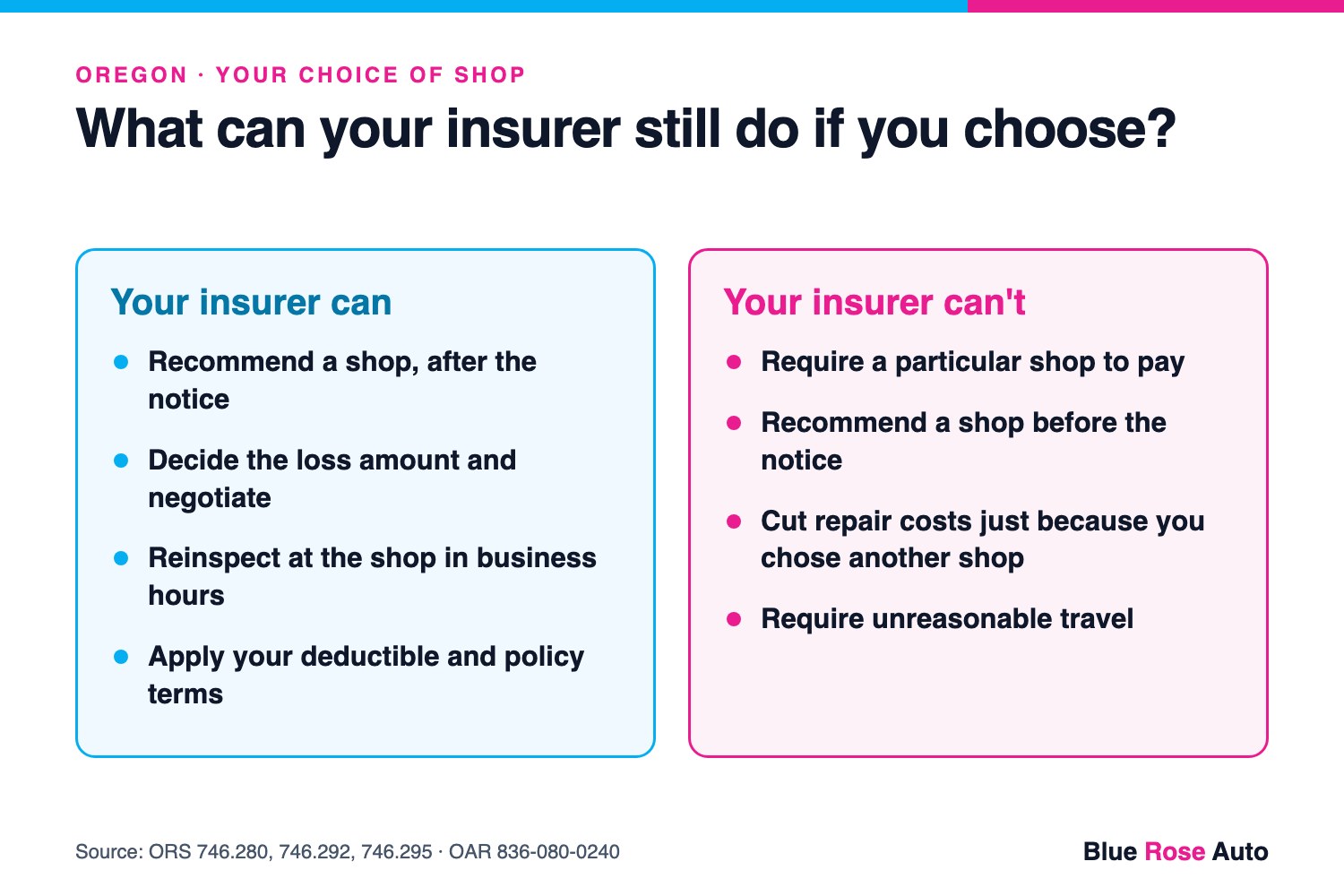
Here’s what an Oregon insurer can and can’t do once you pick your own shop.
| Your insurer can | Your insurer can’t |
|---|---|
| Recommend a shop, after the notice | Require a particular shop to pay (746.280(1)) |
| Set proof-of-loss rules and investigate (746.295) | Recommend a shop before the notice (746.280(2)) |
| Decide the loss amount and negotiate (746.295) | Cut repair costs just because you chose another shop (746.280(3)) |
| Reinspect at the shop in business hours (746.292(4)(d)) | Require a shop for a third-party claimant (OAR 836-080-0240(12)) |
| Apply your deductible and policy terms (746.280(3)) | Require unreasonable travel (OAR 836-080-0240(9)) |
| Use certified-equivalent aftermarket parts (746.287) | Require uncertified aftermarket crash parts without your consent (746.287(1)) |
Your choice is protected. No shop gets a blank check.
DFR warns, “If you choose the most expensive shop in town, the insurance company may not be willing to pay the whole amount.” Our guide to what collision insurance covers explains deductibles and limits. And under OAR 836-080-0240(11), any estimate must be “in the amount for which the damage may reasonably be expected to be satisfactorily repaired.”
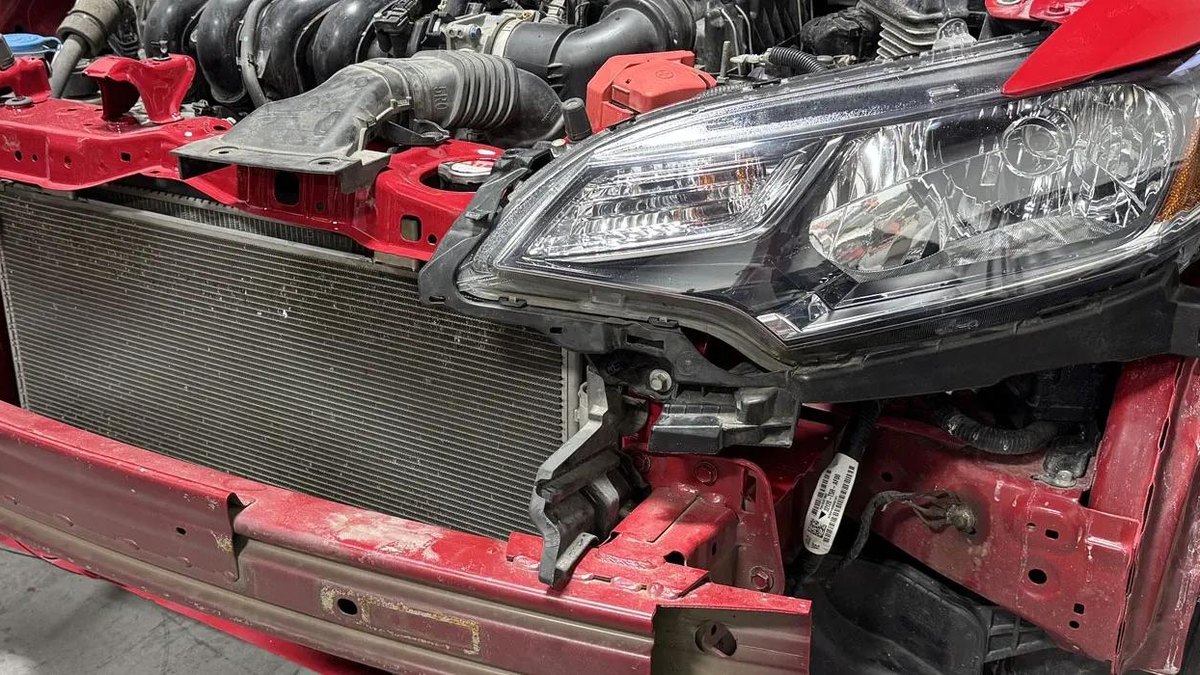
How estimates usually go. The insurer’s first estimate is often written from photos or a quick look, before anyone pulls the bumper cover. Open the car up and it’s common to find more, maybe a cracked headlamp mount or a bent bumper reinforcement, and that work goes back to the insurer as a supplement. First numbers move.
Two things Oregon law doesn’t promise
- Factory parts. There’s no general Oregon right to OEM parts. DFR says insurers “can opt for aftermarket or recycled parts instead.” ORS 746.287 only bars requiring, without your consent, aftermarket crash parts not certified “at least equivalent” by an independent test facility.
- A rental car. Nothing in ORS 746.275 to 746.300 grants one. It comes from your policy’s rental coverage, if you bought it.
Why do insurers recommend certain body shops?
Mostly because of direct repair programs. The Insurance Information Institute (Triple-I) says, “A DRP is a network of auto repair shops and dealerships approved by an insurer,” and adds that consumers “are not required to use a direct repair program.”
The insurer’s case isn’t empty. Triple-I says insurers “offer a lifetime guarantee on workmanship to customers who decide to use the DRP shops” (check what yours promises). The Hartford, an insurer, says an approved shop “can save you time and possibly money.” Its list also includes less paperwork and a possible break on your deductible, plus help extending a rental when hidden damage stretches the job.
Our take? Plenty of network shops do good work. The law just leaves the pick to you.
Here is how an insurer’s network shop compares with a body shop you pick yourself in Oregon.
| Insurer’s network (DRP) shop | A shop you choose | |
|---|---|---|
| Written insurer promise | Within 3 business days (746.280(4)) | None; ask before signing (DFR) |
| Insurer’s role in quality | Works with the shop on pre-loss repair (DFR) | Not responsible (DFR) |
| Workmanship guarantee | Lifetime, per Triple-I (check your terms) | The shop’s own warranty |
| Cost limits | Policy terms | Policy terms, plus DFR’s pricing warning |
What does insurance steering sound like?
Steering is when an insurer pushes you toward its own network shop in a way that makes your choice feel like it isn’t really yours, for example by suggesting your claim won’t be paid if you go elsewhere. Oregon law lets an insurer recommend a shop, but not require one. That’s the line.
Here are lines a driver might hear, and the fact that answers each.
- “You’ll have to pay the difference if you go elsewhere.” Under ORS 746.280(3), your choice alone can’t limit preloss repair costs. Ask for any difference in writing.
- “We can’t guarantee the repair at another shop.” True enough. DFR says insurers aren’t responsible for out-of-network repairs, so ask your shop about its warranty.
- “Our shop is the only one we work with.” Preferring a network is allowed. Making it a condition of payment isn’t (746.280(1)).
- “Approval takes longer somewhere else.” Maybe. The insurer still inspects and negotiates wherever the car sits (746.295).
A calm way to answer your adjuster
“I’d like my car repaired at [shop name]. I understand Oregon law, ORS 746.280, lets me choose the repair shop. Please send your estimate to them and let me know how you’d like to handle the inspection.”
No threats, no lawyers. A follow-up email gives you a dated record.
What should you do before signing a repair authorization?
Settle the money with your insurer before a shop touches the car. DFR advises, “Before you sign a contract with the repair shop, notify your insurer and make sure you understand what the insurance company will pay.” These six steps build on that.
- Tell your insurer which shop you chose. The adjuster needs it to route the estimate and inspection.
- Ask what the insurer will pay. Confirm your deductible, and whether the check goes to you, the shop or both.
- Get a written estimate first. Under ORS 746.292(2), a body and frame shop must write one on request and can’t charge more “without the consent of such customer.”
- Ask how added damage is handled. Who tells you, and who approves it? Here’s what to expect once your car is in the shop.
- Check complaints. DFR suggests the Better Business Bureau and the Oregon Department of Justice.
- Look for the wall sign. ORS 746.285 makes every body and frame shop post, “in letters at least two inches high,” that an insurer “MAY NOT REQUIRE THAT REPAIRS BE MADE TO A MOTOR VEHICLE BY A PARTICULAR PERSON OR REPAIR SHOP.”
At pickup, remember DFR’s tip. “Make sure you are satisfied with the finished work before the insurance company pays the repair shop.”
What if you think an insurer broke the rule?
Insurer complaints go to the Oregon Division of Financial Regulation, through the online form on DFR’s complaint page, the Consumer Hotline at 888-877-4894 (toll-free) or DFR.InsuranceHelp@dcbs.oregon.gov. DFR is upfront about its limits. “We are not attorneys and cannot act as your legal representative.”
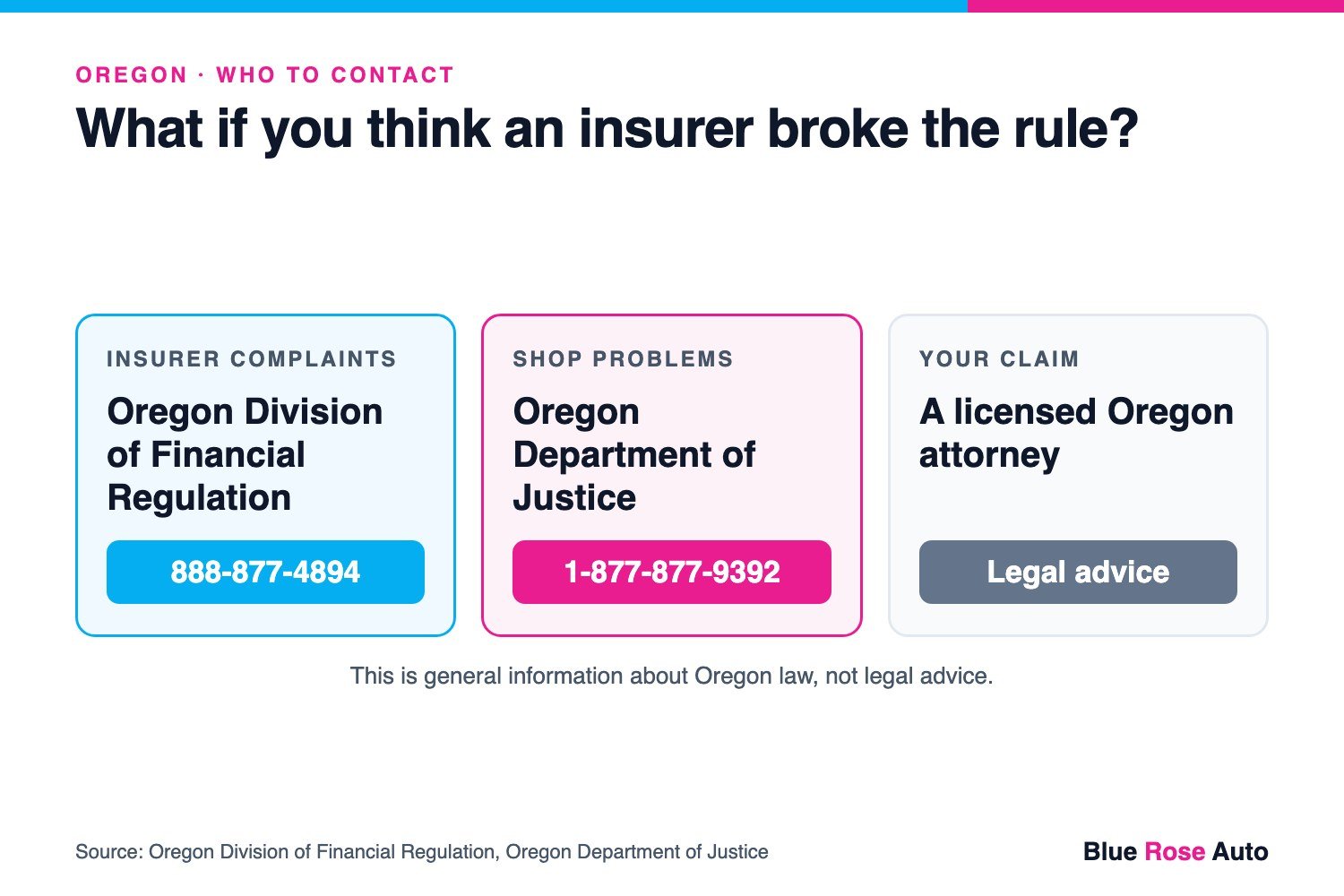
Shop problems go to the Oregon Department of Justice, at 1-877-877-9392 on weekdays or the form on its consumer protection contact page.
Two statutory facts, no advice attached. ORS 746.991 says “Violation of ORS 746.280 to 746.292 is a Class D violation.” ORS 746.300 says an insured whose insurer violates ORS 746.280 or 746.290 “may file an action to recover actual damages or $100, whichever is greater, for each violation,” and the court may award reasonable attorney fees to the prevailing party. Whether that fits your claim is a question for a licensed Oregon attorney, not a body shop.
This is general information about Oregon law, not legal advice. For a dispute about your claim, contact the Oregon Division of Financial Regulation or a licensed Oregon attorney.
How does Blue Rose handle insurance repairs?
Blue Rose Auto opened in 1994 and works from a shop at 3436 Olympic St in Springfield, about 15 minutes from downtown Eugene via I-105. Our ASE-certified technicians handle collision repair and auto body work, and our mechanical, collision, wrap, PPF and ceramic coating work carries a 3-year/36,000-mile warranty. We tell you what we find before any part gets ordered.
We also help with the insurance side to keep approvals moving, and we explain how auto body and collision repair works at our shop. Blue Rose Auto is a Tesla Approved Body Shop, so Tesla owners can have structural and cosmetic repairs done to Tesla’s standards. If your insurer suggested another shop, you can still call us. We write up an estimate and work with the insurer you have.
Frequently asked questions
Can I choose my own body shop in Oregon if insurance is paying?
Yes. ORS 746.280(1) bars an insurer from making a particular shop a condition of paying, and DFR answers “No” when asked whether you must use the shop your company recommends. Your deductible and limits still apply, since subsection (3) keeps whatever is “stated in the policy.”
What happens if the insurance estimate is lower than my body shop’s?
The insurer and your shop can negotiate the difference. The insurer can inspect and negotiate under ORS 746.295, and damage found after teardown goes back to it as a supplement. Get both estimates in writing and ask the adjuster to explain any line it won’t pay.
Will my insurance pay me directly or the repair shop?
It depends. Your policy sets the rules, and a lender with an interest in the car can be named too, which is why a check sometimes lists more than one party. Ask your insurer how it will pay before repairs begin. DFR advises being satisfied with the work before the shop is paid.
What does DRP mean at a body shop?
Direct repair program. Triple-I calls it “a network of auto repair shops and dealerships approved by an insurer,” meaning the insurer has already agreed to work with those shops. Consumers aren’t required to use one, Triple-I says, and in Oregon ORS 746.280 puts that into law.
Does the body shop have to let the adjuster inspect my car?
Yes. Under ORS 746.292(4)(d), an Oregon body and frame shop can’t refuse an insurer or its agents “reasonable access” to inspect or reinspect the damaged vehicle “during usual business hours.” Choosing your own shop changes where the inspection happens, not whether it does.
Can I switch body shops after repairs start?
ORS 746.280 doesn’t address switching mid-repair. Call your insurer before the car moves. Ask what you’ll owe the first shop for work done and parts ordered, and get the new shop’s written estimate before it starts. Your policy governs how the insurer handles the change.
If I’m not at fault, can I still pick the shop?
Yes. OAR 836-080-0240(12) applies the no-required-shop rule to a third-party claimant’s car, and section (14) confirms it. So the other driver’s insurer can recommend a shop but can’t tie payment to it. Its travel limit in section (9) applies to you as well.
Can my insurer make me use aftermarket parts?
Oregon law doesn’t give you a general right to factory parts. Under ORS 746.287, though, an insurer can’t require aftermarket crash parts without your consent unless an independent test facility has certified them at least equivalent to the part being replaced. Your shop’s written estimate must also say when a part isn’t from the original maker.
What is insurance steering?
Steering means pushing you toward the insurer’s network shop so strongly that the choice stops feeling like yours, for example by hinting your claim won’t be paid elsewhere. Oregon lets an insurer recommend a shop after giving the required notice, but ORS 746.280(1) bars making that shop a condition of payment.
Who do I contact if my insurer ignored my choice of shop?
Start with the Oregon Division of Financial Regulation, which handles insurer complaints through its online form or its Consumer Hotline at 888-877-4894. Problems with a repair shop go to the Oregon Department of Justice. For a dispute over your own claim, a licensed Oregon attorney can advise you, since DFR cannot act as your legal representative.
Choosing a shop for your claim?
Blue Rose Auto is at 3436 Olympic St in Springfield, with ASE-certified technicians, and opened in 1994. Call (541) 641-8877, contact us online, or get a written collision repair estimate, whichever insurer is on the claim.
0 Comments