Commercial Vehicle Wraps and Fleet Graphics in Lane County, OR
Blue Rose Auto Care & Repair Services wraps commercial vehicles and fleets from its shop at 3436 Olympic St in Springfield, Oregon, serving Lane County since 1994. Full commercial wraps generally run $2,500 to $6,500 per vehicle. Partial wraps cost 40 to 60 percent less. Call (541) 641-8877.
Commercial Wraps Built for Working Vehicles
A work truck earns its keep twice. It hauls the crew and the tools, and it carries your name past a few thousand people on the way to the job. Most of the owners who call us are stuck between those two facts. They know the van should be branded, they have a number in their head, and every shop they have phoned so far told them to come in for a quote.
Blue Rose Auto Care & Repair Services wraps commercial vehicles and fleets across Lane County out of its Springfield shop, and we have worked on vehicles here since 1994. Typical market rates for a full wrap run $2,500 to $6,500 per vehicle depending on size and film grade. Partial wraps cost 40 to 60 percent less, and multi-vehicle fleets usually see 10 to 20 percent off per unit. Federal rules require a carrier's legal name and USDOT number on both sides of the power unit, in letters at least two inches tall and legible from fifty feet, though vehicles at or under 26,000 pounds running intrastate private carriage are generally exempt. Because collision repair, paint, and detailing all happen in this building, the panel under the vinyl can be corrected before anything gets printed. The shop is ASE certified and holds a 4.9-star rating across 884 Google reviews.
Reviewed by Treston Ducker, President, Blue Rose Auto Care & Repair Services. Last updated: August 2026.

Our Commercial Wrap Services
Full Vehicle Wraps
Vinyl over the whole body, seams and recesses included. The most visible option, and the one that hides a tired paint job while it advertises.
Partial Wraps and Decals
Doors, rear panels, quarter panels. The high-visibility real estate without the full-body price. For a lot of two-van operations this is the right answer, not the cheap one.
Vehicle and DOT Lettering
Company name, phone, license and USDOT numbers, cut and applied to spec. Where most new owner-operators start, and the fastest job on this list.
Fleet Graphics
Several vehicles built off one design, so a customer recognizes the third truck as fast as the first. We stage fleets so your crews keep working.
Color-Change and Custom Wraps
For personal vehicles and show trucks rather than branded fleet work: chrome delete, color change, roof and accent wraps. See color-change and custom vehicle wraps.
Commercial Wraps Across Lane County
Springfield
Our home city, ten minutes from the bay. Thurston, Glenwood, Gateway, Downtown, and the 97477, 97478, and 97475 ZIPs. See commercial wraps in Springfield.
Eugene
The same work for businesses based on the Eugene side, with fleet scheduling built around a west-side commute. See commercial wraps in Eugene.
Ring Towns
Junction City, Coburg, Creswell, Veneta, Cottage Grove, Harrisburg, and Lowell, roughly fifteen to twenty-five minutes out.
Custom Paint
When the panel needs refinishing rather than covering, our custom paint work happens in the same building.
Paint Protection Film
Clear film for high-impact panels on vehicles you would rather not wrap. See paint protection film.
What Does a Commercial Wrap Cost in Lane County?
Nobody local publishes wrap prices, which is why every quote feels like a negotiation. These are typical 2026 market ranges for our region. Honest brackets, not a quote, because the real number depends on how much of the vehicle gets covered and how awkward the panels are.
| Vehicle | Full wrap | Partial wrap |
|---|---|---|
| Cargo van (Transit, ProMaster) | $3,500 to $5,500 | $1,400 to $3,300 |
| High-roof van (Sprinter, Transit high-roof) | $4,000 to $7,000 | $1,600 to $4,200 |
| Box truck / straight truck | $4,000 to $6,500 | $1,600 to $3,900 |
| Pickup (F-250 and similar) | $2,500 to $4,500 | $1,000 to $2,700 |
| Fleet, per vehicle | $2,500 to $6,500 | 40 to 60% less |
Two things move those numbers more than anything else. Fleets of several vehicles usually earn 10 to 20 percent off per unit, because the design work happens once and the print run is continuous. And a box truck's flat sides are cheap surface to cover next to a van full of curves and recesses. More square footage, less labor. If the roll-up door has to be part of the design, say so early. It changes the material.
Ask what your vehicle would cost: (541) 641-8877.
Full Wrap, Partial Wrap, or Lettering: Which Do You Need?
This is the question we field most, usually phrased as "how are wraps different from graphics." They are points on a scale, and plenty of businesses buy more coverage than the job needs.
| Coverage | Relative cost | Best for | Typical life | |
|---|---|---|---|---|
| Lettering | Name, phone, DOT numbers | Lowest | Owner-operators, compliance, trades that sell on word of mouth | Longest, small vinyl and few seams |
| Partial wrap | Doors, rear, quarter panels | 40 to 60% below full | Two-to-five vehicle operations needing presence on a budget | Long, less exposed area |
| Full wrap | Entire body | Highest | Consumer-facing brands, faded paint, fleets that must match | Shortest of the three, still years |
A plumber who works off repeat business and referrals may need nothing beyond clean lettering and a phone number people can read at a light. A home-services brand pushing into a new neighborhood is buying attention, and a full wrap buys more of it. If you are torn, a partial wrap on the highest-traffic panels is the option people regret least.
Does Your Truck Need DOT Lettering?
If you operate a commercial motor vehicle, federal rules require your carrier's legal name and USDOT number on both sides of the power unit, in letters at least two inches tall, in a color that contrasts sharply with the background, readable from fifty feet in daylight while the truck is parked.
- Both sides of the power unit. Not the trailer, the unit pulling it.
- Two-inch minimum letter height, contrasting color, legible at fifty feet.
- Leased or owner-operator vehicles show the lessor or owner's name, then "Operated by", then the operating carrier's name and USDOT number.
Generally exempt: vehicles at or under 26,000 pounds gross combination weight rating used only in intrastate private carriage. Required regardless: vehicles placarded for hazardous materials, and passenger vehicles seating 15 or more including the driver.
Oregon follows the federal marking rules. ODOT's Commerce and Compliance Division publishes the state's own cab-marking guidance plus a question-and-answer sheet worth reading before you order anything. Between that and Oregon's weight-mile tax program, operators here tend to be more marking-aware than most, which suits us fine. Getting lettering wrong means cutting it twice.
Sources: FMCSA marking requirements (49 CFR 390.21); Oregon Department of Transportation, Commerce and Compliance Division, Truck Cab Marking Requirements.


How the Wrap Process Works, Step by Step
- Quote. Bring the vehicle by, or send the year, make, model, and body style with a note on how much coverage you want. We talk through full versus partial before anyone talks money.
- Design proof. We need your logo as vector artwork: an AI, EPS, or SVG file. A low-resolution JPEG can usually be rebuilt, but that is design time, so mention it up front. Nothing prints until you sign off on a proof.
- Print. Cast vinyl with an overlaminate over it. The laminate is not an upsell. It is the layer that takes the UV and the abrasion instead of your artwork.
- Surface prep. The vehicle arrives clean and we clean it again: a wash, then a solvent wipe on every surface that will take adhesive. This step decides whether the wrap is still tight in three years.
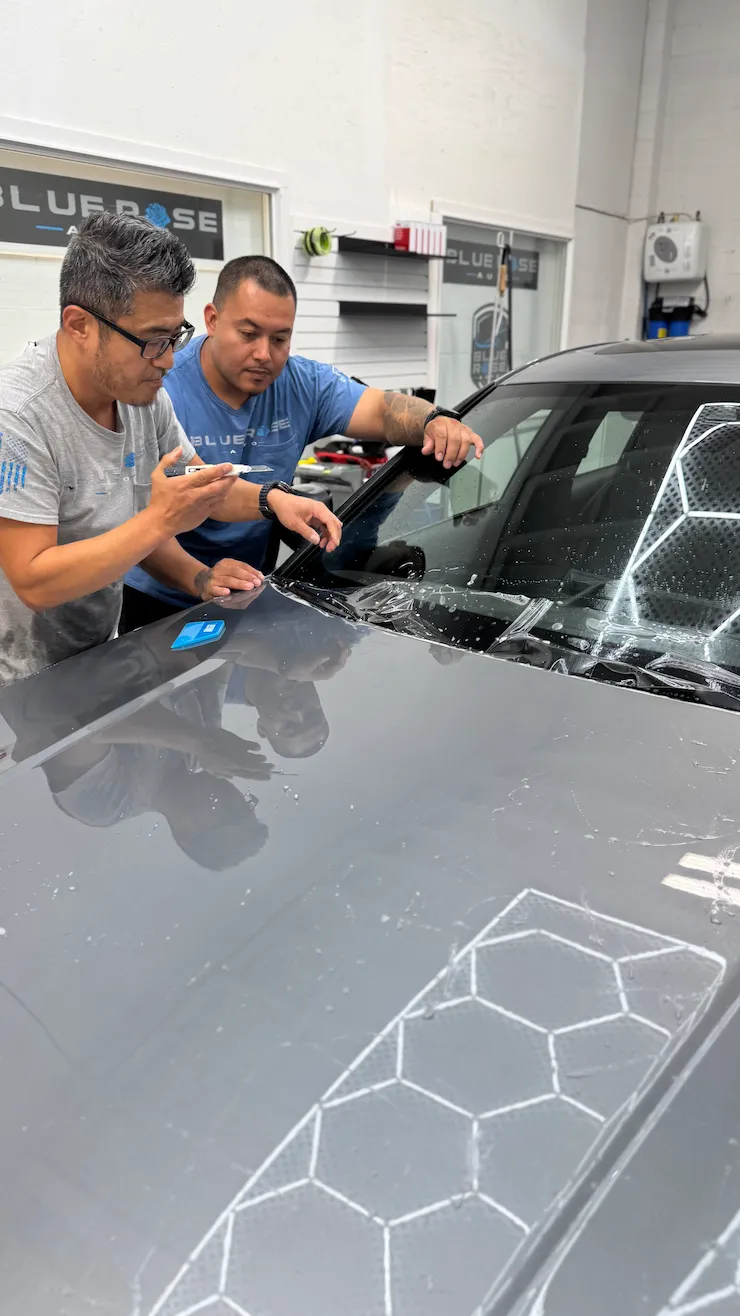
- Install. Panels laid, seams and recesses worked, rivets brushed, edges post-heated so they stay down. Post-heating is the difference between an edge that holds and one that lifts in a wet winter.
- Inspection and handover. We walk the vehicle with you, point out the seams, explain how to wash it. Then it goes back to work.
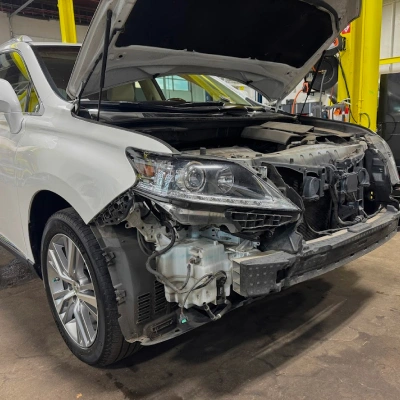
One honest note on what we turn away. Vinyl needs sound paint underneath it. Failing or peeling clearcoat, active rust, or a previous repair nobody did properly will telegraph through a wrap, or pull the wrap off with it. If that is what we find, we say so. And because the body shop and paint booth are in this building, we can quote fixing it instead of sending you across town.
Keeping Your Fleet on the Road While We Wrap It
Yes, we can wrap a fleet without taking every vehicle at once. Vehicles come through one at a time on scheduled drop-offs, so your crews keep working, and once your design is set up each additional truck is a print and an install rather than a new project.
Downtime is the real cost of a fleet wrap, and it is the part nobody quotes. How we handle it:
- One vehicle at a time, by arrangement, so your crews keep working.
- Scheduled drop-offs instead of an open-ended "leave it with us."
- Saturday hours, 10 to 5, for when a vehicle cannot come off the road midweek.
Repeat runs come off the same design. Once your artwork is set up, adding the next truck is a print and an install, not a new project.

Why Wrap at a Full-Service Auto Shop
Because the wrap is only as good as the panel under it. A sign shop can print and install, but it cannot correct chalky paint, lifting clearcoat, or a bad prior repair, and vinyl telegraphs all three.
Every other wrap shop in this market is a sign and print business. They design, print, and install, and some do it well. What they cannot do is anything to the panel underneath.
- The panel comes first. Chalky paint, lifting clearcoat, a door somebody else repaired badly: no vinyl fixes any of that. We can correct or repaint it, then wrap it, without moving the truck.
- Collision and wrap in one visit. If a truck is already here for body work, the wrap or the re-lettered panel can happen before it leaves.
- The same shop for what comes next. Paint protection film, ceramic coating, detailing, and mechanical work all live here, so the vehicle keeps one history and one point of contact.
One drop-off, not two vendors and two schedules.

What Wrap Advertising Is, and What It Is Not
Worth clearing up, because the phrase has been poisoned. The scam people have read about is an offer to pay you for driving a car wrapped in somebody else's advertising, usually with an upfront payment or a fake check involved.
That is not this. We wrap your vehicle with your own branding. You own the graphics, you keep the vehicle, and nobody pays anybody to drive around. The only money moving is you paying for a wrap, once, on a truck you already own.

How Long a Wrap Lasts in Willamette Valley Weather
Our climate treats vinyl better than most of the country does. The Valley takes 45 to 50 inches of rain a year, nearly all of it between October and May, and we get neither the UV load of the Southwest nor the road salt of the Midwest. What we do get is months of moisture. Moisture goes after edges and seams, not the middle of a panel.
- Install season matters. Most wrap work here books June through September, when panels are dry and warm enough to bond properly.
- Edges are the weak point. Post-heated, properly sealed edges are what carry a wrap through a wet winter.
- Wash by hand where you can. Keep pressure washers back from seams and off the edges entirely.
- Cast film with laminate lasts. Calendared film without it does not. If a quote comes in far below everyone else, that is usually why.
When something does go wrong, it is normally one of these:
| What you notice | Usual cause | What we do |
|---|---|---|
| Edges lifting on a door | Under-prepped surface, or an edge nobody post-heated | Re-prep and re-seat, or replace the section if the adhesive is spent |
| Bubbles across a flat panel | Air trapped on install, or film applied too cold | Relieve and re-seat small ones, reprint the panel if it is widespread |
| Color gone chalky in a year | No overlaminate, or calendared film where cast was needed | Assess the film, reprint in cast with laminate |
| Cracking around rivets | Rivets never brushed or heat-set | Rivet-brush and heat-set, or replace the panel |
| Lettering too small to pass | Marking below the two-inch rule | Re-cut to spec |
Commercial Wrap FAQs
How much does a commercial vehicle wrap cost in Springfield?
A full commercial wrap generally runs $2,500 to $6,500 per vehicle, with cargo vans around $3,500 to $5,500 and box trucks $4,000 to $6,500. Partial wraps cost 40 to 60 percent less, and fleets usually see 10 to 20 percent off per unit. The variables are coverage, vehicle size, and how complex the panels are. Call with your year, make, and model and we will give you a real number.
How long will my vehicle be off the road?
Plan on a scheduled drop-off rather than a same-day job. Printing happens before the vehicle arrives, then prep and installation run in one continuous stretch so nothing sits half-finished between stages. For fleets we stage vehicles one at a time by arrangement, so you are never without the whole fleet.
Full wrap, partial wrap, or lettering: which do I actually need?
It depends on how much of the vehicle needs to work as signage. Lettering covers your name, number, and DOT compliance, and costs the least. A partial wrap puts graphics on the doors, rear, and quarter panels for 40 to 60 percent below a full wrap. A full wrap covers the body, makes the strongest impression, and hides paint that has seen better days.
Do I need a USDOT number on my truck in Oregon, and how big does it have to be?
If you run a commercial motor vehicle, federal rules require your legal name and USDOT number on both sides of the power unit in letters at least two inches tall, contrasting with the background and readable from fifty feet. Vehicles at or under 26,000 pounds GCWR in intrastate private carriage are generally exempt, though placarded hazmat vehicles and passenger vehicles seating 15 or more are not. Oregon follows the federal rules, and ODOT publishes its own cab-marking guidance.
How long does a commercial wrap last in Oregon weather?
Longer than in a hot, high-UV market, provided the edges were done right. The Valley's 45 to 50 inches of annual rain works on seams and edges rather than fading the surface, so post-heated edges and a proper overlaminate matter more here than sun protection does. Hand-washing, and keeping pressure washers away from seams, adds years.
Still deciding? Call the shop at (541) 641-8877 with your year, make, and model and we will talk it through.

Get a Wrap Quote for Your Vehicle or Fleet
Tell us the year, make, model, and body style, how much coverage you are after, and send your logo as vector artwork if you have it. We will talk through full versus partial versus lettering before anyone talks price. If lettering is all you need, we will say so.
Blue Rose Auto Care & Repair Services, 3436 Olympic St, Springfield, OR 97478. Call (541) 641-8877. Monday to Friday 8 to 5, Saturday 10 to 5. ASE certified, 4.9 stars across 884 Google reviews, wrapping vehicles in Lane County since 1994.