
A clogged catalytic converter usually shows up as a car that loses power under load, gets worse fuel mileage and may throw a P0420 or P0430 code, sometimes with a rotten-egg smell from the tailpipe. Those signs also fit a bad oxygen sensor or a misfire, so the only way to confirm a clog is a backpressure, vacuum or temperature test. We run that diagnosis at Blue Rose Auto in Springfield, Oregon, and the first 15 minutes are free.
Last updated October 2026
Key takeaways
- Power loss that gets worse under load is the headline sign of a clogged converter.
- P0420 and P0430 say the catalyst is working below its efficiency threshold, not that it is clogged.
- A clog is confirmed by a backpressure, vacuum or temperature test, never by a code alone.
- The converter is usually the victim, so we fix the misfire, oil burn or sensor fault before we replace it.
What Does the Catalytic Converter Do
The catalytic converter is a canister in your exhaust system, between the engine and the muffler, that turns harmful exhaust gases into less harmful ones. Exhaust passes through a honeycomb-like brick coated with precious metals, and that brick gets very hot while it works. If the honeycomb blocks up, the engine has to push against its own exhaust, and it struggles to breathe.
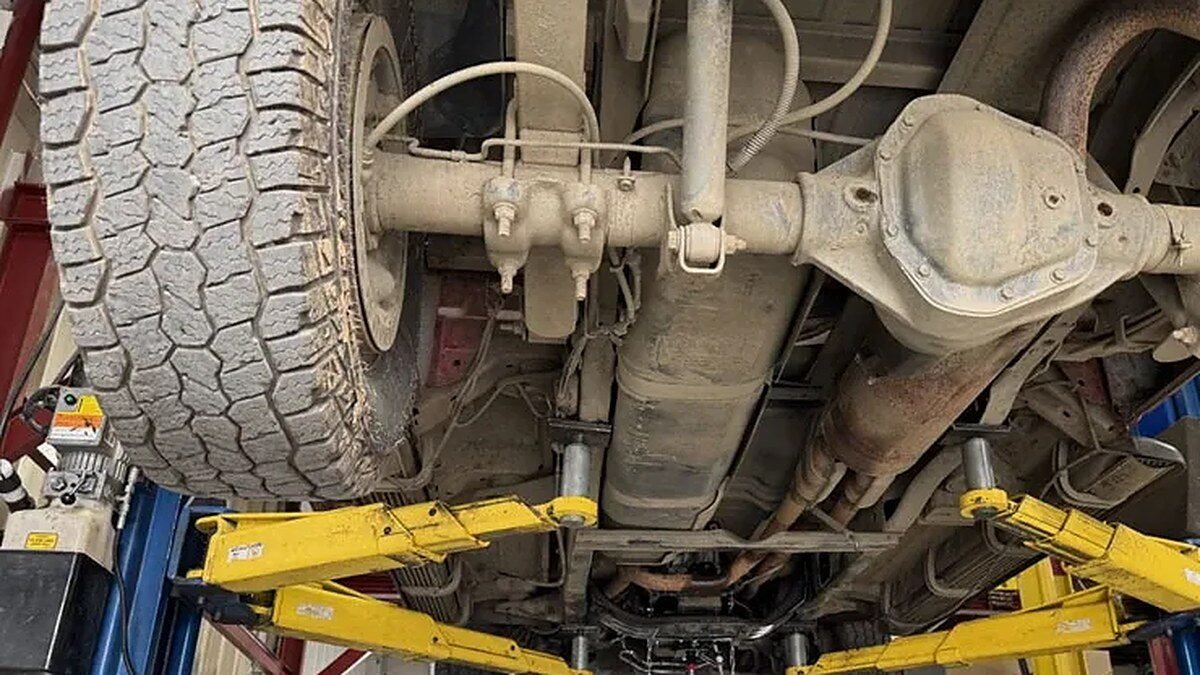
Two words get mixed up here. A clogged converter is restricted, so exhaust cannot flow through it. A failed converter no longer cleans the exhaust, even if gas still passes. A car can have one problem, the other or both, and the symptoms overlap, which is why we test before we recommend a part.
Clogged Catalytic Converter Symptoms at a Glance
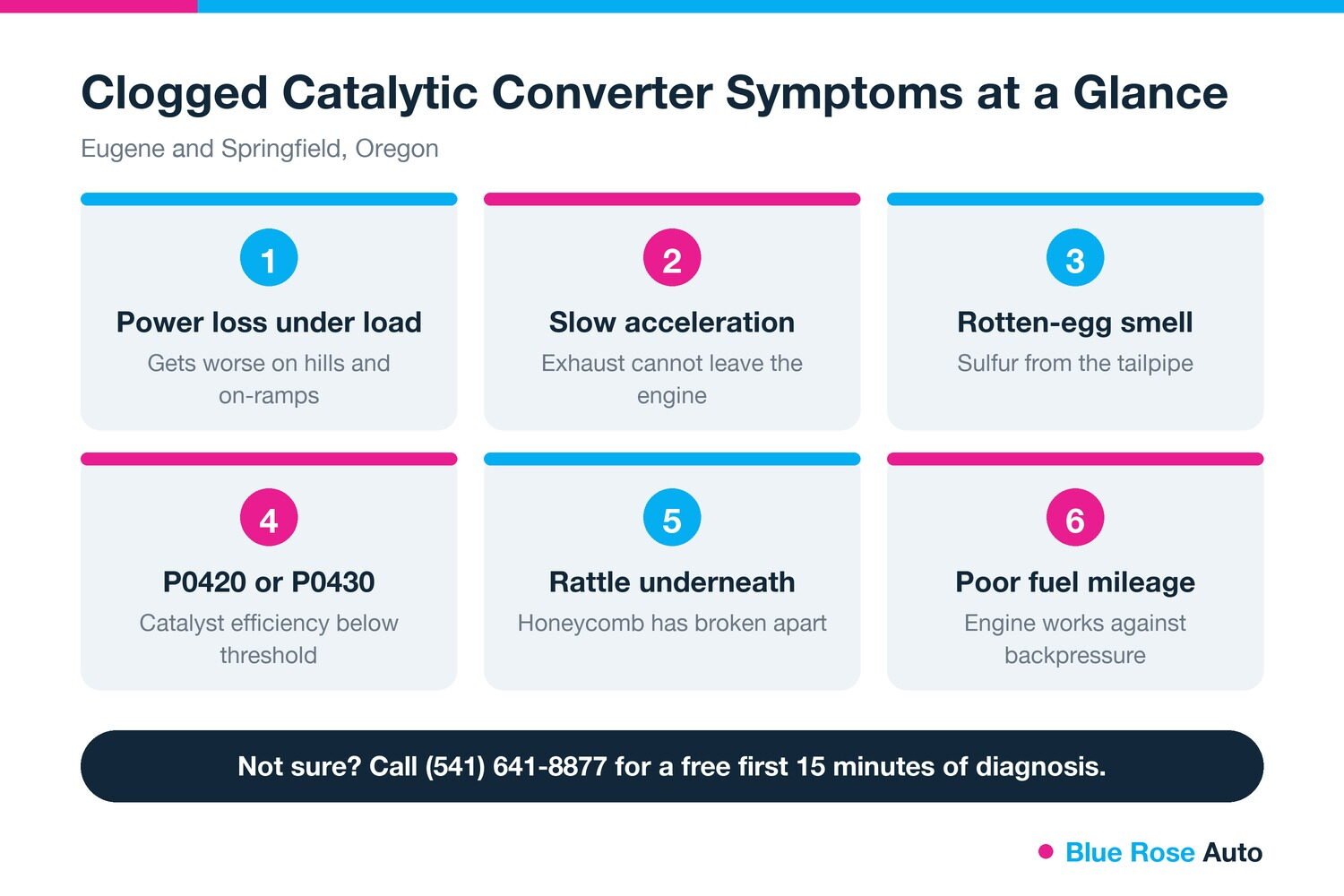
Drivers notice a handful of changes first, and the table below pairs each one with what it often means and what else it could be. Most of these signs also come from other faults, so treat the list as a reason to test, not a diagnosis.
| What you notice | What it often means | What else it could be |
|---|---|---|
| Power loss under load, and it gets worse on hills and on-ramps | Restricted exhaust flow from a clogged converter | Fuel delivery, ignition or a clogged air filter |
| Slow acceleration from a stop | The exhaust cannot leave the engine fast enough | Transmission or fuel problem |
| Rotten-egg smell from the tailpipe | Sulfur from the tailpipe because the converter is not processing it, often with a rich mixture | Fuel system fault |
| Check engine light with P0420 or P0430 | Catalyst efficiency below threshold | Bad oxygen sensor, misfire, exhaust leak |
| Rattle underneath, worse at idle or on startup | The honeycomb has broken apart inside the converter | Loose heat shield or exhaust hanger |
| Poor fuel mileage | The engine works against backpressure | Tires, sensors, driving pattern |
| Hard starting, stalling or no start | Severe blockage, which is rare | Fuel pump, ignition, battery |
| Heat under the car and a hot floor | Overheated converter | Exhaust leak or a dragging brake |
| Failed emissions test | Converter not cleaning exhaust | Misfire, sensor or fuel fault |
Not sure? Call (541) 641-8877 for a free first 15 minutes of diagnosis. The symptom lists above follow what AA1Car, Rick’s Free Auto Repair Advice and O’Reilly Auto Parts publish, reworded from what we see in the bay.
How Can You Tell If a Catalytic Converter Is Clogged
You tell by how the car drives, what it smells like and what the computer reports, and then you confirm with a test. These are the signs we look for first when a car comes in with a suspected clog.
Main Signs to Watch For
Six signs account for most of the converter calls we get, and the first five are the classic ones.
1. Loss of Power
You press the gas and the car feels tired. The engine may rev, but the car barely picks up speed, and it feels like pulling a trailer even when you are not. The loss is worse going up a hill or an on-ramp, because the engine needs the most air when it works hardest. A failing fuel pump, weak ignition or a clogged air filter can feel the same, so power loss alone does not prove a clog.
2. Sluggish Acceleration
Even from a stop sign, the car does not move the way it used to. The engine pulls air in and pushes exhaust out, and a blocked converter keeps the exhaust from escaping fast enough, so the next intake stroke gets less fresh air. Transmission and fuel problems cause slow acceleration too.
3. Strong Exhaust Smell
A rotten-egg or sulfur smell from the tailpipe can mean the converter is not processing sulfur in the fuel. A failing converter or a rich fuel mixture can cause it, and a fuel-system fault can as well. If you smell it more than once, get the car looked at.
4. Check Engine Light
The computer often flags a problem with the exhaust system before you feel anything. The codes that point at the catalyst are P0420 and P0430, and the section on what they really mean below explains why a code is a starting point and not a verdict. A scan may also show oxygen sensor or misfire codes, and those matter just as much.
5. Rattling Sound
A clogged catalytic converter sound is rarely a sound at all, because a blockage is quiet. A rattle under the car, especially on startup or at idle, usually means the internal brick has broken apart. That loose material is a different failure, but it can also block flow. A loose heat shield or exhaust hanger rattles in much the same way, so we look under the car before we blame the converter.
6. Hard Starting, Stalling or No Start
In a severe blockage the engine can hard-start, stall or die because exhaust has nowhere to go. It is rare, and a no-start is far more often a fuel, ignition or battery problem. If the car runs for a moment and then dies, and it also has the power loss above, tell us both things when you call.
Extra Catalytic Converter Clogging Symptoms
These show up less often, and each one can have other causes, so we treat them as clues.
- Overheating can happen because the engine works harder when exhaust cannot move, and heat builds up under the car.
- Poor fuel mileage can follow because the engine burns more fuel trying to make power.
- Rough idle can appear as extra shaking while the car sits still.
- Excess heat under the car can show as a hot floor or a hot smell after a drive, and it can also come from an exhaust leak.
- A failed emissions test can point at a converter that is not cleaning the exhaust. Lane County has no emissions test, so see the local section below.
- A dark or discolored converter housing can mean it has run hot.
Each of these signs can come from other problems too. That is why testing matters, and the next sections show what we check and what the readings mean.
What P0420 and P0430 Really Mean
P0420 means the catalyst system on bank 1 is working below its efficiency threshold, and P0430 is the same fault on bank 2. Bank 1 is the side of the engine with cylinder 1, and an inline engine has only one bank. The computer decides by comparing the oxygen sensor before the converter with the one after it, and when the two readings look too alike, it sets the code. P0420 and P0430 are the common ones among the catalyst codes (O’Reilly Auto Parts).
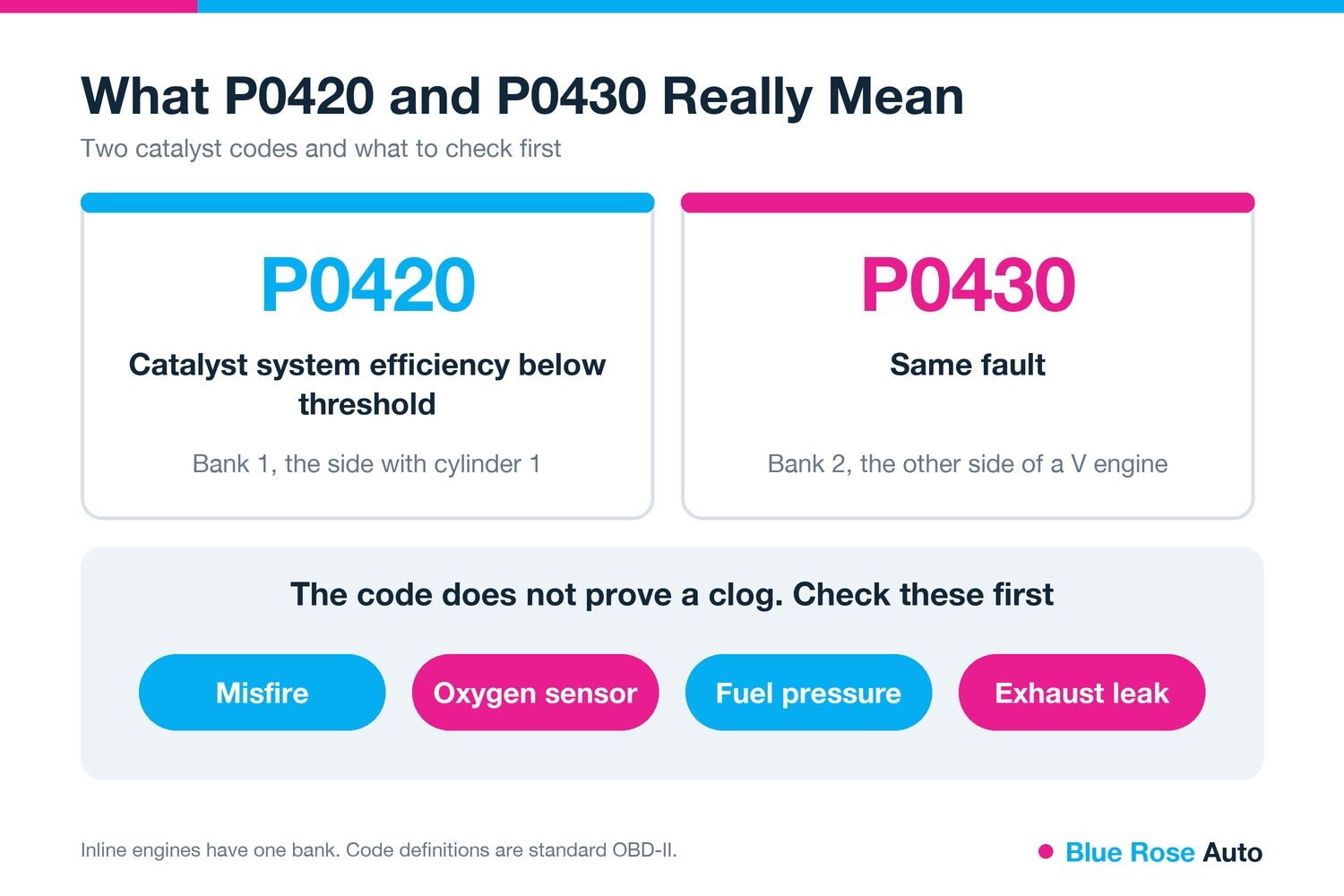
Two catalyst codes and what to check first. Bank 1, the side with cylinder 1, sets P0420. Bank 2, the other side of a V engine, sets P0430, which is the same fault. Inline engines have one bank. Code definitions are standard OBD-II.
The code does not prove a clog. Check these first, a misfire, an oxygen sensor, fuel pressure and an exhaust leak. Any one of them can set the code on a converter that is healthy. The code tells us where to look, not what to replace, and replacing a converter on a guess for a P0420 can cost real money.
How We Test for a Clogged Catalytic Converter
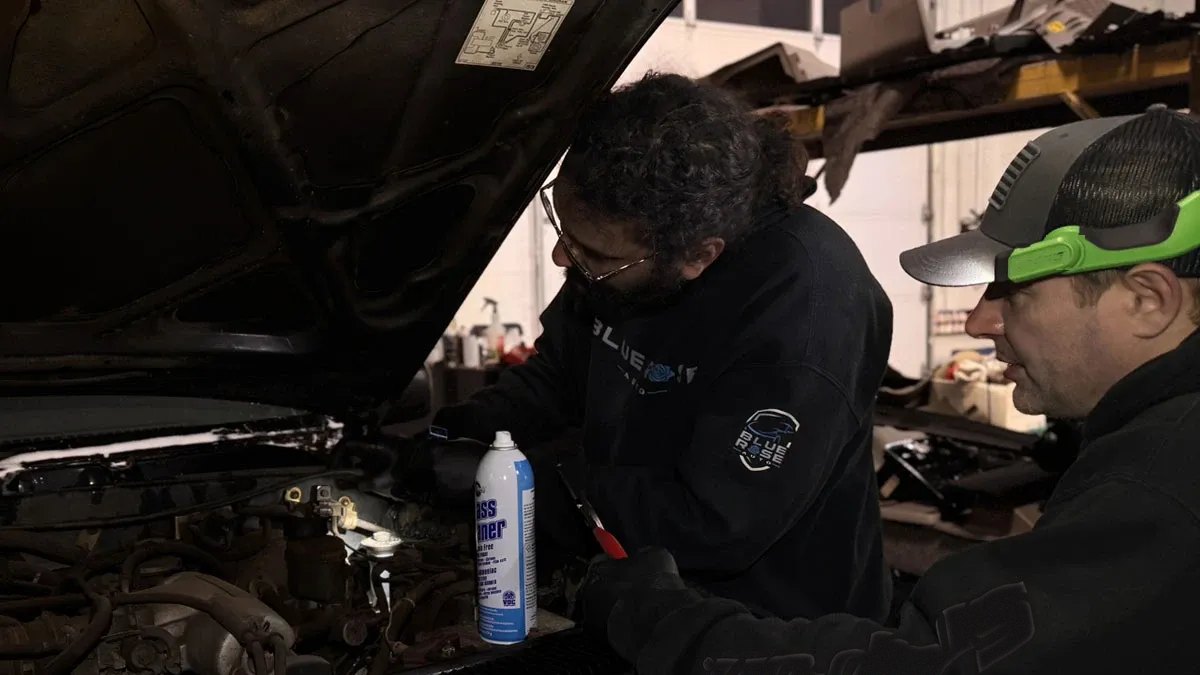
We confirm a clog with measurements, not guesses, and we start with the cheapest and fastest checks. We go in a set order, six steps from the scan to the quote.
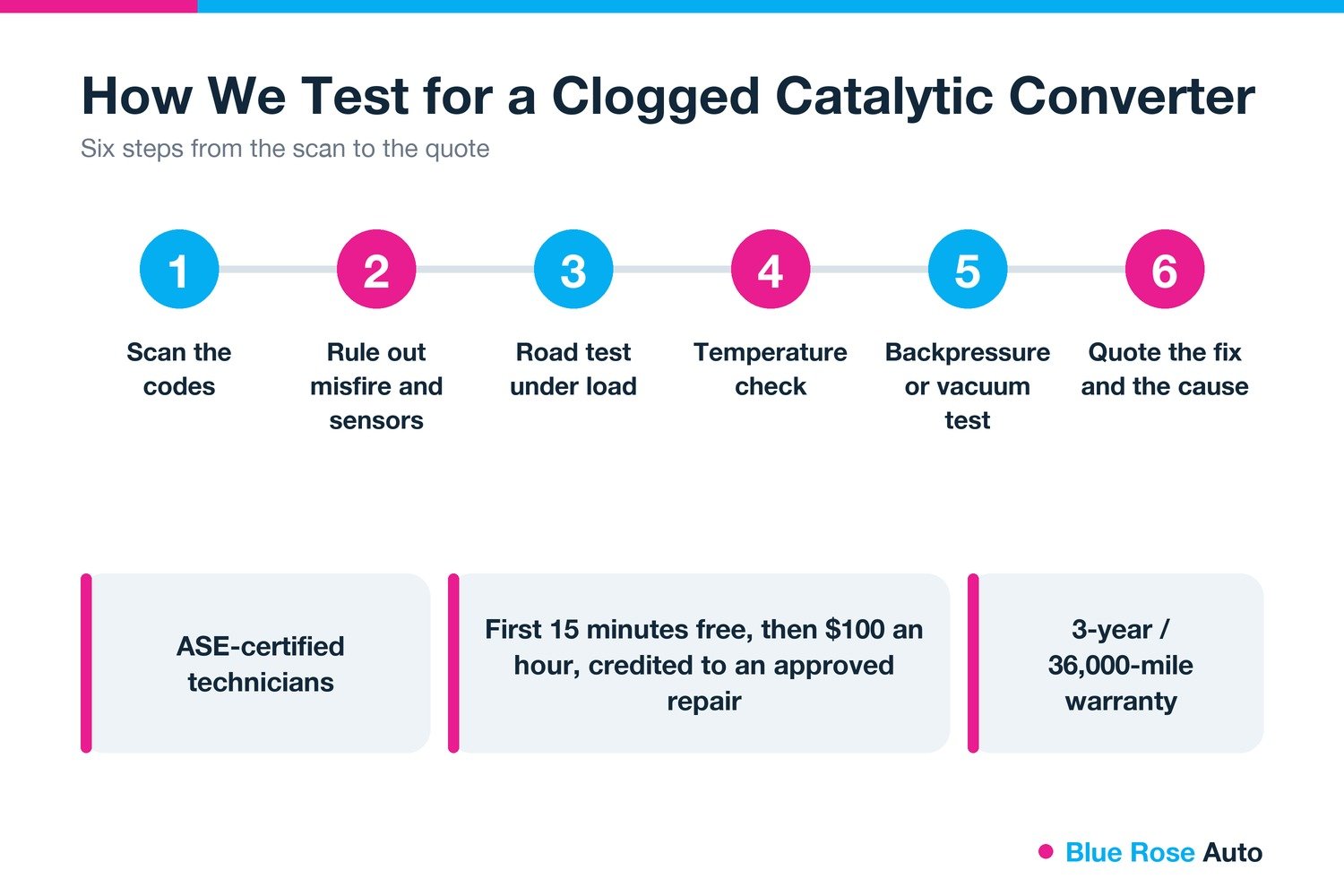
- Scan the codes
- Rule out misfire and sensors
- Road test under load
- Temperature check
- Backpressure or vacuum test
- Quote the fix and the cause
| Test | What we do | What it tells us |
|---|---|---|
| Scan | Read the codes and the oxygen sensor data | Where to look, not a verdict |
| Road test | Drive under load and in Park or Neutral | Restriction shows as power that falls off |
| Temperature check | Infrared thermometer at the converter inlet and outlet | A working converter outlet runs hotter, so a cooler outlet is a red flag |
| Backpressure | Gauge in the upstream oxygen sensor port, idle and about 2,500 rpm | Direct measure of restriction, compared to the manufacturer’s spec |
| Vacuum | Gauge on the intake, idle and a quick throttle snap | Vacuum that falls or recovers slowly suggests restricted exhaust |
Start With a Scan and a Look at the Data
We ask about symptoms and history, then read the codes along with the freeze-frame and oxygen sensor data. We also look for misfires and fuel trim problems first, because those are the usual reasons a converter fails. This is where we diagnose catalytic converter and check engine problems before anything gets unbolted.
The Temperature Test
With the engine warm, we point an infrared thermometer at the converter inlet and then the outlet. A working converter makes heat as it cleans the exhaust, so the outlet should run hotter than the inlet. An outlet that is cooler or no hotter at speed is a red flag. It is a screen and not a verdict, and AA1Car notes that late-model converters can show little difference at idle.
The Backpressure Test
We thread a pressure gauge into the upstream oxygen sensor port and read it at idle and at about 2,500 rpm. AA1Car reports that some vehicles should read near zero at idle and should not exceed 1.25 psi at 2,500 rpm, and that 8 to 10 psi or more points to a major restriction that may be a collapsed pipe or muffler instead of the converter. Other guides publish different limits, so the spec varies by vehicle and we compare the reading to the manufacturer’s number.
The Vacuum Gauge Check
Normal idle vacuum is 18 to 22 inches of mercury (inHg). A reading about 10 percent low, or one that keeps falling as the engine runs, suggests restricted exhaust (AA1Car). Rick’s Free Auto Repair Advice adds that a drop of 5 inHg or more on a quick throttle close that recovers slowly is another sign. Ignition and valve timing problems also move vacuum, so we read it alongside the other tests.
Exhaust parts are hot enough to burn, and the backpressure test means removing an oxygen sensor, so we do it with the right tools and with the car cool to warm. If you want to look at the exhaust yourself, let the car cool first and keep your hands away from the pipe.
How Can You Tell If a Catalytic Converter Is Clogged During a Road Test
A road test shows how the engine reacts under load. We look for a car that revs freely in Park or Neutral but will not accelerate under load, or one that bogs when you push the pedal. A car that runs fine at light throttle and then bogs down when it needs more air is another sign of restricted exhaust. We explain what we find as we go, so you know why we are recommending the next test.
What Causes a Catalytic Converter to Get Clogged
A converter rarely fails on its own, because it is usually the victim of something upstream. Causes follow the AA1Car converter reference.
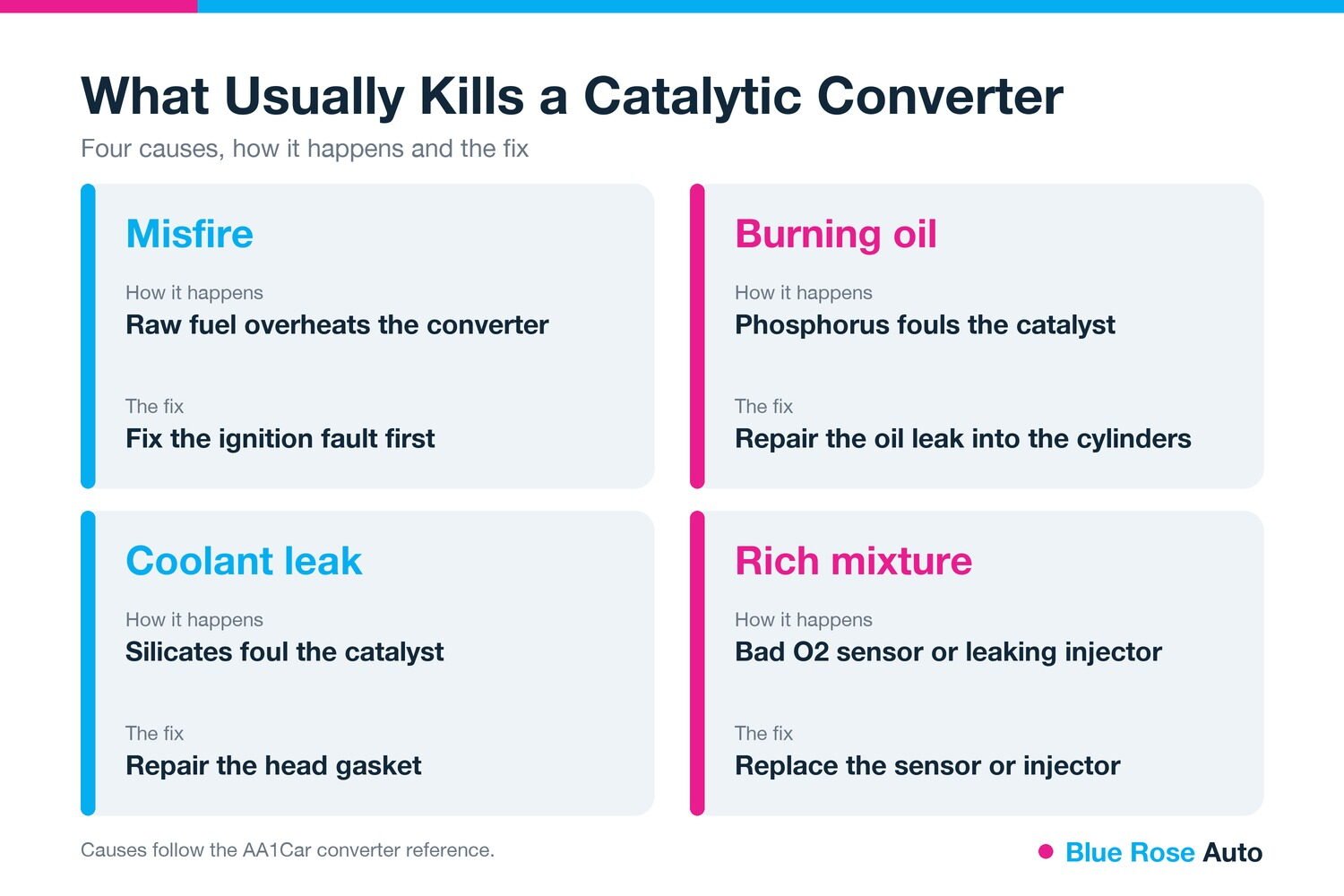
Four causes, how it happens and the fix. A new converter clogs again if the cause stays, which is why the cause comes before the part.
Common Reasons
- Misfires and unburned fuel. Raw fuel overheats the converter, and AA1Car says a single misfiring spark plug can raise hydrocarbon emissions by 2,500 parts per million or more. Fix the ignition fault first, and a rough-running engine is one of the signs your engine needs a tune-up.
- Burning oil. Oil burned through worn valve guides, seals or rings leaves phosphorus, and phosphorus fouls the catalyst. Blue exhaust smoke is the clue, and the fix is to repair the oil leak into the cylinders.
- Coolant leaks. Coolant from a leaking head gasket or a cracked combustion chamber leaves silicates, and silicates foul the catalyst and the sensors. White exhaust smoke is the clue. Repair the head gasket. Overheating and a leaking gasket often travel together, so we also track down what causes engine overheating.
- Rich mixture and bad sensors. Bad O2 sensor or leaking injector problems run the engine rich, which overheats the converter, and severe overheating can collapse the honeycomb. We replace the sensor or injector.
- Short trips. Repeated short trips keep the exhaust cool and can leave deposits behind.
Fixing the root cause matters. If it stays, the new converter clogs again.
Can You Unclog a Catalytic Converter
Sometimes a cleaner helps with light buildup, but it cannot rebuild a melted or broken honeycomb, and we do not promise a result from one. Drivers search for how to unclog a catalytic converter fast and how to fix a clogged catalytic converter without replacing it. Once the brick melts or collapses, the safe fix is replacement, and a rattle tells you the brick has already broken apart.
How to Fix Clogged Catalytic Converter Without Replacing It
You can sometimes avoid the converter by fixing what is killing it. If a misfire, a bad sensor or an oil leak caused the clog on a converter that is only lightly restricted, repairing that cause early may be all it needs. When the test shows a real restriction, we replace the converter and fix the cause in the same visit, because a new one clogs again if we leave the cause alone. We repair exhaust systems, catalytic converters and O2 sensors in the bay.
What a Clogged Catalytic Converter Costs to Fix
A catalytic converter replacement runs $1,300 to $3,500 nationally, and CarMD’s 2025 data puts the average at $1,510.88 (7.43 percent of check-engine repairs), with $1,475 in the West. We quote after diagnosis, because the number depends on the vehicle. Cars with more than one converter or an integrated manifold design cost more.
| Item | Typical range | Note |
|---|---|---|
| Catalytic converter replacement | $1,300 to $3,500 | National range. Exact quote after diagnosis. |
| CarMD 2025 average, catalytic converter | $1,510.88 | 7.43% of check-engine repairs |
| CarMD 2025 average, catalytic converter, West | $1,475 | Region that includes Oregon |
| Oxygen sensor, one | $150 to $525 | National range |
| CarMD 2025 average, oxygen sensor | $286.87 | 6.68% of check-engine repairs |
| Check-engine diagnostic | $100 to $200 nationally | Our first 15 minutes are free, then $100 an hour, credited to an approved repair |
The oxygen sensor row matters. A $286.87 sensor job costs far less than a $1,510.88 converter, and a failing sensor can set a catalyst code on a healthy converter, which is why we test first. Our first 15 minutes of diagnosis are free, then $100 an hour, and we credit that time to the repair when you approve it. We use the same national ranges when we explain how repair prices add up across the whole car.
Why a Check Engine Light Is Easy to Ignore in Lane County
Lane County is outside Oregon DEQ’s emissions testing areas, which sit in the Portland area and Medford. With no test forcing the issue, a P0420 can sit for months while a misfire or an oxygen sensor fault keeps overheating the converter. Drivers wait because the car still runs, and the converter pays for it. If you move to a testing area with that code, the car will fail, and a repair done early costs less than one done at a test station.
Catalytic Converter Theft Versus a Clog
A stolen converter and a clogged one feel nothing alike. A stolen converter sounds like a loud roar from underneath, because the exhaust now runs open, while a clog is quiet and shows up as lost power. Oregon Senate Bill 803 (2021), in effect since January 1, 2022, limits who scrap metal businesses can buy converters from and requires records such as the make, model year and VIN (KPTV). That law is why a missing converter is a different problem from the one this guide covers.
What Happens When You Bring the Car In
We start by asking what you have noticed and when it started, then we scan the car and work through the steps above. Our technicians are ASE-certified, and the first 15 minutes of diagnosis are free, then $100 an hour, credited to an approved repair. We explain the cause, the part and the price, and our mechanical repairs carry a 3-year / 36,000-mile warranty.
- ASE-certified technicians
- First 15 minutes free, then $100 an hour, credited to an approved repair
- 3-year / 36,000-mile warranty
Areas We Serve in Eugene and Springfield
Blue Rose Auto sits at 3436 Olympic St in Springfield, about 15 minutes from downtown Eugene (97401) by I-105 east and about 5 minutes from Mohawk (97477). Coburg is about 20 minutes away. We test converters for drivers from Eugene and Springfield, Oregon.
Frequently Asked Questions About a Clogged Catalytic Converter
How do you tell if a catalytic converter is clogged?
Power that falls off under load, slow acceleration, a rotten-egg smell and a P0420 or P0430 code point to a clog. Those signs also fit a bad oxygen sensor or a misfire, so a backpressure, vacuum or temperature test is what confirms it. We run those tests in Springfield.
What does a clogged catalytic converter sound like?
Usually nothing, because a clog is quiet and shows up as lost power instead of noise. A rattle under the car means the honeycomb inside has broken apart, which is a different failure. A loud roar after a theft is a missing converter, not a clog, so the sound tells you which problem you have.
What does P0420 mean?
P0420 means the catalyst system on bank 1 is working below its efficiency threshold. P0430 is the same fault on bank 2. The code can come from a bad oxygen sensor, a misfire or an exhaust leak, so it does not prove the converter is bad.
Can a clogged catalytic converter stop a car from starting?
In severe cases it can, because exhaust cannot leave the engine, and the engine may stall soon after it starts. A no-start is far more often a fuel, ignition or battery problem, so we test those first and measure exhaust backpressure before we blame the converter for a car that will not start.
Can you drive with a clogged catalytic converter?
You can for a short time, but the restriction builds heat and backpressure that stress the engine, and the car can stall when you need power most. Get it tested soon, especially if the car is losing power on hills or rattling underneath, and avoid long trips until we know the cause.
Can you unclog a catalytic converter without replacing it?
Cleaners can help light buildup, but they cannot rebuild a melted or broken honeycomb, and we do not promise a result from one. If the converter rattles or tests badly, replacement is the fix. We repair the cause first, such as a misfire or oil leak, so the new converter lasts.
How much does it cost to fix a clogged catalytic converter?
Replacement runs $1,300 to $3,500 nationally, and CarMD’s 2025 average is $1,510.88, with $1,475 in the West. The final number depends on the vehicle, and some cars have more than one converter. We quote after diagnosis, and our first 15 minutes are free, then $100 an hour credited to an approved repair.
What causes a catalytic converter to clog?
Misfires, burning oil, coolant leaks and a rich fuel mixture are the common causes, and repeated short trips can add deposits. The converter is usually the victim of one of these upstream faults, so we find and fix the cause before we fit a new converter, or the new one clogs again.
Does Lane County require an emissions test?
No. Oregon DEQ tests vehicles only in the Portland area and Medford, and Lane County is not in a testing area. A check engine light will not fail you on a test here, which is why a P0420 is easy to ignore, and why we suggest testing the converter anyway.
Can a clogged catalytic converter hurt my engine?
Yes. Heat and backpressure stress engine parts, and a collapsed honeycomb can block exhaust enough to stall the car. The restriction tends to get worse as the blockage grows, so fixing the cause early costs less than the repair that follows. Ask us for a test if the car is losing power.
Book a Catalytic Converter Diagnosis in Springfield
If your car is losing power or has a P0420 on the dash, bring it to 3436 Olympic St, Springfield, and we will test it before we quote a part. Call (541) 641-8877 or send us a message online. Blue Rose Auto handles auto repair in Springfield for every make, not just exhaust work.
Sources
- CarMD, 2026 Vehicle Health Index (2025 repair averages)
- Oregon DEQ, Vehicle Inspection Program
- AA1Car, Catalytic Converters reference
- Rick’s Free Auto Repair Advice, Plugged Catalytic Converter Test
- KPTV, Oregon bill that cracks down on catalytic converter thefts now in effect, January 11, 2022
- O’Reilly Auto Parts, P0420 and P0430 catalyst system efficiency below threshold

0 Comments