
Timing belt vs timing chain comes down to material and maintenance. A timing belt is toothed rubber with a replacement schedule, usually 60,000 to 100,000 miles according to AAA, plus an age limit. A timing chain is metal, runs in engine oil and usually has no scheduled interval. Which one you have decides what you owe.
Written by the Blue Rose Auto team in Springfield, OR. Last updated October 2026.
Below is a five-brand lookup, the mileage and age limits side by side, and what a snapped belt does. The tables are a starting point. Your owner’s manual or a VIN lookup is the final word.
What’s the difference between a timing belt and a timing chain?
A timing belt and a timing chain do the same job. Each one keeps the crankshaft and camshaft in sync, so the valves open at the right moment. A belt is toothed rubber behind a cover, and it gets replaced on a schedule by miles and by years, whichever occurs first. Subaru’s number is 105,000 miles or 7 years. GMB North America puts the risk bluntly, saying “Often times, timing belts break without warning.” A chain is metal and is oiled by the engine itself. Subaru’s dealer guidance says its chains are “engineered to last the full lifecycle of the vehicle engine” as long as the oil gets changed regularly. Chains also tend to warn you first, usually with a rattle at cold start. The stakes match. On an interference engine, a snapped belt or a jumped chain lets the pistons hit the valves. Our ASE-certified technicians in Springfield can tell you which one your engine uses and whether it’s due. Call (541) 641-8877.
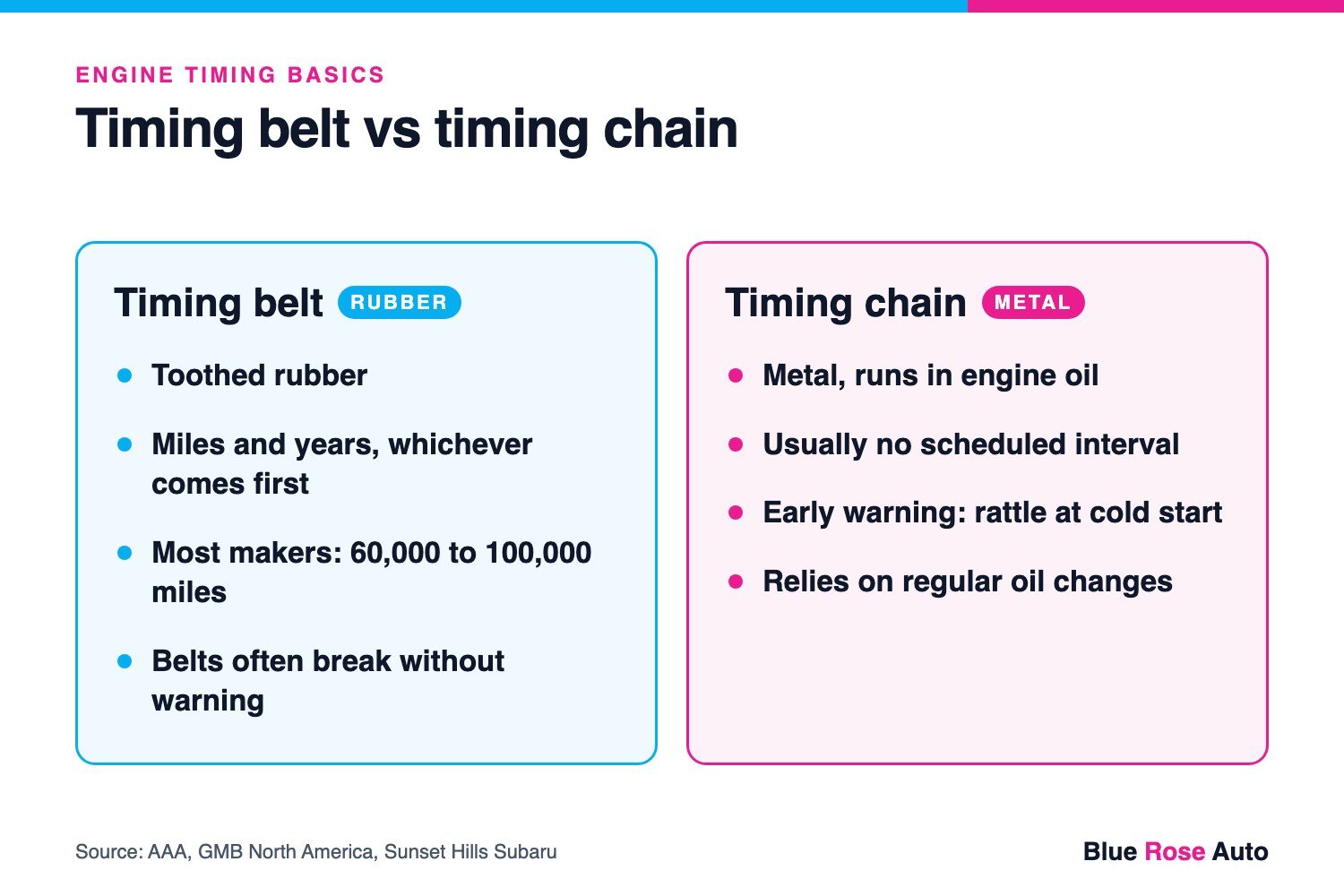
Here is the timing belt vs timing chain comparison at a glance, with the source behind each line.
| Timing belt | Timing chain | |
|---|---|---|
| What it is | Toothed rubber belt behind a cover | Metal chain on sprockets inside the engine |
| Lubrication | Runs dry, except “wet” belts like Ford’s 1.0L EcoBoost (Vehicle Service Pros) | Runs in engine oil and relies on regular oil changes (Sunset Hills Subaru) |
| Replacement schedule | Miles and years, whichever comes first; most makers say “somewhere between 60,000 and 100,000 miles” (AAA) | Usually no scheduled interval (Sunset Hills Subaru; CarsCounsel for the Mazda3) |
| Typical life | Until the scheduled mileage or age, whichever comes first (AAA) | Built to last the life of the engine with regular oil changes (Sunset Hills Subaru); J.D. Power says a chain can last as long as the vehicle |
| Noise | Quieter (Wikipedia lists “less noise” as a belt advantage) | Louder; JD Power‘s list says a chain “makes greater noise” |
| Warning before failure | Often none (GMB); a failing tensioner or idler can tick, squeal or grind first (Sunset Hills Subaru) | Usually warns first with a cold-start rattle, rough idle or timing-related codes (CarsCounsel) |
| Parts replaced with it | Belt, water pump, tensioner, idler pulleys (Sunset Hills Subaru) | Chain, plus tensioners and guides as needed (Sayville Ford) |
| If it fails on an interference engine | Valve-to-piston damage is likely (Gates; GMB) | Same risk if it jumps or breaks; Wikipedia warns interference engines “can suffer catastrophic damage in the event of timing system failure” |
The short version is that a belt costs you a planned job every so many years, while a chain costs you attention to oil changes and odd noises.
Is one better? Honestly, no. Each side has a real case.
- The case for the belt. Lower cost, less noise and no lubrication, the advantages Wikipedia’s timing belt article lists. The price is a replacement date.
- The case for the chain. No scheduled replacement on most engines. The catch is clean oil. Skip changes and the guides and tensioner wear early, and that repair costs more than a belt.
J.D. Power describes chains as more durable and belts as more affordable. That tradeoff matters on a used car, so ask whether the specific engine has a history of chain trouble. A chain suits an owner who keeps up with oil changes, while a belt suits one who keeps records. Your engine already made that choice, and your part is knowing which one it got.
Why did carmakers switch to chains?
To get rid of the belt service. Per Wikipedia, metal chains have “become more widespread in car engines produced since the 1990s in order to eliminate the regular maintenance interval replacement of a rubber timing belt.” The switch is still visible in the lookup below, where MotorBiscuit’s Toyota chart notes “the latest gas-powered models are all chain-driven,” while Honda’s V6 engines kept the belt through 2025.
What about timing gears?
A third design exists. Some older overhead-valve (pushrod) engines, where the camshaft sits in the block close to the crankshaft, drive it with meshing gears instead of a belt or chain, Wikipedia explains. Overhead-cam engines “mostly use timing belts or timing chains,” because the drive has to reach farther. Every engine in the lookup below is one or the other.
Does my car have a timing belt or chain?
Check the maintenance schedule in your owner’s manual. If it lists a timing belt replacement, you have a belt. No listing usually means a chain. A dealer or shop can confirm from the VIN, which Sayville Ford calls “the most accurate way to know.” The table below covers common engines from five brands.
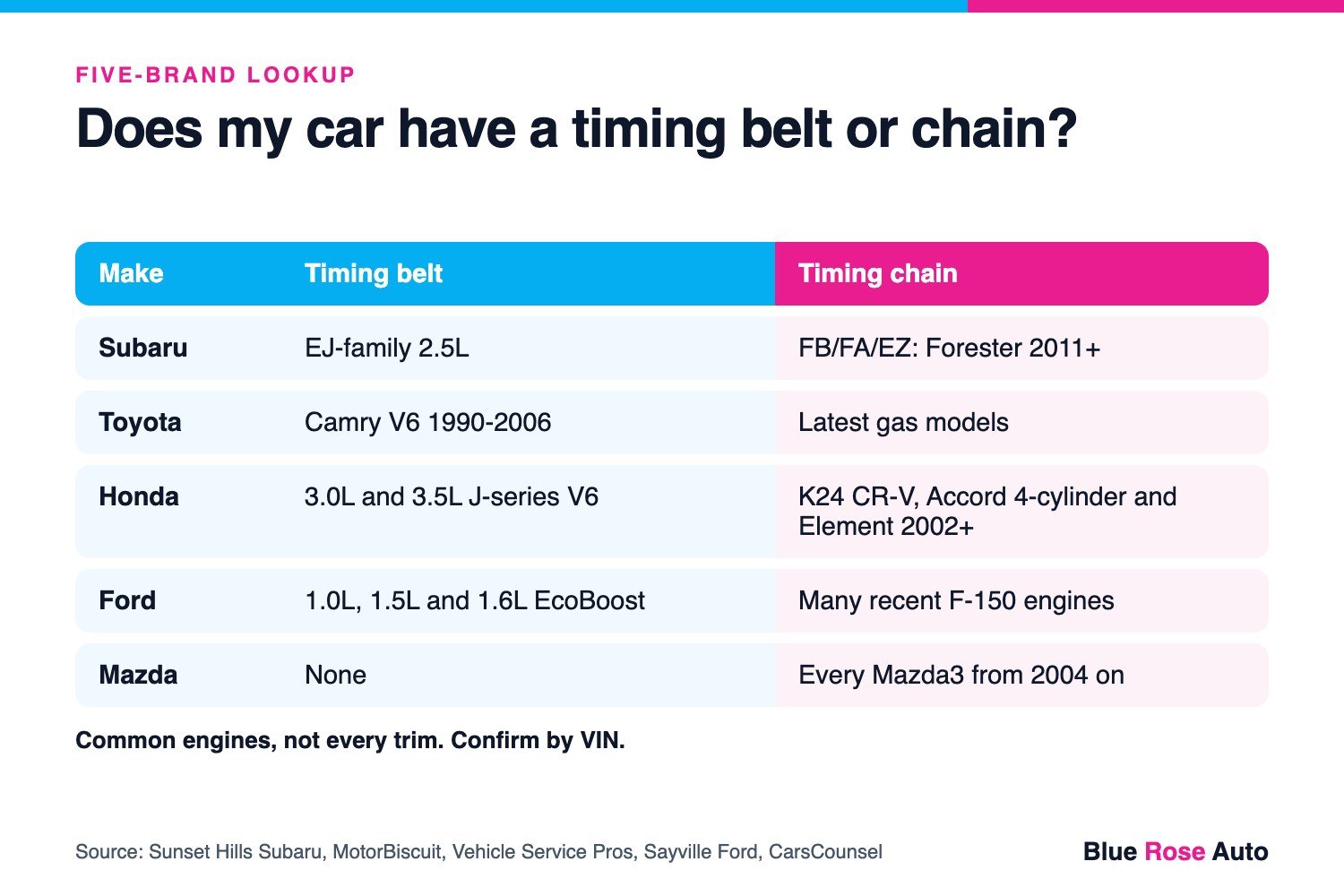
Find your make and engine. Years are model years; when in doubt, check the VIN.
| Make | Timing belt | Timing chain | Belt interval (as published) | Source |
|---|---|---|---|---|
| Subaru | EJ-family 2.5L in the Outback and Legacy up through 2012; Forester up through 2010; Impreza non-turbo up through 2011; WRX STI (EJ25) up through 2021 | FB, FA and EZ engines in the Forester 2011+; Impreza 2012+; Outback and Legacy 2013+ plus the 3.6R six-cylinder; Crosstrek all years (2013+); Ascent, WRX (2015+), BRZ | 105,000 miles or 7 years, whichever occurs first | Sunset Hills Subaru (dealer) |
| Toyota | Camry 1990-2001 (all engines); Camry V6 1990-2006; Corolla 1990-1997; RAV4 1996-2000; Tacoma V6 1995-2004; 4Runner V6 1990-2002 and V8 2003-2009; Tundra V6 2000-2004 and 4.7 V8 2000-2009; Sequoia 4.7 V8 2001-2009; Sienna V6 1998-2006; Highlander V6 2001-2007; Avalon V6 1995-2004 | Corolla 1998-2020; RAV4 4-cylinder 2001-2019; Prius 2001-2020; Camry 4-cylinder 2002-2020 and V6 2007-2020; Tacoma 4-cylinder 1995-2020 and V6 2005-2020; 4Runner V6 2003-2020; Sienna V6 2007-2020; Highlander V6 2008-2019; Tundra 5.7 V8 2007-2020 | 90,000 or 100,000 miles; 2005-2009 4Runner 4.7 V8 at 90,000 miles or 72 months | MotorBiscuit chart (chart source listed as Toyota); Gates TCK298 |
| Honda | Every 3.0L and 3.5L J-series V6 in the chart, 1997 through 2025 (Accord V6, Odyssey, Pilot, Ridgeline, Passport); older 4-cylinders such as the D16 Civic 1997-2000, F22/F23 Accord 1997-2001, B20 CR-V 1999-2001 | K24 CR-V, Accord 4-cylinder and Element 2002+; R18 Civic 2006-2011; 1.5T L15B7 Civic, Accord and CR-V 2016+; 2.0T K20C; hybrids (LFA1/LFB1); L15 Civic, HR-V and CR-V 2018+ | “every 60,000 to 100,000 miles, depending on the vehicle” | MotorBiscuit Honda chart |
| Ford | 1.0L EcoBoost (wet belt, runs in oil); 1.5L and 1.6L EcoBoost (dry belt); some older four-cylinders | Many recent F-150 engines; most modern V6 and EcoBoost Explorer engines; many newer turbo Escape engines | 150,000 miles (1.0L, 1.5L and 1.6L EcoBoost) | Vehicle Service Pros; Sayville Ford |
| Mazda | None in the Mazda3 line covered | Mazda3 MZR (2004-2013) and Skyactiv-G (2012-2026) | No scheduled interval (chain); listed as an interference engine | CarsCounsel |
This covers common engines, not every trim. We also handle Ford repair, and Ford owners get one wrinkle, since Vehicle Service Pros notes the 2018 redesigned 1.5L three-cylinder EcoBoost moved to a chain, so a 1.5L could have either. Confirm by VIN.
How to confirm yours
- Read the maintenance schedule. A timing belt line item means a belt. Chain engines don’t list one.
- Ask for a VIN check. Sayville Ford notes that two Escapes parked side by side “may have different engines and different timing systems.”
- On a Honda, read what sub-code 4 covers. Per Jalopnik’s Maintenance Minder guide, “4” covers “the spark plugs, timing belt, water pump, and valves.” If your manual’s 4 entry names the belt, it’s a belt engine.
- Have someone look at the front of the engine. A belt usually hides behind a bolted-on plastic cover; a chain lives inside, behind a metal cover that holds oil.
How often should a timing belt be replaced?
Replace a timing belt at the mileage or the age in your schedule. Whichever comes first counts. Most manufacturers land “somewhere between 60,000 and 100,000 miles,” according to AAA. Subaru’s EJ engines call for 105,000 miles or 7 years. Toyota’s 4.7-liter V8 in the 2005-2009 4Runner gets 90,000 miles or 72 months.
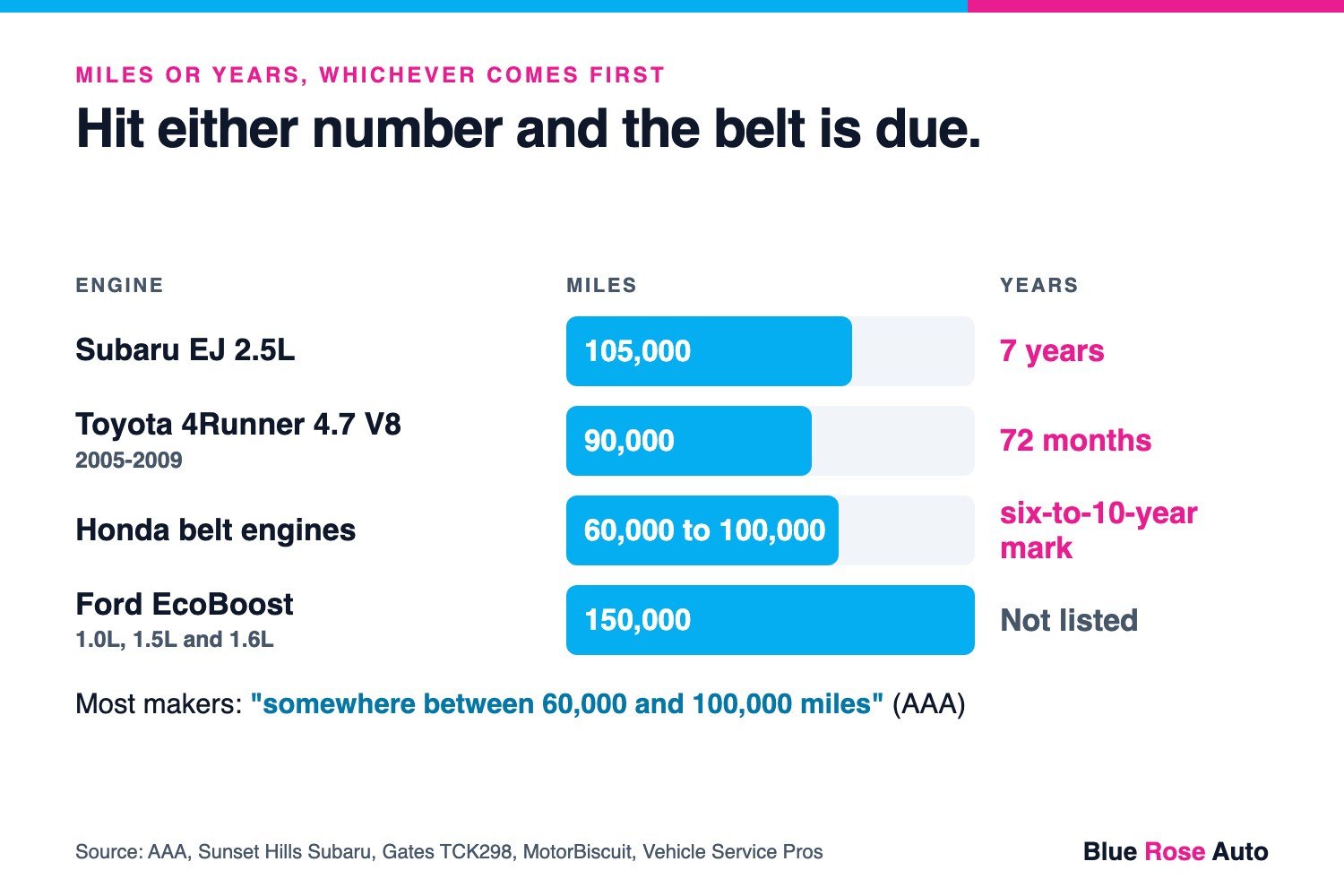
Here are timing belt replacement intervals, by miles and by years.
| Engine / brand | Miles | Years | Source |
|---|---|---|---|
| Most manufacturers (general) | “somewhere between 60,000 and 100,000” | Check your schedule | AAA Club Alliance |
| Subaru EJ 2.5L | 105,000 | 7 years | Sunset Hills Subaru |
| Toyota 4Runner 4.7 V8 (2UZ-FE, 2005-2009) | 90,000 | 72 months | Gates TCK298, quoting Toyota |
| Toyota belt engines (general) | 90,000 or 100,000 | Not listed | MotorBiscuit |
| Honda belt engines | 60,000 to 100,000 | “six-to-10-year mark” | MotorBiscuit |
| Ford 1.0L, 1.5L and 1.6L EcoBoost | 150,000 | Not listed | Vehicle Service Pros |
| Any belt, rule of thumb | Per your schedule | Consider it once the belt passes 5 years, even at low miles | Beach Mazda |
Hit either number and the belt is due.
People skip the age column. Rubber ages whether the engine turns or not, so on a low-mileage car the calendar usually wins. MotorBiscuit’s editor, who once worked in a shop, puts it plainly, saying “if you don’t hit the mileage interval by the six-to-10-year mark, you’d best get it done anyway.”
Here’s the local catch. Nothing at registration will remind you. Oregon DEQ runs “a biennial vehicle emissions testing program in the Portland and Medford areas,” an emissions test that never looks at a timing belt. Lane County sits outside DEQ testing entirely. No periodic check, then. Your manual and service records are the only reminder, and the 30-60-90 maintenance schedule shows what else comes due around the same mileage.
What are the signs of a bad timing belt?
Often there are none, which is why the schedule matters more than symptoms. Wikipedia notes that rubber belts “give no indication of impending failure,” unlike a worn chain. When a belt engine does give clues, they tend to look like this.
- Ticking from the front of the engine. A failing tensioner or idler can tick, squeal or grind, per Sunset Hills Subaru.
- Misfires, a rough idle or hard starting. Plenty of other faults cause these too, so treat them as a reason to look, not a diagnosis.
- Oil leaking near the timing cover. A leaking cam or crank seal soaks the belt, and Beach Mazda notes oil degrades a belt faster.
- An engine that cranks but won’t start, or stalls while driving. That is a belt that has already let go, since a timing failure “will prevent an engine from running” (Wikipedia).
Hearing any of these on a belt engine that’s near or past its date is a reason to stop stretching it.
What is a wet belt?
A wet belt is a timing belt that runs in engine oil. Ford’s 1.0L EcoBoost uses one, while the 1.5L and 1.6L use conventional dry belts, according to Vehicle Service Pros. All three list replacement “at the 150,000-mile mark.” The catch is that on the 1.0L, belt debris “can clog the oil pump,” risking “loss of oil pressure and severe engine damage,” and the wrong oil or a skipped schedule can bring that on early. So on a wet belt, the oil change doubles as timing belt care, and we fill with oil that meets the manufacturer’s spec for type, weight and volume.
Do timing chains ever need replacing?
Sometimes, but not on a schedule. Most chain engines carry no replacement interval. Subaru designs its chains for the life of the engine, and CarsCounsel lists “No scheduled interval” for the Mazda3. A chain gets replaced when it wears out, and neglected oil is what wears it out early.
You may have read that chains need replacing every 80,000 to 120,000 miles. The manufacturers don’t say that. Sunset Hills Subaru’s factory-schedule answer is that chains go “without scheduled replacement, provided regular engine oil changes are performed,” and Beach Mazda notes some makers suggest inspecting the chain “every 100,000 miles or so.” A look, not a replacement.
Bulletproof? No. As MotorBiscuit’s Honda chart notes, “A chain is more durable, but can still fail if oil changes are neglected.” Chain, guides and tensioner all live in engine oil, and dirty or low oil lets the tensioner lose its grip.
Signs a timing chain is wearing include the following.
- Rattle at startup. A metallic rattle for a second or two on a cold start, before oil pressure comes up. CarsCounsel calls this “the most common early warning of timing chain wear” on Mazda’s Skyactiv-G engine.
- Misfires or a rough idle, once the cam timing has drifted.
- Less power or sluggish acceleration, once timing has drifted.
- A check-engine light with timing-related codes. CarsCounsel names P0016 and P0017 (camshaft timing deviation) on the Mazda3. Treat a code as a reason to diagnose, since it is not proof the chain is worn.
The order can flip on newer engines. Wikipedia, citing chain maker Cloyes, says later engines with variable valve timing “will generate engine codes and check engine lights prior to engine rattle,” while older pre-VVT engines rattle first. On a recent car, then, the light may come first. A code alone still proves nothing about the chain. If you hear a rattle, tell us how long it lasts and whether the engine was fully cold, then have the timing system inspected before a stretched chain jumps a tooth.
Cold-start rattle, or a belt past its mileage or age? Call Blue Rose Auto at (541) 641-8877.
What happens if a timing belt breaks?
On an interference engine, a broken belt usually does serious damage. With the belt gone, the pistons keep moving and hit valves that are still open. GMB North America lists bent or broken valves, cylinder head, camshaft, cylinder wall and piston damage. On a non-interference engine, the engine just stops, with no internal damage.
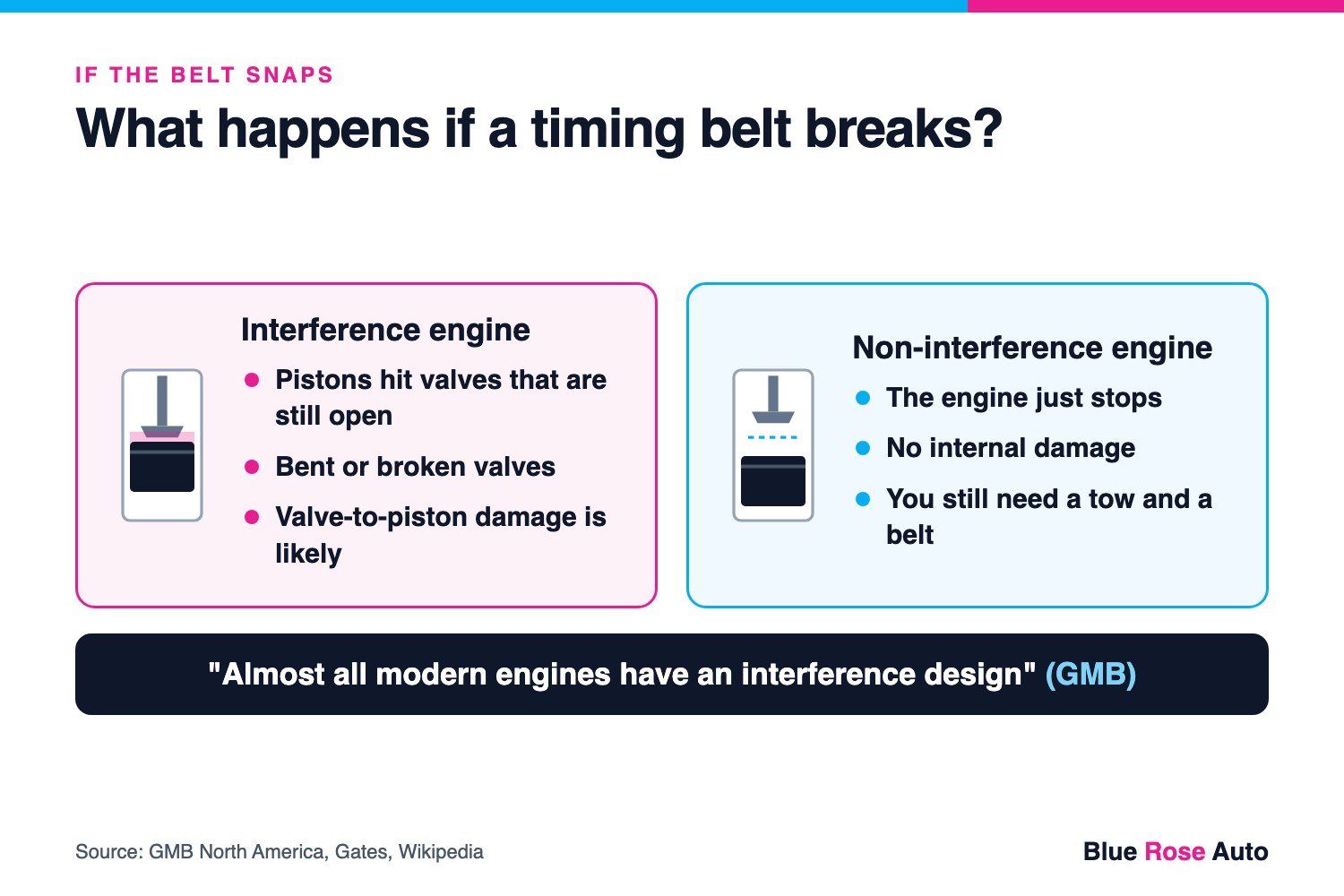
Wikipedia defines an interference engine as one where “one or more valves in the fully open position extends into any area through which the piston may travel.” Only timing keeps them apart. Engineers accept that because interference designs “allow for higher compression ratios,” GMB explains, which is why “Almost all modern engines have an interference design.”
How bad does it get? Car Talk‘s columnist offered his own estimate, saying “I’d say in 95 percent of cases, when a timing belt breaks on a car with an interference engine … at least one of the valves gets crushed, and you end up having to rebuild the entire cylinder head.” One mechanic’s guess, not a study. Still, the parts makers agree, since Gates’ sheet for the 2005-2009 4Runner 4.7 V8 calls valve-to-piston damage after a belt failure “MOST LIKELY.”
A non-interference engine gets off lighter. GMB says it “won’t suffer any damage, but it will stop running.” You still need a tow and a belt. At the far end, an interference failure can go past a head rebuild, so read what an engine replacement involves before stretching a belt another year.
How do you tell if your engine is interference?
Timing-kit makers state it engine by engine on the install sheet, as the Gates TCK298 does, and a shop can look it up by engine code. If the sheet isn’t handy, assume interference. Given GMB’s “almost all modern engines,” that’s the safer bet.
What does a timing belt or chain job include?
A timing job is rarely just the belt or the chain. On a belt engine, the water pump, tensioner and idler pulleys usually come out at the same time, since they sit behind the same cover. A chain job usually covers the tensioners and guides along with the chain, the related parts Sayville Ford lists for replacement “when needed.”

Going by the Subaru dealer’s service list, a typical belt job includes the following.
- New timing belt
- New water pump
- New hydraulic belt tensioner and idler pulleys
- Fresh coolant and a thermostat
- An inspection of the front camshaft and crankshaft oil seals
Gates says to “replace all tensioners and guides during belt replacement” on its kits. The water pump makes the list for two reasons. On many belt engines it sits behind the timing cover, so the labor to reach it is already paid for. And per Wikipedia, a belt-driven pump that seizes “can break the timing belt or chain,” which is why kits bundle the pump, tensioner and idlers. Honda’s Maintenance Minder even bundles “timing belt, water pump” in one sub-code. When a belt engine comes in for a timing job, we look at the pump, tensioner and idlers too, because they come off anyway. The coolant drain is where cooling system service overlaps.
A chain job can be bigger. The chain sits inside the engine behind a sealed cover, so reaching it usually takes more labor than a belt.
What does a timing belt or chain replacement cost?
A timing belt replacement runs $500 to $1,000 at Blue Rose Auto in Eugene-Springfield, and replacing the water pump at the same time can push the total past $1,000. That is our local range, and we quote the exact number after we look at your engine. A chain job usually costs more per visit, but you pay for a belt again and again. National figures give context.
| Job | Blue Rose Auto Eugene-Springfield range | National figure (J.D. Power) |
|---|---|---|
| Timing belt replacement | $500 to $1,000 | $500 to $1,000, and “as much as $2,000 or more” if you wait until it breaks |
| Timing belt with water pump at the same time | Can pass $1,000 | Water pump alone runs $450 to $1,150 nationally |
| Timing chain repair or replacement | Quoted after inspection, since it varies by engine | $1,500 to $4,000 at a repair facility |
Our local belt range and the national water pump range come from our breakdown of major car repair costs in Eugene-Springfield, which shows why the water pump belongs in the same visit, since the labor overlaps. J.D. Power’s belt and chain figures are national, so treat them as rough. Over a car’s life the belt job repeats while a chain job often never comes up, so the long-run gap is smaller than the sticker price. Three things move the bill.
- Engine layout and labor time. Some engines put the belt right up front, while others bury it behind mounts and accessories. For scale, Gates lists 3.70 hours just to remove and install the belt on the Toyota 2UZ-FE V8.
- What goes in the kit. Belt only, or belt plus water pump, tensioner, idlers, thermostat and coolant.
- Waiting too long. On an interference engine, a snapped belt turns maintenance into a head rebuild.
Whatever the job, ask for a written estimate that lists every part in the kit.
Is a timing belt the same as a serpentine belt?
No. The timing belt sits inside the front of the engine, behind a cover, and keeps the camshaft and crankshaft in sync. The serpentine belt runs outside on pulleys you can see with the hood up, and it drives the accessories.
The serpentine belt connects the engine to the alternator, power steering pump and air conditioning compressor. A worn one usually squeals, and replacing a serpentine (accessory) belt is a much smaller job. A snapped one will leave you stranded. It won’t bend valves.
Buying a used car with a timing belt?
Ask for proof the belt was done before you buy. Sunset Hills Subaru’s pre-purchase checklist works for any belt engine, and it matters most on an EJ25 Subaru, a J-series Honda V6 or an older Toyota V6 or V8.
- Service records. Proof that “the timing belt, water pump, hydraulic tensioner, and idler pulleys were replaced” on time.
- A sticker on the timing cover. Reputable shops leave “a date and mileage sticker” on the plastic belt cover.
- No oil leaks up front. Front camshaft or crankshaft seal leaks can “saturate and degrade a rubber belt prematurely.”
- No records? Budget for it. Treat the belt job as part of the price and negotiate accordingly.
Frequently asked questions
Is it better to have a timing chain or timing belt?
Neither is better in every way. A chain usually needs no scheduled replacement if the oil is changed on time, which is how Subaru describes its chain engines. A belt is quieter and cheaper per job but carries a mileage-and-age replacement date. What matters most is knowing which one your engine has and following its schedule.
How much does a timing belt replacement cost in Eugene and Springfield?
A timing belt replacement runs $500 to $1,000 at Blue Rose Auto, and replacing the water pump at the same time can push the total past $1,000. We quote the exact price after we look at your engine. J.D. Power’s national range for a belt is also $500 to $1,000.
Is it more expensive to replace a timing belt or timing chain?
Per job, the chain usually costs more. J.D. Power puts national chain work at $1,500 to $4,000 at a repair facility, against $500 to $1,000 for a belt. A belt comes back on a schedule, though, so the long-run gap is smaller. Labor time and kit contents drive the bill, so ask for a written estimate.
Which cars use timing chains instead of belts?
Most newer gas engines from Toyota, Mazda and Subaru use chains. MotorBiscuit’s Toyota-sourced chart says the latest gas models are all chain-driven, every Mazda3 from 2004 on has a chain, and Subaru’s FB and FA engines use chains starting with the 2011 Forester. Honda is split, since its 3.0L and 3.5L V6 engines kept belts through 2025.
Should I replace a timing belt that has low miles but is 10 years old?
Usually, yes. Schedules count miles or years, whichever comes first. Subaru says 7 years for its EJ engines, Toyota gives the 2UZ-FE V8 72 months, and MotorBiscuit tells Honda owners to act by the six-to-10-year mark. Lane County sits outside Oregon DEQ testing, so no inspection here will remind you.
On a non-interference engine, do you have to replace the timing belt?
Yes, on schedule. A snapped belt won’t damage a non-interference engine, but GMB North America says it will stop running, so you still end up with a tow and a belt job. GMB also notes almost all modern engines are interference designs, so confirm yours isn’t before planning around it.
Can you drive if your timing chain is rattling?
Get it checked soon instead of driving on it indefinitely. A short rattle at cold start is the most common early sign of chain wear, according to CarsCounsel, and a chain that jumps a tooth on an interference engine can do the same valve damage as a snapped belt. Any warning light needs diagnosis, not guesswork.
How long can a timing chain last?
Many are designed to last the life of the engine. Subaru says its chains are engineered to last the full lifecycle of the engine with regular oil changes, and CarsCounsel lists no scheduled interval for the Mazda3. Nobody guarantees a mileage, though, and neglected oil shortens chain and tensioner life, so keep your oil change records.
Can you still drive with a bad timing belt?
Not safely for long. Belts often break without warning, and any early sounds usually come from a failing tensioner or idler, such as ticking, a squeak or grinding. On an interference engine, a break while driving usually means valve damage. Have it inspected before your next long drive.
Not sure what’s in your engine?
Tell us the year, make and engine, and our ASE-certified technicians at 3436 Olympic St in Springfield will check the schedule, look at the timing system and explain what we find before quoting anything. Blue Rose Auto opened in 1994. Call (541) 641-8877 about engine diagnostics and repair, or book a visit online.
Sources
- AAA Club Alliance, when should timing belts be replaced
- Sunset Hills Subaru, Subaru timing belt vs chain intervals
- Gates installation sheet TCK298, Toyota 2UZ-FE (90,000 miles or 72 months, 3.70 labor hours)
- MotorBiscuit, Toyota timing belt or chain and Honda chart
- Vehicle Service Pros, the Ford EcoBoost and Sayville Ford
- CarsCounsel, Mazda3 timing belt or chain
- GMB North America, what if a timing belt breaks
- J.D. Power, timing chain vs timing belt (national cost figures)
- Car Talk, how did an engine survive a broken timing belt
- Oregon DEQ, vehicle inspection program
- Wikipedia, timing belt and interference engine
- Beach Mazda and Jalopnik, Honda Maintenance Minder codes

0 Comments