
Usually, yes. A branded vehicle wrap is generally deductible as advertising, which Treasury Regulation §1.162-1(a) lists among ordinary business expenses. Your CPA may instead treat it as depreciable property, since IRS Publication 946 names signs among its examples of tangible personal property. One Oregon wrinkle for 2026 is that, according to two accounting-firm summaries of a new state law, Oregon adds back federal bonus depreciation.
People type “are vehicle wraps tax deductible” hoping for a yes or a no. The better question is how. Expensed this year as advertising? Or depreciated like a sign, maybe folded into the van it’s stuck to? In 2026, Oregon may answer differently. And if the wrap gets capitalized, the day the install is finished (not the day you paid the deposit) is what puts it in a tax year.
By the Blue Rose Auto team in Springfield, OR. Last updated October 2026.
Blue Rose Auto installs wraps and is not a tax adviser. This is general information, not tax advice. It explains the IRS and Oregon rules as published on October 5, 2026, and your CPA decides how your wrap is treated.
Are vehicle wraps tax deductible as advertising?
A vehicle wrap that carries your business name is usually an advertising cost. Treasury Regulation §1.162-1(a) lists “advertising and other selling expenses” among deductible business expenses, and §1.162-20(a)(2) says institutional or goodwill advertising that “keeps the taxpayer’s name before the public” is generally deductible as an ordinary and necessary expense. Some CPAs go the other way and capitalize the wrap, because IRS Publication 946 names signs among its examples of tangible personal property, and a graphic built to last years can look more like an asset than an ad buy. If the wrap is depreciated under Section 179, the property has to be used more than 50% for business in the year it’s placed in service. Oregon adds a layer for 2026, because as RSM US and Baker Tilly summarize Senate Bill 1507, it requires an add-back of federal bonus depreciation on the state return. Blue Rose Auto in Springfield, OR installs commercial wraps, and you can ask us to write the quote with design, print, lamination and installation on separate lines so your CPA can see each one. Call (541) 641-8877.
The advertising reading has history behind it. After the Supreme Court’s 1992 INDOPCO decision made businesses nervous about capitalizing anything with a long-term benefit, the IRS said in Rev. Rul. 92-80 that INDOPCO would not affect a company’s ability to deduct advertising under section 162(a), as the Journal of Accountancy explains. The plain-English version today is IRS Publication 334 (2025). It puts “Advertising” first on its list of “Other Expenses You Can Deduct.”
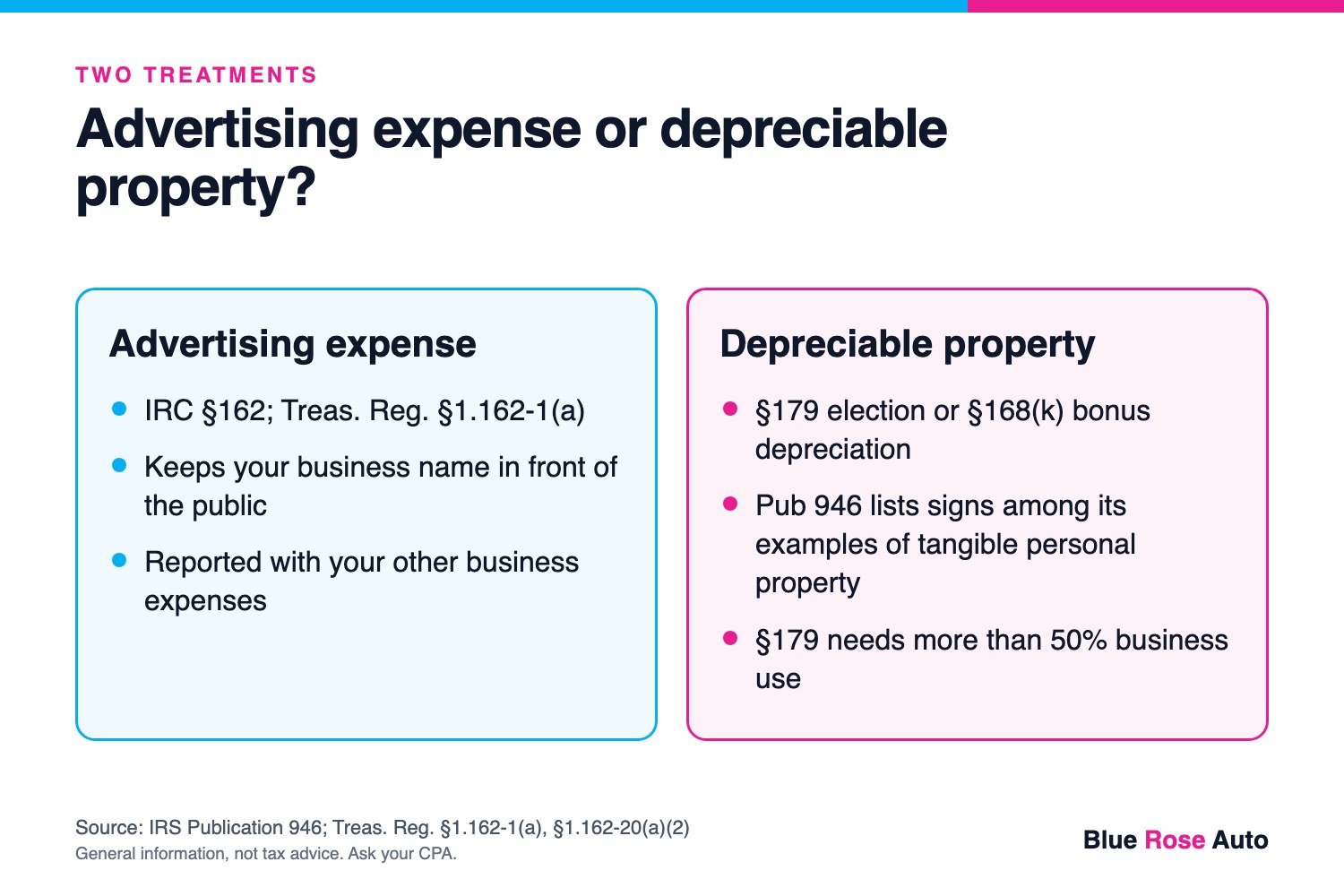
The short answer is generally yes, as an advertising expense. The follow-up question is how. The two treatments compare as follows, and your CPA picks one.
| Advertising expense | Depreciable property | |
|---|---|---|
| Rule | IRC §162; Treas. Reg. §1.162-1(a), §1.162-20(a)(2) | IRC §179 election or §168(k) bonus depreciation; otherwise regular depreciation |
| Why it fits a wrap | It keeps your business name in front of the public | Pub 946 lists signs among its examples of tangible personal property |
| Business-use test | Ordinary and necessary for your business | §179 needs more than 50% business use in the year placed in service |
| Where it’s reported | With your other business expenses | Form 4562 |
| Oregon 2026 | No add-back tied to this treatment, per the published summaries (confirm with your CPA) | Federal bonus depreciation is added back under SB 1507, per RSM US and Baker Tilly |
Neither column is the “right” one for everyone. It depends on the wrap, the vehicle and your books.
Why some CPAs capitalize a wrap instead
Pub 946’s definition of tangible personal property covers property attached to a building, with examples running from grocery store counters to printing presses “and signs.” A wrap is laminated cast vinyl on a vehicle the business plans to drive for years. Compare that with a sign bolted to a storefront and the logic is easy to follow. Other preparers stay with §162 because the wrap’s whole job is advertising. Your installer shouldn’t be picking between them.
Does Section 179 or bonus depreciation apply to a wrap?
Only if the wrap is treated as depreciable property, either on its own or capitalized into the vehicle. An expensed advertising cost never touches Section 179. If your CPA does depreciate it, IRS Publication 946 sets a first gate. The property must be used more than 50% for business in the year you place it in service.
Section 179 is also capped at your taxable income from actively running the business. Whatever doesn’t fit carries to the next year. Bonus depreciation works differently. In IR-2026-06, Treasury and the IRS issued Notice 2026-11 on “the permanent 100% additional first year depreciation deduction for eligible depreciable property acquired after Jan. 19, 2025.” Both changes trace to the One, Big, Beautiful Bill Act, which also set the §179 base at $2.5 million with a $4 million phase-out. Heavy-SUV rules are about the vehicle, not the wrap; see Pub 946.
The wrap vs the vehicle
Say you bought a work van in October and want it wrapped before the year ends. Does the wrap ride along on the van’s deduction? It might. Your CPA could capitalize it into the van’s cost, carry it as a separate item, or expense it as advertising and leave the van alone. Once anything is depreciated, the van’s business-use percentage applies. An itemized invoice is what lets your CPA make that call cleanly.
2026 federal numbers at a glance
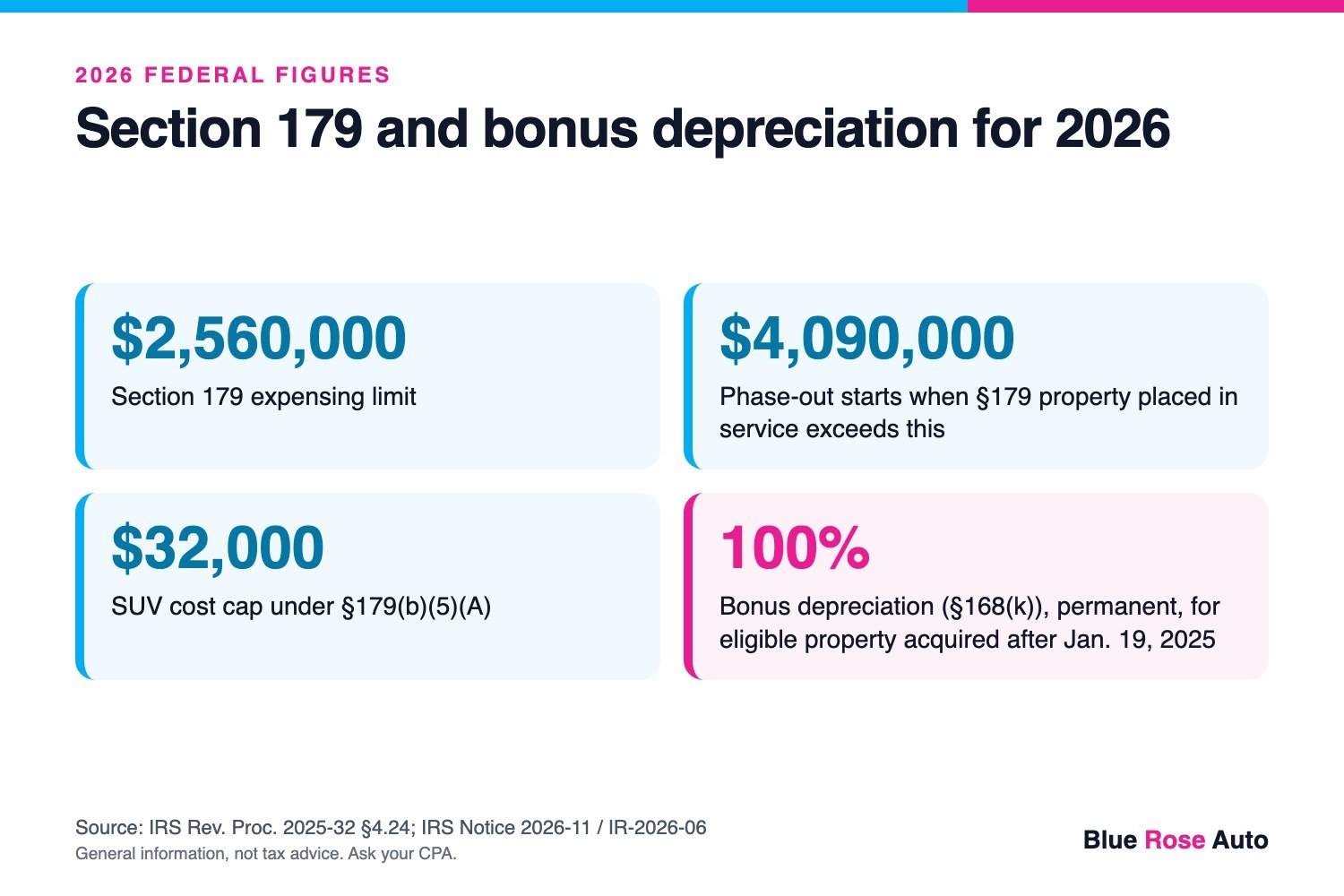
| Item | 2026 figure | Source |
|---|---|---|
| Section 179 expensing limit | $2,560,000 | Rev. Proc. 2025-32 §4.24 |
| Phase-out starts when §179 property placed in service exceeds | $4,090,000 | Rev. Proc. 2025-32 §4.24 |
| SUV cost cap under §179(b)(5)(A) | $32,000 | Rev. Proc. 2025-32 §4.24 |
| Bonus depreciation (§168(k)) | 100%, permanent, for eligible property acquired after Jan. 19, 2025 | IRS Notice 2026-11 / IR-2026-06 |
| Section 179 business-use test | More than 50% in the year placed in service | IRS Pub 946 (2025) |
Figures were checked on October 5, 2026 against irs.gov. No single wrap comes near those dollar limits. For most shops, the business-use row is the one that decides things.
How is Oregon different for 2026?
Oregon generally makes you add back federal bonus depreciation on property placed in service in 2026 and later, so the state deduction for that property comes out smaller in the first year. Two accounting firms read Senate Bill 1507 that way, and their summaries agree on the core mechanics. RSM US published its alert on April 13, 2026, and Baker Tilly followed on June 5. It changes the Oregon math for any business taking bonus depreciation.
What Senate Bill 1507 changed
According to RSM US, Gov. Tina Kotek signed SB 1507 on April 9, 2026. It moves Oregon’s tie to the Internal Revenue Code from Dec. 31, 2023 to Dec. 31, 2025. It also cuts the state loose from §168(k) bonus depreciation. Taxpayers add back the difference between the federal §168(k) deduction and what §168(k) allowed as in effect on Dec. 1, 2017. They may then subtract the depreciation that 2017 version would have allowed. RSM says the change applies to property placed in service in tax years beginning on or after Jan. 1, 2026; Baker Tilly says the changes apply to tax years beginning, or property placed in service, on or after Jan. 1, 2026.
What it means for a wrap you capitalize
Capitalize the wrap and take 100% federal bonus depreciation, and your Oregon return will likely show a different number for it. Expense the wrap as advertising and the add-back generally isn’t in play, because SB 1507 is about bonus depreciation, not §162 expenses. Section 179 is the open question. Neither summary addresses it, so ask your CPA how Oregon treats a §179 election on your return, and check the Oregon Department of Revenue for state guidance.
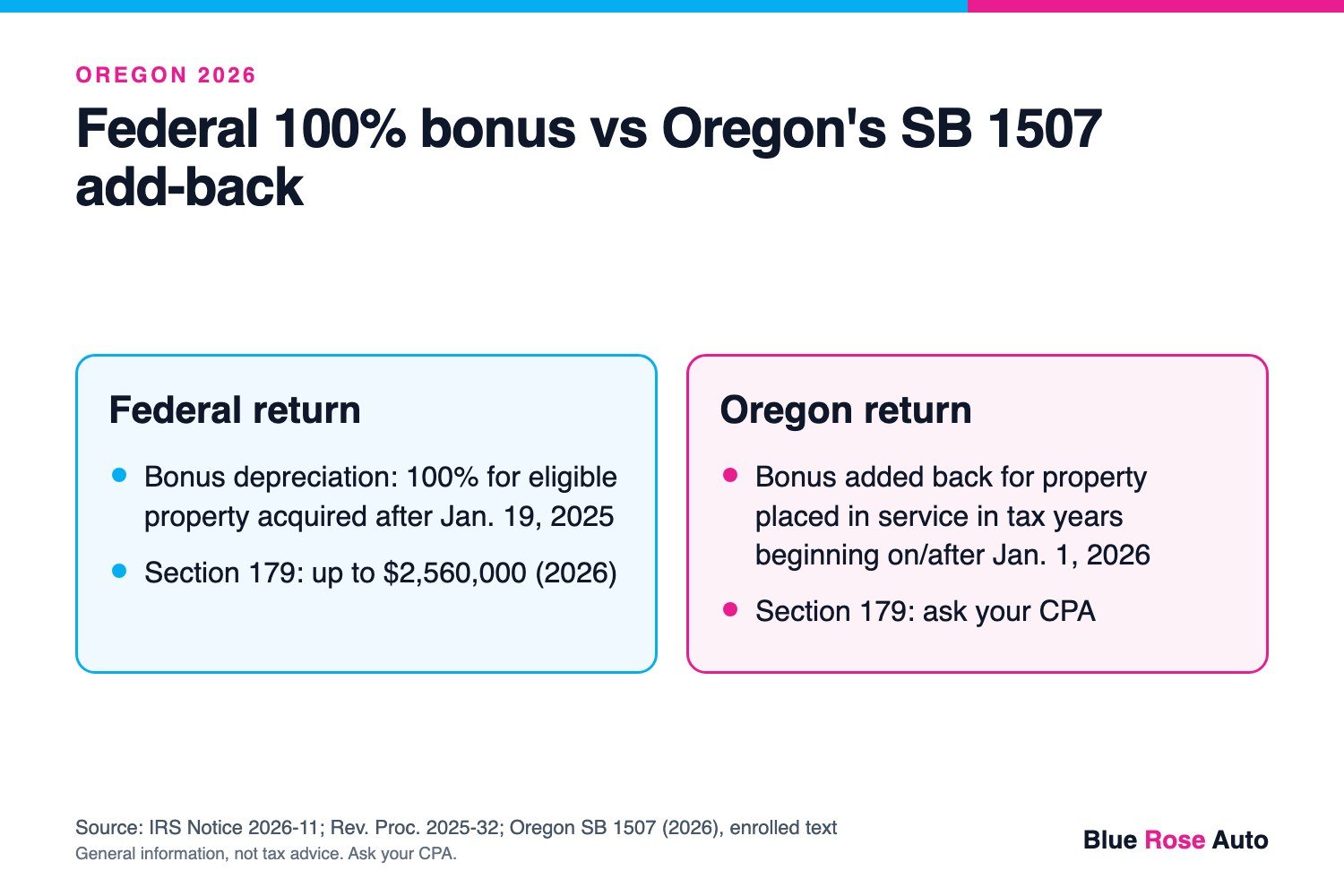
| Federal return | Oregon return | |
|---|---|---|
| Bonus depreciation (§168(k)) | 100% for eligible property acquired after Jan. 19, 2025 | Added back for property placed in service in tax years beginning on/after Jan. 1, 2026 |
| How the cost is recovered | First year | Bonus amount added back; your CPA works out the Oregon depreciation schedule |
| Section 179 | Up to $2,560,000 (2026) | Not addressed by SB 1507 summaries; ask your CPA |
| Source | Notice 2026-11; Rev. Proc. 2025-32 | SB 1507 via RSM US and Baker Tilly |
So a fleet order placed in Lane County can come out one way on the federal return and another way on the Oregon return.
Does a wrap make a vehicle 100% business use?
No. Business-use percentage comes from how the vehicle is driven, not from what’s printed on it. Section 179 needs more than 50% business use in the year the property goes into service, per Pub 946, and door graphics don’t move that number. A logo is not a mileage log.
These records support business use.
- A mileage log of business trips, kept as you go rather than rebuilt in April.
- A record of personal trips, commute included.
- Notes on what the vehicle does for the business, like service calls or hauling materials to job sites.
The wrap is advertising riding on the vehicle. Good advertising, maybe deductible. Just not proof of how many of your miles are business miles.
Can you use standard mileage and deduct the wrap?
The IRS doesn’t say directly. Publication 463 is clear about what the standard mileage rate replaces. Use it for a year and you can’t deduct your actual car expenses for that year, including depreciation, lease payments, maintenance and repairs, gasoline, oil, insurance or vehicle registration fees.
Advertising isn’t on that list. That doesn’t make the wrap deductible on top of mileage, though. Pub 463 simply doesn’t mention wraps, and a wrap capitalized into the vehicle starts to look like the depreciation the mileage rate already covers. If you’re on standard mileage, bring this question to your CPA before you order. Not to a forum, and not to your installer either.
Does the $2,500 de minimis rule cover a wrap?
Sometimes, for smaller jobs. The IRS tangible property regulations let a business without an applicable financial statement deduct up to $2,500 per invoice or item, or $5,000 with one. You have to elect it. Your books have to match. Notice 2015-82 raised the threshold from $500 for tax years beginning on or after Jan. 1, 2016.
Market-wide, a wrap runs about $2,000 to $5,000 (AAA and Car and Driver, 2026), so many jobs land near that line. Our commercial price table lines up like this.
- Every full-wrap range on our published commercial price table starts at $3,000 or more (trailers are quoted per design), so a full commercial wrap usually won’t fit under $2,500.
- Partial wraps on the table run from $1,500, so they can land either side of the line depending on the vehicle.
- Door lettering starts at $450 per vehicle, which a CPA may decide fits.
- Whether a multi-vehicle fleet invoice counts “per invoice or per item” is your CPA’s call.
An itemized quote helps here. Each piece of the job sits on its own line, so your CPA can see what the safe harbor might reach and what has to be handled some other way.
Why does installed by December 31 matter?
For a capitalized wrap, the tax year follows the finished install, not the order date. Pub 946 puts it this way, “You place property in service when it is ready and available for a specific use.” A deposit paid Dec. 15 on a wrap installed Jan. 8 makes a January asset. For the advertising treatment, timing follows your accounting method, so ask your CPA which date counts.
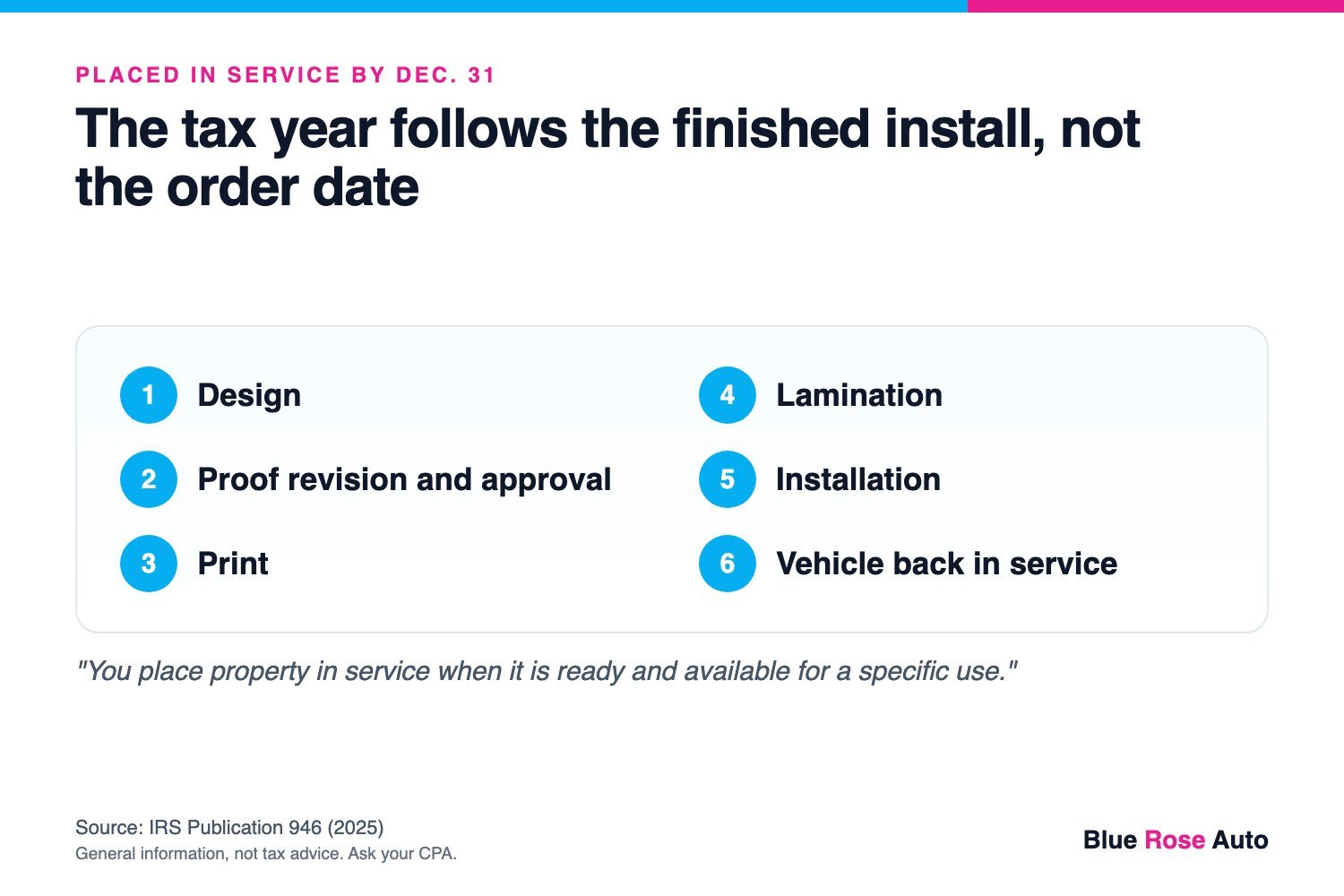
A commercial wrap gets to “ready” in these steps.
- Design. We lay out your logo, colors and copy for the vehicle you’re wrapping.
- Proof and approval. You review the proof, and nothing prints until you sign off.
- Print. The approved file goes to print.
- Lamination. A clear laminate goes over the printed film.
- Installation. Your vehicle comes into our bay and we apply the panels.
- Vehicle back in service. Now the wrap is ready and available for business use.
Each step waits on the one before it, and the proof waits on you. If you want a wrap on the road before Dec. 31, call early so the install isn’t squeezed. We install fleet graphics at our Olympic Street shop in Springfield, and a December job goes through the same six steps as any other.
What records should you keep for a wrap?
Keep enough that your CPA never has to guess. This is the checklist we’d hand any fleet owner.
- The itemized quote and invoice, with design, print, lamination and installation broken out.
- Proof of payment matched to that invoice.
- A dated install-complete record (ask your installer for one in writing).
- Before-and-after photos of each vehicle.
- A mileage log for every wrapped vehicle.
- A note from the lease, if the vehicle is leased, on the condition it must be returned in.
The commercial wrap price ranges by vehicle type show what a typical Eugene-Springfield quote covers.
Does a color-change wrap or PPF count as advertising?
Probably not. The regulation’s test is whether the spending keeps your name before the public, and a plain matte color change or clear paint protection film with no branding doesn’t. That kind of film might still be a business cost on a work vehicle, but it would be judged on business use rather than as an ad.
This matters if you’re weighing color-change wraps on a company car. Add a logo and contact details, and the advertising argument comes back.
Vehicle wrap tax questions
Can I deduct a wrap on my personal car if I use it for business?
Often in part. The advertising cost of the wrap may be deductible, but anything depreciated follows the car’s business-use share. Section 179 needs more than 50% business use in the year the wrap goes into service. Keep a mileage log from day one. Ask your CPA how to split the cost.
Does wrapping my car make the whole vehicle tax deductible?
No. The wrap is one cost. The vehicle is a separate question. How much of the car you can deduct depends on how much you drive it for business, not on the graphics on its doors. A fully wrapped car used mostly for errands is still a mostly personal car. The section above on 100% business use explains why.
When should you not use Section 179?
When business use is 50% or less, Pub 946 doesn’t allow it. The deduction is also limited by your business taxable income, so in a thin year the excess carries forward instead of helping now. And in Oregon, according to published summaries of SB 1507, 2026 bonus depreciation gets added back on the state return, which means federal and state results can split.
Does Oregon follow Section 179 for 2026?
The published summaries don’t say. SB 1507 targeted federal bonus depreciation under §168(k), and the RSM US and Baker Tilly write-ups we read never mention Section 179. Ask your CPA how Oregon treats a §179 election on your return, or look for Oregon Department of Revenue guidance before you file.
What happens to a wrap on a leased vehicle when the lease ends?
Plan the removal before the return date. Read the lease before the wrap goes on, because it usually spells out what condition the vehicle has to come back in and who pays if it doesn’t. Wrap removal at a lease return or rebrand is something we cover on commercial wraps for Eugene and Springfield businesses. The tax side of removal is your CPA’s call.
When should I book a wrap to have it installed before December 31?
As early as you can. For a capitalized wrap, the vehicle has to be ready and available for business use by Dec. 31. Getting there takes design, proof approval, printing, lamination and installation, in that order. The proof step waits on your sign-off, so call in the fall rather than the week before Christmas.
Are vehicle wraps tax deductible for a small business?
Usually, yes. A wrap that carries your business name is generally treated as advertising, which Treasury Regulation 1.162-1(a) lists among deductible business expenses. Some CPAs capitalize it and depreciate it instead. Which treatment fits depends on the wrap, the vehicle and your books, so your CPA makes the call.
Can I deduct a wrap if I use the standard mileage rate?
The IRS doesn’t say directly. Publication 463 says the standard mileage rate replaces actual car expenses such as depreciation, maintenance and insurance. Advertising isn’t on that list, but a wrap capitalized into the vehicle may look like depreciation. Ask your CPA before you order a wrap on a vehicle you run on standard mileage.
Can a wrap fit under the $2,500 de minimis safe harbor?
Sometimes, for smaller jobs. A business without an applicable financial statement can elect to deduct up to $2,500 per invoice or item, or $5,000 with one. Market-wide, wraps run about $2,000 to $5,000 (AAA and Car and Driver, 2026), so a full wrap often lands above the line and a partial or lettering job may land below it.
Planning a wrap before year-end?
We’ll give you a written quote, and you can ask for design, print, lamination and installation on separate lines, which is what your CPA will want to see. Book early if the vehicle has to be back in service by Dec. 31. Call (541) 641-8877 or stop by 3436 Olympic St in Springfield, where Blue Rose Auto opened in 1994. We install commercial and fleet wraps, and commercial wrap pricing by vehicle type is worth a look before you call.
0 Comments